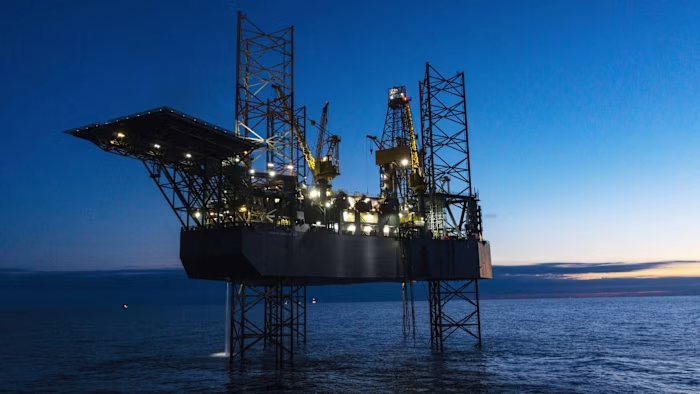
The UK oil and gas industry suffered its worst ever year for exploration in 2025, with investment set to plunge further, as companies shelved plans in the North Sea while they waited for clarity on the government’s tax plans.
Wood Mackenzie, the energy consultancy, said no exploration wells were drilled in UK waters this year, the first time there has been no fresh exploration activity in the basin since oil and gas was found there in the 1960s.
Investment, which was £4.4bn in 2025, is set to fall more than 40 per cent to just over £2.5bn next year, marking the lowest level since the UK oil industry was buffeted by high costs, industrial strife and rampant inflation in the early 1970s.
“Drilling is at an all-time low,” said Gail Anderson, Wood Mackenzie research director for the North Sea, who expects the number of North Sea operators to shrink further as consolidation continues, driven by a headline tax rate of 78 per cent.
While there was no new exploration, 36 appraisal and development wells were drilled in the North Sea, although this is half the figure for 2020, the first year of the coronavirus pandemic.
“Activity was terrible in 2025 because there was so much uncertainty,” said Martin Copeland, chief financial officer at North Sea oil and gas producer Serica.
However, executives and analysts said that while 2025 and 2026 likely marked a nadir, investment in UK waters would pick up in anticipation of a more generous tax regime that starts in 2030.
The UK North Sea is in long-term decline, with production falling from a peak of about 2.3mn barrels of oil a day in 1983 to 530,000 b/d, according to government data.
The oil majors that once operated there have sold down, merged their assets or exited entirely to pursue more lucrative opportunities, leaving the basin in the hands of smaller independent companies.
The industry blames the energy profits levy (EPL), introduced by the previous Conservative government in 2022, for accelerating the fall. The levy imposes an additional 35 per cent tax on profits when oil prices exceed $76 a barrel or gas prices go above 59p a therm.
Oil has traded below the threshold for most of 2025, but gas exceeded 140p a therm early in the year and has remained well above the level that triggers the levy.
Official forecasts show that EPL tax receipts are set to plunge from £2.9bn in 2024-25 to £300mn in 2029-30, as companies optimise their tax strategy or leave the basin.
“It’s the worst of the fiscal environments among all the countries that [we] operate in,” said Linda Cook, chief executive of Harbour Energy, one of the North Sea’s largest producers, adding that the UK industry was competing with “one arm tied behind its back”.

The Labour government has said that from 2030, when the EPL expires, additional tax will only be levied on revenues on oil sold above $90 a barrel and gas at 90p a therm.
“What has replaced the EPL is a very pragmatic system which will work for all parties,” said James Midgley, an oil and gas research analyst at Cavendish, adding that companies could start investing from 2027 in order to start production in 2030.
Copeland said Serica would target “quick and easy” opportunities for now, saying there were “probably things companies can do that are economically sensible and good for our shareholders”. But he also said the UK government had “missed a trick” by using the North Sea to drive economic growth.

But Cook at Harbour said the UK remained a hostile environment for oil and gas investment. Recent projects such as Equinor’s Rosebank development and Shell’s Jackdaw field have been hit by legal cases and the government has yet to rule on whether they can proceed.
“Every other country, when I visit, asks us what they can do to encourage us to invest more. In the UK, the discussion always feels like the opposite. I continue to struggle to understand why, as long as the UK needs oil and gas, it does not choose to be supportive of producing it domestically,” said Cook.
The UK government said it had set out a plan to build a “prosperous and sustainable future for the North Sea — with record investment to grow clean energy industries, while supporting the management of existing oil and gasfields” during the transition to green energy.
“We know oil and gas will be with us for decades to come, which is why a new permanent windfall tax will replace EPL when it ends, giving the sector and its investors the long-term certainty to plan, invest and support jobs.”