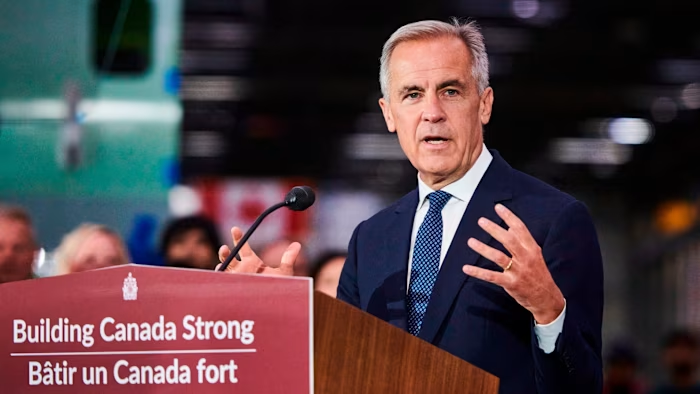
The debate surrounding Canadian Prime Minister Mark Carney’s recent positioning on fossil fuels (“Carney’s fossil fuels pivot undoes climate legacy”, Report, December 15) reveals a recurring flaw in how climate leadership is assessed.
From the standpoint of industrial systems, including fashion and textiles, climate transition failures rarely stem from insufficient ambition. They arise from misaligned sequencing. Energy policy, material innovation, labour systems and capital flows move at different speeds, yet are often treated as if they can be transformed simultaneously.
In fashion, one of the most energy- and resource-intensive global industries, this misalignment is already visible. Brands are urged to decarbonise faster than clean energy access expands. Recycling mandates advance ahead of viable infrastructure. Capital is redirected without ensuring that low-carbon materials and skilled labour are available at scale. When this happens, companies do not transform. They substitute, offshore or relabel.
This is not an argument for preserving fossil fuel dependence, nor a defence of delay. It is an argument for realism. Abrupt withdrawal of incumbent systems without credible alternatives in place does not accelerate decarbonisation. It displaces emissions, weakens regulatory trust and fuels public scepticism.
Climate leadership should therefore be judged less by symbolic positioning and more by whether policies are designed to carry industries through transition without fracture. Finance plays a central role here, not only through divestment, but through disciplined sequencing. Capital must build the bridge before burning it.
If sustainability is to retain economic and political credibility, it must be governed as a design problem, not a moral contest. Markets respond to coherence. They punish confusion swiftly.
Nirbhay Rana
Professor of Design & Sustainable Systems, IILM University, Gurugram, India; and Programme Coordinator, Fashion, Regional Editor (Asia), Bloomsbury Fashion Business Cases, Bloomsbury Publishing