11 January 2026
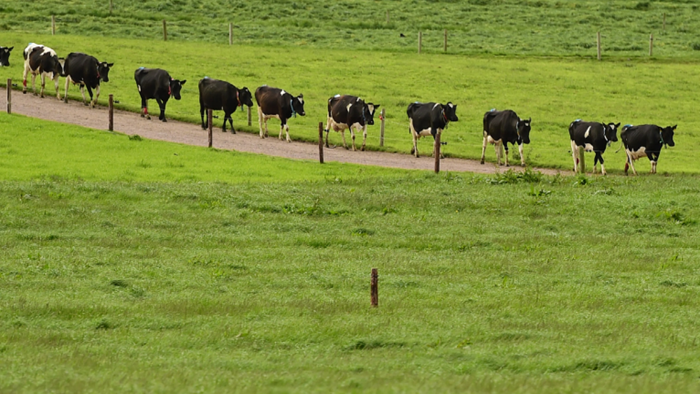
A preliminary study at Teagasc Moorepark aimed to evaluate the performance of virtual fence collars on a herd of cows grazing in paddocks with multiple daily grass allocations. Read about the study here.
Virtual fencing enables animal containment within, or exclusion from, land areas without physical fences by conditioning animals to a virtual boundary delimited with an audio cue and an electric pulse.
The technology typically comprises a mobile phone application through which the user maps the virtual boundary, and a neck collar device on the animal which produces an audio cue when the animal approaches the boundary.
If the animal breaches the boundary, it receives an electric pulse from the collar. This signal pattern engages the associative learning capabilities of the animal so that they can avoid receiving an electrical pulse by learning to stop or turn away from the virtual boundary when the audio cue is emitted.
This technology has been highlighted in recent research as a benefit to the operation of farming systems, from farmer, animal and production perspectives, as well as representing an innovative solution for protecting and re-vitalising special conservation areas.
Studies in Australia, Tasmania and Germany have examined virtual fencing in recent years and have reported positive findings with regard to animal containment, learning, behaviour, welfare and performance. The technology was also found to be successful at remotely herding dairy cows to the milking parlour.
Virtual fencing opens up new opportunities in reducing the labour-intensive task of fencing, allowing remote animal monitoring and control of forage availability on pasture.
The technology can increase the flexibility of the interaction of herd and pasture management; it can prevent over-grazing or allow time limited access to a specific herbage, e.g. clover.
However, it is important to investigate the operation of this technology within a conventional dairy herd in Irish pasture-based systems. This preliminary study aimed to evaluate the performance of virtual fence collars on a herd of cows grazing in paddocks with multiple daily grass allocations (three per day, increasing the challenge of containing the herd within smaller areas), compared to a herd managed with a conventional electric fence receiving a single daily grazing allocation.
The study
One hundred and sixty-eight spring-calved Holstein-Friesian dairy cows were assembled. Cows were on average 154 days in milk at the commencement of the experiment. Animals were balanced for calving date, milk yield, parity and bodyweight, blocked into groups of two and randomly assigned to one of two treatments.
Cows in Treatments 1 and 2 were managed by a conventional electric fence and by virtual fence collars (Norwegian company, Nofence), respectively. Cows in Treatment 1 had 22-h (full-time) access to pasture (24 h minus 2 h for morning and evening milkings) with an allocation of 18 kg DM/cow per day.
Treatment 2 cows received the equivalent grass allocation over 22 h (but with this allocation given in three portions over the 22 h. Forty five percent of the 22 h allocation was given over the 4 h period (08:00 – 12:00) after morning milking; the next 10 % was given over the 3 h period (12:00 – 15:00) until evening milking; and the remaining 45 % was given over the 15 h period (16:00 – 07:00) until the following morning milking.
Training of the cows to the collar equipment took place prior to the experimental period. Nofence collars were switched off during milking. Treatments were imposed over four weeks from 22nd July. All audio cues and electric pulses emitted to cows were recorded. Grass measurements were carried out daily, and milk yield and composition were also recorded daily.
Results from the Virtual Fencing study
Virtual fence data, grass measurements and milk yield and composition data from cow herds with and without virtual fence collars is shown in Table 1. Average number of audio cues/cow per day and average number of electric pulses/cow per day were in line with those observed in other studies. The audio cues outnumbered electrical stimuli, indicating cows generally responded to the benign audio cues alone and avoided receiving electric pulses.
Pre-grazing pasture biomass and post-grazing height were similar for the two treatments. Likewise, milk yield/cow per day and milk solids yield/cow per day were similar for the treatments.
Table 1: Virtual fence data (audio cues and electric pulses), grass measurements and milk yield and composition data from cow herds with and without virtual fence collars and receiving one or three grazing allocations per day
| Treatment 11 | Treatment 21 | |
| Average number of audio cues/cow per day | – | (Week 1: 7.3)(Week 4: 10.9) |
| Average number of electric pulses/cow/day | – | (Week 1: 0.3)(Week 4: 0.3) |
| Pre-grazing herbage mass (kg DM/ha) | 1,344 | 1,308 |
| Post-grazing sward height (mm) | 50 | 52 |
| Milk yield/cow per day (kg) | 16.7 | 16.6 |
| Milk solids/cow per day (kg) | 1.55 | 1.50 |
1 Treatment 1: herd managed with a conventional electric fence and receiving one grass allocation per day; Treatment 2; cows wearing virtual fence collars and receiving three grass allocations per day
Conclusion
This preliminary study on virtual fencing showed that the virtual fence retained cows in the areas specified without apparent negative implications for cow behaviour or welfare. But further work is required to interpret the potential for, and implications of, combining grass measurements with virtual fence collar data to create a decision support tool that could optimise grassland management and grazing efficiency while optimising animal performance and welfare, with minimum labour requirement.
Acknowledgements
Appreciation is extended to placement students who contributed towards conducting grass measurements, providing grass allocations and cow behaviour data collection. The authors also acknowledge receipt of funding to carry out this research work.
The above was authored by Bernadette O’Brien, Ilan Halachmi, Violet Ryan and Ricki Fitzgerald and published in the Moorepark 2025 Open Day proceedings (PDF).