- Peace Must Prevail, Secretary-General Says, Calling on World Leaders to ‘Get Serious’ about Fighting Poverty, Not War, in New Year’s Message | UN Meetings Coverage and Press Releases UN Meetings Coverage and Press Releases
- ‘Invest in…
Author: admin
-
Peace Must Prevail, Secretary-General Says, Calling on World Leaders to ‘Get Serious’ about Fighting Poverty, Not War, in New Year’s Message | UN Meetings Coverage and Press Releases – UN Meetings Coverage and Press Releases
-

Baker Hughes Announces Dates for Fourth-quarter and Full-year 2025 Earnings Release and Webcast
HOUSTON and LONDON, Dec. 29, 2025 (GLOBE NEWSWIRE) — Baker Hughes (NASDAQ: BKR) will announce the results of the fourth quarter and full year ending Dec. 31, 2025, via press release at 5 p.m. Eastern Time (4 p.m. Central Time) on Sunday, Jan. 25, 2026. A webcast to discuss the results will be held Monday, Jan. 26, at 9:30 a.m. Eastern Time (8:30 a.m. Central Time).
To access the webcast, listeners should visit the
Baker Hughes website at: investors.bakerhughes.com. An archived version will be available on the website following the webcast.About
Baker Hughes Baker Hughes (NASDAQ: BKR) is an energy technology company that provides solutions to energy and industrial customers worldwide. Built on a century of experience and conducting business in over 120 countries, our innovative technologies and services are taking energy forward – making it safer, cleaner and more efficient for people and the planet. Visit us at bakerhughes.com.For more information, please contact:
Investor Relations
Chase Mulvehill +1 346-297-2561
investor.relations@bakerhughes.comMedia Relations
Adrienne M. Lynch +1 713-906-8407
media.relations@bakerhughes.com

Source: Baker Hughes
Continue Reading
-
Microbial collagenase activity is linked to oral–gut translocation in advanced chronic liver disease
Study participants and biological sampling
Patients were consecutively recruited at King’s College Hospital after admission to the ward or from the hepatology outpatient clinic. The study was granted ethics approval by the national research ethics committee (12/LO/1417) and local research and development department (KCH12-126) and performed conforming to the Declaration of Helsinki. Patient participants, or their family nominee as consultees in the case of lack of capacity, provided written informed consent within 48 h of presentation. Patients were managed according to standard evidence-based protocols and guidelines74. Patient and public involvement and engagement were undertaken with a patient advisory group that partnered with us to determine acceptability of the study; provided their perspective on study design, informational material and measures to minimize participation burden; and agreed on a dissemination plan of the findings.
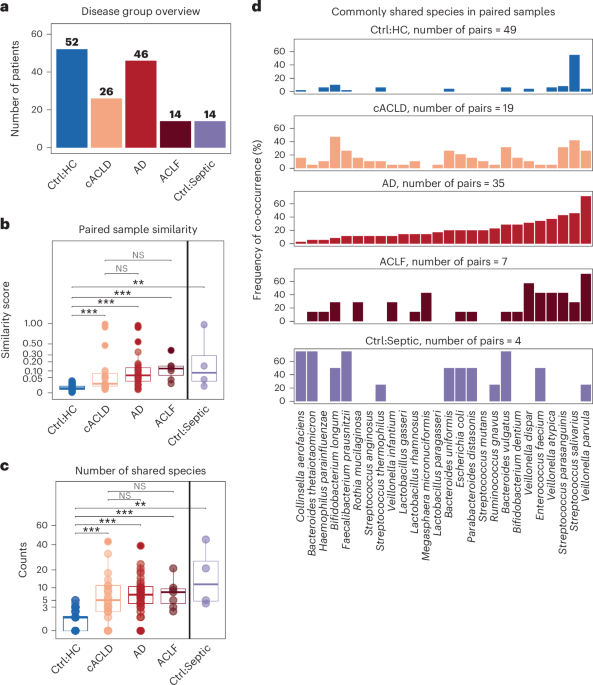
Patient participants were stratified into and phenotyped according to clinically relevant groups based on the severity and time course of their underlying cirrhosis, degree of stability and hepatic decompensation, and presence and extent of hepatic and extrahepatic organ failure at the time of sampling. These groups were cACLD, AD and ACLF, with separately recruited healthy controls (Ctrl:HC) and patients with sepsis with no underlying ACLD as an additional control group (Ctrl:Septic). AD was defined as acute development of one or more major complications of cirrhosis, including ascites, hepatic encephalopathy, variceal haemorrhage and bacterial infection. ACLF was defined and graded according to the number of organ failures in concordance with criteria reported in the CANONIC study75,76. Main exclusion criteria included pregnancy, hepatic or non-hepatic malignancy, pre-existing immunosuppressive states, replicating HBV, HCV or HIV infection, and known IBD.
Demographic, clinical and biochemical metadata were collected at the time of biological sampling. Standard clinical composite scores used for risk stratification and prognostication included the Child–Pugh score77 and MELD78. For patients with sepsis without chronic liver disease (Ctrl:Septic), the diagnosis of sepsis was based on the Sepsis-3 criteria79 in which life-threatening organ dysfunction caused by a dysregulated host response to infection was evident, with organ dysfunction defined as an increase in the sequential (sepsis-related) organ failure assessment (SOFA) score of 2 points or more. The absence of chronic liver disease in this patient group was determined by a combined assessment of clinical history and biochemical and radiological parameters.
Healthy controls aged >18 years (n = 52) were recruited to establish reference values for the various assays performed. Exclusion criteria for healthy controls were body mass index <18 or >27; pregnancy or actively breastfeeding; personal history of thrombotic or liver disease; chronic medical conditions requiring regular primary or secondary care review and/or prescribed pharmacotherapies; or current use of anticoagulants, platelet function inhibitors or oral contraceptives.
Plasma FABP2 quantification
Plasma samples for FABP2 profiling and quantification were obtained within 24 h of admission to hospital. Intestinal FABP2 (refs. 42,44) was quantified to serve as a gut-specific marker of intestinal barrier integrity, to assess whether these differentiated at the different stages of cirrhosis and in the Ctrl:HC cohort to define whether physiological or basal levels were detectable. FABP2 was quantified using the human FABP2/I-FABP Quantikine enzyme-linked immunosorbent assay (ELISA) kit (R&D Systems). All assays were conducted according to the manufacturers’ instructions. Optical densities were measured with a FLUOstar Omega absorbance microplate reader.
Faecal and saliva sample acquisition
Faecal samples were obtained within 48 h of admission to hospital and collected into non-treated sterile universal tubes (Alpha Laboratories) without any additives. Faecal samples were kept at 4 °C without any preservative and were homogenized within 2 h and pre-weighed into 200-mg aliquots in Fastprep tubes (MP Biomedicals). Saliva samples were obtained within 48 h of admission and collected into non-treated sterile universal tubes (Alpha Laboratories) without any additives. A controlled passive ‘drool’ was performed by the study participant into a universal container repeatedly until at least 6 ml of saliva was obtained. For patients who were intubated for mechanical ventilation, oropharyngeal suctioning of accumulating oral secretions was performed. Saliva samples were kept at 4 °C without any preservative and within 2 h were homogenized and measured into 1-ml aliquots using sterile wide-bore pipettes in Fastprep tubes (MP Biomedicals), which were then centrifuged at 17,000 g for 10 min. The saliva supernatant was removed and stored separately from the remaining pellet. Faecal and saliva samples were stored at −80 °C for subsequent DNA extraction and metabolite measurements.
Metagenomic data generation for saliva and faecal samples
Metagenomic data of SRA Project ID PRJEB52891 were generated as part of a previous study80. Briefly, microbial DNA was extracted from stored faecal and saliva pelleted samples using a 2-day protocol adapted from the International Human Microbiome Standards81,82. A 200-mg pre-weighed and homogenized aliquot was used for faeces, while for saliva, a post-centrifugation pellet was used. For the processing of additional healthy control samples (project ID: PRJNA1307628), sample collection and storage were identical to those of the initial cohort samples. DNA for the additional faecal samples was extracted with the AllPrep PowerFecal DNA/RNA Kit Qiagen (kit catalogue number 80244), and for saliva samples, the extraction kit DNeasy PowerSoil Pro Kit (Qiagen, 47014) was used according to the manufacturer’s instructions. DNA was subsequently sequenced (Illumina NovoSeq, paired-end mode, read length 2 × 150 bp) with a targeted sequencing depth of 25 Gbp for both saliva and faecal samples. Reads retained after quality control were uploaded to the Sequence Read Archive (SRA).
Quantification of absolute bacterial abundances using qPCR
To quantify total bacterial biomass and V. parvula absolute abundances, we performed qPCR assays following the protocol of previous studies35,83. Briefly, we first conducted serial dilutions of E. coli (strain BL21(DE3)) culture grown in Gifu Anaerobic Broth, modified agar (mGAM) medium and enumerated colony-forming units (CFU) for each of the dilutions. Next, DNA isolation was performed using 6 ml of E. coli culture applying phenol-chloroform-isoamylalcohol as described in a previous study84. A universal 16S rRNA primer83 targeting the V9 region (forward: AGAGTTTGATYMTGGCTCAG; reverse: TACGGYTACCTTGTTACG ACT) was used, and 2 μl of DNA was added to the mix of 2 μl of nuclease-free water, 0.5 μl of forward and reverse primers (10 μM) and 5 μl of 2 × SensiFast SYBR mix (BioCat). The assay was run according to the following set-up: initial denaturation for 2 min at 95 °C, 40 cycles of 3-step cycling at 95 °C for 15 s, 53 °C for 15 s and 72 °C for 15 s followed by melting at 95 °C for 30 s, 53 °C for 30 s and 60 °C for 1 s with final cooling at 40 °C for 30 s. The same procedure was repeated for the V. parvula patient isolate with nifJ gene-specific primers introduced in a previous study35 (forward: TGGTGACCACCAAGACGTAA; reverse: ACAGCATCCATGTCAACCAA). Based on the computed crossing point (Cp) values, calibration curves were established as described in a previous study85 to set ratios between cycle threshold (Ct) values and calculated CFUs further enabling estimations of CFU per gram faeces (Extended Data Fig. 2d,e). Next, patient samples were processed using the same qPCR set-up and master mix with both V9 region 16S and V. parvula-specific nifJ primers and compared with the calibration curve.
Metagenomic data analysis
The metaGEAR pipeline was used for metagenomic quality control, reference-based microbial profiling and gene-centric analyses (https://github.com/schirmer-lab/metagear-pipeline). Briefly, raw metagenomic reads went through the following quality control pipeline to remove (1) sequencing adaptors, (2) low-quality reads and (3) human host contaminations. First, we applied trim_galore86 for adaptor removal using the parameters ‘–paired –phred33 –quality 0 –stringency 5 –length 10’. Then, we applied KneadData (https://github.com/biobakery/kneaddata) to remove low-quality reads and host contaminations. Low-quality reads and adaptors were removed using the parameters ‘–trimmomatic-options ‘SLIDINGWINDOW:4:15 MINLEN:50’’. Human reads were removed by mapping against the human reference genome (hg38). In addition, tandem repeats were removed using the default ‘trf’ option. The ‘–reorder’ flag was applied to match quality-controlled forward and reverse reads.
For reference-based microbial profiling and strain comparison, we first applied MetaPhlAn3 (ref. 37) to profile the microbial community based on clade-specific marker genes. Strain-level profiles were then generated for the species of interest based on (1) SNPs in the marker genes using StrainPhlAn3 (ref. 37) and (2) presence–absence profiling of gene families using PanPhlAn3 (ref. 37).
Assembly-based analyses for generating metagenomic assembled pangenomes included de novo assembly using MEGAHIT with default parameters87 for each sample. Then, protein-coding genes were predicted using Prodigal with the ‘-p meta’ flag88,89. Incomplete genes were subsequently filtered with the ‘partial==00’ flag. Afterwards, genes from different samples were merged and clustered to generate a gene catalogue using cd-hit-est90 with parameters ‘-aS 0.9 -aL 0.9 -c 0.95’ to group genes with sequence identity >95% and coverage >90%. Protein sequences were extracted for the representative sequences of each gene family and further grouped into a protein catalogue using cd-hit90,91 with parameters ‘-c 0.9 -aL 0.8 -aS 0.8’ to group proteins with sequence identity >90% and coverage >80%. Abundance profiles for the clustered genes were generated using CoverM92 contig (methods count and reads per kilobase per million mapped reads (RPKM)) using parameters ‘–min-read-percent-identity 95 –min-read-aligned-percent 75 –min-covered-fraction 20’.
The protein catalogue was annotated with interproscan v5.47-82.0 (refs. 93,94) using the parameter ‘-appl Pfam’ to get domain-level annotation. Functional group annotation was extracted for each representative sequence of the protein families by combining Pfam domain annotations according to their order for each protein. Afterwards, reads from each sample were mapped against the gene catalogue to obtain the respective abundance profiles. The MSPs were generated with MSPminer95 with its default parameters. Taxonomy annotation for each MSP was predicted based on gtdb-tk (v2.3.0)96 on its pangenomes, and the abundance of each MSP was profiled by the median abundance of its core genes in each sample.
Integration of reference- and assembly-based results
Many MSPs lacked species-level taxonomy annotations based on gtdb-tk annotations. Therefore, we introduced a new taxonomy annotation approach for MSPs that additionally integrates information from reference-based profiles. This approach is based on the assumption that each MSP will have a similar abundance profile as its corresponding referenced-based counterpart. Therefore, we inferred MSP taxonomic information based on abundance correlations with reference-based abundance profiles (MetaPhlAn3). For each MSP, the species from the MetaPhlAn profile with the best abundance correlation was assigned as its taxonomic annotation.
Definition of dysbiosis score
We adapted the dysbiosis score introduced by a previous study34 to quantify the deviation of a given patient sample from the healthy control group. For our study, we calculated the dysbiosis separately for faecal and saliva samples. Specifically, for each body site, the dysbiosis score D for sample x is defined as the median Bray–Curtis distance to the samples from the healthy control group:
$$D(x)={mathrm{median}}_{sin mathrm{HC}}{{mathrm{dist}}_{mathrm{Bray}-mathrm{Curtis}}(x,s)}$$
Identification of candidate oral–gut translocators
First, we identified co-occurring species within each sample pair. For this, species were required to be present with a relative abundance of >0.1% in both sample types. Species were defined as candidate oral–gut translocators if they (1) frequently co-occurred in paired faecal and saliva samples (detected in at least five paired samples) and (2) were common members of the healthy oral microbiome (>1% abundance and detected in >20% of saliva samples). Overall, the number of co-occurring species was 26 (details in Supplementary Table 1). Among these, nine species were commonly detected in the oral samples, forming the final list of our candidate oral–gut translocators for the subsequent analyses. For each candidate translocator, we then compared the strain-level similarity between paired and unpaired samples using two different strategies: Phylogenetic similarity was quantified with the Kimura 2-parameter (K2P) genetic distance based on marker gene alignment generated with StrainPhlAn3 (ref. 37). The function distmat (https://www.bioinformatics.nl/cgi-bin/emboss/help/distmat) was used, which calculates the evolutionary distance between every pair of sequences in a multiple sequence alignment. Distances are expressed in terms of the number of substitutions per 100 bases. In addition, gene content similarity was compared, which was measured by the binary distance between the gene content of strains inferred with PanPhlAn3 (ref. 37).
Associations of bacterial species with disease severity and plasma barrier dysfunction
The faecal abundance of oral–gut translocators was analysed for associations with clinical indices, including disease severity (Child–Pugh and MELD scores) and barrier dysfunction (plasma FABP2). We used the pcor.test function in R to calculate partial correlations and corresponding P values between each species and each clinical index. Associations were computed using a rank-based Spearman method, with age, gender and antibiotic usage included as covariates. P values were calculated using asymptotic t approximation (with default options in the pcor.test function). The detection limit for MetaPhlAn was set at 0.01%, with abundances below this threshold set to zero. BH-adjusted P values were calculated separately for each clinical index, and results were visualized as a heatmap in which colours indicate partial correlation and asterisks denote significance levels (***P < 0.01; **P = 0.01–0.05; *P = 0.05–0.2).
Statistics and reproducibility
This is a non-interventional, cross-sectional, prospective cohort study. No predefined sample size was determined, and no data were excluded from the analyses. Our sample sizes are comparable to those reported in previous publications26,80,97. Data collection and analysis were not performed blind to the conditions of the experiments.
Statistical analyses involving the five disease subgroups
For these analyses, the healthy control group, Ctrl:HC, was compared with each of the disease subgroups, including cACLD, AD, ACLF and Ctrl:Septic. In addition, the cACLD group was compared with AD and ACLF to evaluate differences involved in disease progression. This resulted in six statistical tests in total. All P values were correct for multiple testing (BH), and adjusted P values were reported (Figs. 1b,c, 2c and 3d and Extended Data Fig. 1a). For a subset of supplementary figures, the primary focus was on identifying changes between healthy controls (Ctrl:HC) and disease subgroups; here only four statistical comparisons were performed and corrected for multiple testing (Extended Data Figs. 1b, 2b, 3a and 4a).
Associations between oral–gut translocators and clinical indices
To test for associations between the nine species identified as potential oral–gut translocators with Child–Pugh, MELD scores and plasma FABP2 levels, respectively, nine statistical tests were performed for each index. All P values were corrected for multiple testing (BH) and adjusted P values are reported (Extended Data Figs. 2a and 3a).
All P values mentioned above are calculated using two-side Wilcoxon tests.
Strain isolation
Saliva and faecal strains were isolated on SK agar plates (as used in previous work98) supplemented with vancomycin (Vc; 7.5 μg μl−1), chloramphenicol (Cm; 0.5 μg μl−1) and erythromycin (Ery; 14.6 μg μl−1), in addition to mGAM agar plates (HiMedia M2079). SK (Vc, Cm and Ery) and mGAM agar plates (1.5% agar, Fisher Scientific, 10572775) were prepared. For plates supplemented with Vc, Cm and Ery, antibiotics were added during the plate preparation. All plates were transferred to an anaerobic chamber under anaerobic conditions (5% H2, 10% CO2 and 85% N2) to be pre-reduced for 24 h before plating. Frozen saliva and faecal samples were thawed in the anaerobic chamber and serial dilution was realized, in which 100 μl of diluted samples was dispensed and spread on the plates. The plates were incubated for up to 4 days at 37 °C in the anaerobic chamber for colony growth.
After each day, strain imaging and colony picking were performed for further isolation. The colony picking was based on the identification of morphologically unique colonies including area perimeter, circularity, convexity, colour and consistency. Colonies were stricken on the equivalent media from which they were picked and incubated at 37 °C in the anaerobic chamber for colony growth.
Bacterial strains and growth conditions
Supplementary Table 1 lists the bacterial strains used in this study. Strains were grown at 37 °C in an anaerobic chamber (Whitley M45, Meintrup DWS Laborgeräte) at an atmosphere of 5% H2, 5% CO2 and 90% N2. MS082 was cultivated on mGAM (Himedia) agar plates. Strains MS055, MS061, MS072, MS097, MS107 and MS164 were cultivated in SK broth or on agar plates (Difco tryptone 10 g l−1, yeast extract 10 g l−1, NaCl 2 g l−1, Na2HPO4 0.4 g l−1)35.
Growth curve characteristics of Veillonella strains
Strains MS055 and MS061 were grown in SK broth as detailed under the ‘Bacterial strains and growth conditions’ section, and in SK medium supplemented with 50 mM DL-lactate (Sigma-Aldrich) or 50 mM potassium nitrate (Sigma-Aldrich), respectively. In brief, overnight cultures of MS055 and MS061 in SK medium were diluted into fresh medium for log-phase growth and used to inoculate the main culture of 6 ml medium (start optical density at 600 nm (OD600) 0.05) of SK medium only, and SK medium with 50 mM lactate or nitrate, respectively. Growth of strains was monitored every 2 h using a spectrophotometer (CO8000, Biowave). The results represent three independent experiments and are presented as means with standard errors of the means.
Gene neighbourhood visualization from de novo assemblies
For each gene family of interest, we retrieved all assembled contigs containing this gene. Then, we aligned the contigs centred to the gene of interest taking strand information into account. The gene families in the same relative position to the centre gene were retrieved, and the most prevalent gene family at each relative position was visualized including the number of observations of that gene.
Identification of prtC homologues in MSPs
Each candidate oral–gut translocator species was first matched to their corresponding MSPs based on gtdb-tk taxonomic annotations of the assembled MSPs and linear correlations of the respective MetaPhlAn and MSP abundances (for further details, see section ‘Integration of reference- and assembly-based results’). We were able to assign MSPs for seven out of nine oral–gut translocators. FG annotations for each gene family in the MSPs were extracted, and 288 FGs were found to be commonly shared among MSPs associated with oral–gut translocation (>80% prevalence). Next, we excluded functional groups that represent functions commonly found in the gut, by comparing these 288 FGs to those present in the core genomes of prevalent gut commensals. For this comparison, we selected MSPs with a mean abundance greater than 5% across all healthy faecal samples, including P. copri, B. uniformis and F. prausnitzii. FGs were filtered if they were also present in these common healthy gut microorganisms, and this filtering step reduced the number of remaining FGs to 52, which may represent bacterial functions that are essential for oral–gut translocation and/or result in aberrant host–microbial interactions in disease. Cumulative faecal abundances for these 52 FGs were calculated by summing over all matched gene families in oral–gut translocators. Subsequently, we further prioritized these FGs according to the correlations between their faecal abundance and plasma FABP2 levels. For this, the pcor.test function in R (rank-based Spearman) was used to calculate partial correlations with age, gender and antibiotic usage included as covariates. P values were corrected for multiple testing with BH.
Predicting ACLD based on faecal prtC gene abundance
First, the cumulative abundance of prtC genes encoded by oral–gut translocators was inferred for each faecal sample and represented as a single value with the detection limit set to 0.5 RPKM. These values were then used to predict disease status: any sample with a value above this threshold was predicted as ‘ACLD’, and samples below this value as ‘control’. The confusion matrix, specificity and sensitivity are reported in Supplementary Table 2. The corresponding receiver operating characteristic (ROC) and precision–recall (PR) curves were generated using the cumulative prtC abundance as the predictor and actual disease status (based on the clinical metadata) as the ground truth (1 for ACLD, 0 for controls)
Verification of the prtC signals in CLD-Sole2021 cohort
The cohort of a previous study11 (CLD-Sole2021) contained metagenomic data with single-end reads based on ion proton sequencing. Due to the shorter read length and lower read quality, we did not assemble this dataset but used a mapping-based strategy (bowtie2) against the gene catalogue generated from our cohort. RPKM values are calculated from reads mapped to the prtC genes.
Structure comparisons between prtC genes and a known bacterial collagenase
We applied blastx to search the UniProt database using gene sequences of the prtC genes identified in our cohort (Supplementary Table 2). The best hit for each query sequence was taken for further analysis, in which the predicted protein structure was downloaded as .pdb format and was aligned against the structure of a well-characterized bacterial collagenase (P33437). In cases in which multiple queries matched the same protein from the UniProt database, we took only one matched protein for downstream analysis. For example, the prtC genes from V. parvula, V. atypica and V. dispar were all mapped to Veillonella sp. HPA0037; therefore, we used the predicted prtC structure from Veillonella sp. HPA0037 for the alignment to represent these three prtC genes. To quantify the structural similarity, the RMSD was calculated for each structure alignment.
Experimental procedures in animals
In vivo experimental procedures were performed in 10–12-week-old male C57/Bl6 mice at the Disease Modelling Unit (University of East Anglia, UK). Experiments were approved by the Animal Welfare and Ethical Review Body (University of East Anglia, Norwich, UK) and the UK Home Office (project licence to Beraza: PP9417531, protocol 6). All procedures were carried out following the guidelines of the National Academy of Sciences (National Institutes of Health, publication 86-23, revised 1985) and were performed within the provisions of the Animals (Scientific Procedures) Act 1986. All animals were provided with free access to food (EURodent Diet 22%) and water. The animals were randomly assigned to cages and to the various experimental groups. No animals or data were excluded.
Induction of hepatic fibrosis in vivo
Mice were treated with CCl4 (1 ml kg−1) that was administered intraperitoneally (IP) twice per week for a total of 6 weeks. One group of mice received 200 μl of a bacterial cocktail (109 CFU ml−1) composed of V. parvula (isolates MS061, MS107 and MS164), V. dispar (isolate MS072) and S. parasanguinis (isolate MS082) by oral gavage 2 weeks after the initiation of CCl4 treatment. The strain cocktail was administered for three consecutive days each week for 4 weeks (week 3 to week 6 of treatment). All mice were killed 2 days after the last administration of CCl4 (Fig. 4a).
Quantification of fibrosis severity in mice
Liver tissues were fixed in 10% neutral buffered formalin (Sigma–HT501128-4L), embedded in paraffin and sectioned. Liver sections were dewaxed, hydrated and stained with Sirius red to stain collagen and detect fibrosis. Slides were imaged on a BX53 upright microscope (Olympus) with an Olympus DP74 colour camera and a pT100 LED transmitted light source (CoolLED). For quantification of the deposition of collagen in the liver, a total of 6–10 fields of view per sample were imaged and analysed using open-source FIJI software99. Images were split into three channels using the Colour tool, and the green channel was selected for quantification. A consistent threshold was applied across all images. Fibrosis was represented as the percentage of stained area relative to the total area per field100.
Quantification of gut barrier dysfunction in mice
Frozen faecal material from the large intestine was weighed and diluted in a 1:15 weight-to-volume ratio using extraction buffer (50 mM Tris HCl, 150 mM NaCl, 0.1% SDS, 2 mM EDTA (pH 8.0)). Samples were homogenized 3 times at 6 m s−1 for 40 s, and homogenates were centrifuged at 13,523 g (12,000 rpm) at 4 °C for 10 min. Supernatants were collected and assessed for albumin levels. Albumin levels were quantified using the DY1455 human albumin Duoset ELISA from R&D Systems according to the manufacturer’s instructions. Results were quantified using a FluoStar Optima plate reader. The mouse gastro-intestinal tract was dissected into anatomically defined regions, and the terminal portions of the ileum and colon were fixed and embedded in paraffin for immunohistological analysis: slides were mounted with a 4′,6-diamidino-2-phenylindole (DAPI)-mounting solution (Vector Laboratories H-1200) to stain cell nuclei. Fluorescence microscopic imaging was performed using an AxioImager M2 (Zeiss) with the AxioCam mRM monochrome camera and standard light source and filter sets supplied.
Preparation of faecal water
Frozen faecal samples from patients with AD (n = 10) and healthy individuals (n = 10) were thawed on ice. A 0.3-g aliquot from each sample was suspended in 2 ml of 1× phosphate-buffered saline and homogenized thoroughly. The homogenates were centrifuged at 5,000 g for 30 min at 4 °C. The resulting supernatants were collected and subjected to two additional centrifugation steps at 5,000 g for 20 min and 10 min, respectively, both at 4 °C. Supernatants were collected and kept on ice after each step for downstream analysis.
E. coli BL21(DE3) pET29b(+)/prtC transformation
The prtC gene sequence from V. parvula (isolate MS055) was synthetized and cloned in pEt29b(+) by TwistBioscience. Competent E. coli BL21 was transformed by heat shock with the pET-29b(+)/prtC vector and plated on Luria broth agar media supplemented with kanamycin (25 μg ml−1) and incubated for 24 h at 37 °C.
Recombinant protein expression and preparation
E. coli BL21(DE3) and BL21(DE3) harbouring the pET-29b(+)/prtC plasmid were cultured in 100 ml Luria broth at 25 °C until reaching an optical density (OD₆₀₀) of 0.8. Protein expression in BL21(DE3) pET-29b(+)/prtC was induced with 0.1 M isopropyl β-D-1-thiogalactopyranoside (IPTG), followed by incubation at 25 °C for 18 h. Induced and non-induced cultures were centrifuged at 5,000 g for 20 min at 4 °C. The resulting supernatants were transferred to Amicon Ultra Centrifugal Filter tubes and centrifuged again at 5,000 g for 10 min at 4 °C.
Collagenase activity in faecal water: collagen degradation assay
Collagen degradation was assessed using the EnzChek Gelatinase/Collagenase Assay Kit (Thermo Fisher Scientific). DQ-collagen I was added to concentrated supernatants or faecal water, a media-only control and a positive control (Clostridium histolyticum’s collagenase) at a final concentration of 100 µg ml−1. Samples were incubated overnight at 37 °C. Fluorescence was measured at an excitation wavelength of 495 nm and emission at 515 nm. The fluorescence intensity was directly proportional to the extent of collagen degradation.
Reporting summary
Further information on research design is available in the Nature Portfolio Reporting Summary linked to this article.
Continue Reading
-
Q4 2025 Delivery Consensus – Tesla Investor Relations
- Q4 2025 Delivery Consensus Tesla Investor Relations
- Canaccord Remains Bullish on Tesla (TSLA) Despite Near-Term Delivery Softness Yahoo Finance
- Tesla’s EV sales keep falling, but Wall Street stays focused on robotaxis MarketWatch
- ‘Sell’ TSLA Stock (TSLA) Now? Analyst Predicts 50% Plunge in 2026 TipRanks
- Tesla Q4 Deliveries Face Steep Slump, Gene Munster Warns; Adds Real Value Now Lies In Physical AI Benzinga
Continue Reading
-
Large-scale analysis of bacterial genomes reveals thousands of lytic phages
Identification of lytic phages in bacterial assemblies
To identify complete lytic bacteriophage genome sequences within bacterial genome assemblies (BAPS), we developed a comprehensive bioinformatic workflow (Supplementary Fig. 1), starting with…
Continue Reading
-

DRC's Congo Airways eyes 1Q26 restart with E190 – ch-aviation
- DRC’s Congo Airways eyes 1Q26 restart with E190 ch-aviation
- Why is the sale of Pakistan’s national airline stirring a political storm? Al Jazeera
- Privatisation push Dawn
- PIA privatisation, without the spin Geo News
- Pakistan concludes bidding…
Continue Reading
-

Trump to meet Netanyahu in Florida as focus turns to Middle East
US President Donald Trump will turn his focus to the Middle East on Monday, as he hosts Israeli Prime Minister Benjamin Netanyahu in Florida for talks that are expected to cover Gaza and a range of other pressing issues.
Any decisions made could…
Continue Reading
-

Astronomical events to look out for over the break
It will be possible to view the Quadrantid shower from all over the country if you can find an area of low enough light pollutionWikimedia Commons/Carl Young/https://creativecommons.org/licenses/by-sa/4.0/deed.en
The…
Continue Reading
-

Rupee Achieves 68 Successive Gains Against US Dollar Despite Small Increase
The Pakistani rupee (PKR) closed in green against the US Dollar (USD) for the 68th consecutive day on Monday.
Meanwhile, it posted gains against most of the other major currencies during today’s session.
The PKR closed at 280.16 after gaining one paisa against the US Dollar today.
Other Currencies
The PKR was green against most of the other major currencies in the interbank market today.
It ended on a positive note for the UAE Dirham (AED) and also positive for the Saudi Riyal (SAR).
Currency 24-Dec 2025
26-Dec 2025
29-Dec 2025
Change +/–
USD 280.2018 280.1731 280.1602 0.0129 EUR 330.3439 329.7077 329.8467 -0.1390 GBP 378.6648 377.6033 377.7120 -0.1087 AUD 188.1135 187.7020 187.8614 -0.1594 MYR 69.2369 69.2812 69.0135 0.2677 CNY 39.9410 39.9688 39.9721 -0.0033 CAD 204.7735 204.8124 204.6085 0.2039 AED 76.2952 76.2832 76.2797 0.0035 SAR 74.7065 74.6989 74.6955 0.0034 It lost 10 paisas against GBP and 16 paisas against the Australian Dollar.
Continue Reading