Category: 3. Business

  • Top Wall Street analysts favor 3 tech stocks for their growth outlook

    Top Wall Street analysts favor 3 tech stocks for their growth outlook

    High valuations for artificial intelligence (AI) stocks were the focus of the market this week, with fears of a potential AI bubble capping investor sentiment. But the view on Wall Street is still that several tech stocks offer strong fundamentals and are delivering rapid, AI-induced growth, justifying their sky-high valuations.

    The recommendations of top Wall Street analysts can help investors find attractive AI stocks displaying robust long-term growth outlooks.

    Here are three stocks favored by the Street’s top pros, according to TipRanks, a platform that ranks analysts based on their past performance.

    Amazon

    E-commerce and cloud computing giant Amazon (AMZN) recently impressed investors with its upbeat Q3 results. Accelerating growth in the Amazon Web Services (AWS) cloud unit confirmed the Street’s faith in Amazon’s expansion into artificial intelligence.

    In reaction to the solid Q3 print and the recently-announced deal with OpenAI, Mizuho analyst Lloyd Walmsley increased his price forecast for Amazon to $315 from $300 and reiterated a buy rating. TipRanks’ AI Analyst is also bullish on AMZN stock, with an “outperform” rating and a price target of $276.

    Walmsley said that the Q3 performance, OpenAI deal and positive outlook for Amazon’s Trainium chips made him more optimistic toward AWS’s long-term growth. In fact, the 5-star analyst expects acceleration in AWS revenue growth from 20% in Q3 to 21% in Q4 2025 and 22% in the first quarter of 2026. He expects AWS revenue to rise by 23% to $157 billion in the full year 2026, followed by a 22% increase to $192 billion in 2027 — above the Street’s expectations of $154 billion and $185 billion for 2026 and 2027, respectively.

    “We believe investors continue to rotate into AMZN shares given a valuation well below its historic ranges and positive news likely to continue into the AWS ReInvent Conference in early December,” said Walmsley.

    The analyst’s bullish investment thesis is also based on the cost-to-serve improvements in Amazon’s retail business, driven by automation in fulfillment centers and an enhanced logistics network.

    Walmsley ranks No. 103 among more than 10,100 analysts tracked by TipRanks. His ratings have been successful 64% of the time, delivering an average return of 27.5%. See Amazon Insider Trading Activity on TipRanks.

    Alphabet

    This second stock pick is Google- and YouTube owner Alphabet (GOOGL). The company reported better-than-expected third-quarter results, with AI driving solid momentum in its cloud business.

    Impressed by the Q3 performance, JPMorgan analyst Doug Anmuth raised his price target for Alphabet to $340 from $300 and reaffirmed a buy rating. In comparison, TipRanks’ AI Analyst has a price target of $316 with an “outperform” rating on GOOGL.

    Anmuth highlighted that Q3 marked the first time that Alphabet’s quarterly revenue crossed the $100 billion mark. The top-rated analyst noted Alphabet’s robust performance in the third quarter, with double-digit growth across every major business.

    Interestingly, Anmuth believes that Q3 results and favorable insights on AI search formats could change investors’ views toward Google’s AI search transition. Alphabet noted AI-induced acceleration in query growth and paid clicks, while Anmuth noted that industry conversations indicate that paid clicks using Google’s AI Overviews (AIO) and AI Mode (AIM) features are driving higher conversion rates.

    “Overall, the AI search transition has been viewed as the greatest risk to Google, but additional signs that AI search is more opportunity than threat will continue to flip the narrative,” said Anmuth.

    The analyst is also encouraged by the surge in Google Cloud’s backlog to $155 billion. He contends that the figure doesn’t include all the gains from the recently announced expansion of GOOGL’s partnership with Anthropic, implying a further increase in the backlog at the end of the fourth quarter. Overall, Anmuth is confident about Alphabet’s prospects and said it remains JPMorgan’s Top 2 idea, behind only Amazon.

    Anmuth ranks No. 113 among more than 10,100 analysts tracked by TipRanks. His ratings have been profitable 63% of the time, delivering an average return of 22%. See Alphabet Ownership Structure on TipRanks.

    Advanced Micro Devices

    The third tech giant this week is chipmaker Advanced Micro Devices (AMD), which delivered strong results in the third quarter of Fiscal 2025. AMD attributed stronger earnings and revenue to its expanding compute business and fast-growing AI data center segment.

    In reaction, Stifel analyst Ruben Roy increased his price target for AMD to $280 from $240 and reiterated a buy rating. With a price target of $285, TipRanks’ AI Analyst has an “outperform” rating on AMD stock.

    Roy noted that AMD’s Q3 top line was driven by strength across the company’s data center, AI, server and PC businesses. The 5-star analyst highlighted management’s optimism toward continued momentum in Q4 FY25, with revenue expected to grow 25% year-over-year to $9.6 billion. AMD expects Q4 revenue growth will be supported by strong performances in its data center, client and embedded businesses, partially offset by a double-digit decline in the gaming segment.

    Interestingly, Roy believes that AMD’s performance in the near-term is being fueled more by increasing demand for server central processing units and continued share gains in client CPUs rather than data center AI graphics processing units. The analyst expects AMD’s data center AI GPU business to increase to a range of $6 billion to $6.5 billion in FY25, versus a prior estimate of $5 billion.

    “Looking ahead, we continue to believe that AMD is executing well as the company nears production shipments of the MI400/450 series GPUs and the Helios rack next year,” Roy said.

    The analyst is also optimistic on AMD’s recently-announced deals with OpenAI and Oracle Cloud Infrastructure, saying they provide clarity on the longer-term growth outlook in its data center AI business. Roy awaits further insights from AMD about its technology roadmap and total addressable market (TAM) at an upcoming Analyst Day event on November 11.

    Roy ranks No. 20 among more than 10,100 analysts tracked by TipRanks. His ratings have been profitable 71% of the time, delivering an average return of 34.4%. See AMD Statistics on TipRanks.

    Continue Reading

  • China’s earnings season is underway. Here’s who’s benefiting from AI

    China’s earnings season is underway. Here’s who’s benefiting from AI

    Continue Reading

  • Four Days Left Until Enghouse Systems Limited (TSE:ENGH) Trades Ex-Dividend

    Four Days Left Until Enghouse Systems Limited (TSE:ENGH) Trades Ex-Dividend

    Enghouse Systems Limited (TSE:ENGH) is about to trade ex-dividend in the next four days. Typically, the ex-dividend date is one business day before the record date, which is the date on which a company determines the shareholders eligible to receive a dividend. The ex-dividend date is important as the process of settlement involves a full business day. So if you miss that date, you would not show up on the company’s books on the record date. Meaning, you will need to purchase Enghouse Systems’ shares before the 14th of November to receive the dividend, which will be paid on the 28th of November.

    The company’s next dividend payment will be CA$0.30 per share, and in the last 12 months, the company paid a total of CA$1.20 per share. Last year’s total dividend payments show that Enghouse Systems has a trailing yield of 5.7% on the current share price of CA$20.98. Dividends are a major contributor to investment returns for long term holders, but only if the dividend continues to be paid. As a result, readers should always check whether Enghouse Systems has been able to grow its dividends, or if the dividend might be cut.

    This technology could replace computers: discover the 20 stocks are working to make quantum computing a reality.

    Dividends are usually paid out of company profits, so if a company pays out more than it earned then its dividend is usually at greater risk of being cut. It paid out 85% of its earnings as dividends last year, which is not unreasonable, but limits reinvestment in the business and leaves the dividend vulnerable to a business downturn. We’d be concerned if earnings began to decline. That said, even highly profitable companies sometimes might not generate enough cash to pay the dividend, which is why we should always check if the dividend is covered by cash flow. It paid out more than half (52%) of its free cash flow in the past year, which is within an average range for most companies.

    It’s positive to see that Enghouse Systems’s dividend is covered by both profits and cash flow, since this is generally a sign that the dividend is sustainable, and a lower payout ratio usually suggests a greater margin of safety before the dividend gets cut.

    Check out our latest analysis for Enghouse Systems

    Click here to see the company’s payout ratio, plus analyst estimates of its future dividends.

    TSX:ENGH Historic Dividend November 9th 2025

    Companies that aren’t growing their earnings can still be valuable, but it is even more important to assess the sustainability of the dividend if it looks like the company will struggle to grow. Investors love dividends, so if earnings fall and the dividend is reduced, expect a stock to be sold off heavily at the same time. With that in mind, we’re not enthused to see that Enghouse Systems’s earnings per share have remained effectively flat over the past five years. Better than seeing them fall off a cliff, for sure, but the best dividend stocks grow their earnings meaningfully over the long run. A payout ratio of 85% looks like a tacit signal from management that reinvestment opportunities in the business are low. In line with limited earnings growth in recent years, this is not the most appealing combination.

    Many investors will assess a company’s dividend performance by evaluating how much the dividend payments have changed over time. Since the start of our data, 10 years ago, Enghouse Systems has lifted its dividend by approximately 20% a year on average.

    Is Enghouse Systems an attractive dividend stock, or better left on the shelf? Enghouse Systems has struggled to grow its earnings per share, and while the company is paying out a majority of its earnings and cash flow in the form of dividends, the dividend payments don’t appear unsustainable. In summary, while it has some positive characteristics, we’re not inclined to race out and buy Enghouse Systems today.

    Wondering what the future holds for Enghouse Systems? See what the four analysts we track are forecasting, with this visualisation of its historical and future estimated earnings and cash flow

    Generally, we wouldn’t recommend just buying the first dividend stock you see. Here’s a curated list of interesting stocks that are strong dividend payers.

    Have feedback on this article? Concerned about the content? Get in touch with us directly. Alternatively, email editorial-team (at) simplywallst.com.

    This article by Simply Wall St is general in nature. We provide commentary based on historical data and analyst forecasts only using an unbiased methodology and our articles are not intended to be financial advice. It does not constitute a recommendation to buy or sell any stock, and does not take account of your objectives, or your financial situation. We aim to bring you long-term focused analysis driven by fundamental data. Note that our analysis may not factor in the latest price-sensitive company announcements or qualitative material. Simply Wall St has no position in any stocks mentioned.

    Continue Reading

  • Trump tariffs and strict US border rules threaten flight of Canada’s ‘snowbirds’ | Florida

    Trump tariffs and strict US border rules threaten flight of Canada’s ‘snowbirds’ | Florida

    The annual migration of hundreds of thousands of Canadian “snowbirds” escaping freezing temperatures in their homeland and heading to warmer US states such as Florida for the duration of the winter could be about to become noticeably thinner.

    Many have ditched plans to visit their southern neighbor and are looking to spend their valuable dollars elsewhere, largely put off by Donald Trump’s escalating economic war with Canada and strict new immigration rules that have created fear and confusion.

    “There’s some resistance. There’s always someone calls in [from Canada] and says, ‘No, no more US! Before we were friends, and now enemies,’” said Richard Clavet, a Canadian originally from Quebec who has owned a motel and apartment rental business in Fort Lauderdale popular with snowbirds for more than three decades.

    “Bookings have declined, our rates are a little lower to try to attract them. In March and April a lot of people kind of walked away from the deposits, which wasn’t so bad because we were able to rent the rooms to others.

    “But in the summer, what was bad was they also didn’t book for the following year, and that hurt us financially.”

    Richard Clavet walks past a statue of a moose he brought from Canada and put on display at one the Canadian themed hotels and motels he owns. Photograph: Miami Herald/TNS

    The boycott, which began last winter after Trump’s election to a second term as president and imposition of trade tariffs, appears to be gathering pace, according to research by the Travel Health Insurance Association of Canada. It promises to put a severe dent in the $20.5bn snowbirds traditionally pump into the US economy between late October and April.

    The study found only 26% of Canadians intend to take a US vacation this winter, down from 41% last year, and of those 61 and older, only one in 10 plan to visit, compared to one in three a year ago.

    Canada’s own tourism industry, meanwhile, is reporting record revenue. Buoyed by visitors who decided to stay home, the sector took in CA$59bn ($42bn) from May to August, a 6% increase on 2014. (American visitors to Canada dropped 1.7% during that same period.)

    Business owners such as Clavet, and realtors in popular snowbird states such as Arizona, Florida, Texas and Hawaii are reporting significantly fewer rental bookings, and higher than usual numbers of Canadians seeking to offload second houses and condos.

    More than half of Canadians with homes in the US – 54% – are considering selling in the next 12 months, with 62% of those citing the political situation as their main reason, according to research published in August.

    While some blame a weak Canadian dollar and rising travel costs for their decision not to travel, 40% also cite political tensions with the US. Trump has frequently assailed Canada and its political leaders, recently retaliating for an anti-tariff advertisement posted by the Ontario government by slapping an additional 10% tariff on imports from a country he has repeatedly taunted as the 51st state.

    Of equal concern to traveling Canadians, experts say, are a raft of invasive new immigration measures imposed by the Trump administration that have left many uncomfortable about crossing the border.

    A Zumba fitness instructor at Richard’s Motel in Hollywood, Florida. Photograph: Miami Herald/TNS

    From December, all non-American visitors will be photographed on both their arrival and departure from the US. The move follows new enforcement this year of an obligation on Canadians visiting for longer than 30 days to register their presence and whereabouts with the US government.

    Ryan Rachkovsky, director of research and communications at the Toronto-based Canadian Snowbird Association, said there was confusion over the registration policy, which he said was being enforced erratically at points of immigration.

    Some members, he said, had been subjected to secondary screening, featuring the collection of biometric data including fingerprints and photographs, while others experienced smooth entries.

    “There is so much inconsistency right now, based on the border officer that you get, based on the port of entry that you’re entering the US from, and because of that we’re providing our members with a warning and letting them know that this might be a possibility,” he said.

    “Our message to snowbirds every year is: be prepared. This year, obviously people are going to be prepared in a different way.”

    Rachkovsky said he believed the drop in travel by Canadians would be more by shorter-term vacationers than the estimated 900,000 snowbirds who traditionally spend up to the permitted six months in the US, but acknowledged many were uneasy about the political situation.

    “The longer-term travelers, some of those individuals have made it clear to us they don’t want to travel to the US this coming season – but I would say the vast majority, particularly those that own homes in the US, will be making the trip this year as they always have,” he said.

    “Economic and political headwinds are making the snowbird lifestyle more difficult,” he added. “In Florida, prices are going up, particularly for things like insurance coverage, and the Canadian dollar isn’t helping as well, so it’s a much more complex picture than just looking at it from a political standpoint.”

    Analysts say any significant drop in snowbird visits could be catastrophic for states where they are among the biggest spenders during the winter months. The snowbird economy brings in an estimated $20.5bn annually in direct spending, property and sales taxes, and supports millions of jobs, especially in tourism, hospitality and retail.

    The US Travel Association warned earlier this year that even a 10% drop in travel would mean two million fewer visits and cost $2.1bn in lost spending, with local businesses suffering the most.

    “You’ve got businesses that have to recalibrate their projections regarding the number of visitors, which has a very significant ripple effect throughout the manufacturing sector and supply chains, all the way into the travel and tourism industries, but also much beyond that,” said Valorie Crooks of Simon Fraser University and an expert in snowbird demographics and behaviors.

    “There are entire hospitals that bring in seasonal workers to address the demand by the influx of snowbirds from the northern US and Canada, and when you change the numbers you change everything about how a particular hospital system is able to operate.”

    Crooks said the more obstacles that are placed in the path of snowbirds, the more likely they are to take themselves, and their money, elsewhere, such as Mexico, the second most popular destination for Canadian winter travelers.

    “One of the things that being a snowbird is really predicated on is the ease of movement across the border. This is the next step of sentiment that people are concerned about – that political will can seemingly change on a whim, and ease of access across the border shifts because of a change brought about by a government administration,” she said.

    “There are countries all over the world looking to attract people to come and stay for winter seasons, and they’re going to look even more attractive when an established destination like the southern part of the US is no longer somewhere Americans and many Canadians feel comfortable going.”

    Clavet, the Fort Lauderdale rental business owner, disagrees. “As it gets cold and those real snowbirds starts to fly this way, others will follow. Florida is safe and clean, there’s plenty to do, you don’t have to be afraid of the water you’re drinking, you don’t need special vaccines.

    “Florida is just the best place for them. They will come back, and we’ll be OK.”

    Continue Reading

  • UK divisions of ticket resale website Viagogo hit with £15m bill over tax shortfall | Viagogo

    UK divisions of ticket resale website Viagogo hit with £15m bill over tax shortfall | Viagogo

    Two UK divisions of the ticket resale website Viagogo have been hit with a £15m tax bill after HMRC found they had not paid enough duty.

    Corporate filings for VGL Services and IFOT Services, both part of the US-listed StubHub group that includes Viagogo, reveal that both firms set aside money to cover costs arising from a “transfer pricing inquiry with HMRC” relating to the period between 2016 and 2018.

    Transfer pricing refers to the way in which separate entities within a larger corporate group charge each other for services or goods they provide to one another.

    Any such transactions should take place at market rates. Tax authorities are known to monitor whether companies are inflating prices artificially in order to move money from a division in a high-tax jurisdiction to one based in a low-tax area.

    The accounts did not go into detail about HMRC’s findings about Viagogo’s tax affairs and there is no suggestion the company deliberately sought to avoid or evade tax.

    The UK businesses do not directly sell tickets but both supplied group companies during the period in question, according to the accounts, including providing technology and customer services.

    The £15m combined sum set aside by the two companies, both of which are registered to an address on London’s Cannon Street, includes interest that HMRC would have earned on the tax receipts, had they been paid, as well as charges for late payment.

    In their filings, the businesses said they believe HMRC’s findings have resulted in “double taxation”, which is when a business is taxed on the same activity in two different jurisdictions.

    The firms said they had now changed their transfer pricing policy but would also seek “remediation” under the UK’s tax agreement with other countries, which could result in a future financial benefit.

    The companies already paid a combined £5.5m earlier this year, but said the “timing of further payments and settlement remains unclear”.

    skip past newsletter promotion

    Viagogo is under intense scrutiny as the government moves towards a review of “secondary ticketing”, which is expected to result in a cap on the resell price of tickets, amid an outcry over touts using such platforms to exploit fans.

    Any such policy in one of its most important markets could deal a blow to Viagogo, whose parent company StubHub Holdings floated on the US Nasdaq index in September with a valuation of $8.6bn (£6.5bn), which has since dwindled to $6.6bn.

    StubHub Holdings is separate to StubHub International, which includes the UK brand of the same name. The Competition and Markets Authority forced the two businesses to split to ensure continued competition in the UK, after Viagogo and StubHub agreed a merger.

    Viagogo did not return a request for comment.

    Continue Reading

  • Examining Valuation After Strong Profit Growth in Third Quarter Results

    Examining Valuation After Strong Profit Growth in Third Quarter Results

    Avis Budget Group (CAR) just released its third quarter results, highlighting a clear jump in both net income and earnings per share compared to last year. Sales edged up; however, profitability was the real standout this quarter.

    See our latest analysis for Avis Budget Group.

    Following that strong earnings report, Avis Budget Group’s share price momentum has been notable, with a 78% jump year-to-date and a 1-year total shareholder return of 54%. While there have been some pullbacks over the past quarter, performance over both the short and long term remains robust. This signals that investors are recognizing the company’s improved profitability and growth potential.

    If Avis’s latest rally has you looking for fresh opportunities, now is a great time to broaden your search and discover fast growing stocks with high insider ownership

    But with shares already up sharply this year, investors face a crucial question: Is Avis Budget Group still trading at an attractive valuation, or is the market now fully pricing in its recent surge and future prospects?

    With a most popular narrative fair value of $139.50, Avis Budget Group’s last close of $143.31 stands slightly above what analysts believe is justified at this stage. There is a subtle tension in analyst expectations, which are less bullish than recent share price trends suggest.

    The launch and rapid scaling of Avis First, a premium rental offering, could be fueling expectations of significant revenue and margin expansion, as investors anticipate a sustained uplift in average revenue per day (RPD) and market share capture from price-insensitive travelers. This optimism may not fully account for competitive responses or changing customer preferences, increasing the risk that future revenue and net margin improvements fall short of current valuations.

    Read the complete narrative.

    Want to know the secret formula behind this tight valuation call? The narrative leans on big promises about future revenue momentum and profit margin breakthroughs. Curious which dramatic financial shifts would need to happen for today’s price to be warranted? Find out what drives the numbers in this forecast and see why the narrative walks such a fine line.

    Result: Fair Value of $139.50 (OVERVALUED)

    Have a read of the narrative in full and understand what’s behind the forecasts.

    However, rapid adoption of alternative mobility options or aggressive new competitors in the premium segment could challenge Avis’s growth expectations and threaten future margins.

    Find out about the key risks to this Avis Budget Group narrative.

    Looking at how Avis Budget Group trades versus its revenue, the price-to-sales ratio of 0.4x seems attractively low. This is far below the US Transportation industry average of 1.2x, the peer average of 2.4x, and even the fair ratio of 0.9x that the market could pivot toward. Does this gap point to a hidden opportunity, or is the market rightly cautious based on recent results?

    See what the numbers say about this price — find out in our valuation breakdown.

    NasdaqGS:CAR PS Ratio as at Nov 2025

    If this perspective does not resonate with you or you prefer to draw your own conclusions, consider diving into the data and crafting a personalized story in just a few minutes. Do it your way

    A great starting point for your Avis Budget Group research is our analysis highlighting 2 key rewards and 2 important warning signs that could impact your investment decision.

    Unlock your edge and make smarter investment moves. Don’t leave potential returns on the table. Tap into these hand-picked stock ideas and open up new opportunities:

    This article by Simply Wall St is general in nature. We provide commentary based on historical data and analyst forecasts only using an unbiased methodology and our articles are not intended to be financial advice. It does not constitute a recommendation to buy or sell any stock, and does not take account of your objectives, or your financial situation. We aim to bring you long-term focused analysis driven by fundamental data. Note that our analysis may not factor in the latest price-sensitive company announcements or qualitative material. Simply Wall St has no position in any stocks mentioned.

    Companies discussed in this article include CAR.

    Have feedback on this article? Concerned about the content? Get in touch with us directly. Alternatively, email editorial-team@simplywallst.com

    Continue Reading

  • Stock market hits speed bump but investors stay on bullish path – Reuters

    1. Stock market hits speed bump but investors stay on bullish path  Reuters
    2. Valuation Is a Scapegoat. Don’t Blame It for the Market Selloff Tuesday.  Barron’s
    3. Valuations Up, Leadership Down: The Market’s High-Wire Act  MSN
    4. Don’t believe the valuation devastation fears  AFR
    5. Valuation concerns persist, but fundamentals are solid  UBS

    Continue Reading

  • Frontline STK-012 Plus Pembrolizumab and Chemo Shows Early Promise in PD-L1–Negative NSCLC

    Frontline STK-012 Plus Pembrolizumab and Chemo Shows Early Promise in PD-L1–Negative NSCLC

    The combination of STK-012 and standard-of-care pembrolizumab (Keytruda) plus chemotherapy (PCT) demonstrated early efficacy and safety when used as first-line treatment in patients with PD-L1–negative nonsquamous non–small cell lung cancer (NSCLC), according to data from the phase 1a/1b STK-012-101 trial (NCT05098132) presented during the 2025 SITC Annual Meeting.1

    No dose-limiting toxicities were reported, and most treatment-related adverse effects (TRAEs) were noted to be manageable and reversible. One grade 4 TRAE in the form of neutropenia was reported, and no grade 5 toxicities occurred. Notably, no TRAEs resulted in treatment discontinuation, and there were no substantive hallmark interleukin-2 (IL-2) TRAEs.

    At a median follow-up of 4 months (range, 1.3-12.2), the regimen elicited an objective response rate (ORR) of 55% in all efficacy-evaluable patients (n = 22), which was comprised entirely of partial responses (PRs); the disease control rate (DCR) was 96%. In those with a PD-L1 tumor proportion score (TPS) below 1% (n = 18) experienced an ORR of 50%, again comprised entirely of PRs, with a DCR of 94%.

    Top Takeaways Regarding STK-012 Combination in PD-L1–Negative NSCLC

    • STK-012 plus pembrolizumab and chemotherapy achieved an 55% response rate and a disease control rate of 96% in patients with PD-L1–negative nonsquamous NSCLC.
    • Responses deepened over time, including in patients with STK11 and KEAP1 mutations, with most remaining on treatment at cutoff.
    • The regimen showed manageable, reversible toxicity and no hallmark IL-2–related adverse effects, supporting further evaluation in phase 2.

    Moreover, those who received the combination of STK-102 and PCT experienced deepening of response over time; 15 of 22 patients were still receiving treatment at the time of the efficacy clinical cutoff date of September 15, 2025. In those with at least 1 immuno-oncology resistance TSG mutation (n = 11), the ORR with the combination was 55%; in those with 2 TSG mutations in the form of STK11 and KEAP1 (n = 4), this rate was even higher, at 75%.

    “Despite advances that have improved outcomes for newly diagnosed lung cancer patients, a significant unmet need persists—most notably among PD-L1–negative nonsquamous NSCLC and tumors with immune resistance mutations,” Adam J. Schoenfeld, MD, of Memorial Sloan Kettering Cancer Center, in New York, NY, stated in a news release.2 “Early STK-012 + SoC PCT data in these hard-to-treat populations are encouraging; if replicated in larger cohorts, they could reshape the treatment landscape.”

    What Was the Study Design of STK-012-101?

    The phase 1a portion sought to enroll 6 to 10 patients with stage IV nonsquamous NSCLC who were treatment naive, not selected for PD-L1 expression, and who did not have actionable genetic alterations.1 The phase 1b portion sought to include 20 to 40 patients with stage IV nonsquamous NSCLC who were treatment naive, without actionable genetic alterations, and who had a PD-L1 TPS below 1%.

    STK-012 was given in the outpatient setting at 2.25 mg subcutaneously for cycles 1 to 5+, pembrolizumab at 200 mg intravenously for cycles 1 to 5+, pemetrexed at 500 mg/m2 for cycles 1 to 5+, and carboplatin at area under the curve 5 for cycles 1 to 4. The primary end point was safety, and the secondary end point was ORR.

    In the efficacy-evaluable patients (n = 22), the median age was 69 years (range, 30-82), and 55% were male. Regarding ECOG performance status, 59% had a status of 0, and 41% had a status of 1. In terms of smoking status, 73% of patients were current or former smokers, and 27% had never smoked. With regard to PD-L1 TPS, the majority of patients (82%) had a TPS under 1% and 18% had a TPS of 1%. Most patients had non-mucinous adenocarcinoma (77%).

    At baseline, of the 11 patients with at least 1 TSG, 10 had STK11 mutations, 4 had KEAP1 mutations, and 2 had SMARCA4 mutations. Of the 4 patients with at least 2 TSG, 3 had STK11 and KEAP1, and 1 had STK11 with KEAP1 and SMARCA4. Eight patients had the following KRAS mutations: G12D (n = 3), G12V (n = 2), G13D (n = 1), G12C (n = 1), and Q61H (n = 1); 4 had KRAS mutation co-occurring with STK11.

    What Was the Safety Profile of STK-012 Plus Pembrolizumab and Chemotherapy?

    STK-012 plus PCT had a manageable toxicity profile. The safety clinical cutoff date was August 8, 2025. At a median follow-up of 3.12 months (range, 0.1-11.0), 25 patients were evaluable for safety; 10 of these patients were enrolled in the phase 1a portion of the research, and 15 were enrolled in the phase 1b portion. Grade 1/2 TRAEs occurred in 52% of patients; they were grade 3 or 4 for 28% of patients.

    The most common TRAEs reported in at least 10% of patients were nausea (grade 1/2, 44%), fatigue (grade 1/2, 36%; grade 3, 4%), rash/dermatitis (grade 1/2, 24%; grade 3, 16%), injection site reaction (grade 1/2, 28%), diarrhea (grade 1/2, 28%), pyrexia (grade 1/2, 16%), anemia (grade 1/2, 4%; grade 3, 12%), decreased appetite (grade 1/2, 16%), neutropenia (grade 3, 8%; grade 4, 4%), chills (grade 1/2, 12%), cough (grade 1/2, 12%), and vomiting (grade 1/2, 12%).

    No significant IL-2 TRAEs were reported. Eight percent of patients each experienced grade 1/2 increase in aspartate and alanine aminotransferase, and 4% of patients experienced lymphopenia.

    What’s Next for STK-012?

    The phase 2 portion, SYNERGY-101, is recruiting patients with nonsquamous NSCLC who have stage IIIB/IIIC or IV disease and who are treatment naive.3 Patients will be required to have a PD-L1 TPS below 1% per local testing and test negative for actionable genetic alterations.

    Patients (n = 105) will be randomized 1:1:1 to receive STK-012 at 2.25 mg with PTC every 3 weeks or STK-012 at 1.5 mg plus PTC every 3 weeks, or PTC alone. Stratification factors comprise ECOG performance status (0 vs 1) and smoking status (current vs former). The primary end point is ORR by blinded independent central review.

    References

    1. Schoenfeld AJ, Garon EB, Chiang AC, et al. Initial phase 1a/1b results of STK-012, an α/β IL-2 receptor biased partial agonist, with pembrolizumab, pemetrexed, and carboplatin in 1L PD-L1 negative non-squamous NSCLC. Presented at: 2025 SITC Annual Meeting; November 5-9, 2025; National Harbor, MD. Accessed November 8, 2025.
    2. Synthekine presents positive initial results from phase 1a/1b clinical trial of STK-012 plus pembrolizumab and chemotherapy in first-line, PD-L1 negative nonsquamous non-small cell lung cancer. News release. Synthekine, Inc. November 7, 2025. Accessed November 8, 2025. https://www.businesswire.com/news/home/20251107945337/en/Synthekine-Presents-Positive-Initial-Results-from-Phase-1a1b-Clinical-Trial-of-STK-012-Plus-Pembrolizumab-and-Chemotherapy-in-First-Line-PD-L1-Negative-Nonsquamous-Non-Small-Cell-Lung-Cancer
    3. STK-012 monotherapy and in combination therapy in patients with solid tumors. ClinicalTrials.gov. Updated August 7, 2025. Accessed November 8, 2025. https://clinicaltrials.gov/study/NCT05098132

    Continue Reading

  • Significant Demographic Headwinds in China

    Significant Demographic Headwinds in China

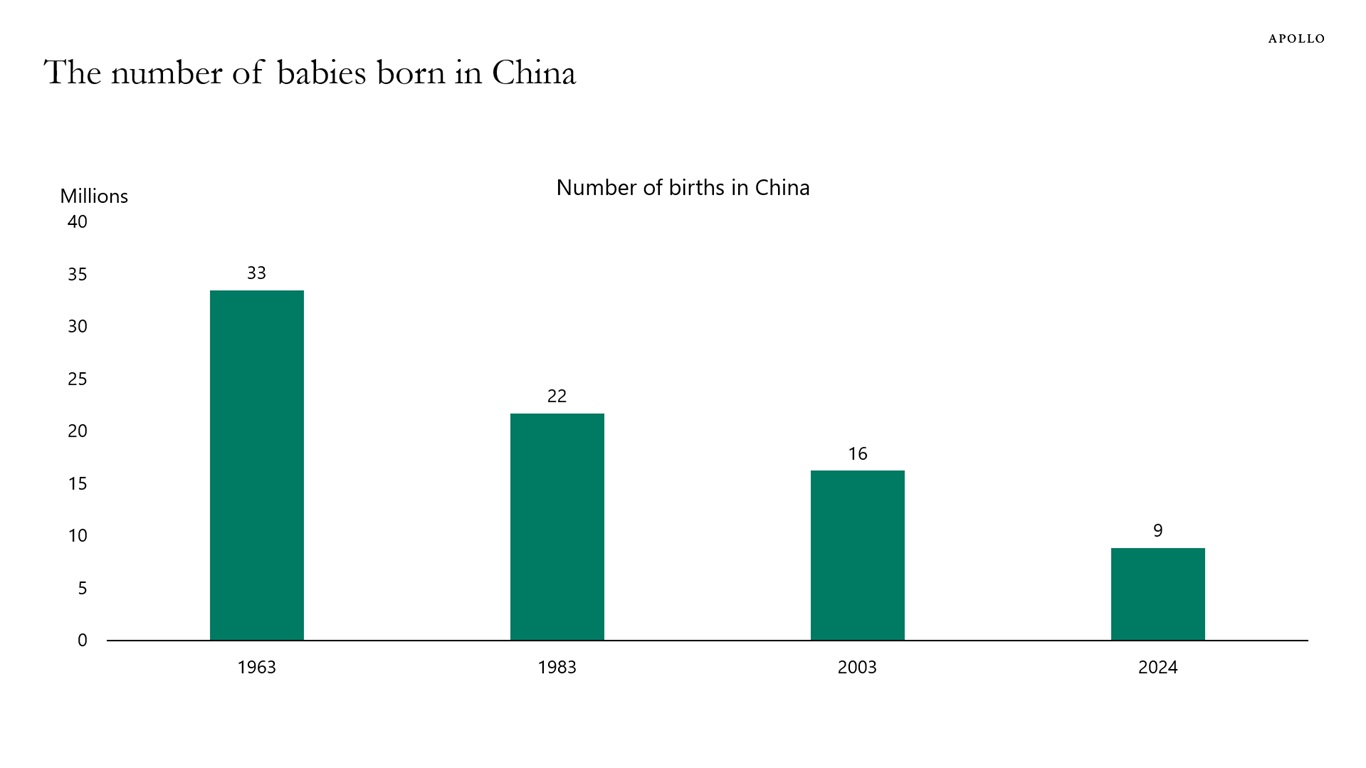
    In 1963, 33 million babies were born in China. In 2024, there were 9 million, see chart below.

    Sources: United Nations, Apollo Chief Economist

    Download high-res chart


    This presentation may not be distributed, transmitted or otherwise communicated to others in whole or in part without the express consent of Apollo Global Management, Inc. (together with its subsidiaries, “Apollo”).  

    Apollo makes no representation or warranty, expressed or implied, with respect to the accuracy, reasonableness, or completeness of any of the statements made during this presentation, including, but not limited to, statements obtained from third parties. Opinions, estimates and projections constitute the current judgment of the speaker as of the date indicated. They do not necessarily reflect the views and opinions of Apollo and are subject to change at any time without notice. Apollo does not have any responsibility to update this presentation to account for such changes. There can be no assurance that any trends discussed during this presentation will continue.   

    Statements made throughout this presentation are not intended to provide, and should not be relied upon for, accounting, legal or tax advice and do not constitute an investment recommendation or investment advice. Investors should make an independent investigation of the information discussed during this presentation, including consulting their tax, legal, accounting or other advisors about such information. Apollo does not act for you and is not responsible for providing you with the protections afforded to its clients. This presentation does not constitute an offer to sell, or the solicitation of an offer to buy, any security, product or service, including interest in any investment product or fund or account managed or advised by Apollo. 

    Certain statements made throughout this presentation may be “forward-looking” in nature. Due to various risks and uncertainties, actual events or results may differ materially from those reflected or contemplated in such forward-looking information. As such, undue reliance should not be placed on such statements. Forward-looking statements may be identified by the use of terminology including, but not limited to, “may”, “will”, “should”, “expect”, “anticipate”, “target”, “project”, “estimate”, “intend”, “continue” or “believe” or the negatives thereof or other variations thereon or comparable terminology.


    Continue Reading

  • EU climate rules risk energy security, warn gas suppliers – Financial Times

    EU climate rules risk energy security, warn gas suppliers – Financial Times

    1. EU climate rules risk energy security, warn gas suppliers  Financial Times
    2. ExxonMobil Threatens To Leave EU Over Sustainability Rules  Crude Oil Prices Today | OilPrice.com
    3. Europe’s green rules stir row, draws international flak: India opposes, Qatar warns  Firstpost
    4. Exclusive-QatarEnergy, Exxon Executives Warn of Europe Exit Over Climate Law  US News Money
    5. Darren Woods Warns EU: Soften Rules or Exxon Exits Europe  Business Chief

    Continue Reading