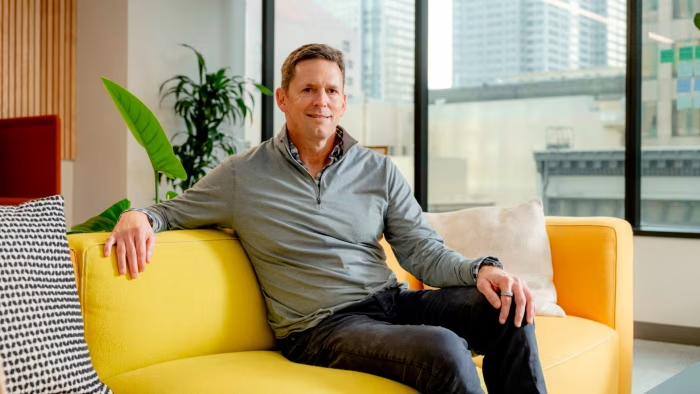
Before meeting for this interview, Tom Pickett opened Headspace, the app best known for mindfulness, and did a “breathing exercise” to “reset [his] brain”.
Usually he uses it at night. “My mind latches on to something before I go to bed, then I just can’t get it out of my head and I end up having poor sleep,” he says.
Since taking over as chief executive of Headspace in August last year, moving from US food delivery company, DoorDash, the 57-year-old, who has no formal experience in mental healthcare, has had a lot to get his head around. Over Zoom from his home office in San Francisco, Pickett has the look of a tech executive, with neat hair and a three-quarter zip fleece. In the background is a small sign: “Get Sh*t Done”.
“The healthcare industry is definitely complex. Every time you think you understand everything, you find that there’s a lot of nuances. It’s a constant learning process.”
Describing US-based Headspace as healthcare is a departure from its origins as a meditation app created by former Buddhist monk Andy Puddicombe and marketing executive Richard Pierson in 2010. It served up short digital programmes to busy professionals, with large employers, including Google, among the first to offer it to staff.
Four years ago, Headspace merged with Ginger, a mental health app focused more on coaching therapy and psychiatry, in a deal that valued the combined companies at $3bn. This broadened the product range to include access to virtual therapists, advice and workshops on topics such as mood management and insomnia. Headspace’s founders left in 2022, although Puddicombe’s voice continues to guide many of its meditations.
Since then, the company has intensified its push from consumers to employers and private health plans. More than 5.8mn people have access to Headspace through staff benefits provided by more than 4,500 organisations worldwide. In the new year, a deal with health insurer Cigna, will make the app accessible to an additional 7mn members in the US, through 18,000 employers’ health plans.
Overstretched public services and worsening mental health have created a gap for businesses to step in. But cynics see the type of digital service offered by Headspace as a cheap way to burnish the wellness credentials of organisations with long-hour cultures.
“This is one of the biggest challenges of our time,” says Pickett. “You can’t listen to the news without somebody talking about mental health, and increasingly so for the younger generations.”
The old model of “sending people to a therapist, a one-on-one human interaction” seemed inefficient to Pickett, who previously worked at Google, primarily for YouTube, for a decade.
“It was quite surprising to me . . . that there really isn’t a technology play in this space . . . We need to embrace technology. And if the primary modality of mental health is talking, then conversational AI has to have a big [part] in terms of how we solve this.”
Getting this right is among Pickett’s most important responsibilities. There have already been allegations of a chatbot encouraging one teenager to take his own life, and others urging users to self-harm. Mustafa Suleyma, Microsoft’s head of AI, has warned of “AI psychosis”, describing those who believe the technology is a God or lover.
“People are using AI tools that weren’t built for mental health,” warns Pickett. “General-use chatbots [are] built to do a lot of things. And they’re amazing. But they were not designed to take somebody who maybe has an acute mental illness and support them through a difficult time.”
Last year Pickett scaled back Headspace’s full-time therapists, moving them to part-time and contractor roles, to cut costs. At about the same time he launched the chatbot Ebb, which on Monday is upgrading from text-only to voice. Pickett insists this service is not designed for serious mental health issues and the company still offers remote therapists. Chatbots help “everyday emotional regulation” with bouts of anxiety or sleeplessness. “That’s frankly what a large part of the population really needs . . . Something to talk to, to reflect, to help process their emotions.”
Pickett says the company has developed a safety system to identify high-risk language and escalate serious concerns for human clinician review. All messages are monitored for potential risks, including suicidal and homicidal ideation, self-harm, domestic violence, substance use, eating disorders and abuse of vulnerable populations. When the conversation takes a turn into this territory, Ebb directs the user to crisis care, and ends the conversation.
Research finds well-designed chatbots can help with mental health issues, and some users find it easier to open up to them. “There’s some really interesting things that are evolving around people’s openness to put things on the table with a conversational AI in a way that they might not have done with a human therapist,” says Pickett.
He is “bullish” on AI’s potential. But “we have to make sure we protect against the downside”. At stake is the company’s reputation. “We’ve got 15 years of a brand that we’ve built up, building user trust, and we really do not want to lose that.”
The wellbeing sector is fiercely competitive. Headspace has lower downloads and monthly average users than its larger rival, Calm, according to Sensor Tower, the market intelligence company. But new downloads for both have fallen. In the third quarter of this year, Sensor Tower says Headspace’s monthly average users were 12 per cent lower than a year earlier.
Headspace says the fall reflects a shift from direct subscriptions to employer and health plans. Pickett says that, despite economic uncertainty, employers are not pulling back from wellbeing benefits. “Mental health continues to be a top two or three issue for companies . . . I think most of them want a solution that’s more than . . . the ‘call up a phone number’ kind of model.”
He hopes more insurers will follow Cigna by adding Headspace to employer schemes. “Historically, the only thing health plans covered was clinical . . . With employers, you go 10,000, 50,000 100,000 at a time, but with health plans, you go millions at a time. Ultimately, that could become the biggest part of our business.”
As a private company, Headspace does not disclose detailed financial information. Pickett says last year it made “north of $200mn in revenue” and operates “ebitda profitable”.
Pickett gained an insight into mental health struggles at the start of his career, when he spent nine years in the navy as an F-18 pilot, including two deployments to the Gulf. Behind him is a model and a large photo of F-18 aircraft. “We were put in stressful situations — a bunch of 18-year-olds to largely 30-somethings, away from their families. Stress, anxiety, [and] later forms of depression were out there, and people were trying to figure out how to deal with that.” Then, the attitude was “suck it up”.
His time in the navy provided a “great learning opportunity for management”, he says.
That might have helped when he took over at Headspace, and oversaw job cuts. “There were still elements of the merger that we were cleaning up. Systems integration, two products that you’re pushing into one. There [were] some cultural differences.”
Employees, he realised, were drawn by “the mission” of improving mental health; it “really matters deeply to people who work there”.
That has led to some criticism on Glassdoor, the anonymous employer review site, that Headspace’s culture is more focused on numbers than on wellbeing. One former employee wrote: “It’s quite ironic that so much of their content centres around taking care of your mental health at work.”
Pickett says the company is now in “a much better place”. “I’m happy with the size . . . today [about 400 staff]. People are definitely pushed. We have a lot to do.”
An IPO might be a long-term goal but for now his focus is on building a “sustainable, healthy business”. “You want the flexibility to move and evolve and invest.”
A day in the life of Tom Pickett
6:45am Wake up and check my Oura smart ring stats — seven hours of actual sleep is the goal. I then grab a coffee for the road and head to our San Francisco office.
Morning This is my peak problem-solving and creative-thinking window, so I frontload the day with meetings and anything that requires sharp thinking and clear decision-making.
Lunch When I’m not travelling, I eat at the office and try to catch up with others, all while staying on top of emails and Slack messages.
Afternoon Some days are dedicated to strategy deep dives, others are all about product. I do “skip-level” meetings to keep a pulse on what is going on through the organisation, do customer calls and meet my direct reports.
Evening It’s very important to me to get home for family dinner. With four kids, three still at home, this is the time to connect as a family. Everyone’s at the table, sharing their day.
I’ll try to squeeze in a run or walk. The rest of the night is spent helping with homework while prepping for the next day’s meetings. We have a no TV rule during the week.
Before bed, I wind down with Headspace, shut down all screens, and give myself the best shot at hitting my seven-hour sleep target.