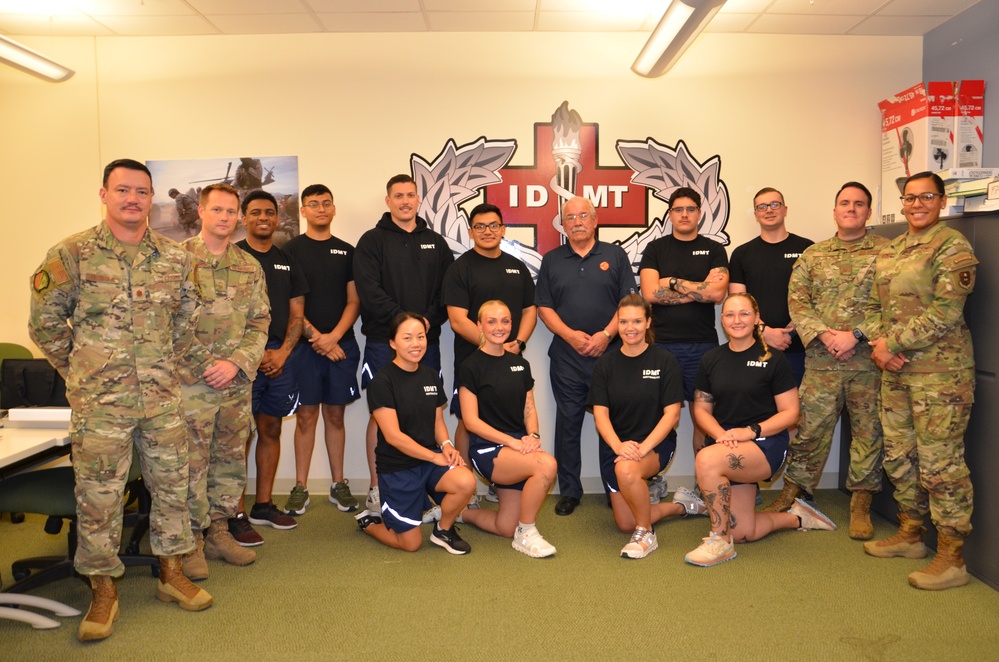
Retired Senior Master Sgt. Michael Currey, a former Air Force Independent Duty Medical Technician, spent the afternoon answering questions and sharing stories about his experiences from decades ago with IDMT course instructors…
Author: admin
-

IU Cinema celebrates 15 years with birthday bash, Michael Shannon, awards contenders: IU News
BLOOMINGTON,…
Continue Reading
-

More Than The Score – Oba Femi: the Nigerian wrestler aiming to become WWE’s next big star
Available for over a year
Isaac Odugbesan or Oba Femi as he’s known in WWE is making waves in the world’s largest professional wrestling company. He’s a former Track and Field star in the US collegiate system and is a current NXT Champion, which…
Continue Reading
-

Travis County Property Owners Reminded to Apply for Homestead Exemptions in the New Year
FOR IMMEDIATE RELEASE | January 6, 2026
Media Contact
Cynthia Martinez, Chief Strategy Officer
Travis Central Appraisal District
[email protected]AUSTIN, Texas – The Travis Central Appraisal District (TCAD) is reminding property owners who own and live on a property to save money on their property tax bill by filing for their homestead exemptions.
“In 2025, having a homestead exemption saved the average Travis County property owner $3,663 on their property tax bill,” said Chief Appraiser Leana Mann. “If you’re not claiming your exemptions, you’re paying too much in property taxes.”
A homestead exemption can provide significant property tax savings for homeowners by reducing the taxable value of their primary residence. Homeowners who purchased a home in 2025 or who have not previously applied for a homestead exemption are encouraged to apply as soon as they qualify. The application form must be accompanied by a copy of a Texas driver’s license or identification card reflecting the property’s address. Filing for an exemption is free.
Several types of homestead exemptions are available, including a general residence homestead exemption and exemptions for people over the age of 65, people and veterans with disabilities, and the surviving spouses of service members or first responders killed in the line of duty. To be eligible for a homestead exemption, a property owner must own and occupy a property.
Additionally, property owners who began claiming a homestead exemption on their property from 2010 to 2019 will be included in the District’s exemption verification program for 2026. The verification process ensures exemptions are applied only to eligible properties, as required by state law. If a homeowner needs to provide any information to the District as part of the verification process, they will be notified directly. No action is required unless a taxpayer receives a notice from TCAD.
Added Mann, “Property owners who need help with their forms should never pay someone to assist them. Our staff is always available to help.”
TCAD’s homestead exemption hotline is available to provide property owners with assistance in completing their applications and verifications. By calling 512-873-1560, Travis County residents can speak with a customer service representative who can answer their questions and help with submitting completed forms. The helpline is staffed Monday through Friday, 9 a.m. to 4:30 p.m.
Travis County property owners can view the current exemptions on their property, review a list of available homestead exemptions, and download or complete exemption application forms online at traviscad.org/homesteadexemptions. More information on the exemption verification process is available at traviscad.org/verify.
About the Travis Central Appraisal District
The mission of Travis Central Appraisal District, in accordance with the Texas Constitution and the laws of the state, is to provide accurate appraisal of all property in Travis County at one hundred percent market value, equally and uniformly, in a professional, ethical, economical and courteous manner, working to ensure that each taxpayer pays only their fair share of the property tax burden. For more information, please visit traviscad.org.
###
Continue Reading
-

Grant Park Music Festival announces 2026 lineup, featuring Ben Folds and ample American music
Chicago’s Grant Park Music Festival announced its season lineup Tuesday, offering the first glimmer of hope that the city’s…
Continue Reading
-
Aleem Khan orders for addressing issues related to Motoways – RADIO PAKISTAN
- Aleem Khan orders for addressing issues related to Motoways RADIO PAKISTAN
- Rest Areas on Major Motorways to Get Upgrades ProPakistani
- Federal Minister for Communications Abdul Aleem Khan inspected rest areas at M-2 Motorway Lahore Associated…
Continue Reading
-
12-member Gilgit Baltistan caretaker cabinet takes oath – RADIO PAKISTAN
- 12-member Gilgit Baltistan caretaker cabinet takes oath RADIO PAKISTAN
- Protests erupt in GB over caretaker cabinet appointments Dawn
- Caretaker cabinet of Gilgit Baltistan to take oath today Geo News
- 14-Member Caretaker Cabinet for…
Continue Reading
-

What we’re reading: Alan Hollinghurst, Samantha Harvey and Guardian readers on the books they enjoyed in December | Books
Tomasz, Guardian reader
Ever since my father presented me with a copy of The Unicorn, beautifully translated into my mother tongue, I have been an ardent admirer of Iris Murdoch’s. I went on to read all of her novels, plays and poetry with great…
Continue Reading
-

New rides to open at Lightwater Valley following sale
James Mellors, managing director of Mellors Group, said: “Lightwater Valley is a park with real heart, history, personality, and potential, and it’s a place our own family has loved since childhood.
“We’re incredibly proud to be taking on its…
Continue Reading
-
Bike ride in France raises hope for a Pictou County family
When Chanda MacDonald’s 20‑year‑old daughter was diagnosed with gastric cancer last spring, she knew the road ahead would be daunting. What she didn’t expect was the outpouring of support for Raleigh’s fight.
A clinical registered nurse educator with Nova Scotia Health, MacDonald says the diagnosis last May was devastating. Raleigh’s cancer developed from Peutz‑Jeghers syndrome, a rare genetic condition that had gone undetected since childhood.
MacDonald’s two close friends, Dr. Colin Sutton, an emergency physician at Aberdeen Hospital in New Glasgow, and his wife Linda MacNeil, a retired nurse, joined the Great Cycle Challenge. It’s a national fundraiser for childhood cancer research. The couple dedicated their fundraising efforts to research in Raleigh’s name, logging almost 600 kilometres over an 8-day bike tour in France last summer.
Awareness is critical, says MacDonald, especially for rare conditions like Peutz‑Jeghers syndrome. “Where a diagnosis can sometimes come as a total shock, these syndromes can be ‘silent’ until they become serious. Research isn’t a luxury; it’s how treatments are discovered. Every dollar raised goes toward a future where mothers like myself won’t have to go through this.”
For Sutton and MacNeil, who raised $6,500 for research into the syndrome, the ride was both a physical challenge and a symbol of solidarity. “You think about your own kids and how unpredictable life can be,” Sutton said. “Here’s a young woman writing exams, feeling tired and suddenly facing a terrible diagnosis. It reminds you how vulnerable we all are.”
MacNeil says “We’ve known Chanda for decades. To be able to do something tangible, to ride and raise money, it felt like the least we could do. It was about hope, strength and community.”
MacDonald considers the gesture more meaningful than simply financial. “What Colin and Linda did is the definition of humanity,” she said. “They gave us the strength to keep fighting. Families like ours need that hope.”
MacNeil says “You just want awareness out there. There’s still a long way to go. If anybody can donate, it all helps, especially with the type of cancer Raleigh has. It is so rare.”
“Raleigh says the efforts of Sutton and MacNeil make it easier to remain positive and have faith. p “It gets me through each day along with the amazing support from the community.” “I am humbled by the kindness of Colin and Linda and the awareness they’ve brought to help research kids’ cancers,” she said. “It is people like them that will help save many children.”
Raleigh had been preparing to enter her third year at St. Francis Xavier University when she paused her studies to start chemotherapy. Despite the fatigue after her treatments, Raleigh is determined to pursue a career in healthcare. She says she’s always wanted to help people and believes she has a natural ability to care and to demonstrate her empathy for others.
Sutton says they’ve done the ride in other places before, “but this time we wanted to dedicate it to Raleigh. She may have been 19 when diagnosed, but from our point of view she’s still our friend’s child. Everyone was trying to figure out how they could help. For us, raising money for research in her name was the way.” They carried a photograph of Raleigh with them, Sutton says “We wanted Raleigh to ride with us, so to speak,”
MacNeil said the ride drew attention from fellow cyclists and even strangers abroad. “People were quite intrigued by what we were doing,” she said. Some of the people they met donated to the cause. Sutton and MacNeil were among the top fundraisers in Nova Scotia for the ride.
If awareness there can lead to earlier detection, that’s a difference Raleigh is proud to have made,” MacDonald said. “Raleigh doesn’t walk this path alone; she has a huge community behind her. That’s really the whole message.”
Photo of Raleigh MacDonald.
Continue Reading