Source: AGU Advances
Single-celled algae in the ocean known as coccolithophores play an important role in the marine carbon cycle when they take up bicarbonate from seawater to build their shells. Coccolithophore numbers have been…

Single-celled algae in the ocean known as coccolithophores play an important role in the marine carbon cycle when they take up bicarbonate from seawater to build their shells. Coccolithophore numbers have been…

Findings from the prospective DIRECT (NCT04226937) study demonstrated that an ultrasensitive circulating tumor DNA (ctDNA) assay tracking tumor-specific phased variants (PVs) to detect minimal residual disease (MRD) at the end of first-line…
The CFO role is no longer just about financial stewardship, it’s about shaping technology strategy, navigating political and regulatory uncertainty, and building organizations that can adapt as fast as the world changes. AI is rewriting workflows, cloud environments are continuing to redefine infrastructure, and compliance pressures continue to shift. In a landscape defined by constant disruption, success isn’t just about making the right decisions. It’s about creating a finance function that can learn, pivot, and thrive no matter what comes next.
These five trends stand out as critical for CFOs who want to lead, not lag, in 2026:
By 2028, 33% of all enterprise software applications are expected to incorporate agentic AI1, a shift that will fundamentally change how work gets done. That’s because, unlike previous tech waves, agentic AI isn’t just a tool. It’s a collaborator. AI agents can plan, execute, and adapt entire processes autonomously, transforming workflows from static sequences into dynamic, self-optimizing systems.
For CFOs, this means rethinking workforce development and training from the ground up. Traditional transformation focused on speed, cost, and agility. Transformation shaped by agentic AI demands bigger questions:
The disruptive nature of agentic AI makes human-led governance and principle-based oversight – anchored in transparency, privacy, and adaptability – essential. CFOs must prioritize and build technical fluency across finance teams, define clear objectives for AI agents, and embed continuous learning into the fabric of their organizations.
The payoff? Finance operations that are predictive, adaptive, and capable of self-improvement—unlocking a new era of intelligent transformation.
As AI agents are changing how work gets done, who then orchestrates that change? Enter the CIO–CFO partnership.
Eighty-two percent of CIOs now lead enterprise-wide digital transformation initiatives2, and nowhere is this shift more visible than in financial software decisions, once considered primarily the CFO’s domain.
One reason is that corporate performance management (CPM) tools – essential for planning, forecasting, and compliance – are increasingly powered by AI for predictive analytics and automation. As these tools evolve beyond traditional functionality, decisions about their adoption can no longer sit in silos. That means, what might initially look like a potential turf war is, in reality, an opportunity for CFOs and CIOs to align and jointly shape the enterprise’s AI-enabled future.
By collaborating on finance software decisions, these leaders can create a blueprint for broader alignment, ensuring technology investments deliver measurable outcomes, scalability, and security. CIOs bring expertise in architecture and integration. CFOs ensure platforms meet compliance needs and improve, or completely transform, real finance workflows.
The momentum is clear: 93% of CFOs and CIOs agree AI integration has already increased collaboration3, and most say this partnership significantly impacts innovation, efficiency, and risk management. For CFOs, success isn’t about becoming IT experts, it’s about articulating finance priorities, championing change management, and developing enough technical fluency to engage on data models and integration. Done right, this collaboration will set the stage for smarter AI-driven decisions across the enterprise.
Shared CIO–CFO leadership sets the strategy for AI adoption, but the cloud architecture and data foundation you choose will determine how fast and safely you can execute it.
As finance systems migrate to the cloud, hyperscalers like AWS, Azure and Google Cloud are becoming the backbone of enterprise infrastructure. But with this convenience comes risk. Locking into a single provider can limit flexibility, inflate costs, and constrain innovation when new AI capabilities or regulatory requirements emerge.
For CFOs, having technology that is hyperscaler neutral isn’t just an IT preference, it’s a strategic safeguard. Neutrality means building architectures that avoid deep dependencies on one vendor, enabling organizations to pivot quickly as technology, pricing, and compliance landscapes shift. It also strengthens negotiating power, mitigates concentration risk, and ensures resilience in the face of geopolitical or regulatory disruptions.
Equally critical is your data foundation. The quality, structure, and accessibility of your data will determine whether AI delivers real value or stalls as an exceedingly costly experiment.
CFOs should work with CIOs to ensure that cloud platforms support open standards, robust APIs, and scalable data models. Because agility isn’t just about infrastructure; it’s about making data accessible and actionable across the enterprise. And agility isn’t just an IT advantage; it’s a financial one.
While CFOs collaborate with CIOs to accelerate AI-driven transformation, they can’t lose sight of another force shaping the future of finance: geopolitical and regulatory complexity. Take into consideration just a single example from 2025: the EU’s significantly loosened CSRD requirements. Now, only companies with 1,000+ employees and €50 million (approximately $55–57 million USD) in annual revenue are required to meet CSRD’s mandatory reporting requirements, removing nearly 80% of organizations that were previously in-scope. Compliance deadlines were also pushed back up to two years, and reporting standards were simplified, cutting mandatory data points by more than half.
For CFOs, this might feel like a reprieve, but that’s a risky illusion. Regulatory pendulums swing. Sustainability reporting remains a political priority in some geographic regions, and future tightening is inevitable. History shows that while progress toward transparency may ebb and flow, even periods of rollback rarely erase the underlying momentum. Over time, the trend continues. Organizations that scale back their ESG and compliance capabilities now will find themselves scrambling (and paying a premium) when stricter rules return.
The smarter play? Operationalize monitoring of the regulatory change, even in this period of relaxation. Why?
CFOs should treat this moment not as an excuse to pause but as an opportunity to lead, ensuring their organizations stay ahead of the curve when the pendulum swings back.
If AI disruption and regulatory shifts have one thing in common, it’s unpredictability. The organizations that win aren’t those that forecast every change, they’re the ones that can absorb it, adapt, and turn it into advantage.
Enter absorptive capacity: an organization’s ability to identify valuable external knowledge, internalize it, and apply it for impact. In the era of Agentic AI, AI that can analyze, decide, and act autonomously, this capability is essential. But it’s equally critical for responding to regulatory swings, market shocks, and competitive disruption.
Organizations that exemplify absorptive capacity share five traits. They:
The next era of finance won’t be defined just by faster closes or cleaner forecasts. It will be defined by intelligent workflows, shared leadership, adaptive architectures, resilient compliance, and teams built for continuous learning. Agentic AI is rewriting the rules of work, and the CIO-CFO partnership is the engine that will drive this transformation. But technology alone isn’t enough. CFOs must champion hyperscaler neutrality to preserve flexibility, build absorptive capacity to turn disruption into advantage, and operate at the higher end of regulatory complexity to stay ahead of the pendulum swing.
CFOs who lead boldly, by asking bigger questions, investing in future-proof systems, and embedding governance and adaptability into every decision, won’t just keep pace with change. They’ll set the pace. Those who hesitate risk being left behind in a world where finance isn’t just a function – it’s a strategic force shaping the enterprise of tomorrow.
Launching in early March: The Future-Ready CFO report. Reserve your complimentary copy today and get instant access as soon as it’s released.
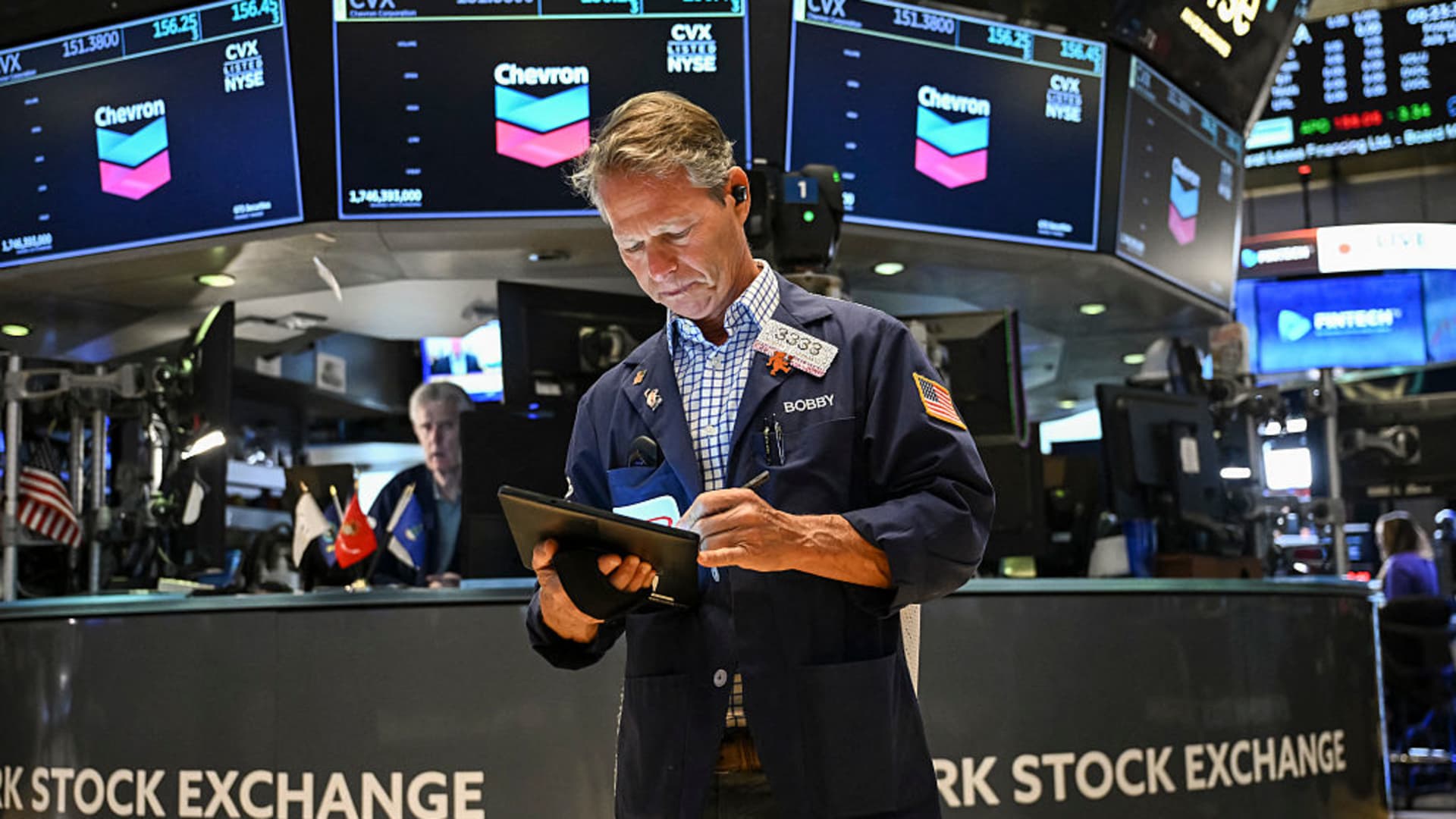
Traders work on the floor of the New York Stock Exchange (NYSE) at the opening bell on July 18, 2025, in New York City.
Angela Weiss | AFP | Getty Images
Stocks rose on Monday even after the U.S.’ attack on Venezuela and capture of leader Nicolas Maduro as crude oil prices showed little reaction and investors bet the action would not lead to bigger geopolitical conflicts that upset markets.
The Dow Jones Industrial Average gained 653 points, or 1.3%, and hit a new all-time high in the session. The S&P 500 advanced 0.7%, while the Nasdaq Composite climbed 0.9%.
Energy stocks led the early gains on the notion the companies would benefit from rebuilding Venezuela’s oil infrastructure. Chevron surged 4% and was seen as the biggest beneficiary because of its presence already in Venezuela, which has the largest proven oil reserves in the world. Exxon Mobil traded up more than 1%. Shares of oilfield services companies that could aid the Venezuela energy rebuild like Halliburton and SLB moved higher by 9% each. The State Street Energy Select Sector ETF (XLE) increased more than 2%.
“Maybe in the short term, it’ll boost the price of oil because the question is surrounding the supply and delivery of oil,” Sam Stovall, chief investment strategist at CFRA Research, said to CNBC. “Longer term, it could end up being an improvement because Venezuela represents only 1% of the world’s oil supply, and they’ve been getting worse and worse over the years. Their infrastructure needs to be improved, and possibly that is something that the U.S. can help with.”
Even with the bullish equities reaction, traders also added exposure to gold. Futures contracts tied to the precious metal rose 2%. Bitcoin traded above $93,000.
“The market is basically saying, ‘We’re going to focus on putting money back to work after doing tax-loss harvesting, doing portfolio realignments in the end of 2025, and then buying back into stocks early in 2026,’” Stovall continued. “It remains a risk-on environment.”
Following the attack and capture by the U.S. military, Maduro and his wife, Cilia Flores, were flown to New York, where they were charged with narco-terrorism conspiracy and other crimes. Drug trafficking, according to the indictment, “has enriched and entrenched Venezuela’s political and military elite.” President Donald Trump said Saturday in a news conference that the U.S. would “run” Venezuela “until such time as we can do a safe, proper and judicious transition.”
“This is a significant geopolitical event though unlikely to be a major near-term market-mover,” wrote Matthew Aks, policy analyst with Evercore ISI, in a note. “For now, investors are left to navigate a now-familiar landscape of Trump’s likely purposeful ambiguity around his next steps.”
“Our instinct is that Trump is generally not interested in full-scale boots-on-the-ground regime change like the Iraq and Afghanistan wars he has long criticized. However, Trump’s statements today leave open the possibility this won’t quite be a one-and-done like the Iran nuclear strike last year,” Aks added.
Shares of defense giants General Dynamics and Lockheed Martin received a bit of a boost, moving higher by more than 2%, with Trump’s latest action showing quick military strikes would be a key part of his policy for dealing with geopolitical issues that arise.