December 29, 2025 (MLN): Pakistan and Brazil have agreed to significantly expand their bilateral cooperation in the livestock, dairy and meat industries.
This marked a major step towards modernising Pakistan’s agri-based economy under the…

December 29, 2025 (MLN): Pakistan and Brazil have agreed to significantly expand their bilateral cooperation in the livestock, dairy and meat industries.
This marked a major step towards modernising Pakistan’s agri-based economy under the…

LAHORE – Punjab is under deadly blanket of fog with visibility plummeted to shocking lows, just 20 meters in Sialkot, 30 meters in Narowal, and 50 meters in Gujranwala.
National Highways & Motorway Police warned against inter-city travelling….

Cracks continue to form around a shear zone of the Thwaites Glacier, also known as the Doomsday Glacier, as observed by satellites between 2002 and 2022. A team of researchers from the University of Manitoba wrote in a paper, “Over the past two…

As the new year approaches, four doctors with a special interest in brain health describe the best…

 Eastern Theater Command
China is holding military drills around Taiwan simulating the seizure and blockade of the island’s…

Half a million people are expected to converge on Melbourne’s CBD on New Year’s Eve as the city welcomes in 2026.
Fireworks and laser lights synchronised to a party soundtrack will operate from 27 rooftops as part of a $6 million celebration.
There…
I don’t own a dishwasher, so when it’s time for me to help stack one in the homes of friends and family, I’m not across the rules.
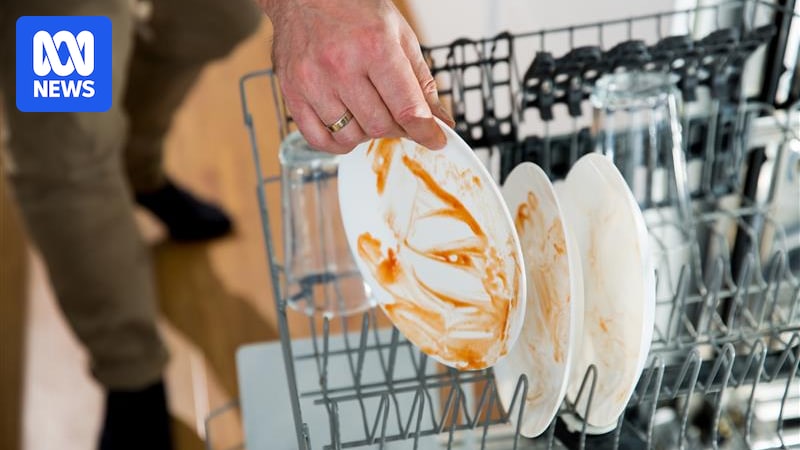
What I do know is some people like to rinse the dishes before stacking, and others bypass this step, loading up some of the crustiest plates I’ve seen.
So, is rinsing necessary, and how should we be stacking a dishwasher?
Rinsing can actually send a message to your dishwasher that your plate doesn’t need as much washing, explains Ashley Iredale.
He is a whitegoods expert who worked at advocacy group Choice at the time of this interview.
“There’s absolutely no need to pre-rinse,” he says.
All you need to do is scrape off any solid food before stacking your dishes. The dishwasher will clean off the rest.
Mr Iredale says if you pre-rinse, you may trick your dishwasher.
That’s because most dishwashers have sensors that detect how dirty your plates are, and wash your dishes with a suitably strong jet.
Rinsing is especially redundant if you have a good detergent, explains Mr Iredale.
Your dishwasher will do a better job of washing those unrinsed dishes if you use tablets rather than powders, Choice’s research has found.
But that doesn’t mean you have to buy the costly fancy ones, he says, noting price is not an indication of performance.
Scraping properly before stacking is important, so you don’t clog your dishwasher with food residue.
That’s according to Joshua Henzel, who runs an appliance servicing and repair business in Melbourne/Naarm.
And the newer the model, the greater the risk of this happening.
To stay on top of things, he recommends cleaning your dishwasher’s filter once a month.
If you’ve left your dishes a while before loading them in, a pre-wash can be beneficial, says Bridget Gardner, the director of a firm that advises cleaning and facility managers.
“If the dishes are coated in food containing proteins and carbs that tend to stick, such as milk, cereal or egg, and they are left for hours or even a day before washing, it is expecting too much of any dishwasher to remove.”
But if you’re keen to save water and avoid rinsing, there’s a workaround.
“I know people who try to live sustainably who use stale bread to clean away residual food rather than water, which they then put into the compost or feed their chooks,” Ms Gardner says.
Stacking correctly is going to optimise the cleaning process.
For example, the size of your plates determines where they should go.
“You want your big plates on the outside, and the smaller plates closer to the centre,” says Mr Iredale.
“And everything should be facing towards the centre.”
That’s because there’s typically a jet spray at the bottom of a dishwasher.
Placing larger dishes on the outside, facing in, will allow the water to reach the smaller dishes, while also spraying the dirtiest surfaces of all your items.
For similar reasons, Kate Croukamp, the owner of a Gold Coast-based cleaning business, recommends stacking larger plates at the back of the dishwasher.
“This positioning prevents large items from obstructing water and detergent from reaching smaller dishes, allowing for a more thorough and efficient cleaning process.”
If you’re working with an upright cutlery basket, Mr Iredale says to place the “business end” of cutlery — so, “all your points and prongs” — facing downwards.
That’s for safety reasons, but also for hygiene.
“When it does come time to unload your cutlery, you’re not touching the end that goes in your mouth with your germ-laden fingers,” Mr Iredale says.
There are multiple jets and spray arms in a dishwasher, but the bottom shelf is “typically the more intensive wash zone”, says Mr Iredale, which is why heavily soiled pots and pans go on the bottom rack, and delicates go on top.
Plastics will also last longer if they’re stacked on the top shelf, because they’ll be less aggressively washed, he says.
And always run a full load, our experts recommend, provided water can reach all surfaces.
That way your dishwasher is “more energy-efficient and eco-friendly” as it saves water and energy, explains Ms Croukamp.
“This not only reduces your environmental impact but also cuts down on your power bills and saves you time in the long run.”

This tournament is a critical pillar of the national team pathway and an…
ANTHONY ALBANESE, PRIME MINISTER: Thank you for joining us. Just over two weeks ago antisemitic terrorists tried to tear our country apart, but our country is stronger than these cowards. They went to Bondi Beach to unleash mass murder against…