More than two-thirds of patients with rheumatoid arthritis (RA) in a Veterans Affairs (VA) cohort demonstrated cognitive impairment, and several modifiable factors such as pain, exhaustion, sleep disturbance, and reduced
Author: admin
-

Cognitive Impairment in Veterans With RA Linked to Modifiable Risk Factors
-

SABCS: Omission of SLNB Safe in Clinically T1-2 Node-Negative Breast Cancer
HealthDay News — For patients with clinically T1-2 node-negative (cN0) breast cancer, the omission of sentinel lymph node biopsy (SLNB) results in noninferior five-year regional recurrence rates (RR) and regional…
Continue Reading
-

Daily Prescription Opioid Use Linked to Lower Anxiety in Non-Cancer Pain
Daily opioid use is associated with fewer generalized anxiety symptoms and lower odds of generalized anxiety disorder (GAD), while higher opioid doses are not significantly related to anxiety outcomes, according to study results…
Continue Reading
-
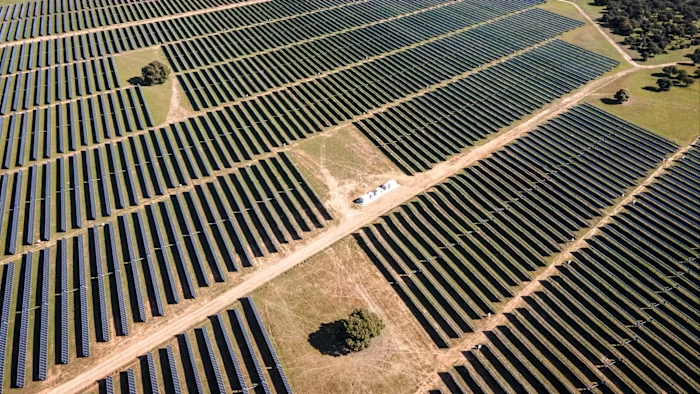
Solar power surplus in Spain triggers ‘discount season’ for plants
Spanish solar power is going through a shake out after a plunge in electricity prices left the owners of weak projects in one of Europe’s top renewables markets searching for exits.
The country has become a solar champion thanks to abundant sunshine and the government’s pro-renewables policies. But a surge in power production has outpaced demand, depressing electricity prices and profits for generators.
Some power producers are struggling to offload plants whose valuations have plunged as executives talk of solar “saturation”, creating a contrast between Spain and other places — China, India, Gulf states and European neighbours — where solar arrays are being built apace.
“It’s discount season,” said Carmen Izquierdo, co-founder of nTeaser, a deals marketplace. “Spain remains a dynamic market, but there is greater scrutiny of assets.”
Other producers are pivoting to installing batteries, which can complement and potentially save unprofitable solar projects.
Operational solar plants were valued at an average of €916,000 per megawatt in early 2024, but have now dropped to €648,000 per megawatt, according to nTeaser.
From 2022-24 there was a vibrant M&A market for Spanish solar portfolios, including those of mixed quality, but sellers are now having to strip out the weakest parks to close deals.
“They are willing to sacrifice part of the portfolio to move the rest forward,” Izquierdo said.
While cheap electricity is a boon for users, the gloom is even greater over so-called ready-to-build projects, where land, permits and grid access have all been secured, but construction has not begun.
A senior executive at an owner of Spanish solar plants said: “The market is flooded with ready-to-build projects that developers want to sell since they’re no longer good enough in the current market.”
Some projects were up for sale for just €1, the executive said, reflecting developers’ desperation to avoid further spending, and potential government penalties for not executing agreed construction plans.
The least attractive ready-to-build projects are often far from power grid nodes, requiring investment in expensive power lines.
As a solar downturn began in the past year, some Spanish companies sold existing plants to foreign investors. Utility group Endesa offloaded 50 per cent stakes in two solar power portfolios for a combined €1bn to Masdar, the United Arab Emirates’ state-owned clean energy company.
Prime Minister Pedro Sánchez’s Socialist-led government says cheap electricity is a good thing, and is already attracting new industrial investments that will bolster the economy.
But low prices are painful for producers. When they fall below zero, as they have for more than 500 hours in Spain this year, producers can end up having to choose between paying wholesale customers to take excess power off their hands or switching off.
Many producers insulate themselves by selling electricity through long-term power purchase agreements (PPAs), which they sign at fixed prices with corporate clients for 10-20 years.
Last month, Zelestra, an independent power producer, signed two PPAs with Microsoft in the Aragón region where the tech group plans to build data centres.
But negative prices are even clouding the market for PPAs, pulling down contract prices and prompting buyers to demand clauses that let them benefit from ultra-low rates in the spot market.
Andrés Acosta, innovation director at LevelTen Energy, a clean energy marketplace, said PPA prices that buyers are willing to pay are generally lower than what developers need — about €30 per megawatt hour — to make projects “bankable”.
“That has dramatically reduced the number of PPAs signed and means the majority of solar projects are not viable anymore unless they are hybridised with batteries,” Acosta said.
Adding battery storage to solar plants helps to limit price plunges by enabling generators to store electricity when prices drop during the day, then sell it in the evening when demand and prices are higher.
Killian Daly, executive director of Energy Tag, a non-profit group, said: “Storage should be the natural cure for the woes of the PPA market, but it’s not scaling as fast as it should do.”
The UK, Germany and Italy are far ahead of Spain in terms of existing and planned battery installations, according to data from the European Commission.
Following a nationwide blackout in Spain in April, the government took steps in November to remove some regulatory barriers to adding battery storage.
One key change eliminated a requirement for a new environmental impact assessment when installing batteries within an existing solar plant, said Pablo Martínez, Iberia lead at Modo Energy, a data provider.
That would reduce the time it takes to complete a battery project from three or four years to less than 18 months, he said.
Additional reporting by Carmen Muela in Madrid. Data visualisation by Nassos Stylianou
Climate Capital

Where climate change meets business, markets and politics. Explore the FT’s coverage here.
Are you curious about the FT’s environmental sustainability commitments? Find out more about our science-based targets here
Continue Reading
-

Guidance Developed for Infection Prevention, Control in Nursing Homes
HealthDay News — In multisociety guidance published in the November issue of Infection Control & Hospital Epidemiology, recommendations are presented for infection prevention and control (IPC) in the context of…
Continue Reading
-
Alcohol Consumption Linked to Higher Cancer Risk Across Multiple Studies – Cancer Therapy Advisor
- Alcohol Consumption Linked to Higher Cancer Risk Across Multiple Studies Cancer Therapy Advisor
- Is your drink increasing your cancer risk? Look at what experts say The News International
- India’s oral cancer puzzle: Why tobacco warnings alone…
Continue Reading
-

Recommendations Developed for Managing Adults With Congenital Heart Disease
(HealthDay News) — In clinical practice guidelines issued by the American College of Cardiology and American Heart Association and published online Dec. 18 in both the Journal of the American College of…
Continue Reading
-
FDA Clears Yartemlea for HSCT-Associated Thrombotic Microangiopathy – Medical Professionals Reference
- FDA Clears Yartemlea for HSCT-Associated Thrombotic Microangiopathy Medical Professionals Reference
- Fatal Complication of Stem Cell Transplants Gets Its First FDA-Approved Therapy MedCity News
- Omeros Announces New Date for YARTEMLEA® Approval Conference Call FinancialContent
- FDA Approves Narsoplimab-wuug for Transplant-Associated Thrombotic Microangiopathy Pharmacy Times
- Omeros (NASDAQ:OMER) Hits New 12-Month High – Time to Buy? MarketBeat
Continue Reading
-
Efficacy and Safety of Bisphosphonates Explored in Complex Regional Pain Syndrome
HealthDay News — Bisphosphonates may reduce complex regional pain syndrome (CRPS) pain intensity in the short term, according to a study published online Dec. 16 in Annals of Internal Medicine.
Michael C. Ferraro, from the University of New South Wales in Sydney, and colleagues conducted a systemic review and meta-analysis to examine the efficacy and safety of bisphosphonates versus placebo for CRPS. Eleven trials with 754 participants, assessing alendronate, clodronate, neridronate, pamidronate, and zoledronate, were included.
The researchers found with low certainty that in the immediate term (four weeks or less) bisphosphonates may result in little to no difference in pain intensity (mean difference [MD], −9.1 [95 percent confidence interval, −19.2 to 1.1]), while they may reduce pain intensity in the short term (more than four weeks to three months; MD, −10.0 [−18.9 to −1.1]), and result in little to no difference in pain intensity in the medium term (more than three months to six months; MD, 8.0 [−15.4 to 31.4]). Regarding the effects of bisphosphonates on pain intensity in the long term (more than six months), the evidence was very uncertain (MD, −2.5 [−19.6 to 14.6]). Bisphosphonates probably increase risk for adverse events (risk ratio, 1.1 [1.0 to 1.2]; moderate certainty).
“While this review represents the best evidence to date on treatment of CRPS, unexplained heterogeneity and limited medium- or long-term data restrict clinical application,” the authors write.
Several authors disclosed financial ties to the biopharmaceutical industry.
Abstract/Full Text (subscription or payment may be required)
Continue Reading
-

A surprising brain cleanup reduced epileptic seizures and restored memory
Temporal lobe epilepsy causes repeated seizures and often interferes with memory and thinking. New research now suggests that this condition is also tied to early aging in certain brain cells. Scientists at Georgetown University Medical Center…
Continue Reading

