Douglas FraserScotland business and economy editor
 AFP via Getty Images
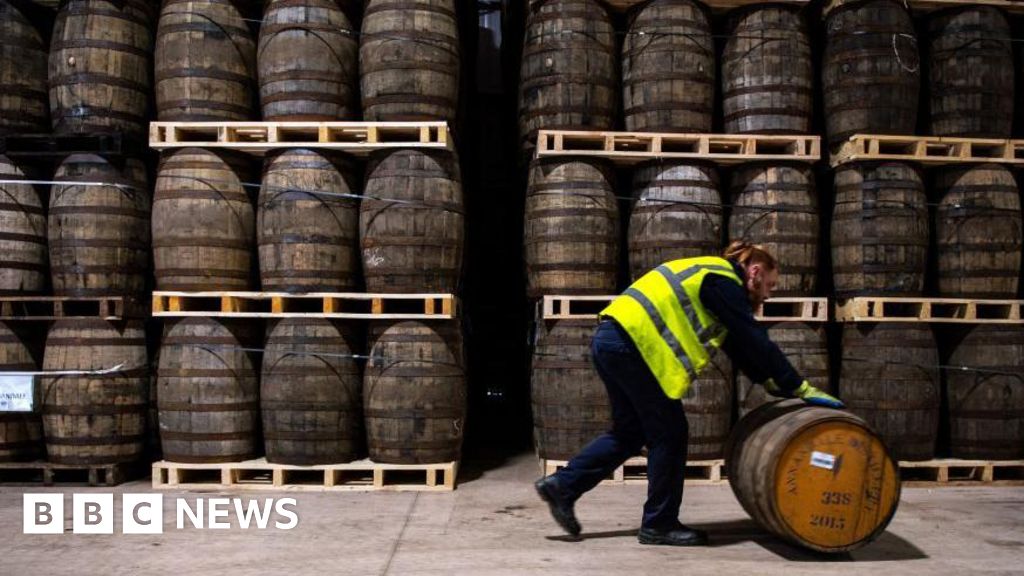
Scotch whisky is facing a sharp downturn in production as it adapts to tough market conditions around the world.
Tariffs for export to the USA, introduced under the Trump administration and adding 10% to importers’ costs, have hit sales in the industry’s biggest export market.
American tariffs on single malts, which were suspended four years ago, are on course to return next spring with a further 25% charge, unless a deal can be done with the Trump administration.
Single malts, which sell at premium prices, are a particularly important part of exports to the US.
However, the downturn is not only in the American market.
There is also weakening demand in other markets due to squeezed growth and consumer spending, increased tax and costs, including packaging regulation, and because of trade disruption.
Shipments to China last year fell by 31%, moving it from THE fifth biggest market to the tenth biggest. The first half of this year shows a 1% increase in the value of Scotch exports, to £2.5bn, while volumes were down nearly 4%.
And the negative effects of US tariffs may not become clear for some months, as distillers moved swiftly to build up stocks in the country ahead of the frontier tax being introduced.

 Getty Images
One of the brightest prospects for distillers is the sharp tariff reductions in India, the world’s biggest whisky market which last year replaced France as the biggest importer of Scotch by volume.
Currently at 150% of the value of each bottle, the trade deal between the London and Delhi governments includes a staged reduction to 40% tariffs.
But with ratification in both countries expected to take time, that is seen as too far off to avoid the slump being felt in the shorter term.
Companies that supply the industry are also feeling the pressure.
Distillers’ demand for malted barley has slumped. Expectations for next year are of a cut from the range of 900,000 to 1 million tonnes to the lower range of 600 to 700,000 tonnes.
Grain farmers are finding it hard to secure contracts for their barley harvests next year. Many are planting other crops such as wheat and rapeseed, or plan to do so.
According to Jack Stevenson, chair of the crop committee of the National Farmers Union in Scotland, who runs Brangan farm between Portsoy and Banff: “A lot of the merchants are struggling to find contracts. The end users are cutting them back hugely.
“It’s the same story the length and breadth of Scotland. We’re trying to keep the dialogue open with the Scotch whisky industry, and it’ll come back. It’s a huge market for Scotland.”
But for now he says: “There’s doom and gloom in the cereals sector. And costs have been getting out of control on the machinery side of things.”
 Getty Images
He says the break-even point for barley is more than £200 per tonne, and around half of it is sold in contracts for future delivery. But the spot price, without a future contract, fell during September to £160 per tonne.
According to data compiled by market intelligence agency AHDB, use of barley for distilling and brewing during July to October was down 14% on last year.
One farmers’ co-operative in Aberdeenshire is facing a halving of its 70,000 tonne barley contract this year with Chivas Brothers, one of the largest whisky distillers, owned by French drinks giant Pernod Ricard.
A maltings plant, supplying distilleries with processed barley, is being permanently closed at Pencaitland in East Lothian, with the loss of around 20 jobs.
Julian South, executive director of the Maltsters’ Association of Great Britain (MAGB), says that is partly because the sector has grown its processing capacity elsewhere in recent years, with plans for more expansion.
“Whisky has its ups and downs, while brewing is more consistent,” he says. “Some people are quite surprised how quickly demand dropped off. Maltsters are having to look at their own production and contracts for barley in the coming season.”
A key signal to farmers is the industry’s forecast of its demand for all malted barley, including around 40% of it used for brewing beer. The MAGB estimated demand next year is down from 1.8m tonnes to 1.4m.

Diageo, the biggest producer of Scotch whisky, has halted work at one of its main maltings, at Roseisle in Moray, until at least next June.
A Diageo spokesperson said: “We have temporarily paused production at Roseisle Maltings as we look to balance capacity against current demand. We continue to assess production volumes and will communicate future plans as part of the normal planning cycle.”
The firm has reduced production in some distilleries and has paused distilling at Teaninich, near Alness in Easter Ross.
Glenmorangie, at Tain in Easter Ross, is among distilleries where production has been halted for several months. Along with Ardbeg, it is a subsidiary of French luxury goods firm LVMH.
A spokeswoman says this is a “short term adjustment” to production based on forecast demand for Glenmorangie: “
There was a temporary pause in distillation early in the summer and another pause over the winter, with production scheduled to resume in spring 2026.
This is part of the strategy to grow the value of the brand, she said.
That reflects the risk that over-production could force down prices, and not only the profit margins but the premium status built up over years.

In most cases, the small number of people required to run a distillery are being redeployed, and visitor centres remain open, though there are knock-on effects for hauliers and other suppliers.
The large US distilling firm that owns the smaller Glenglassaugh and Benriach distilleries in north-east Scotland has been operating only one of them since the start of this year, shutting down Glenglassaugh until autumn. As it started up again, Benriach was closed for two years.
Brown-Forman, based in Kentucky and owner of Jack Daniels whiskey, also operates the Glendronach distillery near Huntly, and says it has slowed production there, “based on demand planning”.
That is despite its output of single malt having to wait at least 12 years before it is bottled and available for sale. The whole industry has to forecast where demand will be at least three years from now – the minimum length of time for Scotch whisky to mature in casks.
Bourbon barrels
A recent update for investors from Brown-Forman warned about global markets: “We continue to anticipate the operating environment to be challenging, with low visibility due to macroeconomic and geopolitical volatility as we face headwinds from consumer uncertainty and lower non-branded sales of used barrels”.
The main customer for used bourbon barrels is the Scotch industry, which has been importing around £200m-worth each year.
The downturn suggests the forecast is for a prolonged downturn in demand, though it may also be due to warehousing, or whisky bonds, being full from high production levels in recent years.
There is criticism in the industry at slow planning decisions holding back investment in extra capacity.
Brown-Forman’s global brand director for malts, Adip Agarwal, emphasised that slowing production, and the two-year closure of Benriach, does not alter availability of its Scotch produce.
“This strategic decision aligns our production with the current market, allowing us to manage our resources effectively and optimise operations,” he said.
No cheer from the Autumn Budget
There have been signs of the downturn in pricing of whisky. The super-premium whiskies, which can typically be found in airport shops, have been coming down in price, and there is increased supermarket discounting of premium single malts.
Some distillers declined to comment on the downturn, referring inquiries to their trade body, the Scotch Whisky Association (SWA).
A spokeswoman there said: “There is no doubt that the industry is facing significant challenges both at home and on the world stage, including the 10% tariff in our biggest export market and a fall in global consumer demand.”
The industry has been critical of the UK Treasury’s duty on alcohol, which covers around 7% of Scotch output that is sold in the UK, as well as other spirits including vodka, gin and rum.
SWA chief executive Mark Kent said another rise in duty announced in the Westminster Budget last month puts “huge additional pressure on a sector suffering job losses, stalled investment and business closures”.
He added: “Put simply, the government cannot expect the Scotch whisky sector to just keep delivering growth, both at home and on the world stage, if the conditions which support growth are not nurtured”.
The SWA has been under pressure from farmers to develop more reliable and steady contracts for barley.
The spokeswoman commented: “The stability of the Scotch Whisky supply chain is of vital importance to our sector, and challenges that impact us will of course impact everyone from the farmers who grow our cereals, through to the hospitality venues who serve our products.
“Rising costs will impact Scotch Whisky producers’ margins, their long term planning and in some cases the viability of their businesses, and we are seeing the reverberating effects of that across our supply chain.”
She added: “We remain in regular communication with our colleagues in the farming sector to address our industries’ shared challenges and boost the resilience of the Scotch Whisky supply chain from grain to glass.”