Author: admin

  • Suspended MPAs split over protest limitation

    Suspended MPAs split over protest limitation


    LAHORE:

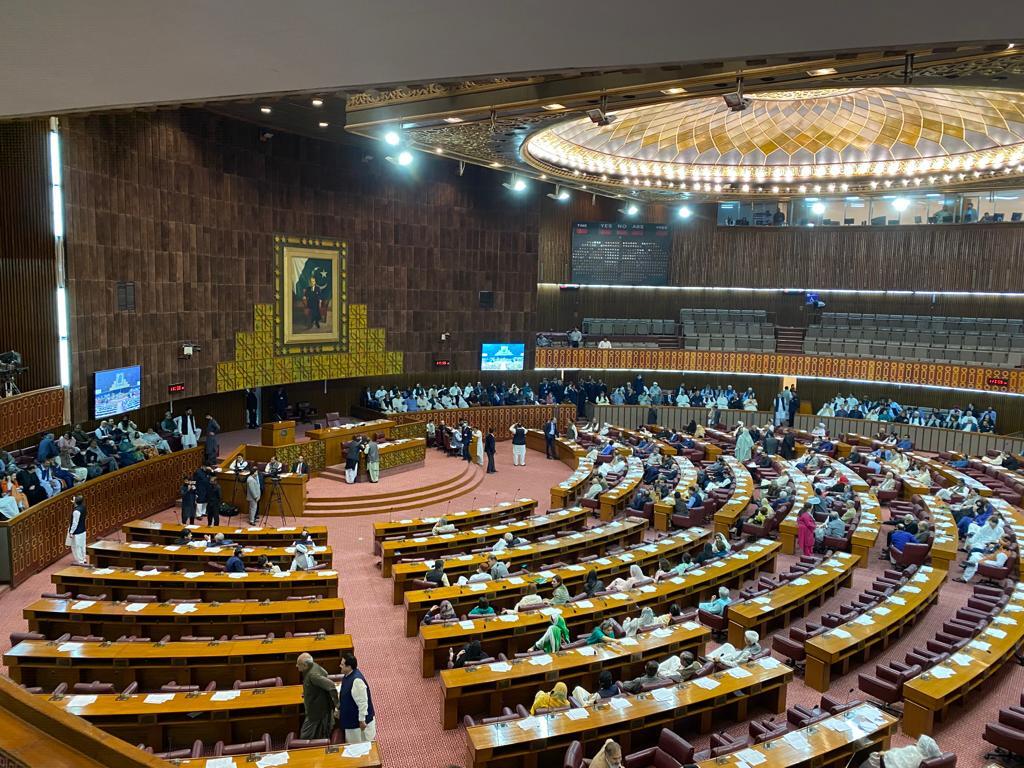
    Pakistan Tehreek-e-Insaf’s (PTI) 26 suspended MPAs are divided over making any commitment regarding their right to protest in Punjab Assembly.

    “Majority of them do not support humiliating, abusive and violent conduct at any cost but will not compromise their right to protest in the garb of devising a strategy on how to run the house proceedings,” an insider wishing not to be named told The Express Tribune.

    He quoted the lawmakers as saying as if Chief Minister Maryam Nawaz is the red line for the Pakistan Muslim League-Nawaz (PML-N), the PTI also has similar concerns.

    However, he said, a few of the members were of the view that negotiations should be continued while avoiding a hard line, but the majority were asserting that they could face the reference but would not compromise their right to protest.

    The latter contend that negotiations must be held on stopping humiliation, abuse and violation of rules but the opposition should not accept the role of a mere spectator.

    Sources said various options were discussed among the lawmakers facing action over disruption of assembly proceedings, especially those that they believed the PML-N could place before them. The dominant view among the suspended MPAs was that they could not afford to confine themselves to their seats or protest as per the ruling party’s wishes in the garb of democratic norms.

    The government has proposed the names of 11 MPAs, of whom eight belong to the PML-N and one each to PPPP, PML-Q and IPP, for the negotiating committee. The PML-N lawmakers are Mian Mujtaba Shujaur Rehman, Rana Arshad, Sami Ullah Khan, Khawaja Slaman Rafique, Ahmad Iqbal Chaudhry, Iftikhar Hussain Chachar, Amjad Ali Javed and Rahila Khadim Hussain. The names of PPPP’s Ali Haider Gillani, PML-Q’s Shafay Hussain and IPP’s Shoaib Siddiqi have also been floated.

    However, no name from the opposition has been proposed.

    After the opposition’s members are nominated, the negotiating committee will be officially formed by the assembly secretariat.

    The MPAs were suspended after the opposition disrupted a speech of the CM on June 27. Treasury and opposition members got embroiled in a scuffle while Speaker Malik Mohammed Ahmed Khan made efforts in vain to pacify the situation.

    He later suspended 26 PTI MPAs under Rule 210 (3) of the Rules of Procedure, Provincial Assembly of Punjab, 1997.

    Speaker Khan also sought on June 28 the recovery of damage amounting to Rs2.035 million from 10 PTI MPAs over mounting on desks and breaking eight microphones during their protest on June 16, when the provincial government presented its budget.

    The speaker had earlier barred opposition MPA Hassan Malik from attending the assembly session till its prorogation for hurling a copy of the budget speech towards Finance Minister Mian Mujtaba Shujaur Rehman.

    On June 24, Speaker Khan gave a ruling, stating, “I emphasise, all members, regardless of their political affiliation, in order to preserve decorum, uphold the dignity of this august assembly, and ensure that parliamentary proceedings can continue without disruption.”

    He warned that in future, “I shall take all the steps within the legal framework to maintain order and uphold dignity of this august house and its members.”

    The speaker gave the ruling in response to Opposition Leader Malik Ahmad Khan Bhachar’s assertion on a point of order that protest is a constitutional right.

    Speaker Khan declared that Rule 223 of the Rules of Procedure, enacted under Article 67 read with Article 127 of the Constitution, provides the code of conduct to be observed by members in the assembly.

    Continue Reading

  • Tabernacle Choir prepares for 5,000th episode – Church News

    Tabernacle Choir prepares for 5,000th episode – Church News

    The first “Music & the Spoken Word” broadcast with the Tabernacle Choir at Temple Square was on Monday, July 15, 1929, and scheduled for 3 p.m.

    A single microphone for the choir and announcer was attached to the ceiling, with a long cable connecting it to KSL’s radio controller, located a city block away. Nineteen-year-old Ted Kimball, son of organist Edward P. Kimball, climbed a 15-foot-tall stepladder and announced each song that was sung by the choir.

    A short article the following day in the Deseret News noted the success of the first broadcast, calling it “highly satisfactory.” The broadcast was transmitted to WJZ in New York over the telephone system and then went to more than 30 stations, including KSL.

    “In the opinion of the National Broadcasting Company officials, the weekly broadcasts of the Tabernacle Choir and Organ will prove a most popular program,” concludes the article.

    Ninety-six years later, Sunday, July 13, 2025, marks the 5,000th week of broadcasting for the 360-voice Tabernacle Choir’s weekly 30-minute “Music & the Spoken Word” broadcast that’s heard or seen on the radio, television or online by about 6 million people in 50 countries around the world.

    The Tabernacle Choir at Temple Square in the Salt Lake Tabernacle in 1920. The first “Music & the Spoken Word” broadcast was in 1929. | Sainsbury-Siddoway Photo Company

    “‘Music & the Spoken Word’ knows no boundaries in this great world with multiple races and nationalities,” said President Russell M. Nelson of The Church of Jesus Christ of Latter-day Saints in a statement on ChurchofJesusChrist.org. “‘Music & the Spoken Word’ is a global resource. Music is the universal language of the Spirit. Music communicates to the heart and soul of individuals in a way that written words cannot duplicate.”

    “Music & the Spoken Word” is broadcast on more than 2,000 stations, available on the Tabernacle Choir’s YouTube channel and on a variety of social media outlets, with captions available in English, Spanish, French and Portuguese. The Spanish version — with Spanish-speaking narrators and other features — is on the El Coro del Tabernáculo YouTube channel and also broadcast by Telemundo Utah.

    The program was inducted into the National Association of Broadcasters Hall of Fame in 2024 and the National Radio Hall of Fame in 2010.

    Tabernacle Choir program "Music and the Spoken Word" is inducted into National Radio Hall of Fame on Nov. 6, 2010, at induction ceremony in Chicago. Mack Wilberg, the choir's musical director, left, holds award while standing in front of Hall of Fame backdrop with Lloyd Newell, announcer for "Music and the Spoken Word."
    Tabernacle Choir program “Music and the Spoken Word” is inducted into National Radio Hall of Fame on Nov. 6, 2010, at induction ceremony in Chicago. Mack Wilberg, the choir’s musical director, left, holds award while standing in front of Hall of Fame backdrop with Lloyd Newell, announcer for “Music and the Spoken Word.” | K. David Scott, Deseret News Archive

    Mack Wilberg, the Tabernacle Choir’s music director, said in a news event Friday, July 11, “I think that our predecessors would be completely amazed at the scope of the program now.”

    Even in the time he’s been with the choir since 1999, he’s seen it grow from a program that mainly went to the intermountain West in the United States to millions listening around the world.

    “Never gets old from week to week,” Wilberg said. “I’m always excited about what’s coming, and then, of course, not only planning them, being able to execute it several weeks later. It’s a great joy.”

    Mack Wilberg, The Tabernacle Choir at Temple Square music director, smiles after an interview during a press conference about an upcoming milestone as “Music & the Spoken Word” prepares to air its 5,000th episode, at the Conference Center in Salt Lake City on Friday, July 11, 2025. | Kristin Murphy, Deseret News

    The 5,000th episode celebration

    On Sunday, July 13, the event in the Conference Center in downtown Salt Lake City includes a preshow starting at 9 a.m., the “Music & the Spoken Word” broadcast at 9:30 a.m. MDT, and a 30-minute celebration will follow. Only the “Music & the Spoken Word” broadcast at 9:30 a.m. will be available online.

    The in-person event in the Conference Center is free, no tickets are required and open to those 8 and older.

    How to watch ‘Music & the Spoken Word’

    The “Music & the Spoken Word” broadcast is available on KSL-TV, KSL News Radio 1160AM/102.7FM, KSL.com, BYUtv, BYUradio, Dish and DirecTV, SiriusXM (Ch. 143), tabernaclechoir.org, youtube.com/TheTabernacleChoir and Amazon Alexa (must enable skill). The program is aired live on Sundays at 9:30 a.m. Mountain Time on these outlets. Look up broadcast information by state and city at musicandthespokenword.com/viewers-listeners/airing-schedules.

    On the Tabernacle Choir’s YouTube channel and on a variety of social media outlets, it’s available with captions available in English, Spanish, French and Portuguese. The Spanish version — with Spanish-speaking narrators and other features — is on the El Coro del Tabernáculo YouTube channel.

    See churchofjesuschrist.org/events/temple-square-guidelines for parking and general event information.

    The first program included the hymn “The Morning Breaks,” which will be part of Sunday’s program — but not the same arrangement as from 1929, Wilberg said. The program concludes with “High on a Mountain Top” and Wilberg will be using the baton of Anthony Lund, the choir’s music director who led the first “Music & the Spoken Word” episodes. The baton was donated by Lund’s family.

    “In that era, the conductor baton was much longer than what we use now. I almost equate it with a pointer that you use to point to the blackboard or something,” Wilberg said, adding that he had to try it out.

    Derrick Porter, executive producer, principal writer and presenter of “Music & the Spoken Word,” invited people to send in their stories of experiences with “Music & the Spoken Word” and has received 1,200 responses and counting — many sharing how the music and the words have brought peace, hope or healing.

    Some of those stories will be part of the pre-show and celebration, along with stories of choir and orchestra members and sound clips from past broadcasts, including the first recorded one in 1933, said Porter, who joined the choir organization about a year ago.

    “There is a treasure trove of history that is being unrolled as we remember where we’ve been, as we recognize where we are and as we now focus and look to where we hope to go,” he said.

    Derrick Porter, “Music & the Spoken Word” executive producer and host, answers interview questions during a press conference about an upcoming milestone as “Music & the Spoken Word” prepares to air its 5,000th episode, at the Conference Center in Salt Lake City on Friday, July 11, 2025. | Kristin Murphy, Deseret News

    Wilberg pointed to the thousands of volunteers who have helped with the broadcasts through the years.

    “I have come to a great appreciation and admiration for the great sacrifice of those who make ‘Music & the Spoken Word’ happen every week,” said Wilberg, also noting their families who support them.

    The 360 singers in the Tabernacle Choir and 200 musicians in the orchestra are all volunteers and are required to audition. Other volunteers are section leaders, librarians and wardrobe managers, among many others.

    On a typical Sunday, the call time for the choir members is 7:25 a.m. and for the orchestra, it’s 7:45 a.m., Wilberg said. Choir and orchestra members are required to live in a 100 mile radius of Temple Square in downtown Salt Lake City, so many have a commute to rehearsals and performances.

    “I have a great admiration for their sacrifice and commitment. It is a huge commitment,” Wilberg said.

    The choir has moved to performing everything by memory, which takes time at home for singers to rehearse and learn their parts. “We perform between 350-400 pieces a year. That’s a lot of music. That’s a lot of memorization,” he said.

    Members of the Tabernacle Choir at Temple Square sing during “Music & the Spoken Word” broadcast in Salt Lake City on Sunday, Aug. 21, 2022. | Jeffrey D. Allred, Deseret News

    5,000 weeks of ‘Music & the Spoken Word’ and looking ahead

    “This is a big moment — 5,000 consecutive weeks,” said Tabernacle Choir President Michael O. Leavitt.

    The show started right before the Great Depression in the United States, through World War II and, more recently, the events of 9/11 and the COVID-19 pandemic.

    “When we get into the significance of how over literally decade after decade through whatever the condition of the world, there was this sense of constant value that’s been provided in a very unique recipe,” President Leavitt said.

    The music softens hearts “and appeals to people in a very unique way,” President Leavitt said. “And then there’s the ‘Spoken Word.’”

    This “recipe” has made “Music & the Spoken Word” sustainable for the past 5,000 weeks, he added.

    The music and the words connect to people, President Leavitt said.

    Michael O. Leavitt, The Tabernacle Choir at Temple Square president, speaks during a press conference about an upcoming milestone as “Music & the Spoken Word” prepares to air its 5,000th episode, at the Conference Center in Salt Lake City on Friday, July 11, 2025. | Kristin Murphy, Deseret News

    “I think it endures because it produces very individual responses that are tailored to what the person is feeling inside. It does connect them to the Divine and then they respond to it. We all do,” President Leavitt said.

    Porter pointed out that the purpose of “Music & the Spoken Word” isn’t necessarily to entertain. “The primary purpose of this program is to help people be filled and to be renewed,” Porter said.

    As the choir leaders look ahead to many more weeks of “Music & the Spoken Word,” they are looking to use technology to help expand geographically where it’s heard. A Spanish version of “Music & the Spoken Word” is available. The choir has been experimenting on a Portuguese version and with a French version on the horizon, President Leavitt said.

    Sister Rios of Peru passes out “Music & the Spoken Word” programs prior to the morning session of the 195th Annual General Conference of The Church of Jesus Christ of Latter-day Saints at the Conference Center in Salt Lake City on Sunday, April 6, 2025. | Scott G Winterton, Deseret News

    In recent weeks two podcasts have been launched. Behind the Scenes is hosted by Porter who interviews people associated with the Tabernacle Choir; the first episodes included organist Richard Elliot, President Leavitt and Wilberg.

    “We’re trying to open up and show people all of the work that it takes every single week from an army of volunteers,” Porter said.

    The second is “Music & Spoken Word” with the audio of the “Spoken Word” message. Also, people can sign up at MusicandtheSpokenWord.com to have the “Spoken Word” emailed to them each week, Porter said.

    Also at the recently launched MusicandtheSpokenWord.com, there’s a library of the spoken words, going back historically both in video and audio format, as available.

    President Leavitt said the choir will continue with the broadcasts.

    “There’s a lot more who need the peace, the unity and the sense of healing that’s available,” he said.

    The Tabernacle Choir at Temple Square’s conductors

    • John Parry 1849–1854
    • Stephen Goddard 1854–1856
    • James Smithies 1856–1862
    • Charles John Thomas 1862–1865
    • Robert Sands 1865–1869
    • George Careless 1869–1880
    • Thomas Griggs 1880
    • Ebenezer Beesley 1880–1889
    • Evan Stephens 1889–1916
    • Anthony C. Lund 1916-1935
    • J. Spencer Cornwall 1935-1957
    • Richard P. Condie 1957-1974
    • Jay E. Welch 1974
    • Jerold Ottley 1974-1999
    • Craig Jessop 1999-2008
    • Mack Wilberg 2008 to present

    The ‘Music & the Spoken Word’ presenters

    Nineteen-year-old Ted Kimball climbed the 15-foot ladder to read the names of the musical numbers until he was called on a mission to France. Other KSL staff members filled that announcer position, including Earl J. Glade, the station manager who “convinced the National Broadcasting Company that the choir would be a good network feature” and Roscoe Glover, according to the Church News’ coverage of the 2,000th broadcast in 1967.

    A young returned missionary named Richard L. Evans began in June 1930. The reading of the musical titles became “a meaningful reading of the message of the song.” Over time, this was expanded to the 2 ½ to 3-minute “Spoken Word,” according to the archives.

    • Elder Richard L. Evans 1930-1971
    • J. Spence Kinard 1971-1990
    • Lloyd D. Newell 1990-2024
    • Derrick Porter 2024-present
    Richard L. Evans speaks into a microphone as he reads a script for "Spoken Word."
    In this historical photo, Richard L. Evans, who was the “Music & the Spoken Word” program announcer from 1930 until his death in 1971, reads a script for “Spoken Word” portion of the program in the Salt Lake Tabernacle. Tabernacle Choir program “Music & the Spoken Word” was inducted into National Radio Hall of Fame on Nov. 6, 2010, at induction ceremony in Chicago, Illinois. | The Church of Jesus Christ of Latter-day Saints.
    Spence Kinard, left, Lloyd Newell and Derrick Porter greet each other in the Conference Center, with the pipes in the background.
    Spence Kinard, left, Lloyd Newell and Derrick Porter greet each other after Newell’s final “Music & the Spoken Word” on Sunday, June 16, 2024, in the Conference Center in Salt Lake City. Kinard was the announcer for “Music & the Spoken Word” from 1972-1990 and was followed by Newell. Porter is the next announcer and will begin June 22, 2024. | Kate Turley, The Tabernacle Choir at Temple Square

    Continue Reading

  • WEC: Lynn heads second consecutive Cadillac qualifying one-two – Federation Internationale de l'Automobile

    1. WEC: Lynn heads second consecutive Cadillac qualifying one-two  Federation Internationale de l’Automobile
    2. Alex Lynn fronts Cadillac front row lock out at Interlagos  Motorsport Week
    3. WEC São Paulo: Cadillac scores 1-2 qualifying lockout for Interlagos 6 Hours race  Motorsport.com
    4. No. 38 Cadillac Demoted to Third Place Start in Brazil  Sportscar365
    5. WEC São Paulo: Cadillac penalty shakes up starting grid for 6 Hours race  Yahoo

    Continue Reading

  • These are the Most Concerning Pieces of Space Debris

    These are the Most Concerning Pieces of Space Debris

    Tens of thousands of pieces of space debris are hurtling around Earth right now. These defunct satellites, spent rocket stages, collision fragments and even a toolbox threaten active spacecraft and could trigger cascading disasters that make space unusable for generations. Since removing just a single piece of debris can cost tens of millions of dollars, the critical question becomes which ones should we prioritise?

    It was during a spacewalk around the ISS that astronauts dropped a toolbox that now poses a threat to future space travellers. (Credit : NASA)

    The numbers tell a sobering story. NASA data shows the monthly count of objects in Earth’s orbit continues to climb relentlessly, while computer simulations predict an alarming future. Without intervention, low Earth orbit could become so cluttered with debris that catastrophic collisions become routine, potentially triggering a runaway chain reaction known as Kessler Syndrome.

    A few years ago, eleven international teams of space experts tackled this challenge by each creating a ranked list of the 50 most concerning objects in low Earth orbit. Although they used different approaches, 20-40% of the objects ended up on several experts’ lists, showing remarkable consensus given the complexity of the problem. However, their lists didn’t perfectly match. Now, researchers from France and Spain have applied social choice theory, the mathematical study of voting and collective decision making to this conundrum, revealing how different ways of combining expert opinions lead to dramatically different conclusions about our most urgent space threats.

    International space agencies agree that simply preventing new debris isn’t enough. To stabilise the space environment, experts estimate we need to actively remove five to ten large pieces of debris, each bigger than 10 centimetres, every year before they fragment into thousands of smaller, untrackable pieces.

    Orbital Debris strike on one of the window’s within the International Space Station. (Credit : NASA) Orbital Debris strike on one of the window’s within the International Space Station. (Credit : NASA)

    Thankfully, the technology for space cleanup missions is rapidly advancing, with the first operational tests scheduled for later in 2025 and 2026. But with removal costs in the tens of millions of dollars per object, choosing the right targets is crucial.

    The eleven expert teams used sophisticated methods to evaluate space debris, considering factors like mass, collision probability, orbital lifetime, and proximity to operational satellites. Despite using different approaches, they showed remarkable agreement with 20-40% of objects appeared on multiple lists. Only one object appeared on every expert’s list, while their collective work identified 273 different pieces of concerning debris across all lists.

    This level of consensus is quite impressive given the complexity of weighing multiple risk factors. However, the remaining disagreements still matter significantly when deciding where to spend tens of millions of dollars on removal missions.

    Illustration of a satellite breaking up into multiple pieces at higher altitudes. (Credit : ESA) Illustration of a satellite breaking up into multiple pieces at higher altitudes. (Credit : ESA)

    The original study combined the expert opinions using a hybrid scoring method, multiplying each object’s Borda score (based on its ranking positions) by the number of lists it appeared on. This approach identified object 22,566 as the most concerning piece of debris.

    However, the new research demonstrates that this conclusion depends entirely on the aggregation method chosen. Using the classic Borda count alone, object 22,220 emerges as the top priority. Apply the Condorcet winner principle, which seeks the object that would beat all others in head to head comparisons, and object 27,006 takes the lead. These aren’t minor technical differences though. Each method reflects different philosophical approaches to collective decision making, with real implications for where humanity spends its limited space cleanup resources.

    The researchers argue for fundamental changes in how we approach space debris prioritisation. Rather than forcing experts to rank exactly 50 objects, they suggest allowing each team to identify however many objects they consider truly concerning. This acknowledges that the threshold for “concerning” debris shouldn’t be artificially constrained by committee decisions.

    They also propose moving from ranked ballots to evaluative voting, where experts would categorise debris as “extremely hazardous,” “hazardous,” or “acceptable risk” based on absolute criteria rather than relative comparisons. This approach would be more robust to changes in the candidate pool and better reflect how experts actually think about risk assessment.

    This research illuminates a broader challenge in scientific decision making, how to fairly aggregate expert opinions when stakes are high and resources are limited. The space debris problem resembles other collective choices, from pandemic response priorities to climate change mitigation strategies, where multiple valid perspectives must be reconciled into policies.

    The study also reveals a critical gap in current debris removal planning, the failure to account for removal costs and dynamic effects. When one piece of debris is removed, the risk profiles of remaining objects change, suggesting we need more sophisticated approaches that consider removal sequences rather than individual targets.

    As private space companies launch thousands of new satellites and space tourism takes off (if you will pardon the pun,) the orbital environment will only become more crowded. The methods we develop today for democratically choosing which space junk to remove, combining expert knowledge with fair aggregation techniques, may determine whether future generations inherit accessible space or a debris filled orbital wasteland that takes centuries to clear.

    Source : These are the Most Concerning Pieces of Space Debris

    Continue Reading

  • iPhone 17e, iPads, MacBooks; Apple to launch new devices in 2026 – ARY News

    1. iPhone 17e, iPads, MacBooks; Apple to launch new devices in 2026  ARY News
    2. Apple Plans New MacBook Pro, iPhone 17e and iPads by Early 2026  Bloomberg.com
    3. iPad fans will have plenty to pick from next year  PhoneArena
    4. Apple Delays M5 MacBook Pro: No Launch in 2025, What to Expect Next  The Bridge Chronicle
    5. Apple Retail Traders Bullish As Cupertino Reportedly Eyes Flurry Of New Product Launches In Spring 2026  Investing.com India

    Continue Reading

  • Oasis crowd boos Man City boss Pep Guardiola at Heaton Park

    Oasis crowd boos Man City boss Pep Guardiola at Heaton Park

    Some Oasis fans weren’t quite “mad fer it” when the band dedicated a song to Manchester City coach Pep Guardiola at their homecoming concert in Manchester.

    A smattering of boos followed Liam Gallagher dedicating ‘D’You Know What I Mean?’ to who he called “the greatest manager of all time, the one and only Pep Guardiola,” — who was in attendance.

    Oasis dedicated the song to Guardiola on Friday night at Heaton Park during the band’s first concert in Manchester in 16 years as part of its reunion tour.

    Noel Gallagher then asked: “Who you f—ing booing?”

    The brothers grew up in Manchester and are longtime City fans, and have attended many games over the years watching as Guardiola has led the club to six Premier League titles — among an array of other trophies.

    Guardiola, who received some respectful applause as well, didn’t seem to mind the reception — likely from crosstown Manchester United fans at the show — and joined the rest of the 70,000-plus fans in singing “Don’t Look Back in Anger.”

    It was the first of five sold-out shows at Heaton Park for the British band, who opened their tour last week in Cardiff, Wales.

    Continue Reading

  • Sweden 4-1 Germany (12 Jul, 2025) Game Analysis

    Sweden 4-1 Germany (12 Jul, 2025) Game Analysis

    Sweden handed Germany their biggest-ever defeat at a Women’s European Championship, with a 4-1 win to secure top spot in Group C.

    Germany, who also go through to the quarterfinals as runners-up, were hampered by a first-half red card for Carlotta Wamser.

    The Swedes finished top of the group with a perfect nine points from their three games and will take on the runners-up in Group D — which features France, England, Netherlands and Wales — with the Germans taking on the winners of that group.

    Germany defender Wamser set up Jule Brand for her side’s opener in the seventh minute, but the Swedes hit back through Stina Blackstenius five minutes later and they took the lead through a fortuitous goal from fullback Smilla Holmberg in the 25th minute.

    Wamser’s red card for a deliberate handball in the box in the 32nd minute allowed Fridolina Rolfö to confidently slot home the resulting penalty, and substitute Lina Hurtig rubbed salt in Germany’s wounds with an 80th-minute goal to seal an emphatic win.

    Germany had previously only lost one match by multiple goals at a Women’s Euro, with a 3-1 defeat to Denmark in 1993’s third-place match.

    Information from Reuters and ESPN Research was used in this report.

    Continue Reading

  • Sweden prove they are contenders with scintillating display against Germany

    Sweden prove they are contenders with scintillating display against Germany

    Sweden show they can have a tilt at the title

    Kosovare Asllani was right – Sweden are real contenders at EURO 2025.

    Inaugural winners in the first edition of the European Championships back in 1984, it was the last major title the Scandinavians have won.

    They’ve gone on to finish runners-up three times, while making the semi-finals on a further five occasions.

    Yet even with such an impeccable record, they are not necessarily the first name in the hat when it comes to competition favourites.

    Germany, England, France, Spain… all names that are likely to be named before them.

    Where others fail to recognise their potential, though, captain Asllani does not.

    “In Sweden, we have a lot of expectations – we’re always a contender,” she told Olympics.com.

    “That’s always our goal in every tournament that we are in. We have won Olympic silver medals, World Cup bronze… but we don’t like that we don’t have a gold, so I would love one for sure.”

    There is still plenty of football to be played, but there’s no denying that the Swedes have put their name firmly in contention with tonight’s thumping win.

    It is the first time in this tournament that they have beaten their German opponents, falling short on six previous occasions.

    Better yet, they are the first side since themselves in 2015 to put four past the eight-time winners – the first nation to do so in EUROs history.

    Peter Gerhardsson’s team were utterly scintillating. Despite going behind early on, they remained relentless in pursuit of an equaliser, going on to run away with the game inside the first 45 minutes.

    Impressively, they have only conceded one goal, the fewest of any side so far with defence often regarded as the catalyst for any title winning side.

    First to every ball, pressing every German move, carving open a nation tipped for the title with some ease; it felt like a Sweden team with a point to prove.

    This was a statement win – now they face the task of living up to the marker laid down in Zurich.

    Continue Reading

  • Facilitators and Barriers to Community-Based Patient Navigation and the Role of Quality of Life

    Facilitators and Barriers to Community-Based Patient Navigation and the Role of Quality of Life

    6 Peer Support Programming Among Women At-Risk for Surviving Breast Cancer: Facilitators and Barriers to Community-Based Patient Navigation and the Role of Quality of Life

    Background/Significance

    Peer support programs offer care to women at-risk for and surviving breast cancer to improve their quality of life. This study evaluated a national, cancer-focused community-based organization’s (CBO) 1-on-1 and no-cost peer support program to identify its uptake and outcomes.

    Materials and Methods

    A secondary data analysis was conducted among 1054 women who contacted the CBO for information and support: patient-reported outcomes were assessed 30 days later. Associations between demographic and clinical characteristics and the offer, uptake, and outcomes of peer support were analyzed in a multivariable manner.

    Results

    In the evaluation sample of women, 49.2% were aged 46 to 64 years, 17.6% were non-White, 78.0% were mothers, and 88.2% were breast cancer survivors. Peer support was offered to 814 (76.7%) women, of whom 305 (37.5%) utilized it. Women offered peer support were younger (t = –2.86, df = 1050, P = .004), and reported higher CBO care (t = –4.57, df = 317, P <.001) and patient navigation quality (t = –3.64, df = 345, P <.001). Among those utilizing peer support, they were more likely to be mothers (χ² = 5.15, P <.05) and breast cancer-free (χ² = 4.24, P <.05), but experienced lower quality of life (t = 2.23, df = 800, P <.05). Among all women, barriers to utilizing peer support included time constraints (17.5%), feeling uncomfortable discussing personal issues (9.8%), and having concerns about peer support meeting their needs (5.7%). Positive outcomes among peer support users (M = 44.37/50, SD = 6.7) were associated with younger age (P <.10), and higher CBO care and parent navigation quality (both P <.001). In logistic regression modeling, the odds of being offered peer support were greater for younger women (OR, 1.26; 95% CI, 1.05-1.50) and those with higher CBO care quality (OR, 1.20; 95% CI, 1.08-1.32); the odds of utilizing peer support were greater for mothers (OR, 1.57; 95% CI, 1.10-2.24), those without a breast cancer diagnosis (OR, 1.59; 95% CI, 1.02-2.47), and lower quality of life (OR, 1.18; 95% CI, 1.02-1.37). In an age-adjusted model, higher-quality CBO care (B = 1.71, P <.001) and parent navigation quality (B = 0.58, P <.001) both contributed significantly to an enhanced peer support experience.

    Conclusion

    CBO-led peer support programs are well-received by women at risk for and diagnosed with breast cancer, and especially those who are younger and with lower quality of life. High-quality CBO care and parent navigation are important components of peer support as well, and barriers to utilizing peer support could be lowered to extend its reach and impact.

    Continue Reading

  • Facilitators and Barriers to Community-Based Patient Navigation and the Role of Quality of Life

    Facilitators and Barriers to Community-Based Patient Navigation and the Role of Quality of Life

    6 Peer Support Programming Among Women At-Risk for Surviving Breast Cancer: Facilitators and Barriers to Community-Based Patient Navigation and the Role of Quality of Life

    Background/Significance

    Peer support programs offer care to women at-risk for and surviving breast cancer to improve their quality of life. This study evaluated a national, cancer-focused community-based organization’s (CBO) 1-on-1 and no-cost peer support program to identify its uptake and outcomes.

    Materials and Methods

    A secondary data analysis was conducted among 1054 women who contacted the CBO for information and support: patient-reported outcomes were assessed 30 days later. Associations between demographic and clinical characteristics and the offer, uptake, and outcomes of peer support were analyzed in a multivariable manner.

    Results

    In the evaluation sample of women, 49.2% were aged 46 to 64 years, 17.6% were non-White, 78.0% were mothers, and 88.2% were breast cancer survivors. Peer support was offered to 814 (76.7%) women, of whom 305 (37.5%) utilized it. Women offered peer support were younger (t = –2.86, df = 1050, P = .004), and reported higher CBO care (t = –4.57, df = 317, P <.001) and patient navigation quality (t = –3.64, df = 345, P <.001). Among those utilizing peer support, they were more likely to be mothers (χ² = 5.15, P <.05) and breast cancer-free (χ² = 4.24, P <.05), but experienced lower quality of life (t = 2.23, df = 800, P <.05). Among all women, barriers to utilizing peer support included time constraints (17.5%), feeling uncomfortable discussing personal issues (9.8%), and having concerns about peer support meeting their needs (5.7%). Positive outcomes among peer support users (M = 44.37/50, SD = 6.7) were associated with younger age (P <.10), and higher CBO care and parent navigation quality (both P <.001). In logistic regression modeling, the odds of being offered peer support were greater for younger women (OR, 1.26; 95% CI, 1.05-1.50) and those with higher CBO care quality (OR, 1.20; 95% CI, 1.08-1.32); the odds of utilizing peer support were greater for mothers (OR, 1.57; 95% CI, 1.10-2.24), those without a breast cancer diagnosis (OR, 1.59; 95% CI, 1.02-2.47), and lower quality of life (OR, 1.18; 95% CI, 1.02-1.37). In an age-adjusted model, higher-quality CBO care (B = 1.71, P <.001) and parent navigation quality (B = 0.58, P <.001) both contributed significantly to an enhanced peer support experience.

    Conclusion

    CBO-led peer support programs are well-received by women at risk for and diagnosed with breast cancer, and especially those who are younger and with lower quality of life. High-quality CBO care and parent navigation are important components of peer support as well, and barriers to utilizing peer support could be lowered to extend its reach and impact.

    Continue Reading