He admits cheerfully that back in the dark days after his career ended in 1972, he never dreamed he would get a second chance in Formula 1. “No, not at all. But the chance came fortunately through Red Bull with the Jaguar team.”
He and the…

He admits cheerfully that back in the dark days after his career ended in 1972, he never dreamed he would get a second chance in Formula 1. “No, not at all. But the chance came fortunately through Red Bull with the Jaguar team.”
He and the…

Built for Business, New Tecra Laptops Pair AMD Ryzen™ and AMD Ryzen™ PRO 200 Series Processors with Practical AI, Radeon™ Graphics, 16:10 Displays and Robust Connectivity
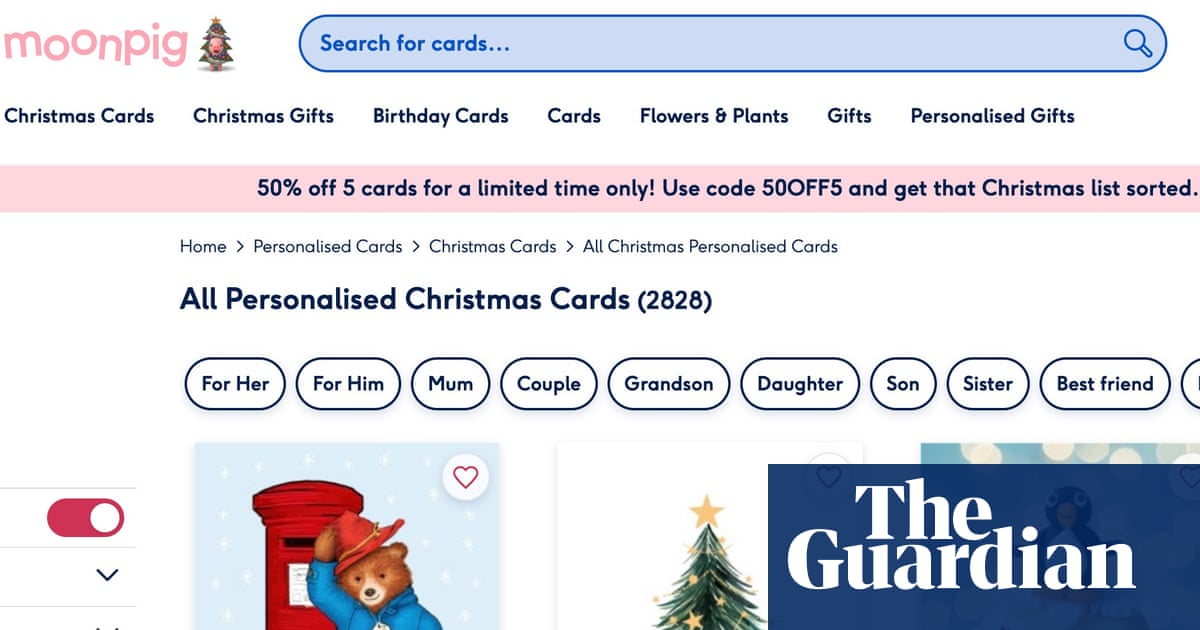
The online card service Moonpig has reported a bump in sales thanks in part to its increased use of AI to help design cards, personalise customers’ messages and answer queries.
The company said sales rose 6.7% to £169m in the six months to 31 October and had remained strong in the weeks since then, largely as as result of increased orders and spend per order at its main Moonpig brand.
“AI is now designing a lot of cards for us,” said its chief executive, Nickyl Raithatha. He said technology had helped create everything from baby and birthday cards to corporate greetings linked to a particular business.
“It is still being managed by our in-house team. We make sure a person will look at it and it is relevant and exciting for customers. We don’t want to fill our site with generic design. We are treading carefully.”
The strong sales helped lift the company, which also operates Greetz elsewhere in Europe and sells vouchers for experiences such as spa days and cinema trips, back into the black with a pre-tax profit of £26.6m for the half year compared with a £33.3m loss a year before.
About half of purchases involve shoppers using AI-led features to help add a creative spin to their messages, whether that is a sticker, photo or personalised handwriting, up from only about 2% two years ago.
Recent developments in the technology allow a shopper to automatically adapt a broad range of designs to fit certain requirements, such as targeting a particular age or relative.
The company said its new AI chat system already resolves about a third of all queries and said: “customers consistently rate these interactions far more highly than human-handled ones”.
Raithatha said the company was “not looking at this as a threat or reduction in jobs” but it could step up productivity by suggesting 50 or more designs that a person could edit, adapt or curate rather than designing just one or two cards in a day.
“We still need that creativity,” said the CEO, who is stepping down at the end of this month and will be replaced by Catherine Faiers, the chief operating officer of the secondhand car marketplace AutoTrader.
after newsletter promotion
Raithatha said that the tax and spending changes announced in the chancellor’s budget last month had not led to any noticeable change in customer behaviour but recent trading had been “very encouraging” with a “great start to peak trading” over the festive period.
He added that there was “hopefully less uncertainty” now the measures had been announced, which made “businesses more able to make decisions”.

Translations: L’engorgement des chaînes d’approvisionnement en aérospatiale continue de freiner les compagnies aériennes (pdf)
Las aerolíneas continúan sufriendo las consecuencias de los cuellos de botella de la cadena de suministro aeroespacial (pdf)
国际航协:供应链瓶颈继续制约航空业发展 (pdf)
(pdf) اختناقات سلاسل التوريد في قطاع الصناعات الجوية والفضائية تواصل فرض قيودها على شركات الطيران
Geneva – The International Air Transport Association (IATA) updated its analysis of aerospace supply chain bottlenecks noting that aircraft availability remains one of the most significant constraints on industry growth in its just released global outlook.
While deliveries of new aircraft began to pick up in late 2025 and production is expected to accelerate in 2026, demand is forecast to outstrip the availability of aircraft and engines. The normalization of the structural mismatch between airline requirements and production capacity is unlikely before 2031-2034 due to irreversible losses on deliveries over the past five years and a record-high order backlog.
Notable points on the current situation include:
“Airlines are feeling the impact of the aerospace supply chain challenges across their business. Higher leasing costs, reduced scheduling flexibility, delayed sustainability gains, and increased reliance on suboptimal aircraft types are the most obvious challenges. Airlines are missing opportunities to strengthen their top-line, improve their environmental performance, and serve customers. Meanwhile, travelers are seeing higher costs from the resulting tighter demand/supply conditions. No effort should be spared to accelerate solutions before the impact becomes even more acute,” said Willie Walsh, IATA’s Director General.
As production bottlenecks continue, new challenges and impacts are being revealed:
A recent study by IATA and Oliver Wymann estimated that the cost to the airline industry of supply chain bottlenecks will be more than USD 11 billion in 2025, driven by four main factors:
To help expedite solutions, the study pointed to several considerations:
> More on aviation supply chain
For more information, please contact:
Corporate Communications
Tel: +41 22 770 2967
Email: corpcomms@iata.org
Notes for Editors:

Montpellier Hérault Rugby and Zebre Parma ignite the weekend on Friday night at Septeo Stadium, both flying high after bonus-point wins, as Round Two of the EPCR Challenge Cup explodes into life.
On Saturday, Benetton Rugby and USAP…

More than two-thirds (69%) of European shoppers reveal they’ve discovered a hidden present before the big day, and almost the same number ( 67%) feel guilty about packaging waste at Christmas.
Four in ten (40%)* European consumers have hidden Christmas presents so well they couldn’t find them again until after Christmas Day, according to new research commissioned by Amazon. The survey of more than 10,000 adults in the UK, France, Germany, Spain and Italy reveals the creative lengths shoppers go to when hiding gifts, with some using suitcases (17%), sock drawers (14%), and even washing machines or tumble dryers (3%) as secret hiding spots. Meanwhile, more than two thirds (69%) of respondents admit to discovering their own Christmas gift before the 25th of December.
With the festive season approaching, Amazon has shared the findings with a reminder to customers. One in two Amazon orders now comes in reduced packaging or the product’s original box. This means less packaging for customers to recycle and it has helped the company avoid more than 4 million metric tons of packaging since 2015.
For some popular gifts, this may mean they arrive without additional Amazon packaging, revealing what’s inside. So if you’re buying a present for someone you live with and they might be home when it’s delivered, simply tick the box at checkout to add Amazon packaging and keep the surprise.
Thais Blumer, Head of Sustainable Packaging, Amazon Europe said: “We’re proud that over half of Amazon orders in Europe now ship with reduced, recyclable packaging, or without anything but a shipping label added by us – helping customers reduce clutter and cut waste. But for those special surprises that need a bit more discretion, there’s always the option to add extra packaging at checkout.”
Key research findings:
For those who want to maintain the surprise without adding additional packaging, Prime members can also select Amazon Day Delivery to choose a specific day when they know gift recipients won’t be home.
Amazon’s Ships in Product Packaging programme is part of the company’s wider efforts to reduce waste across its operations. By shipping items in right-sized packaging – or, where possible, in just the manufacturer’s box – Amazon helps to reduce unnecessary materials and the amount of packaging customers need to recycle at home. Since 2019, more than 1 billion shipments have been sent without added Amazon packaging, arriving in the product’s original box with only a shipping label attached.
Read more about how Amazon continues to improve its packaging.
*Figures taken from a survey of 10,398 consumers in the UK, France, Germany, Italy and Spain, conducted by Kantar between 23rd October and 3rd November 202

1Department of Undergraduate Medical Education, Northern Ontario School of Medicine (NOSM) University, Thunder Bay, Ontario, Canada; 2Chronic Pain Management Program, St. Joseph’s Care Group, Thunder Bay, ON, Canada; 3Interventional Pain Service,…

Blink cameras can now tell you what they’re seeing with video descriptions.
The feature uses AI to give you more detailed motion notifications, like describing people the camera or doorbell detects, much like the…

The Palestinian Campaign for the Academic and Cultural Boycott of Israel (PACBI), a founding member of the Palestinian-led BDS movement, calls for pressure on Live Nation Entertainment, including strategic, targeted…