New Delhi: Pakistan is going all out on crypto, and it’s not merely an economic step but also a deeply political one in which the country’s military and intelligence seem involved too.
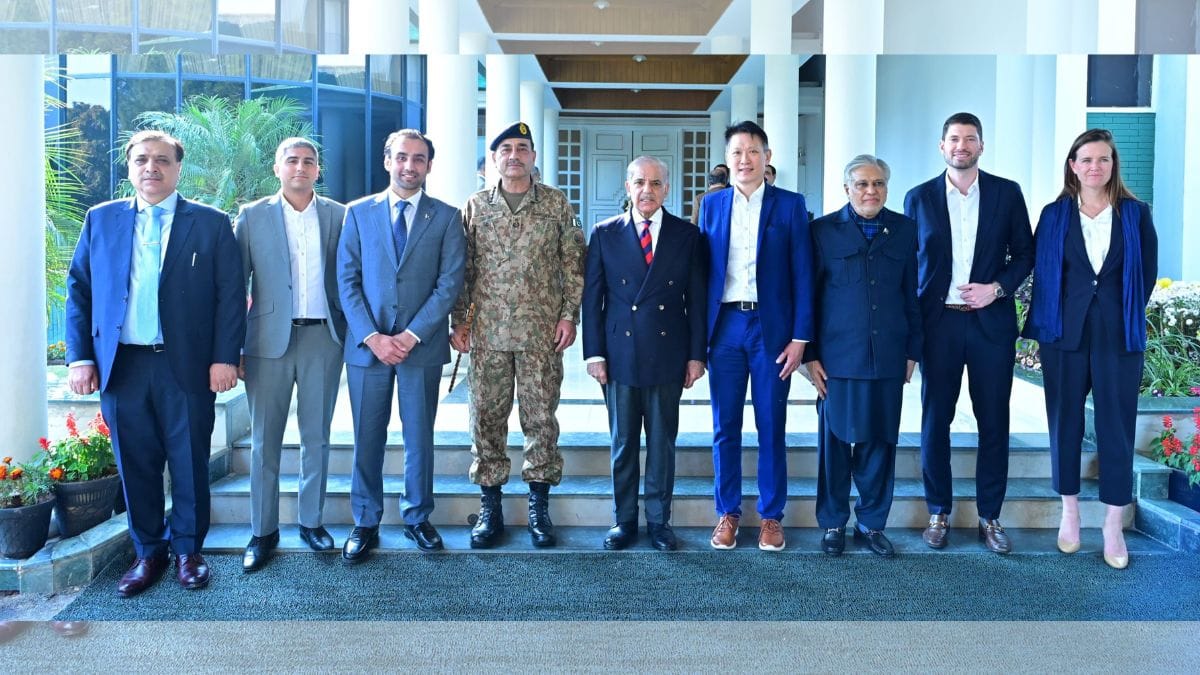
A day after he was elevated as the country’s most powerful commander yet, Army Chief and Chief of Defence Forces Field Marshal Asim Munir joined Prime Minister Shehbaz Sharif and Inter-Services Intelligence (ISI) chief Asim Malik in a high-profile meeting in Islamabad with crypto firm Binance’s CEO Richard Teng.
Also seen with them was Bilal Bin Saqib, chairman of the newly formed Pakistan Virtual Assets Regulatory Authority (PVARA), who briefed them on Pakistan’s National Digital Assets Framework.
Pakistan’s Ministry of Finance later said that the meeting, which also had senior Binance executives in attendance, focused on building a “secure, transparent and innovation-driven digital asset ecosystem” in the country.
Binance Senior Leadership Visits Pakistan as Government Signals Strong Commitment to Digital Asset Regulation
Senior leadership from @binance, including Global CEO @_RichardTeng, visited Islamabad for high-level engagements with Pakistan’s top leadership.
The meeting was… pic.twitter.com/vAh2WoMhg7
— Pakistan Crypto Council (@cryptocouncilpk) December 6, 2025
The meeting and the finance ministry’s assertion came even as local banks have been raising the alarm against the crypto push in Pakistan.
According to a Dawn report, at a consultative meeting convened Friday by the finance ministry and PVARA, Pakistan’s top banks expressed concern about money laundering, compliance risks, and global precedents where crypto-related gaps triggered major regulatory penalties.
Yet, the government appears determined to move forward.
According to the report, the government has now floated a “time-bound amnesty” allowing crypto traders, who handle more than $250 billion in annual turnover, to shift assets onto regulated platforms with no penalty.
A Binance representative told participants that Pakistani users hold around $5 billion on Binance alone, and argued that tokenised assets should be counted as part of Pakistan’s “liquid money supply”, according to the Dawn report.
“Liquid money supply” includes assets that can be easily and immediately used as a medium of exchange for transactions.
The Dawn reported that they were told, according to those present at the meeting, that Binance could provide real-time reporting, enable banks to lend against digitally verified collateral, and help Pakistan attract billions of dollars in new inflows, including new remittance routes that could sit atop the $38-billion Pakistan receives annually from overseas workers.
Banks, however, asked whether expecting such visibility and traceability was realistic.
Also Read: Pakistan’s $21 billion crypto market is out of the shadows. It’s finally legal there
Pakistan’s crypto rush
Crypto is officially banned for financial institutions in Pakistan, but it is allowed as legal tender.
In February, the Pakistani government established a Crypto Council. In May, the government shifted towards legalisation with proposals to regulate it as an economic lifeline through a formal, legal framework.
Also, the Crypto Council was elevated to a full-fledged regulatory body named the Pakistan Digital Assets Authority, tasked with overseeing and regulating digital assets, including cryptocurrencies and blockchain technologies.
Before that, in April, Pakistan entered into a partnership with World Liberty Financial (WLF), a firm reportedly connected to members of Trump’s family. WLF has pledged support in helping Pakistan develop blockchain infrastructure, tokenise assets, and navigate the broader crypto industry. However, the specifics of the agreement remain unclear.
Then in July, the Virtual Assets Ordinance 2025 came into force for establishing a regulatory and sandbox environment through the creation of Pakistan Virtual Assets Regulatory Authority (PVARA), the national regulator for virtual assets in Pakistan which would be independent.
The State Bank of Pakistan (SBP), the country’s central bank which had banned crypto, announced in September that it would withdraw its earlier advisory against cryptocurrencies and begin formal legalisation.
It then announced it was drafting a central bank digital currency (CBDC) and coordinating with lawmakers on the Virtual Assets Act 2025, which will create a fully regulated framework for digital asset trading.
But why did the government move to regulate and legalise crypto so hurriedly—all within a year?
For Pakistan, crypto could offer a potential workaround to its known structural economic constraints—from slow banking systems to chronic foreign exchange shortages. Tokenised assets and remittance rails could ideally unlock new inflows.
From the point of view of Binance, Pakistan has 40 million Binance users, making it one of its biggest untapped regulated markets. A State-backed embrace of crypto could cement Binance’s dominance at a moment when its US legal troubles threaten its global footprint.
And, there could be a US angle, a Chinese and a military push to it too.
Binance–Trump–Pakistan triangle
Looming over Pakistan’s crypto pivot is the global controversy surrounding Binance and its Chinese founder Changpeng Zhao (CZ), who maintains a 90 percent stake in the company.
Zhao, who pleaded guilty in 2023 to failing to implement the US anti-money-laundering law at Binance and served several months in jail, received a presidential pardon from Donald Trump last month—a move Trump later claimed he barely recalled.
The pardon came shortly before Zhao deepened his engagement with Pakistan. In early 2025, Islamabad appointed him strategic adviser to the Pakistan Crypto Council, and several of Pakistan’s new crypto institutions, including the Pakistan Digital Assets Authority, were reportedly shaped with his input.
The relationship also intersects with the Trump family’s own crypto portfolio. Their company, World Liberty Financial (WLF), launched the USD1 stablecoin using code reportedly written with Binance’s help. Binance then promoted USD1 to its vast global user base, helping accumulate more than $2 billion worth of deposits that generate multimillion-dollar yields for Trump-linked interests.
Pakistan has since signed a “letter of intent” with WLF to cooperate on blockchain infrastructure and stablecoin integration. Bilal Bin Saqib, Pakistan’s key crypto architect, is also an adviser to WLF.
(Edited by Ajeet Tiwari)
Also Read: Crypto, crisis & the Trump connection: All about Pakistan’s new Virtual Assets Act