Author: admin

  • Company linked to raid on illicit weight-loss drug facility still selling unlicenced drugs | Consumer affairs

    Company linked to raid on illicit weight-loss drug facility still selling unlicenced drugs | Consumer affairs

    The company linked to the largest global raid on an illicit weight-loss drug facility is still selling unlicenced drugs to thousands of customers, a Guardian investigation has found.

    Just over a month after the Medicines and Healthcare products Regulatory Agency (MHRA) raided the site and released images of seized products with the Alluvi brand name visible, the company is still selling replicas of retatrutide. It is understood that nobody has yet been arrested in connection to the raid.

    Retatrutide, which has not yet completed clinical trials, is an experimental injection developed by the US drugmaker Eli Lilly that targets three gut hormones: GLP-1, GIP and glucagon. Because it remains in clinical trials and is not approved for use, any sale to consumers is illegal. Despite this, counterfeit versions are being widely promoted on social media, with Alluvi – which did not respond to a request for comment – emerging as a key seller.

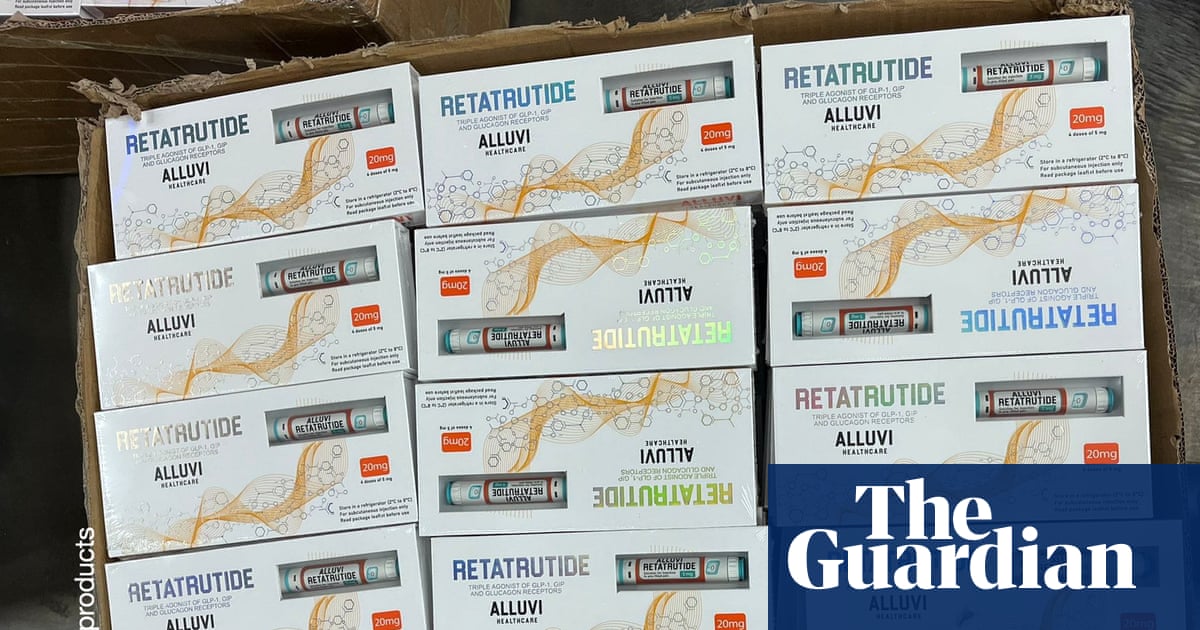
    The MHRA seized unlicensed medication said to be worth £250,000 in its October raid. Photograph: MHRA/PA

    During the October raid, the MHRA carried out one of the largest single seizures of trafficked weight-loss drugs ever recorded globally. Officers confiscated tens of thousands of empty pens ready to be filled, raw chemical ingredients, and more than 2,000 unlicensed retatrutide and tirzepatide branded Alluvi pens destined for customers.

    They also found large quantities of sophisticated packaging and manufacturing equipment, along with about £20,000 in cash suspected to be linked to medicines trafficking.

    Despite this, Alluvi Healthcare Limited continues sales on multiple Telegram channels, one of which has nearly 3,000 subscribers. On 27 October, shortly after news of the raid emerged, one of its channels showed Alluvi-branded retatrutide pens, stating, “we are still fully in stock via telegram”.

    Alluvi’s website is also still up and running as of 5 December, selling a “retatrutide 40mg x2 Bundle (R&D Only) for £339.99”. It advises customers: “If you’re using retatrutide for the first time, it’s essential to follow a gradual dosing plan to allow your body to adjust and minimise side effects.”

    Buying retatrutide illegally carries serious risks. Because the drug is still experimental, products sold online or through unofficial channels are unregulated and may not contain the correct ingredients or dosage, and may not be sterilised to the correct standard.

    Contaminated or incorrectly dosed injectable hormones can cause infections, dangerous blood sugar crashes, pancreatitis and cardiovascular side-effects. Using an unfinished clinical-trial drug outside legitimate medical settings is unsafe and potentially life-threatening.

    One person who bought the Alluvi pen told the Guardian, speaking anonymously, that they had experienced severe “gastrointestinal issues, unstable peaks and troughs of energy, and dehydration”.

    One of Alluvi’s Telegram channels also shares a video claiming to show a Royal Mail employee assuring buyers that “orders will be scanned in and they will be out for delivery”, and prompting the worker to say “from Alluvi”. The post promised next-day delivery.

    On 1 December, the same account advertised that its “pens [are] in stock”, offering a 25% discount and directing customers to another Telegram channel for payments. Another Telegram channel – with over 2,000 members – includes a plethora of customers talking about their experiences taking the counterfeit weight-loss drugs.

    The Guardian has seen evidence suggesting that payments for Alluvi products are being processed by an e-commerce business called Nutri Collectiv. Screenshots of orders indicate that customers buy what is described as a “weight loss plan”, with payments routed through Stripe, allowing the transactions to masquerade as fitness-programme purchases and avoid detection.

    The MHRA seized counterfeit syringes of weight-loss medication in the raid. Photograph: MHRA

    A Channel 4 investigation found that individuals who spoke negatively about Alluvi had their social media accounts taken over. Two TikTok accounts with millions of followers were used to impersonate legitimate weight-loss influencers who had criticised fake weight-loss drugs. The operators cloned the influencers’ profiles by copying their names and profile pictures, then contacted TikTok claiming to be the real account holders and alleging impersonation.

    TikTok subsequently shut down the legitimate accounts, leaving the fake ones active. Five weight-loss affiliates told Channel 4 they had lost their TikTok accounts in this way.

    Concerns about illicit production models of weight-loss drugs are heightened during the winter months, as it becomes harder to know whether products have been stored correctly.

    Experts warn that colder temperatures can pose risks when it comes to storing weight-loss injections. Jason Murphy, a weight-loss expert and head of pharmacy at Chemist4U, said that winter temperatures can affect storage conditions and that the effectiveness and safety of the drug could be compromised.

    “These drugs are made from living organisms and are highly sensitive to temperature variations and extreme highs or lows,” he added. “Extremely cold temperatures or freezing can damage their protein structure, reduce their medicinal effect, and potentially make them unsafe to use even after thawing … If you believe your weight-loss injection has been frozen, dispose of it immediately.”

    The MHRA declined to comment.

    sarah.marsh@theguardian.com

    Continue Reading

  • iPhone 17 Pro Loses Fight Against the Oppo Find X9 Pro’s Camera

    iPhone 17 Pro Loses Fight Against the Oppo Find X9 Pro’s Camera

    The iPhone 17 Pro is unquestionably among the best camera systems available. It can take amazing images in all sorts of conditions with almost no effort on your part. But there are a number of top-end Android phones that pack serious photography…

    Continue Reading

  • Goodbye angels, hello Ozempic needles – what’s behind the boom in bizarre Christmas baubles? | Christmas

    Goodbye angels, hello Ozempic needles – what’s behind the boom in bizarre Christmas baubles? | Christmas

    it was the second Tuesday in November but Christmas was already in crisis. Sarah Gibbons had just received a shipment of baubles at her Glasgow homeware shop, Modern Love Store, and some crucial ornaments were missing. She hopped on a…

    Continue Reading

  • Windows 11 Hallucinations, Amazon’s AI Agents, Nana Banana Pro Gets Tested

    Windows 11 Hallucinations, Amazon’s AI Agents, Nana Banana Pro Gets Tested

    Here are five things in small…

    Continue Reading

  • “Being Modern,” According to Helmut Lang, “Is About the Right Mix of Things.” Read Vogue’s May 2000 Profile of the Designer Here

    “Being Modern,” According to Helmut Lang, “Is About the Right Mix of Things.” Read Vogue’s May 2000 Profile of the Designer Here

    This question becomes all the more pointed this month, as Helmut Lang launches the aforeplugged perfumes on, of all places, the Internet. It’s true that PCs have come a long way, but the scratch-’n’-sniff port has yet to be invented. So why…

    Continue Reading

  • McCullum: England ‘over-prepared’ in second Test build-up

    McCullum: England ‘over-prepared’ in second Test build-up

    Brendon McCullum claimed that his England team were “over-prepared” for the second Ashes Test in Brisbane and defended their planned trip to the resort town of Noosa before travelling to Adelaide.

    England trained five times – once at Allan Border…

    Continue Reading

  • Where’s the normal matter in our universe?

    Where’s the normal matter in our universe?

    Mysterious blasts of radio waves from across the universe called fast radio bursts help astronomers catalog the whereabouts of normal matter in our universe. Image via ESO/ M. Kornmesser/ The Conversation (CC BY-SA).

    The 2026 EarthSky lunar…

    Continue Reading

  • Linux 6.19 Delivers Working USB3 Support For Apple Silicon Devices

    Linux 6.19 Delivers Working USB3 Support For Apple Silicon Devices

    Merged last night for the Linux 6.19 kernel merge window were all of the USB and Thunderbolt driver changes. Standing out this cycle is Apple Silicon devices like the M1 Macs now having working USB3 support on the mainline Linux kernel.

    There…

    Continue Reading

  • 1000 Vehicles Inspected, 80 seized as Pak-EPA steps up anti-smog drive – RADIO PAKISTAN

    1. 1000 Vehicles Inspected, 80 seized as Pak-EPA steps up anti-smog drive  RADIO PAKISTAN
    2. Pak-EPA ramps up anti-smog crackdown as pollution worsens in Islamabad  Dawn
    3. Islamabad issues 1,563 emission stickers in four days as crackdown on smoke-emitting…

    Continue Reading

  • Quality improvement project dramatically boosts iron deficiency screening in pregnancy

    Quality improvement project dramatically boosts iron deficiency screening in pregnancy

    Within a year of initiation, a multidisciplinary project to improve screening and treatment for iron deficiency in pregnancy resulted in a sixfold rise in screening rates for iron deficiency in pregnant patients, a 20-fold rise in the number of intravenous (IV) iron infusions, and a significant improvement in median hemoglobin levels.

    Screening rates went from 10% to over 60% within a year. Two-thirds of pregnant patients screened were found to be iron deficient, indicating that this is a very common, but readily fixable problem.”


    Richard Godby, MD, lead author, hematologist at the Mayo Clinic in Rochester, Minnesota

    Women of child-bearing age are at high risk for iron deficiency. Menstruation and low intake of iron-rich foods are some of the most common causes of iron deficiency among women in this age group, Dr. Godby said. In addition, some commonly used medications, such as proton pump inhibitors, can inhibit the body’s ability to absorb iron.

    The body needs more iron during pregnancy. Iron deficiency and anemia during pregnancy have been associated with adverse outcomes such as fetal growth restriction, premature birth, low birth weight, and compromised development of the fetus’s brain and nervous system. 

    Iron deficiency can be diagnosed with a blood test for ferritin, a protein that enables the body to store iron. However, guidelines from the American College of Obstetrics and Gynecology – the professional society that represents most U.S. doctors in this specialty – currently recommend iron deficiency screening only for pregnant women with anemia, which they define as a hemoglobin level below 11 g/dL in the first or third trimester.

    Dr. Godby and his colleagues worked with a multidisciplinary team at the Mayo Clinic to develop and implement a quality improvement project aimed at standardizing the screening and treatment of iron deficiency in pregnancy. They added ferritin testing to the list of recommended lab tests that patients typically undergo at eight to 12 weeks of pregnancy and again at 24 to 28 weeks. If patients had low ferritin levels at eight to 12 weeks, their teams offered to prescribe oral iron supplements. If patients’ ferritin was low at 24 to 28 weeks, the teams offered them an IV infusion of iron dextran.

    To measure the project’s results, the research team compared changes after project implementation between the two cohorts of patients – one treated before implementation (2,097 pregnancies; the Before cohort) and one treated a year later, after implementation (2,429 pregnancies; the After cohort).

    Results showed that, in the Before cohort, just 10% of patients underwent ferritin testing, compared with 63% in the After cohort. Among those tested, 66% in the Before cohort and 69% in the After cohort were iron deficient. Just 0.9% of patients in the Before cohort received IV iron dextran infusions, compared with 21% in the After cohort.

    Among patients who received IV iron infusions, the median hemoglobin level improved from 10.7 to 11.8 g/dL. Patients whose hemoglobin level was 12 g/dL at study entry (above the cutoff of 11 g/dL to be considered anemic according to current guidelines from the American College of Obstetricians and Gynecologists) saw an increase to 12.8 g/dL. “These findings suggest reassessing the threshold for diagnosing anemia and screening for iron deficiency in pregnancy,” Dr. Godby said. 

    Before the project, 3.1% of pregnancies required a blood transfusion during hospitalization for delivery, compared with 2.7% after the project’s implementation. Most patients who needed blood transfusions had not been tested for iron deficiency. While this difference was not statistically significant, Dr. Godby said, it suggests that a reduction in the need for post-partum blood transfusions could be an additional benefit of treating iron deficiency during pregnancy.

    Dr. Godby noted that nearly all of the patients in both the Before and After cohorts took prenatal vitamins, which are recommended during pregnancy and supposed to contain iron. However, these supplements were usually purchased over the counter rather than prescribed by the health care team. Over-the-counter dietary supplements are not regulated to ensure they contain the ingredients and amounts of ingredients claimed by the manufacturers, he said.

    As a next step, the team hopes to analyze whether treating iron deficiency in pregnancy improves patients’ quality of life by enabling them to feel better, experience less post-partum depression, return to work sooner, and more.

    Richard Godby, MD, of the Mayo Clinic, will present this study on Sunday, December 7, 2025, at 12:00 noon Eastern time in W304A-D of the Orange County Convention Center.

    Source:

    American Society of Hematology

    Continue Reading