RAWALPINDI: The Pakistan Meteorological Department (PMD) has predicted light rain with snowfall over the mountains in northern areas for today (Dec 5).
According to Met Office, a shallow westerly wave is likely to affect the northern areas…

RAWALPINDI: The Pakistan Meteorological Department (PMD) has predicted light rain with snowfall over the mountains in northern areas for today (Dec 5).
According to Met Office, a shallow westerly wave is likely to affect the northern areas…

BRISBANE: Joe Root finally scored his maiden Test century in Australia on his fourth Ashes tour to guide England from a precarious 5-2 to 325-9 at stumps after a pulsating first day of the second Ashes Test in Brisbane on Thursday.
Mitchell…

KARACHI: A seven-year-old girl died of dengue fever at a private hospital on Thursday, the provincial health department stated.
Official data shows that the girl, hailing from Gwadar, passed away the same day she was admitted to the hospital. …

An emotional federal court hearing in Los Angeles on Wednesday brought Matthew Perry’s family face-to-face with Dr Salvador Plasencia, the doctor who…

WASHINGTON: Forty-four Democratic members of the US House of Representatives have written to Secretary of State Marco Rubio, demanding immediate sanctions on senior Pakistani officials over what they described as an “escalating campaign of…

• Invites legal opinion on whether provinces are bound by federal expenditure priorities
• Seven working groups to be formed; second meeting to be held between January 8 and 15
ISLAMABAD: Building the case on overburdening and rising debt…

A 19-minute private video recently went viral on social media, sparking considerable discussion online. Social media posts claimed the video depicted a couple’s intimate moments. Some…
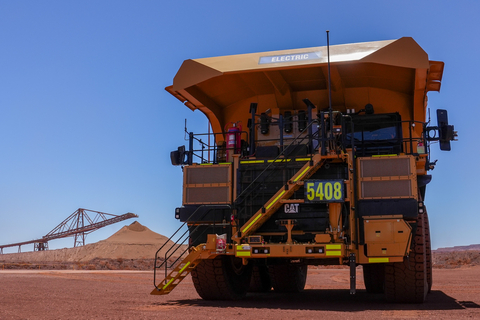
PERTH, Australia–(BUSINESS WIRE)–
Australia’s first Cat® 793 XE Early Learner battery-electric haul trucks have arrived at BHP’s Jimblebar iron ore mine in the Pilbara, marking the start of on-site testing, in collaboration with Rio Tinto, of Caterpillar’s battery-electric heavy haulage technology in the region that powers the nation’s economy.
This press release features multimedia. View the full release here: https://www.businesswire.com/news/home/20251204183951/en/
The two Early Learner trucks, delivered through an industry-first collaboration between BHP, Rio Tinto and Caterpillar represent a major step toward a more sustainable future in mining, designed to deliver zero exhaust emissions while maintaining productivity and performance.
Once safely commissioned, the trials will begin to test the viability of battery-electric technology as an alternative to diesel usage in large-scale iron ore mining operations. The trials will help inform the development of technology, processes, infrastructure and people required to support lower greenhouse gas emissions machines and mine sites of the future.
Decarbonisation of Pilbara iron ore operations will rely on technology advancements and breakthroughs in research and development, which is why BHP and Rio Tinto are working closely with Caterpillar, supported by WesTrac, to accelerate development and transition their fleets as soon as commercially and operationally viable.
Following the joint trial, BHP and Rio Tinto will independently determine progress towards scaled trials within their respective operational environments.
BHP Western Australia Iron Ore Asset President Tim Day said: “Powering up our first battery-electric haul trucks in the Pilbara is an important step forward on the mining industry’s road to decarbonisation.
“Replacing diesel isn’t just about changing energy sources, it’s about reimagining how we operate and creating the technologies, infrastructure and supply chains to transform mining operations. These trials will help us understand how all the pieces of the puzzle fit together: the battery technologies, generation and charging infrastructure, power management, as well as the supply chains to potentially deliver this at scale.
“A significant shift like this demands a strong commitment to research and development, coupled with collaboration across the industry. This is going to take time to get right, which is why trials like this one with Rio Tinto and Caterpillar are so critical.
“These trials are a critical part of this work as we bring the testing to the reality of the Pilbara. We’re excited about what we’ll learn about how best to deliver the breakthroughs required to accelerate this transition.”
Rio Tinto Iron Ore Pilbara Mines Managing Director Andrew Wilson said: “Decarbonising Rio Tinto’s fleet across our 18 Pilbara mines is a significant challenge. By exploring solutions like this to reduce emissions, we hope that, over time, we will be able to move away from diesel.
“No single company can achieve zero emissions haulage on its own. It takes the whole industry working together. That’s why we’re working with BHP and Caterpillar to develop new solutions that will reduce emissions in mining and help us reach our net zero commitments.
“Through this industry-first collaboration to test Cat 793 XE Early Learner battery-electric haul trucks in Pilbara conditions, we hope to meet our shared goals as quickly and efficiently as we can.”
Caterpillar Inc. Resource Industries Sales Services and Technology Senior Vice President Marc Cameron said: “The arrival of the Early Learner trucks in the Pilbara marks a significant milestone in the journey toward a more sustainable future.
“By working side by side with our customers, we’re delivering solutions to help them solve their toughest challenges while learning together each step of the way. This collaboration is key to accelerating innovation and shaping the next generation of mining technology, and we’re excited to be on this journey together with our Early Learner customers.”
Ongoing testing and development throughout this trial will enable learning toward future deployment. This will inform the approach for testing a larger number of haul trucks and the potential integration of battery-electric haul truck fleets into each company’s operations.
The collaboration reflects the shared ambitions of BHP, Rio Tinto and Caterpillar to support BHP’s and Rio Tinto’s respective net zero operational greenhouse gas emissions goals by 2050.
View source version on businesswire.com: https://www.businesswire.com/news/home/20251204183951/en/
Please direct all enquiries to media.enquiries@riotinto.com
Media Relations,
United Kingdom
Matthew Klar
M +44 7796 630 637
David Outhwaite
M +44 7787 597 493
Media Relations,
Australia
Matt Chambers
M +61 433 525 739
Alyesha Anderson
M +61 434 868 118
Rachel Pupazzoni
M +61 438 875 469
Bruce Tobin
M +61 419 103 454
Media Relations,
Canada
Simon Letendre
M +1 514 796 4973
Malika Cherry
M +1 418 592 7293
Vanessa Damha
M +1 514 715 2152
Media Relations,
US & Latin America
Jesse Riseborough
M +1 202 394 9480
Investor Relations,
United Kingdom
Rachel Arellano
M +44 7584 609 644
David Ovington
M +44 7920 010 978
Laura Brooks
M +44 7826 942 797
Weiwei Hu
M +44 7825 907 230
Investor Relations,
Australia
Tom Gallop
M +61 439 353 948
Eddie Gan-Och
M +976 95 091 237
Rio Tinto plc
6 St James’s Square
London SW1Y 4AD
United Kingdom
T +44 20 7781 2000
Registered in England
No. 719885
Rio Tinto Limited
Level 43, 120 Collins Street
Melbourne 3000
Australia
T +61 3 9283 3333
Registered in Australia
ABN 96 004 458 404
riotinto.com
Category: Pilbara
Source: Rio Tinto

The Olympic flame arrived in Rome on Thursday in preparation for a two-month torch relay designed to stir excitement across Italy before the Winter Games in Milan and Cortina d’Ampezzo in February. Photo: REUTERS

Disclaimer: Early release articles are not considered as final versions. Any changes will be reflected in the online version in the month the article is officially released.
Author affiliation: Sheba Medical Center, Ramat-Gan,…