
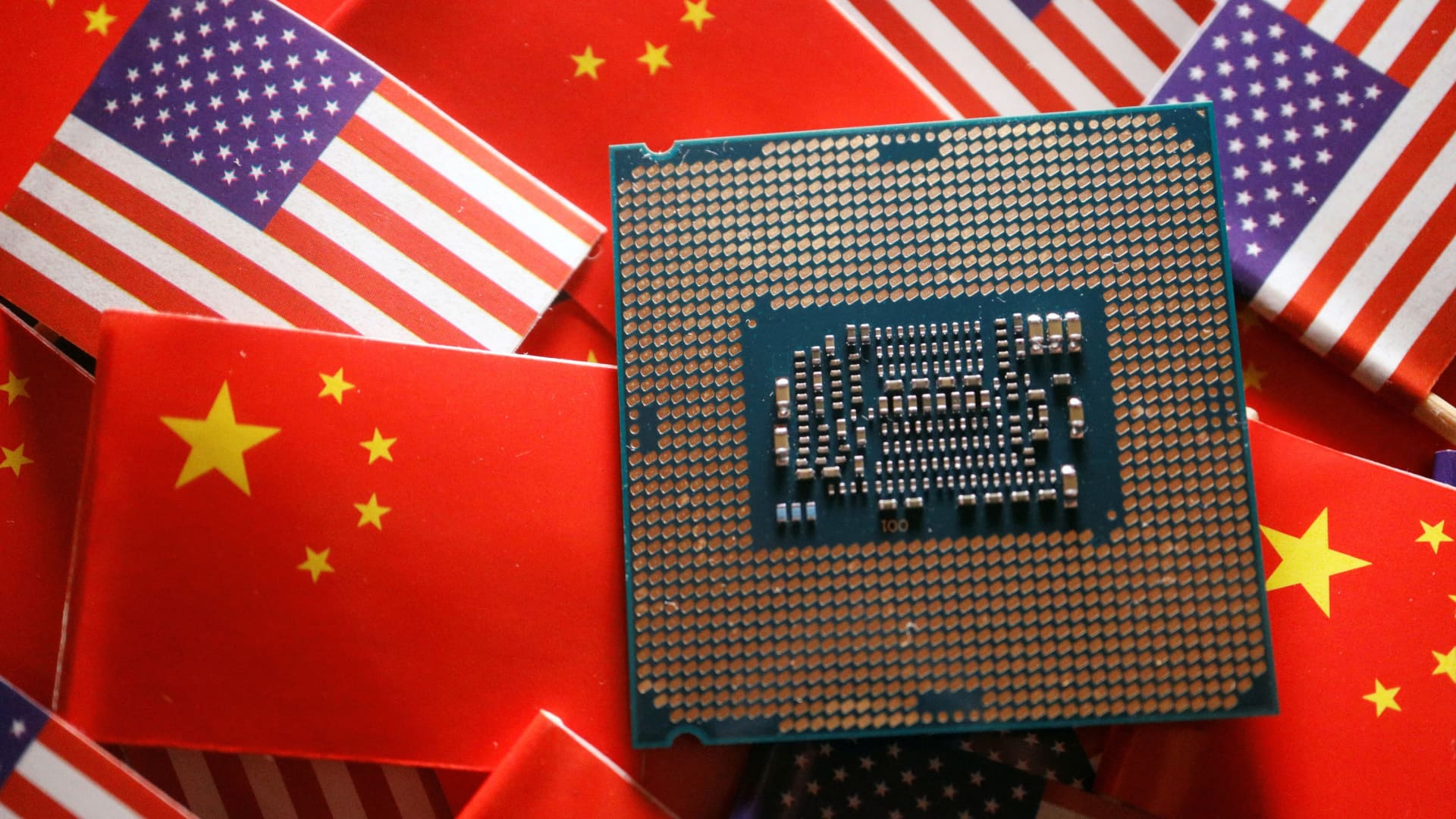
As the U.S. and China settle into an uneasy one-year truce, the takeaway for investors is that each country will double-down on homegrown technology, analysts said. “Own quality exporters and R & D-rich tech stocks aligned with localization, and use scenario odds — not headlines — to assess risk,” Morgan Stanley strategists recommended in a report this month on how to navigate the new “export control regime.” “The strategic rivalry remains unresolved, with technology, critical supply chains and capital markets at the heart of ongoing tensions,” the report said. While Washington has restricted Chinese access to advanced technology and encouraged artificial intelligence-related investment in the U.S., China is ramping up its own spending and resource allocation to advanced technology in its upcoming five-year plan. Semi computing power Core to the AI race is computing power, namely in semiconductors. Morgan Stanley’s top pick is SMIC, China’s domestic chip giant. The analysts rate the Hong Kong-listed shares overweight, and have an 80 Hong Kong dollar ($10.28) price target. That’s more than 16% above where the stock closed Friday. “Given U.S. export controls and expanding capacity, we expect SMIC to receive more orders for advanced node manufacturing,” the analysts said. “We also believe SMIC’s advanced node capacity expansion will support the AI semi development in China.” Another growing concern is whether companies will have enough energy to power AI. Goldman Sachs analysts this month predicted that by 2030, China will have spare power capacity more than three times what the world will likely need then to power data centers. For the year ahead, HSBC late last week called energy self-sufficiency one of the new themes that will drive regional stocks. “We believe the Asia equity story in 2026 will be led by a pivot away from crowded AI trades,” its analysts said. The bank’s leading pick was Hong Kong-listed small cap Harbin Electric, which had more than 60% upside to HSBC’s 22 HKD target price, based on Friday’s close. “Harbin Electric commands around one-third to half of the domestic market share in power equipment for coal, nuclear and hydro power equipment, with these sectors contributing nearly 70% to its revenue (in 2024),” the HSBC analysts said. “Harbin is an asset-light business model and receives prepayments from customers.” Robot hardware In terms of AI commercialization, companies in China are vying with their U.S. peers not only for software advances but hardware applications, particularly in humanoid robots. Goldman Sachs analysts visited nine humanoid robot supply chain companies earlier this month and found that most are “actively planning capacity in both China and overseas (primarily in Thailand, and less in Mexico)” to support possible mass production — to the tune of 100,000 to 1 million units a year. While that may be overly optimistic compared to Goldman’s projections of 1.38 million annual humanoid shipments by 2035, the analysts said suppliers are moving aggressively and have mentioned their customers include well-known humanoid players Tesla Optimus, Agibot and Xpeng. Goldman’s only buy-rated Hong Kong play is Sanhua, which management says is taking a more conservative approach by ramping up production based on actual customer orders. Sanhua has also reserved capacity in Thailand for humanoid robot parts production. Despite the excitement about longer-term tech innovation, markets in the near term will still be focused on the latest U.S.-China trade talks. The two sides have yet to reach a firm deal on rare earths exports, although U.S. Treasury Secretary Scott Bessent has indicated one could happen by Thanksgiving. All this means that Chinese stocks are likely to remain highly volatile. “We consider this truce fragile, given persistent U.S.-China competitive confrontation on multiple fronts,” the Morgan Stanley analysts said, “which means rolling negotiations, truces and periodic flare-ups will likely be the new norm for the foreseeable future.” Morgan Stanley said that the MSCI China index tends to see short-term corrections following periods of U.S.-China tension. But they found that “technology hardware and semiconductor names often rebound within a month after their initial sharp declines.” —CNBC’s Michael Bloom contributed to this report.
Author: admin
-

Guernsey bowel cancer patient calls for earlier screenings
A woman in Guernsey is highlighting the importance of early bowel cancer screenings and the awareness of atypical symptoms after being diagnosed with the disease.
Jess Mauger received an unexpected diagnosis at 50 after experiencing a “really bad…
Continue Reading
-

How Google Is Rebuilding Itself to Win at AI Search, Beat ChatGPT
It made for an irresistible narrative.
The large, slow incumbent — in this case, Google — was caught flat-footed by a more nimble upstart by the name of OpenAI. It was the type of story Silicon Valley built its…
Continue Reading
-

Script Emulator Achieves, Predictive Accuracy, Accelerating Epoch Of Reionization Constraints With Machine Learning
Understanding the Epoch of Reionization, a pivotal moment when the universe emerged from darkness, presents a significant challenge for cosmologists, demanding extensive computational resources. Saptarshi Sarkar and Tirthankar Roy Choudhury,…
Continue Reading
-

Why Chevy Switched To A Flat Plane Crank In The Corvette
Already a star, the Chevrolet Corvette went supernova when the mid-engined version debuted in 2020 — but that was some six years ago, and the location of the car’s engine isn’t as big of a deal as it used to be. Nowadays, there’s more buzz for…
Continue Reading
-

After 60 Years, Diabetes Drug Found to Unexpectedly Affect The Brain : ScienceAlert
Metformin has been prescribed to people with type 2 diabetes to manage blood sugar for more than 60 years, but scientists haven’t been exactly sure how it works. A recent study suggests it works directly in the brain, which could lead to new…
Continue Reading
-

Has Britain become an economic colony? | Technology
Two and a half centuries ago, the American colonies launched a violent protest against British rule, triggered by parliament’s imposition of a monopoly on the sale of tea and the antics of a vainglorious king. Today, the tables have turned: it is Great Britain that finds itself at the mercy of major US tech firms – so huge and dominant that they constitute monopolies in their fields – as well as the whims of an erratic president. Yet, to the outside observer, Britain seems curiously at ease with this arrangement – at times even eager to subsidise its own economic dependence. Britain is hardly alone in submitting to the power of American firms, but it offers a clear case study in why nations need to develop a coordinated response to the rise of these hegemonic companies.
The current age of American tech monopoly began in the 2000s, when the UK, like many other countries, became almost entirely dependent on a small number of US platforms – Google, Facebook, Amazon and a handful of others. It was a time of optimism about the internet as a democratising force, characterised by the belief that these platforms would make everyone rich. The dream of the 1990s – naive but appealing – was that anyone with a hobby or talent could go online and make a living from it.
US tech dominance wasn’t the result of a single policy decision. Yet it was still a choice that countries made – as is highlighted by China’s decision to block foreign sites and build its own. While that move was far easier under an authoritarian system, it also amounted to an industrial policy – one that left China as the only other major economy with its own full digital ecosystem.
The pattern was sustained through the 2000s and 2010s. Cloud computing was quickly cornered by Amazon and Microsoft. No serious European or UK competitor emerged to challenge platforms such as Uber or Airbnb. These companies have undoubtedly brought us convenience and entertainment, but the wealth of the internet has not spread as widely as many hoped; instead, US firms took the lion’s share, becoming the most valuable corporations in history. Now the same thing is happening with artificial intelligence. Once more, the big profits look destined for Silicon Valley.
How did all this meet with such little resistance? In short, the UK and Europe followed the logic of free trade and globalisation. Nations, according to this theory, should focus only on what they do best. So just as it made sense for the UK to import French burgundies and Spanish hams, it also seemed logical to rely on American technology rather than trying to do it locally. Better to specialise instead in the UK’s own strengths, such as finance, the creative industries – or making great whisky.
But when it comes to these new platforms, the analogy with regular trade breaks down. There is a vast difference between fine wines and the technologies that underpin the entire online economy. Burgundies can be pricey, but they don’t extract value from every commercial transaction or collect lucrative data. The trade theories of the 1990s masked the distinction between ordinary goods and what are, in effect, pieces of market infrastructure – systems essential to buying and selling. That’s what Google and Amazon represent. A better analogy might be letting a foreign firm build toll roads across the country, charging whatever it likes to use them.
We’re seeing this again with the build-out of artificial intelligence. During President Trump’s state visit in September, the UK proudly celebrated Google and Microsoft’s investments in “datacentres” – vast warehouses of computer servers that power AI systems. Yet datacentres are the bottom rung of the AI economy, private infrastructure that simply channels profits back to US headquarters.
In another timeline, the UK could have been a true leader in AI. US researchers were once far behind their British and French counterparts. Yet, in a move neither Washington nor Beijing would have permitted, the UK cheerfully allowed the sale of most of its key AI assets and talent over the last decade or so – DeepMind’s purchase by Google being the most famous example. What remains is an AI strategy consisting of the supply of electricity and land for datacentres. It’s like being invited to a party only to discover you’re there to serve the drinks.
If tech platforms are indeed like toll roads, the logical step would be to limit their take – perhaps by capping fees or charging for data extraction. Yet no country has done so: we accept the platforms but fail to regulate their power as we do with other utilities. The European Union has come closest, with its Digital Markets Act, which regulates how dominant platforms treat dependent businesses. The US government, for its part, is also at the mercy of its homegrown tech giants, yet Congress remains paralysed.
If the UK wanted to take a different path, to resist this economic colonisation and extraction, it could partner with the European Union and perhaps Japan in order to develop a joint strategy – one that forces platforms to support local businesses and nurtures alternatives to mature US technologies. So far, though, alongside other nations disadvantaged by American dominance, it has been slow to adapt, instead hoping that the 90s playbook will still work, despite evidence to the contrary.
The truth is that we now live in a more cynical and strategic era. One way or another, the world needs an anti-monopoly framework with far greater force than anything seen so far. Wherever you live, it’s clear the world would be better off with more firms from different countries. The alternative is not only costly but politically dangerous, feeding resentment and dependence. We can do better than a future where what counts as economic freedom is merely a choice between relying on the United States, or relying on China.
Tim Wu is a former special assistant to President Biden and author of The Age of Extraction: How Tech Platforms Conquered the Economy and Threaten Our Future Prosperity (Bodley Head).
Further reading
The Tech Coup by Marietje Schaake (Princeton, £13.99)
Supremacy by Parmy Olson (Pan Macmillan, £10.99)
Chip War by Chris Miller (Simon & Schuster, £10.99)
Continue Reading
-
Gemini Slips After Expense Tracker Test Fails
I decided to test Google’s AI in a practical way that everyone cares about — keeping track of money — and I found it unimpressive. With access to purchase alerts in Gmail and transactional SMS in Google Messages, Gemini ought to be…
Continue Reading
-

DG ISPR visits Jamia Tur Rasheed, holds interactive session with scholars
KARACHI: Director General Inter-Services Public Relations (ISPR), Lieutenant General Ahmed Sharif Chaudhry, visited Jamia Tur Rasheed in Karachi and held an interactive open session with students and religious scholars, the military’s media…
Continue Reading