.
Chief Justice of Pakistan Yahya Afridi speaks at a conference at the Federal Judicial Academy in Islamabad on July 25, 2025. SCREENGRAB
…

.
Chief Justice of Pakistan Yahya Afridi speaks at a conference at the Federal Judicial Academy in Islamabad on July 25, 2025. SCREENGRAB
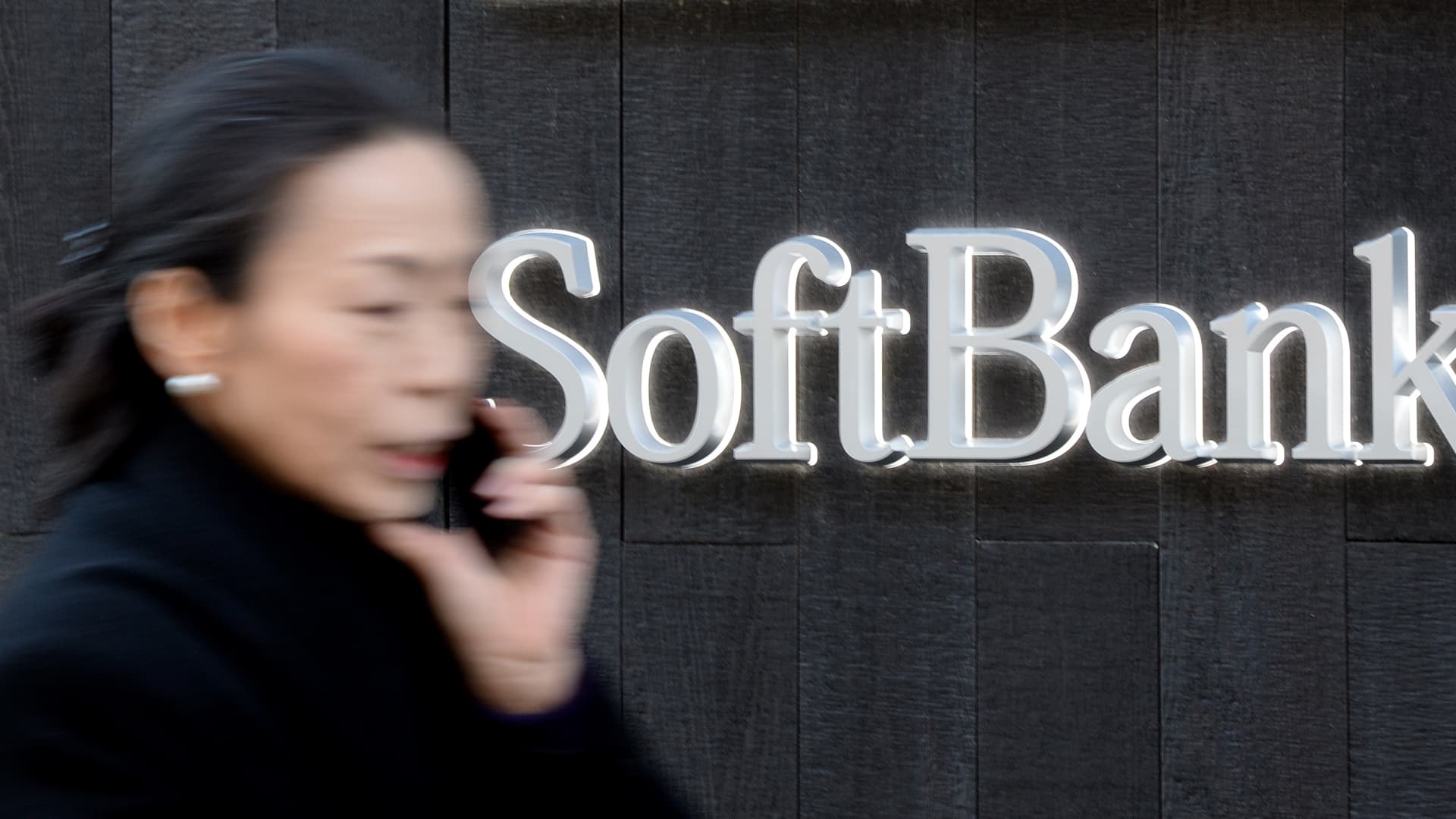
A woman uses her mobile phone as she walks past the logo of Japan’s telecommunications giant SoftBank in Tokyo on December 25, 2013.
Toru Yamanaka | Afp | Getty Images
Tech conglomerate SoftBank plunged more than 10% Friday amid losses across the region, after U.S. tech stocks lost ground and investors’ hopes dimmed of a December rate cut by the Federal Reserve.
Japan’s Nikkei 225 tumbled 1.57% at the open, while the Topix index lost 0.72%. Other tech stocks on the index fell, with Advantest losing more than 9%, Tokyo Electron retreating nearly 6%, Lasertec falling nearly 5%, and Renesas Electron down 1.95%.
Japan’s core inflation in October rose at its sharpest rate since July, in line with market estimates on Friday, supporting the case for interest rate hikes by the Bank of Japan.
South Korea’s Kospi index plunged 4.09%, and the small-cap Kosdaq retreated 3.01%. Kospi’s heavyweights Samsung Electronics and SK Hynix tumbled as much as 4% and 9%, respectively.
Australia’s S&P/ASX 200 fell 1.3%.
Hong Kong Hang Seng index futures were at 25,460, lower than the HSI’s last close of 25,835.57.
Overnight in the U.S., Oracle and AMD were among the first AI plays to fall into the red on the session, followed by Nvidia, which reversed gains and closed nearly 3% lower.
Stronger-than-expected U.S. jobs data renewed doubts about whether the central bank will lower its benchmark overnight rate. Traders were pricing roughly a 40% chance of a quarter-point cut next month, according to the CME FedWatch Tool, a setback for investors hoping for lower borrowing costs.
On Thursday stateside, the Nasdaq Composite fell 2.16%, down from a 2.6% advance at one point in the session.
Other major indexes also slipped, with the Dow Jones Industrial Average down 0.84%. The S&P 500 shed 1.56%, despite rising as much as 1.9% earlier in the day.
—CNBC’s Liz Napolitano, Pia Singh, and Alex Harring contributed to this report.

Customers check out vegetables and other groceries at a supermarket in Tokyo on June 20, 2025.
Kazuhiro Nogi | Afp | Getty Images
Japan’s core inflation in October rose at its sharpest rate since July, in line with market estimates on Friday, supporting the case for interest rate hikes by the Bank of Japan.
Core inflation, which strips out prices of fresh food, came in at 3% as expected by economists polled by Reuters.
The headline inflation rate rose to 3%, marking the the 43rd month in a row that it has run above the BOJ’s 2% target.
The so-called “core-core” inflation rate, which strips out prices of fresh food and energy, crept up to at 3.1%, compared to 3% in September.
The data comes as BOJ governor Kazuo Ueda reportedly had his first bilateral meeting with newly elected Prime Minister Sanae Takaichi earlier this week.
During the meeting, Ueda told Takaichi the central bank was “gradually raising interest rates to guide inflation smoothly towards its 2% target and ensure the economy achieves sustainable growth,” Reuters reported.
Takaichi has been an advocate of loose monetary policy, and had said on Nov. 12 to the country’s parliament that she hopes that the BOJ “conducts policy appropriately” so that the 2% inflation target is achieved by wage gains instead of cost-push factors.
“The type of inflation we’re seeing now is not good,” Takaichi reportedly said. The BOJ governor also said that Takaichi did not make any request related to monetary policy.
The central bank is currently caught between a rock and a hard place, with inflation running above target and GDP growth figures weakening as Japan takes a hit from U.S. tariffs.
Japan’s GDP in the three months to September contracted for the first time in six quarters, falling 0.4% sequentially, and dipping 1.8% on an annualized basis

World number one Judd Trump swept to a 4-0 win over an out-of-sorts Mark Williams in just 48 minutes to reach the semi-finals of the Riyadh Season Snooker Championship.
Trump, who is yet to win a title this term, reverted back to an old cue and…

The struggle to capture and share troubleshooting knowledge is universal, impacting small IT teams to large enterprises alike. Critical fixes and undocumented “hacks” often sit in people’s heads, old chat logs, or scattered files,…

Joel Guinto,in Singapore and
Panisa Aemocha,in Bangkok
 Getty Images
When the golden crown studded with diamonds and pearls…
Issued: London UK
GSK subsidiary, TESARO, Inc., confirms it has initiated litigation against AnaptysBio, Inc. in the Delaware Chancery Court. This action contends that recent conduct by AnaptysBio is in material breach of the existing license agreement with TESARO regarding the oncology treatment Jemperli (dostarlimab). The breach entitles TESARO to terminate the current license agreement, obtain a perpetual and irrevocable license to dostarlimab, and to reduce the royalties and milestone payments due by TESARO to AnaptysBio by 50%.
TESARO has initiated this litigation following allegations made by AnaptysBio that TESARO has not fulfilled certain requirements of the license agreement entered in March 2014 and that AnaptysBio intends to revoke TESARO’s licence for dostarlimab. GSK and TESARO are firmly of the view that these allegations are entirely without merit.
Jemperli is currently approved in over 35 countries for use in certain endometrial cancers, the most common gynaecologic cancer in the United States. GSK and TESARO have reported significant growth for Jemperli driven by label expansions in endometrial cancer, including in the US and EU. A robust and ambitious clinical trial programme to evaluate the potential use of dostarlimab in additional cancers, including rectal, colon and head and neck, is ongoing.
GSK is a global biopharma company with a purpose to unite science, technology, and talent to get ahead of disease together. Find out more at gsk.com.
GSK cautions investors that any forward-looking statements or projections made by GSK, including those made in this announcement, are subject to risks and uncertainties that may cause actual results to differ materially from those projected. Such factors include, but are not limited to, those described in the “Risk Factors” section in GSK’s Annual Report on Form 20-F for 2024, and GSK’s Q3 Results for 2025.

Three months after releasing its Nano Banana image generator, Google LLC today introduced an improved version that is better at generating complex content such as infographics.
The new model is called Nano Banana Pro. It will be available…