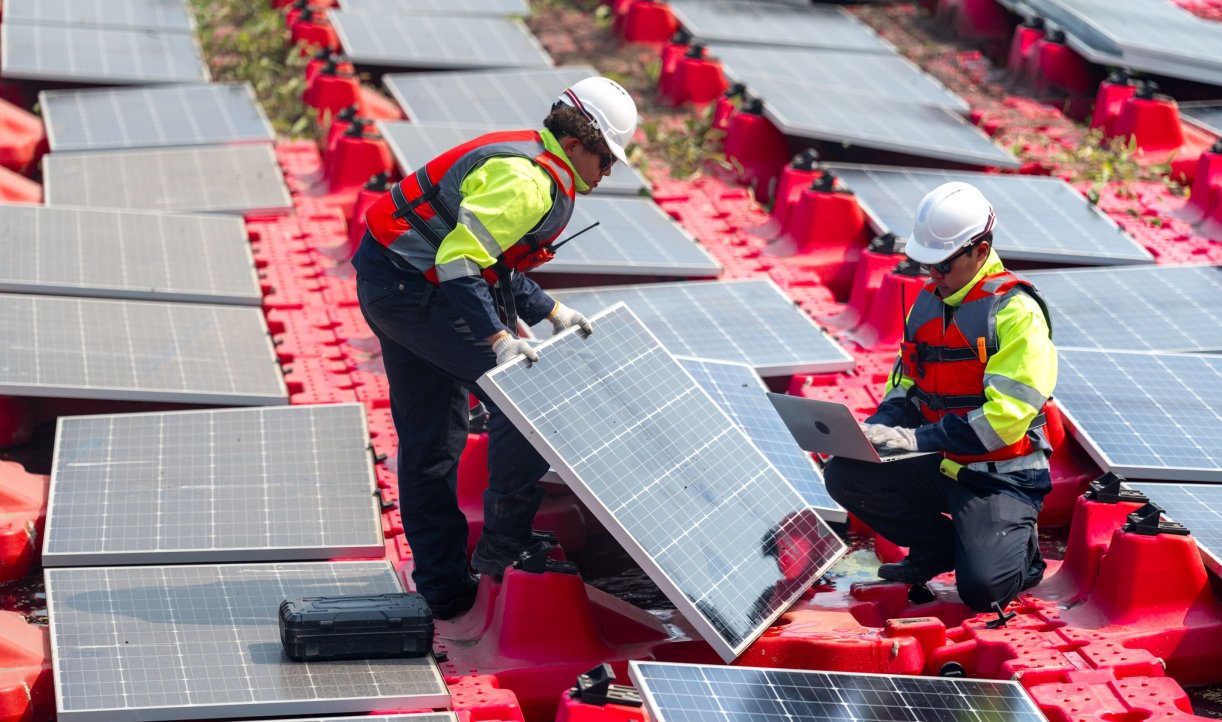
As a major source of new jobs, the clean energy industry represents an innovative and vital sector of the U.S. workforce. Workers with job titles like solar installer, energy storage engineer, battery manufacturing technician, energy efficiency auditor, electric vehicle charger maintenance worker and wind turbine technician, are all part of a workforce whose growth is outpacing overall employment growth despite overall economic slowdown and recessionary conditions in parts of the U.S.
However, policy reversals by the Trump administration are creating an unpredictable environment for clean energy investors and developers, slowing the industry’s rapid growth and risking billions of dollars in investment and thousands of jobs. U.S. renewable energy investment fell by 36% in the first half of 2025 compared to the same period last year. This decline happened despite record-high global investment in renewables during the same period.
Here we used the last several years of data from the annual U.S. Department of Energy’s Energy and Employment Report to better understand the state and outlook of clean energy jobs in the U.S. By deciphering and classifying energy jobs between clean energy and traditional categories we’ve gained a clearer perspective on how critical clean energy jobs are to the nation’s labor market.
Here are five key findings from this analysis:
1) Clean Energy Jobs Have Been Outperforming the Rest of the Labor Market
Driven by increased investment, rising energy demand and government policies that accelerated the transition to a clean energy economy, clean energy jobs grew by . During the same period, the broader U.S. job market only grew by only 8%.
It is especially interesting to note that clean energy employment grew by 3% from 2023 to 2024, while the total U.S. workforce only grew by 1%, after factoring in record-breaking downward revision to the national jobs data, suggesting the U.S. labor market was significantly weaker over the past couple of years than previously believed.
Clean energy gains have been broad based, with jobs in clean fuels; clean electric power generation; clean transmission, distribution and storage; energy efficiency; and clean vehicles sectors all rising year-over-year since 2021. Subsectors leading job growth during this same period include
In terms of total jobs numbers, leads the way with nearly 2.4 million jobs at the end of 2024. Clean electric power generation, clean vehicles, and clean transmission, distribution and storage had 733,000, 398,000 and 173,000 jobs, respectively.

2) Clean Energy Jobs Are Found Nationwide
There is a broad demand for clean energy across the country, in politically diverse counties and states. Recent polls confirm broad, cross partisan support for clean energy, with a majority of Americans prioritizing it over fossil fuels.

California leads the nation with more than 554,000 clean energy jobs, followed by Texas, with more than 283,000 jobs. New York and Florida also host hundreds of thousands of clean energy jobs.
Due to ambitious climate policies and ample renewable energy resources, like sun and wind, California and New York each boast more than 50% of clean energy jobs as a share of their total energy jobs. In Texas, however, clean energy jobs make up only 29% of the state’s more than 990,000 total energy workers — despite the state being the largest generator of wind power in the U.S. and accounting for 21% of wind energy jobs in 2024. That is largely because Texas’ massive energy industry centers around fossil fuels.
Generally, states in the Northeast and West have the highest proportion of clean energy jobs compared to the overall energy sector, making up 71% of both Vermont and Massachusetts’ energy sectors, for example. The West, however, has the highest proportion of clean energy workers in the broader economy, who make up 2.7% of that region’s total workforce. In contrast, the South has the lowest share of clean energy jobs — both as a proportion of energy workers and total workforce.
Clean energy, however, has been and will likely continue to be a source of job creation across all four regions. In recent years, the South experienced the highest job growth with a 13% increase of clean energy jobs between 2021 and 2024 and a 3.6% increase from 2023 to 2024.
According to recent data from the Clean Investment Monitor, the share of clean energy employment could surge from 23 to 27 out of every 1,000 workers in all 50 states, with more than 500,000 new clean energy jobs expected in the South and West alone. These new jobs would make up 9.6% and 7.6%, respectively, of the South and the West’s energy sector jobs, marking a significant shift toward clean energy in these regions.
Still, these projections are not guaranteed. Even during a favorable regulatory and policy environment, energy projects risk cancellations from unexpected costs, labor shortages or community opposition. In today’s environment, as U.S. federal agencies have recently created and exacerbated financial uncertainty for clean energy projects, hundreds of thousands of potential jobs are at risk. For example, the South could potentially lose more than 300,000 jobs from previously announced clean energy projects if these projects are canceled.

3) Construction and Manufacturing Jobs Are Vital to Clean Energy, But Workforce Shortages Loom
Construction and manufacturing are vital to the expansion of clean energy, supplying the physical infrastructure, equipment and materials necessary to produce, store and distribute clean energy. In 2024, construction jobs made up 45% of the clean energy workforce (more than 1.6 million jobs), while manufacturing accounted for nearly 16%, mostly in energy efficiency.

Approximately 64,000 clean energy construction jobs — a 4% gain — were among the 204,000 total construction jobs added to the U.S. economy between 2023 and 2024. Job gains in clean energy manufacturing have been less robust, but still notable when juxtaposed against the entire manufacturing sector. Nearly 10,000 clean energy manufacturing jobs were added in 2024, with a growth rate of 1.8%. In contrast, manufacturing writ large lost more than 55,000 jobs between 2023 and 2024. Additionally, it is important to note, that investments into clean energy manufacturing in the U.S., especially battery storage and electric vehicle manufacturing, have slowed and been canceled at a higher rate than other announced clean energy projects during the first two quarters of 2025.
In addition to recent federal policy changes threatening the momentum of the clean energy industry, construction and manufacturing industries are facing significant worker shortages as a significant portion of the current workforce is nearing retirement age. Meanwhile, younger generations have shown less interest in these types of careers.
For example, demand for electricians is expected to increase by 9% (or 77,400 jobs) economywide between 2024 and 2034, while an estimated 30% of union electricians are expected to reach retirement age in the next decade. As the demand for clean energy solutions like electric vehicles, battery storage, solar panels and wind turbines rises, skilled electricians become even more critical for both new construction and infrastructure upgrades. The American Welding Society also projects a shortage of around 320,000 welders by 2029. These workers are crucial to manufacturing, as welding is involved in over 70% of all manufactured products.
The clean energy industry can’t prosper without a robust workforce training ecosystem, especially for skilled trades. Governments and businesses will need to work together to expand training and education of younger workers through community colleges, vocational schools and labor unions to create new talent pipelines.
4) While Clean Energy Growth Outpaces Fossil Fuels, Many Fossil-Fuel Workers Are Getting Left Behind
Overall, clean energy employment growth has significantly outpaced growth in fossil fuels jobs. Job growth in traditional electricity generation (including natural gas, coal, oil and petroleum) has remained steady, growing by 7% since 2021. In contrast, employment in clean energy electricity generation has grown by 11% since 2021. Other energy sectors have followed a similar trajectory.

Fossil-fuel jobs, however, still account for a significant share of energy jobs in some states such as Alaska (41%), Louisiana (39%), New Mexico (42%), North Dakota (53%), Oklahoma (39%), West Virgina (32%) and Wyoming (45%). Fossil fuel extraction jobs, which includes coal mining and oil and gas extraction jobs, grew by nearly 18% between 2021 and 2024. Despite this growth, these jobs are at higher risk of decline over the long term due to the shift toward renewable energy, with coal mining being particularly vulnerable. Oil and gas extraction workforce is also projected to decline by 6% over the next 10-year period.
These jobs are often concentrated in specific locations. For example, in Texas, fossil-fuel extraction jobs — which account for 29% of energy jobs — are concentrated in the West and South, while clean energy jobs are often located in or near major cities or in areas better suited for renewable energy generation. Texas also saw a 14% decline in coal mining jobs between 2021 and 2024, despite a nationwide increase during the same period (this was a minor uptick after a long-term decline), further highlighting the place-based nature of job creation and displacement.
A growing body of research is demonstrating that a geographic mismatch is occurring between areas experiencing significant losses in fossil-fuel jobs and areas where new clean energy jobs are being created. Displaced fossil-fuel workers are less likely to relocate for clean energy jobs, even when they have transferable skills. Therefore, locally-tailored and place-based responses that include retraining, reskilling initiatives and financial support will be needed to ensure a fair and just transition for these workers, whether within the clean energy industry or other industries.
5) Clean Energy Is Now Facing Significant Headwinds
Despite strong growth over the last four years, the clean energy industry faced setbacks in 2025. A slowing national economy, tariff uncertainty and policy actions by the Trump administration — combined with major changes to federal clean energy funding in the 2025 budget reconciliation act (also known as the One Big Beautiful Bill Act) — have all contributed to a spate of clean energy project cancellations this year.
Data from the Rhodium Group-MIT/CEEPR Clean Investment Monitor shows that 110 projects representing at least $36 billion in announced investments were canceled as of September. As a result, for the first time since at least 2020, canceled and paused clean energy project investments are outpacing newly announced investments. While many of these projects may not have reached completion even in a more favorable business environment, the scale suggests that clean energy projects are facing significant and atypical headwinds.

However, due to rapidly falling costs, widespread innovation, a surge in demand driven by climate concerns and rising electricity needs, the long-term future for the clean energy economy remains optimistic.
Between 2024 and 2034, data from the Bureau of Labor Statistics suggests solar, wind, geothermal, and “other” electric power generation (a category which includes more novel energy sources such as tidal power), as well as the category that includes manufacturing of battery storage systems, will each have double or even triple digit employment growth by percentage. Wind turbine service technicians and solar photovoltaic installers will be the two fastest growing occupations during that same time period.

Clean Energy Can Power a More Sustainable and Prosperous Future
The past four years has proven that clean energy is a key driver of employment growth in the U.S. As clean energy jobs outpace the overall job market and fossil fuels jobs, the path to decarbonization and emissions reductions will come by expanding the economic pie with new jobs for American workers.
Progress toward a clean energy future will not be without its hiccups. The nation’s overall economy and policy decisions are having, and will continue to have, a large impact on the pace of the transition. In addition, movement toward clean energy will create opportunity for millions of Americans. But it will also pose new challenges for workers in traditional energy sectors, a reality which economic policy will need to address. Yet one thing is clear: Clean energy stands to be a leading industry driving job growth in the U.S.
About the Data in this Article
The U.S. Energy and Employment Report, published annually by the U.S. Department of Energy, covers both traditional and clean energy employment across five sectors: electric power generation, energy efficiency, fuels, motor vehicles, and transmission, distribution and storage. The report also breaks down energy employment by industry, providing insights into specific industries such as manufacturing, construction, utilities and professional services. While this article primarily focuses on the 2025 report, which provides data for 2024, previous years data were also analyzed to identify change over time. Additional data were used from E2, the U.S. Bureau of Labor Statistics and the Rhodium Group-MIT/CEEPR Clean Investment Monitor.
To calculate the difference between clean and traditional energy jobs growth, the authors classified clean and traditional energy subsectors based on the sector’s contributions to reducing carbon emissions. Traditional energy subsectors are further divided into fossil and non-fossil-fuel subsectors.
Traditional Energy Vs. Clean Energy
| Category | Traditional Energy | Clean Energy |
|---|---|---|
| Fuel | Natural Gas* | Nuclear Fuels |
| Coal* | ||
| Petroleum* | ||
| Corn Ethanol | ||
| Woody Biomass/Cellulosic Biofuel | ||
| Other Biofuels | ||
| Other Fuels* | ||
| Electric Power Generation | Natural gas* | Wind |
| Coal* | Solar | |
| Oil & Other Petroleum* | Nuclear | |
| Combined Heat & Power* | Geothermal | |
| Bioenergy | Hydropower | |
| Other Power Generation* | ||
| Transmission, Distribution, Storage | Traditional T&D Electricity* | Battery Storage |
| Traditional T&D Fuels* | Smart Grid | |
| Other T&D* | Microgrid | |
| Other Grid Modernization | ||
| Electric Vehicle Charging | ||
| Other Storage | ||
| Motor Vehicles and Component Parts | Gasoline & Diesel Motor Vehicles* | Hybrid Electric Vehicles |
| Natural Gas Vehicles* | Battery Electric Vehicles | |
| Other Vehicles* | Plug-in Hybrid Vehicles | |
| Hydrogen/Fuel Cell Vehicles | ||
| Energy Efficiency | Traditional HVAC | |
| Certified Appliances, Products & Services | ||
| Advanced & Recycled Building Materials | ||
| LED, CFL & Other Efficient Lighting | ||
| Renewable Heating & Cooling | ||
| Other |
* Indicates fossil fuels subsectors
Source: Authors classification based on U.S. Energy and Employment Report (2025)