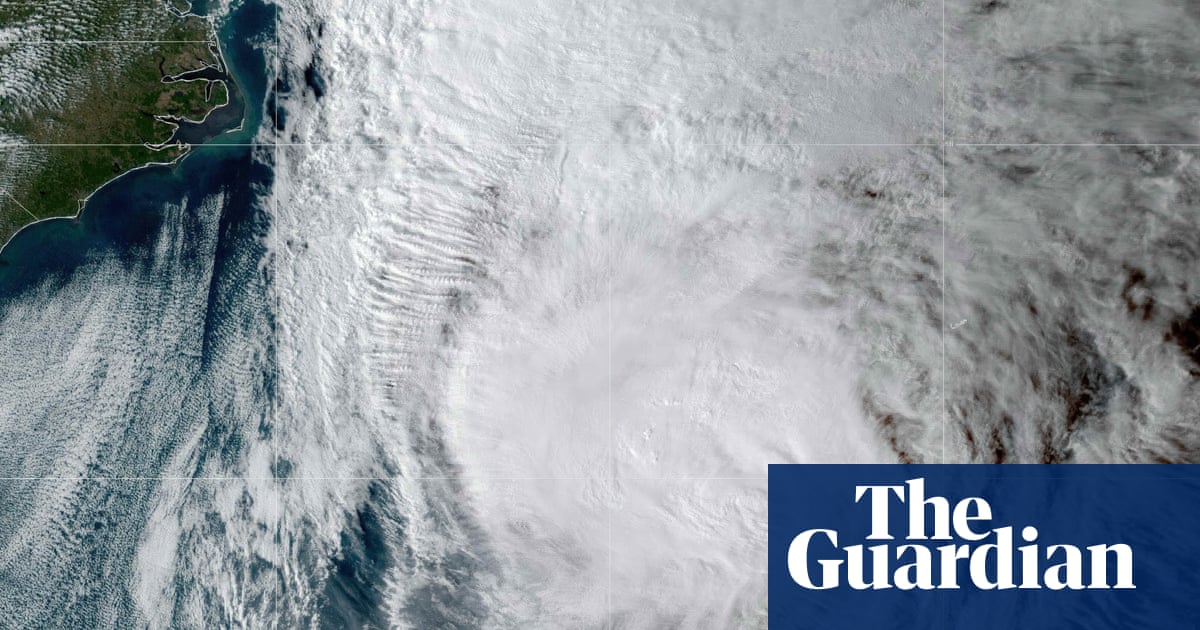
When then Tropical Storm Melissa was churning south of Haiti, Philippe Papin, a National Hurricane Center (NHC) meteorologist, had confidence it was about to grow into a monster hurricane.
As the lead forecaster on duty, he predicted that in just 24 hours the storm would become a category 4 hurricane and begin a turn towards the coast of Jamaica. No NHC forecaster had ever issued such a bold forecast for rapid strengthening.
But Papin had an ace up his sleeve: artificial intelligence in the form of Google’s new DeepMind hurricane model – released for the first time in June. And, as predicted, Melissa did become a storm of astonishing strength that tore through Jamaica.
Forecasters at the NHC are increasingly leaning hard on Google DeepMind. On the morning of 25 October, Papin explained in his public discussion and on social media that Google’s model was a primary reason he was so confident: “Roughly 40/50 Google DeepMind ensemble members show Melissa becoming a Category 5. While I am not ready to forecast that intensity yet given the track uncertainty, that remains a possibility.
“It appears likely that a period of rapid intensification will occur as the storm moves slowly over very warm ocean waters which is the highest oceanic heat content in the entire Atlantic basin.”
Google DeepMind is the first AI model dedicated to hurricanes, and now the first to beat traditional weather forecasters at their own game. Through all 13 Atlantic storms so far this year, Google’s model is the best – even beating human forecasters on track predictions.
Melissa eventually made landfall in Jamaica at category 5 strength, one of the strongest landfalls ever documented in nearly two centuries of record-keeping across the Atlantic basin. Papin’s bold forecast likely gave people in Jamaica extra time to prepare for the disaster, possibly saving lives and property.
Google DeepMind has been making weather forecasts for a few years now, and the parent forecast system from which the new hurricane model is derived also performed spectacularly well in diagnosing large-scale weather patterns last year.
Google’s model works by spotting patterns that traditional time-intensive physics-based weather models may miss.
“They do it much more quickly than their physics-based cousins, and the computing power is less expensive and time consuming,” Michael Lowry, a former NHC forecaster, said.
“What this hurricane season has proven in short order is that the newcomer AI weather models are competitive with and, in some cases, more accurate than the slower physics-based weather models we’ve traditionally leaned on,” Lowry said.
To be sure, Google DeepMind is an example of machine learning – a technique that has been used in data-heavy sciences like meteorology for years – and is not generative AI like ChatGPT.
Machine learning takes mounds of data and pulls out patterns from them in a such a way that its model only takes a few minutes to come up with an answer, and can do so on a desktop computer – in strong contrast to the flagship models that governments have used for decades that can take hours to run and require some of the biggest supercomputers in the world.
Still, the fact that Google’s model could outperform previous gold-standard legacy models so quickly is nothing short of amazing to meteorologists who have spent their careers trying to forecast the world’s strongest storms.
skip past newsletter promotion
after newsletter promotion
“I’m impressed,” said James Franklin, a retired NHC forecaster. “The sample is now large enough that it’s pretty clear this is not a case of beginner’s luck.”
Franklin said that although Google DeepMind is beating all other models on forecasting the future path of hurricanes worldwide this year, like many AI models it occasionally gets high-end intensity forecasts wrong. It struggled with Hurricane Erin earlier this year, as it was also undergoing rapid intensification to category 5 north of the Caribbean. It also struggled with Typhoon Kalmaegi – which made landfall in the Philippines on Monday.
In the coming offseason, Franklin said he plans to talk with Google about how it can make the DeepMind output even more helpful for forecasters by providing additional under-the-hood data they can use to assess exactly why it is coming up with the its answers.
“The one thing that nags at me is that while these forecasts seem to be really, really good, the output of the model is kind of a black box,” said Franklin.
There has never been a private, for-profit company that has produced a top-level weather model which allows researchers a peek into its methods – unlike nearly all other models which are provided free to the public in their entirety by the governments that designed and maintain them. While Google has made top-level output of DeepMind publicly available in real time on a dedicated website, its methods have still largely been hidden.
Google is not alone in starting to use AI to solve difficult weather forecasting problems. The US and European governments also have their own AI weather models in the works – which have also shown improved skill over previous non-AI versions.
The next steps in AI weather forecasts seem to be startup companies taking swings at previously tough-to-solve problems such as sub-seasonal outlooks and better advance warnings of tornado outbreaks and flash flooding – and they are receiving US government funding to do so. One company, WindBorne Systems, is even launching its own weather balloons to fill the gaps in the US weather-observing network, which has recently been downsized by the Trump administration.
Apple’s iPhone is getting its biggest makeover yet — both to its features and release schedule. Here’s what’s happening to the company’s flagship product. Also: The Mac Pro is on the back burner, and Tesla is finally adding support for…
Every week, Oprah sets an intention exclusively for Oprah Daily Insiders, with reflections on topics like letting go, forgiveness, coming into your own, and more.
Happy Sunday, Insiders.
On Tuesday, I announced my 120th Book Club pick, Some Bright…
Options traders appear to be turning bearish on the Brazilian real, which has delivered carry trade returns of around 30% this year.
(Bloomberg) — Some of the year’s most popular emerging-market trades such as betting on the Brazilian real and stocks linked to artificial intelligence are becoming a source of concern as money managers warn of risks from overcrowding.
Most Read from Bloomberg
Wells Fargo Securities sees valuations for Latin American currencies — among 2025’s top carry trade performers — as detached from fundamentals. Fidelity International is concerned about less liquid markets in Africa that it sees at risk should global volatility spike. Lazard Asset Management meanwhile is keeping its guard up after early November’s firesale in Asian tech stocks — the worst since April.
“Investors are too complacent on emerging markets,” said Brendan McKenna, an emerging-market economist and FX strategist at Wells Fargo in New York. “FX valuations, for most if not all, are stretched and not capturing a lot of the risks hovering over markets. They can continue to perform well in the near-term, but I do feel a correction will be unavoidable.”
Such caution isn’t without reason. Many parts of the developing-markets universe look overheated after a heady cocktail of Federal Reserve rate cuts, a softer dollar and an AI boom drove stellar gains. The very flows that propelled the rally are now posing the risk of sudden drawdowns that have the potential to ripple through global sentiment and tighten liquidity across asset classes.
A quarterly HSBC Holdings Plc survey of 100 investors representing a total $423 billion of developing-nation assets showed in September that 61% of them had a net overweight position in local-currency EM bonds, up from minus 15% in June. A Bloomberg gauge of the debt is on track for its best returns in six years.
The MSCI Emerging Markets Index of stocks has risen each month this year through October — the longest run in over two decades. Up almost 30%, the gauge is headed for its best annual gain since 2017, when it rallied 34%. That was followed by a 17% slump in 2018 when a more hawkish than expected Fed, a US-China trade war and a surging dollar took the wind out of overcrowded EM stocks as well as popular carry — in which traders borrow in lower-yielding currencies to buy those that offer higher yields — and local-bond trades.
“As we approach year-end, there is a risk that some investors look to take profits on what has been a successful trade in 2025 and that this leads to a rise in volatility in FX markets,” Anthony Kettle, senior portfolio manager at RBC BlueBay Asset Management in London, said in reference to local-currency bonds.
Stock traders in Asia this month had a first-hand experience of the risks that come with extreme valuations and crowding, when the region’s high-flying AI shares took a sudden nosedive. While tech stocks sold off globally, analysts have cautioned that the risk in some Asian markets are even more pronounced given the sector’s relatively higher weighting in their indexes.
One notable example is South Korea’s Kospi — the world’s top-performing major equity benchmark in 2025, with an almost 70% jump. As volatility spiked, the gauge plunged more than 6% in one session before paring half of the losses by the close. “Positioning in Korea’s AI-memory trade is extremely tight,” said Charu Chanana, chief investment strategist at Saxo Markets in Singapore.
Rohit Chopra, an emerging-market equity portfolio manager at Lazard Asset Management in New York, has turned cautious after the tech rout.
“From a factor perspective, lower-quality companies have been outperforming higher-quality peers,” he said. “Historically, this divergence has not been sustained, suggesting the potential for a reversal if positioning remains concentrated.”
Chopra co-manages the Lazard Emerging Markets Equity Portfolio, which has returned 23% over the past three years, beating 95% of peers, according to data compiled by Bloomberg.
Carry Trades
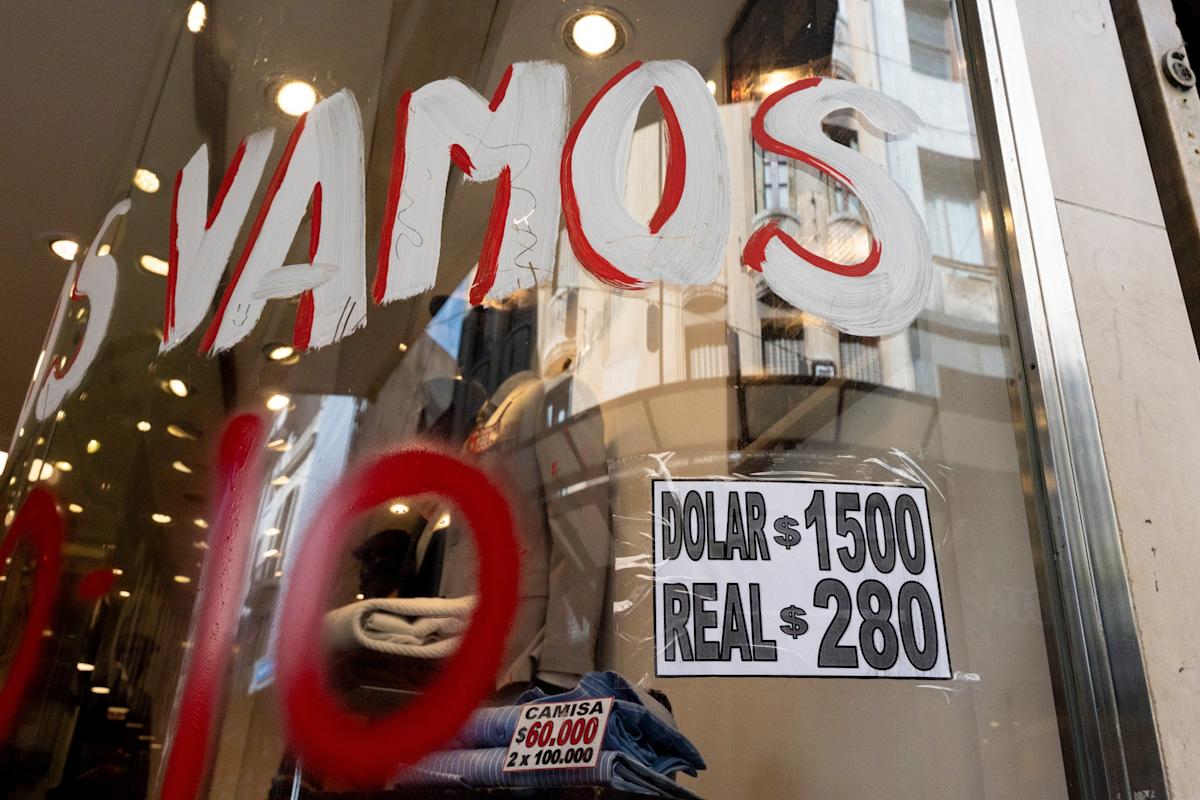
Options traders appear to be turning bearish on the Brazilian real, which has delivered carry trade returns of around 30% this year. Three-month risk reversals rose to a four-year high earlier this month.
The real is the best example of an asset that has had a good run this year and where positioning has now become crowded, said Alvaro Vivanco, head of strategy at TJM FX. There are renewed fiscal concerns for Brazil, which is another reason to be more cautious, he said.
Other Latin American currencies such as Chile’s, Mexico’s and Colombia’s are also “looking a little rich,” said Wells Fargo’s McKenna.
The trade-weighted value of the Colombian peso is at the highest in seven years, according to data from the Bank of International Settlements, and is one standard deviation above the 10-year average. The same gauge for the Mexican peso is 1.4 standard deviations above the average.
Frontier Bonds
Bonds in some frontier markets also emerged as beneficiaries when a broader investor shift away from US assets gathered pace this year. Asset managers such as Fidelity International are now sounding caution on them.
“More concerning to me are trades where a sudden rush for an exit can overwhelm the natural buyer base,” said Philip Fielding, a portfolio manager for Fidelity. Markets such as Egypt, the Ivory Coast or Ghana “can also be illiquid in times of higher volatility,” he added.
Fielding is the lead manager for the $538 million Fidelity Emerging Market Debt Fund that has returned about 12% in the past three years, beating 84% of peers, data compiled by Bloomberg show.
What to Watch
Bank Indonesia’s rate decision will be announced on Wednesday, while China’s loan prime rate will be released Thursday
Malaysia, Poland and South Africa will release the latest inflation statistics, as investors look for signs of dis-inflationary pressures
Hungary, South Africa and Egypt also have policy rate decisions
Thailand, Colombia and Mexico will publish third-quarter gross domestic product figures
–With assistance from Mpho Hlakudi, Malavika Kaur Makol and Zijia Song.
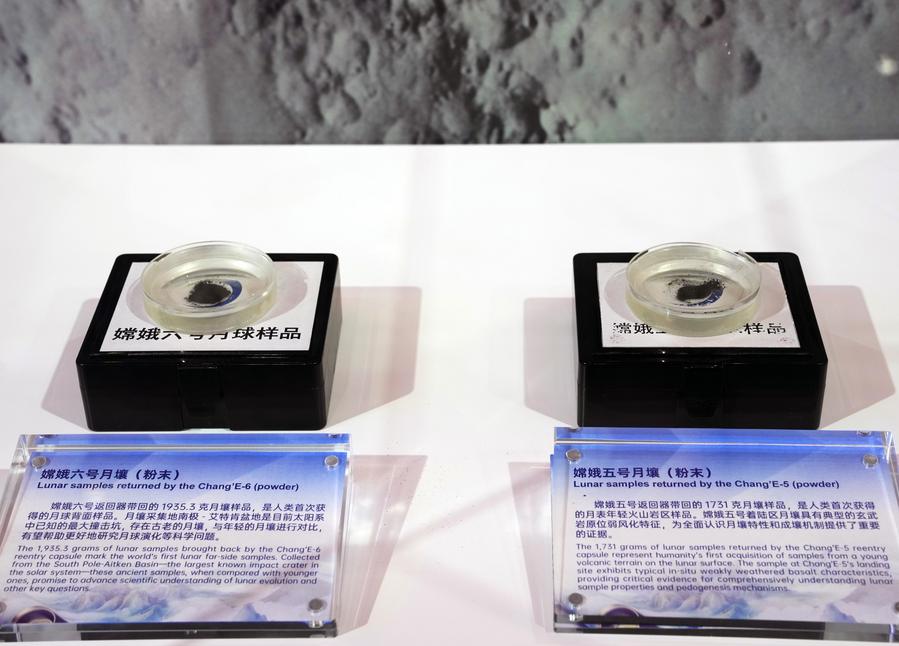
Lunar samples retrieved by China’s Chang’e-5 and Chang’e-6 missions are displayed at the China Pavilion during the eighth China International Import Expo (CIIE) in east China’s Shanghai, Nov. 5, 2025. (Xinhua/Liu Ying)
A growing number of young adults are walking into clinics with symptoms they cannot explain, and according to a Harvard trained gastroenterologist, many of these early clues point toward calcium deficiency long before bones begin to weaken. In a…
DUBAI, United Arab Emirates — Rory McIlroy holed an eagle putt on No. 18 to force a playoff but lost out to Matt Fitzpatrick, who won the World Tour Championship for a third time on a chaotic final day of the 2025 golf…