Author: admin

  • US family sues Tesla, alleging wrongful death due to faulty doors | Automotive Industry News

    US family sues Tesla, alleging wrongful death due to faulty doors | Automotive Industry News

    The lawsuit, filed on Friday, alleges the lithium-ion battery pack in the Model S caused the electronic door systems to fail.

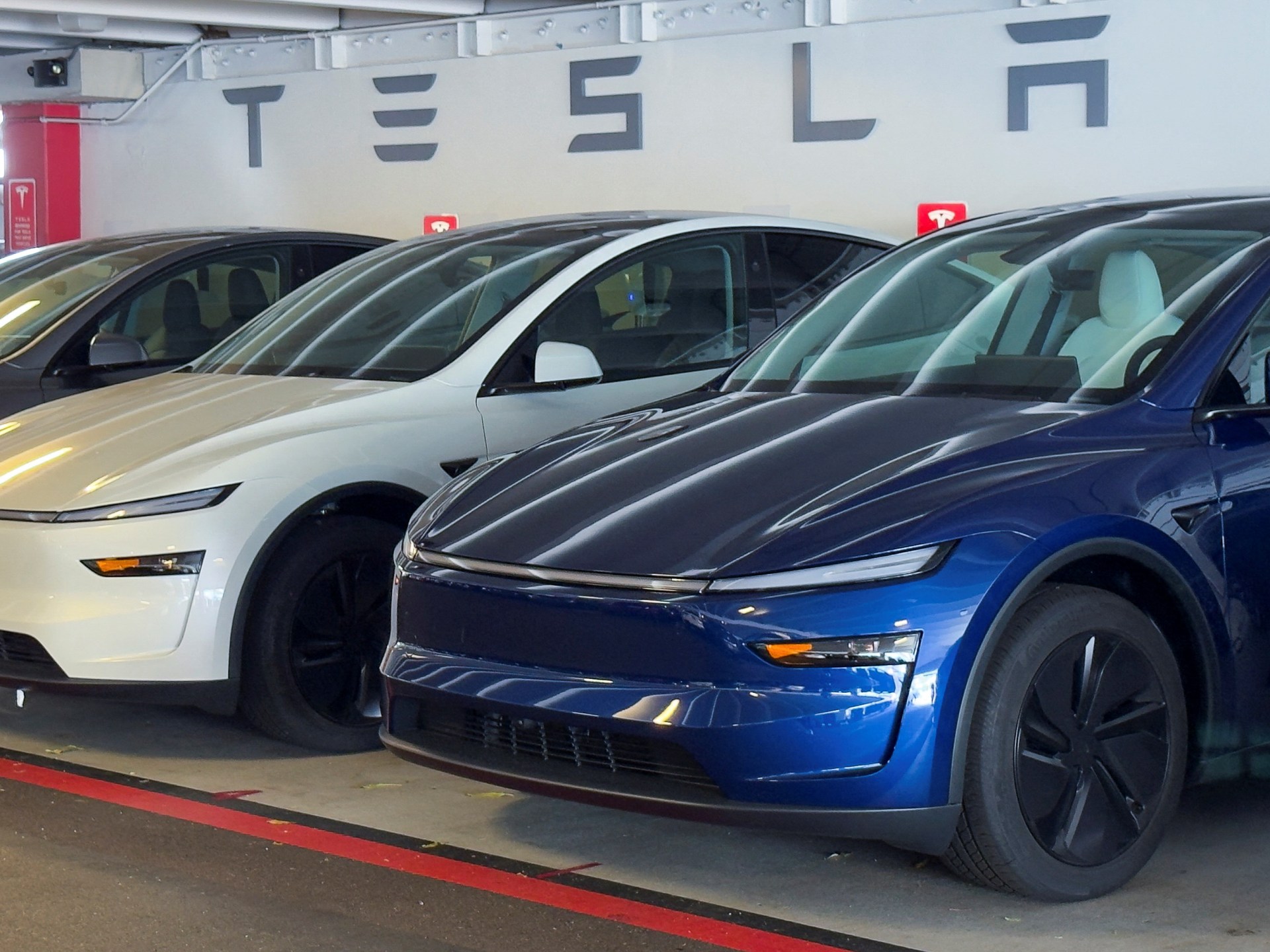
    Electric Vehicle company Tesla has been sued over a fiery crash in the United States that killed all five occupants of a Model S, who were allegedly trapped inside because of a design flaw that prevented them from opening the sedan’s doors.

    Jeffrey Bauer, 54, and Michelle Bauer, 55, of Crandon, Wisconsin, were passengers in a Model S when the car went off the road and struck a tree in Verona, Wisconsin, a suburb of Madison, on November 1, 2024. They died the next day.

    Recommended Stories

    list of 4 itemsend of list

    According to a complaint filed on Friday by four of the Bauers’ children, the couple’s fate was sealed because the Model S’s lithium-ion battery pack caused the electronic door systems to fail.

    The children said that Tesla knew this could happen based on earlier fires, yet made a “conscious departure from known, feasible safety practices”.

    Tesla, based in Austin, Texas, and led by Elon Musk, did not immediately respond to requests for comment on Monday by the Reuters news agency.

    The automaker has also been sued by families of two college students killed in a Cybertruck crash last November in a San Francisco suburb, after allegedly being locked in the burning vehicle because of its door handle design.

    In September, the National Highway Traffic Safety Administration disclosed a probe into the possible defects on some Tesla doors, following reports that handles could fail.

    The Bauer children said that Model S rear seat passengers, like Michelle Bauer, were particularly vulnerable in the event of a crash, because they would have to lift carpeting to find a metal tab allowing their escape, which is not intuitive.

    A nearby homeowner told 911 that she heard screaming from within the Bauers’ vehicle, the complaint said.

    “Tesla’s design choices created a highly foreseeable risk: that occupants who survived a crash would remain trapped inside a burning vehicle,” according to the complaint.

    Other defendants include the estate of the car’s driver, whom the Bauer children accused of negligent driving.

    On Wall Street, Tesla’s stock finished the day up 2.5 percent.

    Continue Reading

  • Locket’s social app is picking up steam with Gen Alpha

    Locket’s social app is picking up steam with Gen Alpha

    Locket, a private social networking app for friends, has scored a win with Gen Alpha users following the launch of its latest feature, Rollcall.

    The app, which lets friends share photos that then appear in home screen widgets, first hit the…

    Continue Reading

  • Altman and Nadella need more power for AI, but they’re not sure how much

    Altman and Nadella need more power for AI, but they’re not sure how much

    Microsoft CEO Satya Nadella and OpenAI CEO Sam Altman at the Microsoft campus in Redmond, Wash. on July 15, 2019. (Photography by Scott Eklund/Red Box Pictures) | Image Credits:Microsoft

    How much power is enough for AI? Nobody knows, not even OpenAI CEO Sam Altman or Microsoft CEO Satya Nadella.

    That has put software-first businesses like OpenAI and Microsoft in a bind. Much of the tech world has been focused on compute as a major barrier to AI deployment. And while tech companies have been racing to secure power, those efforts have lagged GPU purchases to the point where Microsoft has apparently ordered too many chips for the amount of power it has contracted.

    “The cycles of demand and supply in this particular case you can’t really predict,” Nadella said on the BG2 podcast. “The biggest issue we are now having is not a compute glut, but it’s a power and it’s sort of the ability to get the [data center] builds done fast enough close to power.”

    “If you can’t do that, you may actually have a bunch of chips sitting in inventory that I can’t plug in. In fact, that is my problem today. It’s not a supply issue of chips, it’s the fact that I don’t have warm shells to plug into,” Nadella added, referring to the commercial real estate term for buildings ready for tenants.

    In some ways, we’re seeing what happens when companies accustomed to dealing with silicon and code, two technologies that scale and deploy quickly compared with massive power plants, need to ramp up their efforts in the energy world.

    For more than a decade, electricity demand in the U.S. was flat. But over the last five years, demand from data centers has begun to ramp up, outpacing utilities’ plans for new generating capacity. That has led data center developers to add power in so-called behind-the-meter arrangements, where electricity is fed directly to the data center, skipping the grid.

    Altman, who was also on the podcast, thinks that trouble could be brewing: “If a very cheap form of energy comes online soon at mass scale, then a lot of people are going to be extremely burned with existing contracts they’ve signed.”

    “If we can continue this unbelievable reduction in cost per unit of intelligence — let’s say it’s been averaging like 40x for a given level per year — you know, that’s like a very scary exponent from an infrastructure buildout standpoint,” he said.

    Altman has invested in nuclear energy, including fission startup Oklo and fusion startup Helion, along with Exowatt, a solar startup that concentrates the Sun’s heat and stores it for later use.

    None of those are ready for widespread deployment today, though, and fossil-based technologies like natural gas power plants take years to build. Plus, orders placed today for new gas turbine likely won’t get fulfilled until later this decade.

    That’s partially why tech companies have been adding solar at a rapid clip, drawn to the technology’s inexpensive cost, emissions-free power, and ability to deploy rapidly.

    There might be subconscious factors at play, too. Photovoltaic solar is in many ways a parallel technology to semiconductors, and one that has been derisked and commoditized. Both PV solar and semiconductors are built on silicon substrates, and both roll off production lines as modular components that can be packaged together and tied into parallel arrays that make the completed part more powerful than any individual module.

    Because of solar’s modularity and speed of deployment, the pace of construction is much closer to that of a data center.

    But both still take time to build, and demand can change much more quickly than either a data center or solar project can be completed. Altman admitted that if AI gets more efficient or if demand doesn’t grow as he expects, some companies might be saddled with idled power plants.

    But from his other comments, he doesn’t seem to think that’s likely. Instead, he appears to be a firm believer in Jevons Paradox, which says that more efficient use of a resource will lead to greater use, increasing overall demand.

    “If the price of compute per like unit of intelligence or whatever — however you want to think about it — fell by a factor of a 100 tomorrow, you would see usage go up by much more than 100 and there’d be a lot of things that people would love to do with that compute that just make no economic sense at the current cost,” Altman said.

    Continue Reading

  • High Growth Tech Stocks In Asia Including Samsung Electronics

    High Growth Tech Stocks In Asia Including Samsung Electronics

    As global markets navigate mixed performances with large-cap tech companies driving gains, the Asian tech sector remains a focal point for investors eyeing growth opportunities amid easing U.S.-China trade tensions. In this environment, identifying high-growth tech stocks in Asia involves looking for companies that capitalize on technological advancements and robust consumer demand while demonstrating resilience to broader economic shifts.

    Name

    Revenue Growth

    Earnings Growth

    Growth Rating

    Giant Network Group

    32.80%

    35.57%

    ★★★★★★

    Suzhou TFC Optical Communication

    33.73%

    34.36%

    ★★★★★★

    Accton Technology

    24.08%

    28.54%

    ★★★★★★

    Zhongji Innolight

    28.22%

    29.75%

    ★★★★★★

    Fositek

    36.93%

    47.79%

    ★★★★★★

    Eoptolink Technology

    37.03%

    32.46%

    ★★★★★★

    Gold Circuit Electronics

    26.64%

    35.16%

    ★★★★★★

    ISU Petasys

    21.11%

    32.81%

    ★★★★★★

    eWeLLLtd

    25.02%

    24.93%

    ★★★★★★

    CARsgen Therapeutics Holdings

    100.40%

    118.16%

    ★★★★★★

    Click here to see the full list of 175 stocks from our Asian High Growth Tech and AI Stocks screener.

    Let’s uncover some gems from our specialized screener.

    Simply Wall St Growth Rating: ★★★★☆☆

    Overview: Samsung Electronics Co., Ltd. operates globally in consumer electronics, IT and mobile communications, and device solutions, with a market cap of ₩723.16 trillion.

    Operations: Samsung Electronics generates revenue primarily from its Device Solutions (DS) segment, which contributes ₩116.20 billion, and SDC, which adds ₩28.52 billion. Harman also plays a role with ₩15.12 billion in revenue.

    Samsung Electronics’ strategic alliance with NVIDIA to construct an AI-driven semiconductor factory marks a significant leap in integrating intelligent computing within chip manufacturing. This collaboration, leveraging over 50,000 NVIDIA GPUs, is set to revolutionize semiconductor production through predictive maintenance and process enhancements. Notably, Samsung’s commitment extends beyond hardware; its recent patent infringement case involving OLED technologies resulted in a $191.4 million penalty, underscoring the high stakes in protecting innovative tech developments. These initiatives reflect Samsung’s aggressive pursuit of advanced manufacturing capabilities and intellectual property defense essential for maintaining its competitive edge in the fast-evolving tech landscape.

    KOSE:A005930 Revenue and Expenses Breakdown as at Nov 2025

    Simply Wall St Growth Rating: ★★★★☆☆

    Overview: TechMatrix Corporation operates in the information infrastructure and application service sector in Japan, with a market capitalization of ¥87.77 billion.

    Continue Reading

  • Sunderland 1-1 Everton (Nov 3, 2025) Game Analysis

    Sunderland 1-1 Everton (Nov 3, 2025) Game Analysis

    Captain Granit Xhaka’s second-half equaliser earned Sunderland a point in a 1-1 draw against Everton.

    The clash was Everton boss David Moyes’ first visit to the Stadium of Light since he oversaw the Wearsiders’ relegation from the Premier League…

    Continue Reading

  • Celiac Disease and Thyroid Disease in Adolescence Linked to the Development of Type 1 Diabetes in Adulthood

    Celiac Disease and Thyroid Disease in Adolescence Linked to the Development of Type 1 Diabetes in Adulthood

    Adolescents who are diagnosed with certain autoimmune diseases appear to be at a heightened risk of developing Type 1 diabetes (T1D) in young adulthood, according to a new report.

    Writing in the journal Diabetes Care, corresponding author Amir…

    Continue Reading

  • Tigé Boats is Awarded Innovation of the Year with the Alpha E4 Powered Tower

    Tigé Boats is Awarded Innovation of the Year with the Alpha E4 Powered Tower

    ABILENE, Texas, Nov. 3, 2025 /PRNewswire/ — Tigé Boats, a leading manufacturer of luxury surf boats and wakeboard boats, remains a defining innovator in the boating industry….

    Continue Reading

  • This chart shows the risk of an AI bubble is growing, says a stalwart stock-market bull

    This chart shows the risk of an AI bubble is growing, says a stalwart stock-market bull

    By Joseph Adinolfi

    The largest companies have seen their weighting in the S&P 500 rise more quickly than their share of total earnings

    One stock-market bull says recent developments are making her more concerned that an AI-driven bubble might be forming in the U.S. stock market.

    Lori Calvasina, head of U.S. equity strategy at RBC Capital Markets, has repeatedly rebutted claims that the U.S. equity market has entered an AI-driven bubble. But in a report recently shared with MarketWatch, she included one chart that is making her a bit more nervous.

    The chart in question, shown below, compares the weighting of the 10 most valuable stocks in the S&P 500 index SPX with the companies’ share of total net income. As Calvasina points out, the weighting of these stocks in the index recently touched a new peak north of 44% – the highest level going back to at least 1990, according to the data used by RBC. Yet the share of total profit of all index members that is being produced by these firms hasn’t quite kept up.

    “While we’ve generally not agreed with the view that the stock market is in the midst of an AI bubble, similar to the TIMT bubble, due to a better earnings foundation, we do think this risk has grown,” Calvasina said in the report. TIMT in this context refers to Technology, Internet, Media and Telecommunications. The acronym is frequently used in reference to the stock-market bubble that crested in early 2000.

    Among the 10 largest companies in the S&P 500, the AI theme is heavily represented. Names like Nvidia Corp. (NVDA), Meta Platforms Inc. (META), Broadcom Inc. (AVGO), Microsoft Corp. (MSFT), Amazon.com Inc. (AMZN), Alphabet Inc. – which is counted twice by RBC due to its dual share classes, Class A (GOOGL) and Class C (GOOG) – Apple Inc. (AAPL) and Tesla Inc. (TSLA). The only company in the group that doesn’t have direct and significant exposure to the AI theme is Berkshire Hathaway (BRK.B).

    See: The ‘Magnificent Seven’ have never been this important to the stock market – and a big test lies ahead

    To be sure, this isn’t exactly a new trend. The biggest companies in the S&P 500 have been seeing their overall weighting in the index climb more quickly than their share of earnings since at least 2021, Calvasina said.

    This is largely because investors have been willing to pay a premium on the expectation of stronger long-term earnings growth, especially since the launch of ChatGPT kicked off the AI investment frenzy in late 2022.

    However, over the past few months, the pace at which this gap has been widening has intensified. As of the end of October, the 10 largest companies in the S&P 500 accounted for 34.3% of total net income for all of the companies included in the index, according to the latest available data. That pushed the gap between the weighting of these companies in the S&P 500 and their share of profits to 9.9 percentage points. That isn’t far off from the 10.3 percentage-point gap seen in March 2000.

    Worries about an AI bubble have resurfaced as many of the biggest players in the space – the so-called “hyperscalers” – have reported earnings over the past couple of weeks. Although some on Wall Street have been warning about frothy valuations practically since the trend first found its legs during the first half of 2023.

    Meta shares dived last week, erasing more than $200 billion in value. Two Wall Street analysts downgraded the stock after panning the company’s plans for more aggressive AI-related spending, MarketWatch reported at the time. The stock was down again Monday, further trimming its yearly gain to about 8.9%.

    Gains for other members of the big AI-plays, most notably Amazon, helped to compensate as U.S. stocks finished higher for a third straight week on Friday.

    News on Monday that Amazon had inked a deal with OpenAI to provide cloud-computing power to the privately held AI company has helped to keep the stock-market rally going as November trading got under way, one portfolio manager told MarketWatch.

    U.S. stocks mostly climbed on Monday, with the S&P 500 and Nasdaq Composite COMP finishing higher. Meanwhile, the Dow Jones Industrial Average DJIA and the small-cap Russell 2000 RUT ended modestly lower.

    -Joseph Adinolfi

    This content was created by MarketWatch, which is operated by Dow Jones & Co. MarketWatch is published independently from Dow Jones Newswires and The Wall Street Journal.

    (END) Dow Jones Newswires

    11-03-25 1729ET

    Copyright (c) 2025 Dow Jones & Company, Inc.

    Continue Reading

  • Chikungunya in Hong Kong: 3rd local case reported

    Chikungunya in Hong Kong: 3rd local case reported

    Hong Kong health officials reported today the third locally acquired case of chikungunya fever (CF) in a 45-year-old male living in Kwai Tsing District and working in Sheung Wan.

    Image/CHP screen shot

    A preliminary investigation revealed that he…

    Continue Reading

  • Orcas hunt young great white sharks for their livers in California

    Orcas hunt young great white sharks for their livers in California

    A specialized pod of orcas in the Gulf of California has been filmed hunting juvenile great white sharks, flipping them upside down to extract their nutrient-rich livers.

    The pod, known as Moctezuma’s pod, may be exploiting warming waters…

    Continue Reading