TTI Inc. has sponsored this post.
Modern defense systems depend on a complex network of modular electronics. At the core of this technology is the VITA Standards Organization, which leads the development of open…

TTI Inc. has sponsored this post.
Modern defense systems depend on a complex network of modular electronics. At the core of this technology is the VITA Standards Organization, which leads the development of open…

Vaccination is one of the most effective tools for preventing infectious diseases in both humans and animals. Safe and effective vaccines reduce mortality, improve productivity and protect communities from zoonotic diseases that can cross species barriers. However, the success of vaccination programs depends not only on the quality of vaccines produced but also on how they are stored, transported and handled. When vaccines are exposed to temperatures outside their recommended range, their potency can decline, leading to a failure to generate adequate immune protection. Such failures can erode public trust when vaccinated individuals, both human or animal, still fall ill with the targeted disease.
Maintaining vaccines within the correct temperature range from the point of manufacture to administration is therefore critical. The temperature-controlled system that preserves vaccine potency along the travel route is known as the cold chain. A robust cold chain ensures that vaccines remain active and efficacious until their expiry date, forming the backbone of successful immunisation and vaccination programs.
Public health systems worldwide devote substantial resources to building and maintaining cold chain infrastructure. An effective cold chain requires three key elements. First, personnel: trained staff to manage vaccine storage and distribution at every point in the system, ensuring that handling protocols are consistently applied. Second, equipment: reliable refrigeration and transport equipment capable of maintaining required temperatures, together with temperature-monitoring devices that allow real-time oversight. Third, procedures: standardised protocols that guide proper equipment use, temperature monitoring, and the safe transport and storage of vaccines.
When any of these components fail, whether due to lack of training, power outages or equipment breakdowns, the integrity of vaccines can be compromised. For this reason, continuous investment in cold chain systems is not optional but essential for sustaining vaccine confidence and effectiveness.
While public health vaccination programs often receive strong institutional and financial support, animal health services in many low- and middle-income countries remain under-resourced. The consequences are significant: inadequate cold chain capacity can lead to unreliable vaccine supplies, loss of potency and high mortality from diseases that are otherwise preventable.
These weaknesses in animal health systems have several important wider implications. Livestock owners who experience disease outbreaks following vaccination may lose confidence both in vaccines and in veterinary health care services. High animal mortality can make it difficult to detect outbreaks early, diminishing the sensitivity of surveillance systems. Poor disease surveillance allows zoonotic pathogens — that is, those that can infect both animals and humans — to circulate unnoticed in animal populations, potentially spilling over into human communities. Finally, these outbreaks may have serious negative impacts on household livelihoods and national economics.
As a consequence, inadequate investment in animal health cold chains not only affects livestock productivity but also undermines public health security and food systems.
Encouraging progress has been made in Bangladesh, where a community-based One Health initiative funded by the USAID Feed the Future Bangladesh Livestock and Nutrition Activity and UK Research and Innovation-funded One Health Poultry Hub has highlighted the benefits of shared responsibility across sectors. A farmer survey conducted under the Bangladesh Livestock and Nutrition Activity revealed very low levels of vaccination coverage. This finding was presented at a national meeting that brought together public health, animal health and environmental health officials, along with local government representatives, reflecting the essence of the One Health approach, which seeks to balance and optimise the health of people, animals and ecosystems through cross-sectoral collaboration.
Public health officials were surprised to learn about the low coverage of livestock vaccination for two key reasons. Firstly, in rural districts facing high child undernutrition, improving access to nutrient-rich animal-source foods is seen as vital. Second, frequent high mortality in animals reduces surveillance sensitivity and timely disease outbreak reporting. Rather than attributing blame to veterinary services, they expressed readiness to support joint action. Proposed areas of collaboration included cold chain training, shared maintenance responsibilities and coordinated monitoring of livestock vaccination coverage. They further recommended that animal vaccination data, particularly for zoonotic and high-priority diseases, be routinely shared with District Public Health Nutrition Committees. This integration would help raise awareness of challenges in veterinary health systems and strengthen links between animal health and human nutrition initiatives.
Importantly, discussions also explored the potential for shared cold chain infrastructure. Public health facilities in Bangladesh now possess well maintained refrigeration units, backup power generators and trained personnel. Public health officers felt that, with proper coordination, these existing structures could benefit veterinary vaccination programs — and were keen to take this idea forward. (While the World Health Organization prohibits human and animal vaccines from being stored in the same refrigerator, this barrier can be overcome by installing separate storage units powered by a unified electricity source and shared backup systems.)
This example from Bangladesh illustrates the value of the One Health approach in addressing common logistical challenges. In many contexts, animal health and public health services operate in parallel, each maintaining their own infrastructure, staff and supply systems. However, greater efficiency and resilience can be achieved through integrated planning and resource sharing. Beyond Bangladesh, this idea is also being considered in the four countries participating in the West African One Health project — Sierra Leone, Guinea, Liberia and Nigeria — which aims to strengthen the mitigation and prevention of outbreaks and address sectoral inequities through increased multisectoral collaboration.
In fact, the Guinean National Health Security Agency is currently coordinating with the National Directorate of Veterinary Services regarding the storage and distribution of dog rabies vaccine. In Guinea, rabies vaccines are distributed through a tiered system to maintain cold chain integrity. Vaccines are first stored at four regional veterinary laboratories, then transferred to refrigerators within the Prefectural Directorates of Livestock, and subsequently to human health centres at the sub-prefectural level. Transport is conducted using coolers with regularly-replaced ice packs. Most health centres are equipped with solar-powered refrigerators. Coordination between the Expanded Vaccination and Primary Health Care Program and the National Directorate of Veterinary Services ensures effective management and safety of animal vaccinations.
Access to potent vaccines, safe food and effective disease control underpins both human and animal health. Yet sustaining these systems requires collaboration across sectors that have traditionally worked in isolation. The One Health approach offers a pragmatic and equitable framework for doing so. By sharing cold chain resources — equipment, expertise and maintenance systems — countries can strengthen both public and veterinary health services while maximising the impact of limited resources. In short, investing together means saving together: protecting livestock, safeguarding people and securing the health of the ecosystems we all depend on.

The universe’s first galaxies were hot messes, according to a recent study. During their younger days, they were wild, chaotic bundles of turbulent gas, churned up by huge gulps of intergalactic gas, bursts of massive star formation, and raging…

In a seismic deal for indie action fans, Lionsgate has secured a wide-ranging rights deal with Millennium Media for two of Millennium’s most valuable action franchises: Rambo and The Expendables.
Under the agreement announced on Monday,…

With everything from the next Knives Out movie to the final season of Stranger Things on the way, there’s going to be a ton of great stuff to stream in the coming weeks. And if you want to watch it all in glorious 4K resolution, Google’s TV…

FOR IMMEDIATE RELEASE
New research from Johns Hopkins Medicine shows that the enzyme biliverdin reductase A (BVRA) plays a direct protective role against oxidative stress in neurons, independent of its role producing…
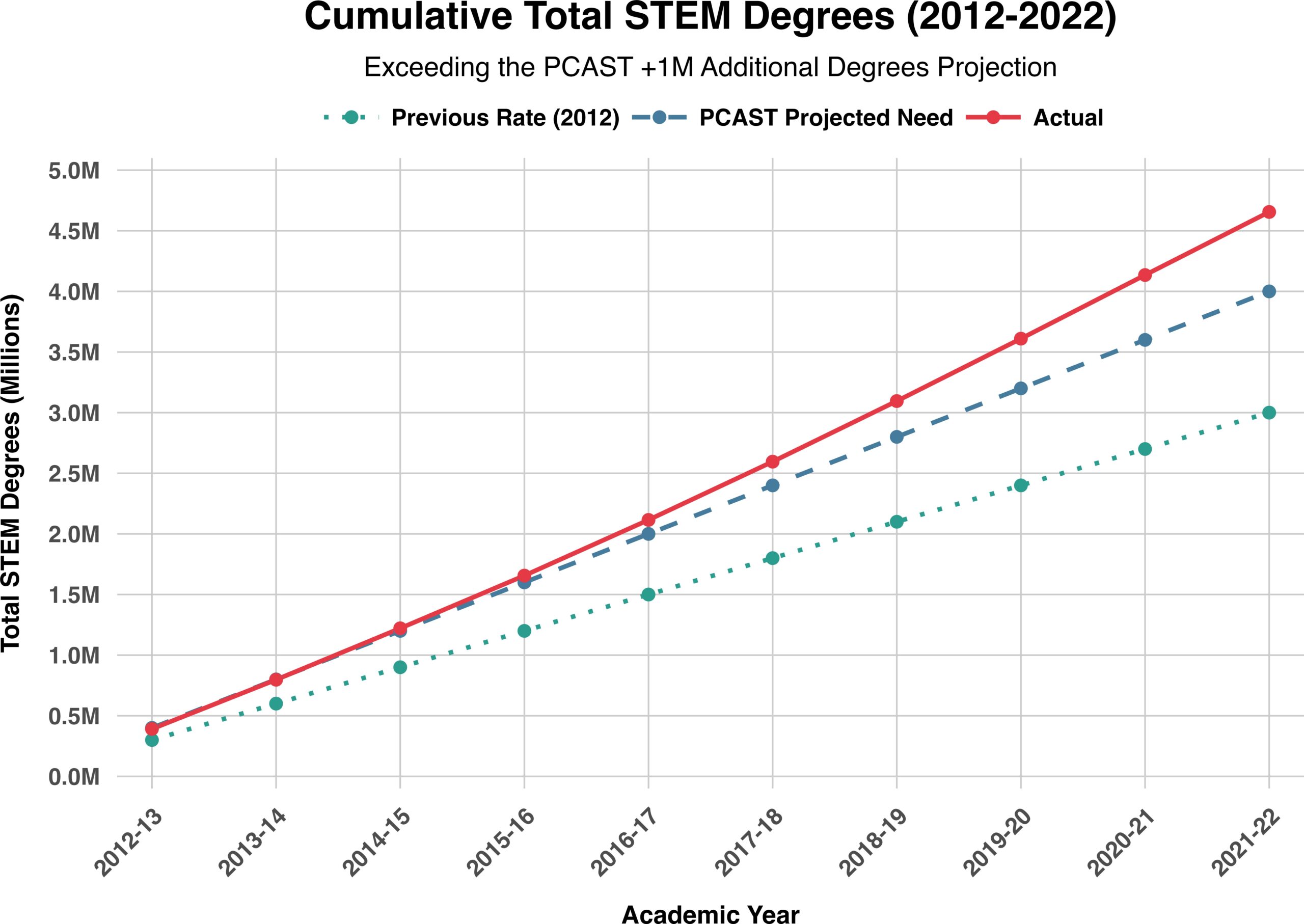
A recent analysis of national higher-education data by a researcher at the University of California, Santa Cruz, found that the United States exceeded the goal of producing one million more graduates in the fields of science, technology, engineering, and mathematics (STEM) over the course of a decade. That goal, set in a 2012 report by then-President Barack Obama’s Council of Advisors on Science and Technology (PCAST), was one of several national objectives created to maintain America’s scientific leadership position in an increasingly competitive global landscape.
The analysis, by National Science Foundation postdoctoral fellow Haider Ali Bhatti was, on the one hand, good news: It indicates that the expansion of programs intended to support STEM education outcomes in the years following the report’s publication yielded a successful return on investment.
But at the same time, Bhatti’s study serves as a warning about the danger of tearing down federal institutions and the information infrastructure they provide. His findings underscored the vital importance of keeping and improving national-level data collection for sustaining STEM education progress and establishing policies and priorities that aim to maintain U.S. leadership in an increasingly competitive scientific and economic landscape.
The study is framed in the present-day context of the growing challenges faced by U.S. universities: public skepticism of their value, claims of ideological indoctrination, and the ongoing dismantling of diversity, equity, and inclusion initiatives.
“These criticisms demand higher education research to demonstrate tangible outcomes of progress informed by evidence-based evaluations,” said Bhatti, in UC Santa Cruz’s Department of Ecology & Evolutionary Biology. “In this climate of heightened public scrutiny, undergraduate STEM education offers a particularly valuable disciplinary domain to assess higher-education outcomes given its importance to national workforce development goals and global economic competitiveness.”
Relying largely on data from the National Center for Education Statistics (NCES), Bhatti found that the number of STEM degrees obtained in the decade following the 2012 “Engage to Excel” report exceeded the goal of an additional million graduates by 16%. He also found that the proportion of STEM degrees among all degrees conferred increased over the decade, reversing previous declining trends.
In addition, STEM employment expanded correspondingly, with growth surpassing the PCAST report’s projections, according to Bhatti. In his study, he explained how the 2012 report emerged as a response to specific workforce and educational concerns facing the country in the years prior. While America had historically relied on foreign-born STEM professionals to satisfy unmet workforce demands, the presidential advisory council warned that this strategy was no longer sustainable.
STEM education and employment opportunities were increasing globally, making other countries potentially more attractive to STEM-trained workers and creating potential vulnerabilities for American economic stability, the study states. Furthermore, other research showed that STEM-related jobs represented some of the best opportunities for upward mobility in the American economy, offering high wages and lower unemployment rates than other sectors.
The 2012 report concluded that expanding access to these high-quality careers provided a potential pathway to reduce income inequality if more Americans were trained in STEM fields. Against this backdrop of global competition and domestic opportunity, PCAST established concrete, measurable goals to address what the report characterized as a critical “decision point” for American educational and economic leadership at the time of its publication.
In his study, Bhatti cited other research that analyzed national data to assess progress on two other goals in the PCAST report: improving retention rates among students in STEM fields, and increasing demographic representation. At the time of the report, only 40% of students who started as STEM majors graduated with a STEM degree. To assess progress on that front, Bhatti presented results from research that analyzed longitudinal cohort data from the ongoing Beginning Postsecondary Students (BPS) study by NCES.
That research found improved retention rates among bachelor’s degree students in STEM fields, at 52%, along with a phenomenon that Bhatti said is more powerful: retention rates in STEM that were equal to or higher than those in non-STEM fields at the bachelor’s degree level. Given the typical amount of exploration and changing of majors that undergraduates do, Bhatti said it was encouraging to see comparatively less attrition in STEM disciplines than in other fields.
In regards to increasing demographic representation, Bhatti reported mixed progress, with national data showing substantial gains for Hispanic students and women, but also persistent gaps for Black and American Indian/Alaska Native students. According to NCES data, the share of Hispanic STEM degree recipients increased from 9.5% to 14.7%.
Bhatti also found that the percentage of science and engineering degrees earned by women rose from 43% to 49% at the associate’s level, while remaining stable at about 50% for bachelor’s degrees over the past decade.
But overall, NCES data show an upward trend for women in STEM: Between 2012 and 2022, the share of women who earned STEM degrees increased steadily from just under 32% (124,853) to over 37% (193,625).
Besides NCES, Bhatti examined other national reports, data sets, and longitudinal studies spanning over 10 years since the publication of the PCAST report. And now, more than a decade later, he said if higher education’s critics are correct, we would expect minimal to no progress toward these goals. But his study clearly showed otherwise.
“Overall, these results reveal patterns that challenge public narratives about the diminishing state of higher education—particularly in undergraduate STEM education,” Bhatti concluded. “These findings provide an evidence-based foundation for both evaluating past investments and guiding future strategies to strengthen America’s talent development in the evolving global STEM ecosystem.”
Bhatti emphasized that NCES is a division of the U.S. Department of Education, which has been critically defunded and affected by mass layoffs due to federal restructuring. “This work shows the importance of data infrastructure to check if we, as a nation, are on track in the increasingly competitive world of STEM,” he said. “We need things like NCES to enable evidence-based evaluations of our educational progress.”
While his study is largely positive about recent trends in undergraduate STEM education, Bhatti also noted several caveats. The decade covered by his study included large‐scale reforms as well as variability across institutions and regional systems. Thus, Bhatti said national averages may have masked pockets of underperformance.
In addition, while degree production and completion have improved, Bhatti’s findings stop short of documenting the quality of the learning experience, the alignment of degrees with workforce needs, or long‐term career outcomes. He points out that “degree counts alone are insufficient; we must also ask whether graduates are succeeding in the jobs of today and tomorrow.”
His analysis, “One million more: assessing a decade of progress in undergraduate STEM education,” originally appeared in the journal Journal of Microbiology & Biology Education on August 21.
You don’t have permission to access “http://indianexpress.com/article/sports/cricket/pakistan-vs-south-africa-1st-odi-live-cricket-streaming-when-and-where-to-watch-pak-vs-sa-live-in-india-10344344/” on this server.
Reference…

A new so-called “miracle” weight-loss pill is sweeping across Russian social media, promising quick results without exercise or dieting.
Branded as Molecule Plus, the capsule has gone viral on TikTok, but doctors are warning that its…