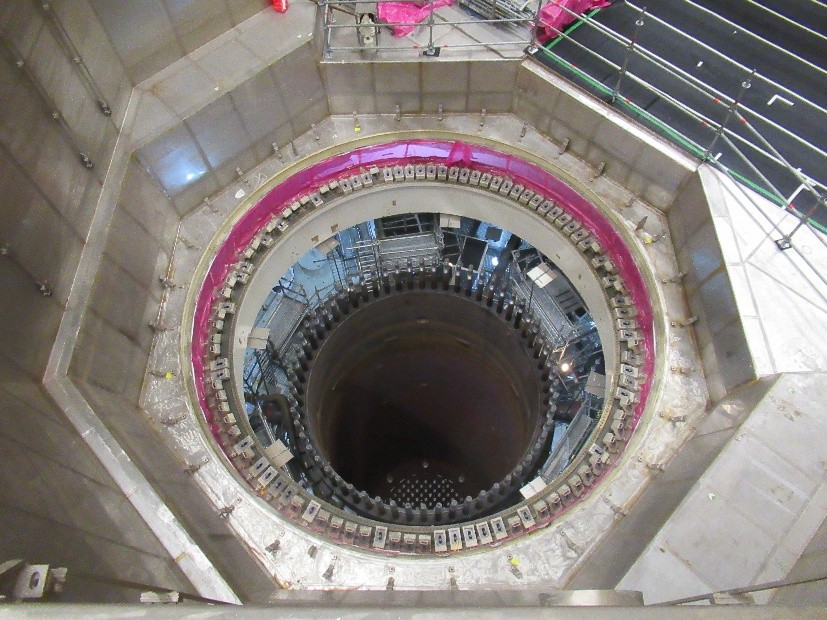
After the shutdown of a nuclear power plant, the first step is so-called post-operation. In this phase, the fuel assemblies are removed from the plant, plant components are recorded, dismantling plans are drawn up and suitable procedures for decontamination and dismantling are defined. Only after the initial decommissioning and dismantling approval – in Brunsbüttel this was in December 2018 – can the actual dismantling begin.
With the removal of the final fuel element in June 2017 and the final special fuel rods in February 2018, around 99 per cent of the radioactive inventory has left the plant. Of the remaining one per cent of the radioactive inventory, more than 90 per cent was in the reactor pressure vessel and its internals, which were subsequently dismantled.
A further nuclear licence is expected in 2025 to allow other areas of the power plant, in particular the reactor pressure vessel, to be dismantled.
Precision under water
In 2019, an especially developed underwater robot was deployed in Brunsbüttel. The water serves as shielding to minimise radiation exposure. A water jet cutter was used to cut the internals of the reactor pressure vessel – a process that combines maximum precision with optimum radiation protection. The dismantling of the first large components was an important milestone on the path to the “green field”.
In November 2022, another milestone was reached in the dismantling process: The final large component was removed from the reactor pressure vessel with the removal of the six-tonne lower core grid. It was then broken down into smaller, packable pieces in the settling tank. Abrasive waterjet cutting was also used here.
Dismantling the components into the smallest possible parts is important, on the one hand in order to minimise the volume of waste and on the other to be able to pack the dismantled parts into the approved final storage containers. For this purpose, all cuts in the dismantling process are planned in detail.
Tonnes of material being disassembled
Another impressive dismantling project at the Brunsbüttel nuclear power plant was started and successfully completed in autumn 2023: the dismantling of the so-called preheater platform. During power plant operation, it was one of the central components of the water vapour circuit and was used to heat the feed water before it entered the reactor pressure vessel – an important contribution to the efficiency of plant operation.
A total of around 1,000 tonnes of material had to be removed. The area on which the preheaters stood occupied almost 800 square metres. During the work, all components were carefully characterised, dismantled and sorted according to their material type and radiation protection status.
The top comes off the egg
Dismantling is visibly progressing at several locations in the power plant, for example the condensation chamber and the steam bypass station. However, it will be a special moment when the first concrete segment is cut out of the containment vessel and the top is cut off the egg, so to speak. The outer casings of the containment vessel are currently being dismantled and removed. In preparation for this, all connections to the reactor pressure vessel and all systems were removed from the containment beforehand.
Safety first
Even during decommissioning, the central protection objective remains the same: the protection of people and the environment. The hazard potential is now significantly lower than during power operation, as the radioactive inventory has been greatly reduced. Numerous protective measures, from closed systems and filter systems to strict radiation protection requirements, ensure maximum safety.
What to do with the residual materials?
Only a small proportion of the total mass of a nuclear power plant cannot actually be released after processing has been completed and is therefore classified as radioactive waste. Here, it is important to distinguish between activation and contamination. In the case of activation, a material has itself become radioactive through irradiation with neutrons during operation; in the case of contamination, only the surface is contaminated with radioactive substances. Contamination can usually be removed by cleaning or melting.
Activated materials cannot be cleaned and are generally conveyed away as radioactive waste. The strength of the activation decreases over time due to radioactive decay.
Around 97 percent of the materials can be recycled or disposed of conventionally following appropriate decontamination. Around one to three per cent must be packaged as radioactive waste, stored temporarily and later deposited in a final repository.
In principle, the dismantling of a nuclear facility is subject to the Recycling Act. This means that only materials that are not suitable for subsequent use are disposed of or sent to landfill.
In addition to radiologically contaminated materials, a significant proportion of the materials must be sent to landfill for conventional reasons, for example because they contain asbestos or PCB-containing paints.
In September 2024, the newly constructed storage facility for low- and intermediate-level radioactive waste at the Brunsbüttel Nuclear Power Plant site was handed over to the federally owned Gesellschaft für Zwischenlagerung, which operates the storage facilities for radioactive waste in Germany. The storage facility is dimensioned as such that it can accommodate all low- and intermediate-level radioactive waste from the operation and dismantling of the Brunsbüttel Nuclear Power Plant, as well as waste from the operating period of the Krümmel Nuclear Power Plant.
Symbol of change
The dismantling of the Brunsbüttel Nuclear Power Plant not only showcases technical expertise, but also stands for change in German energy policy. What once supplied electricity for hundreds of thousands of households is now making way for something new – a visible sign of the transition to a sustainable energy future.
Germany’s phase-out of nuclear power
With the Bundestag resolution of 30 June 2011, Germany decided in favour of an orderly phasing-out of nuclear power. At the time, politicians were reacting to the nuclear disaster in Fukushima, which intensified the public debate on safety and risk.