RALEIGH, N.C. (WTVD) — North Carolina health officials report 12 new flu-related deaths in the past week, bringing the season’s total to 39.
There is a tremendous spike in flu cases and other respiratory illnesses, said Dr. David Weber, the…

RALEIGH, N.C. (WTVD) — North Carolina health officials report 12 new flu-related deaths in the past week, bringing the season’s total to 39.
There is a tremendous spike in flu cases and other respiratory illnesses, said Dr. David Weber, the…

Use of metformin did not reduce progression in male patients with low-risk prostate cancer on active surveillance, though the observed adverse effects (AEs) in patients with obesity may warrant further investigation, according to results from the randomized, double-blind phase 3 MAST trial (NCT01864096) published in the Journal of Clinical Oncology.
Among the 408 eligible patients who were enrolled in the trial and randomly assigned to either the metformin arm (n = 205) or the placebo arm (n = 203), 144 experienced either therapeutic or pathologic progression, with 70 cases of progression in the metformin arm and 74 in the placebo arm. In the metformin arm and placebo arm, the progression-free survival (PFS) probability was 94% (95% CI, 90%-97%) and 96% (95% CI, 93%-99%), respectively, at 12 months, 62% (95% CI, 54%-70%) and 69% (95% CI, 62%-76%) at 24 months, and 58% (95% CI, 51%-67%) and 60% (95% CI, 53%-68%) at 36 months. Per the Kaplan-Meier survival curves, there was no significant difference in time to progression between the treatment arms (P = .59). Notably, the HR for progression in the metformin group was 1.09 (95% CI, 0.79-1.52).
Overall, pathologic progression was observed in 136 patients, with 66 instances in the metformin arm and 70 in the placebo arm. In the metformin arm and placebo arm, the PFS probability was 94% (95% CI, 91%-98%) and 96% (95% CI, 94%-99%), respectively, at 12 months, 64% (95% CI, 57% to 72%) and 70% (95% CI, 63% to 77%) at 24 months, and 58% (95% CI, 51% to 67%) and 61% (95% CI, 54% to 69%) at 36 months. No statistically significant difference was observed (P = .66; HR, 0.77; 95% CI, 0.77-1.51).
A planned a priori analysis was stratified by body mass index (BMI). Patients with a BMI of 30 or greater who were assigned to the metformin group had a higher risk of pathologic progression per Kaplan-Meier survival curves.The HR for progression in the metformin group was 2.36 (95% CI, 1.21-4.59; P = .0092), highlighting the significantly increased risk associated with metformin use in this subgroup, whereas in patients with a BMI less than 30, the HR was 0.82 (95% CI, 0.55-1.23; P = .33). In the Cox proportional hazards model including the treatment group, BMI category, and interaction term, the interaction between BMI and treatment arm was significant (P = .0092).
Overall, the HR for progression in the metformin group was 1.09 (95% CI, 0.78-1.53; P = .60). In the BMI less than 30 and BMI of 30 or higher subgroups, the HRs were 0.86 (95% CI, 0.58-1.29; P = .48) and 2.19 (95% CI, 1.13-4.26; P = .021), respectively.
Further, therapeutic progression was observed in 45 patients, with 27 cases in the metformin arm and 18 in the placebo arm. In the metformin and placebo arms, the PFS probability was 97% (95% CI, 94% to 99%) and 98% (95% CI, 97% to 100%), respectively, at 12 months, 83% (95% CI, 77% to 89%) and 91% (95% CI, 87% to 95%) at 24 months, and 81% (95% CI, 75% to 88%) and 90% (95% CI, 86% to 95%) at 36 months. The difference between the 2 arms was not significant (HR, 1.73; 95% CI, 0.95-3.14; P = .068). The per-protocol sensitivity analysis revealed that the HR for the metformin group was 1.76 (95% CI, 0.97-3.20; P = .063).
“In conclusion, these findings demonstrate no benefit in adding metformin as a means of delaying progression among patients with low-risk [prostate cancer] on [active surveillance]. Furthermore, a potentially harmful effect was noted among obese men,” wrote lead study author Neil E Fleshner, MD, MPH, FRCSC, of the Division of Urologic Oncology at Princess Margaret Cancer Center of University Health Network in Toronto, Ontario, Canada.
A total of 408 patients were included in the analysis and randomly assigned, in a 1:1 ratio, to either receive metformin at 850 mg once daily, escalating to 850 mg twice daily over 1 month, or receive placebo. Eligible patients were between 18 and 80 years old with a biopsy-confirmed, low-risk, localized prostate cancer, and decided to undertake expectant management as their primary treatment. Those who received prior prostate cancer treatment, had any prior use of metformin, sulfonylureas, thiazolidinediones, or insulin, and a diagnosis of type 1 or 2 diabetes were excluded from participation.
The median age of patients was 62.0 years (IQR, 57.5-67.0), and 93.5% of patients were White. Most patients had clinical stage T1c disease (93.7%). The mean baseline BMI was 28.0 kg/m2 (SD, 4.0), and 73.4% were considered nonobese and defined as having a BMI less than 30.
The primary end point of the trial was time to progression, defined as the earliest occurrence of therapeutic or pathologic progression.
The B0 rate at 18 months was 27.3% in the metformin group and 28.1% in the placebo group (P = .880); at 36 months, it was 41.0% vs 31.1%, respectively (P = .181).
Regarding safety, the most reported adverse effects (AEs) were gastrointestinal, which occurred more frequently in the metformin group. Diarrhea occurred in 19% of the metformin group vs 8% of the placebo group, and nausea, dyspepsia, or abdominal pain occurred in 9% of the metformin group vs 1% of the placebo group. These AEs were typically mild or moderate in severity, and no significant differences were observed in serious AEs between the 2 groups.
Fleshner NE, Bernardino RM, Izawa J, et al. Metformin active surveillance trial in low-risk prostate cancer. J Clin Oncol. 2025;43(34):3662-3671. doi:10.1200/JCO-25-01070

In the vast expanse of low Earth orbit, where international cooperation meets the unforgiving vacuum of space, a longstanding issue has finally reached a resolution. For nearly five years, a series of microscopic cracks in the Russian…

LAHORE – Federal Minister for Communications and President of the Istehkam-e-Pakistan Party (IPP) Abdul Aleem Khan on Sunday said that the politics of abuse and intolerance had no place in a civilised society, stressing that mutual respect…

The Australian dollar has been on a slow march down from a peak of 109 US cents achieved in July 2011.
The local currency approached 80 US cents during the depths of the COVID-19 emergency in February 2021.
Five years on, it has fallen roughly 12 per cent from that level, now at around 70 US cents.
The depreciation has been significant enough to benefit exporters, while providing a headwind for importers and travellers.
The local currency now sits at a crossroads, especially considering recent geopolitical events.
The key question now is, as it evolves, who will be the winners and losers?
The value of the Australian dollar, or the “Aussie” as it’s known in market circles, is driven by several forces.
They include the interest rate differential between the United States and Australia, the prices of commodities, geopolitical factors, and overall market sentiment.
The value of the Aussie dollar is driven by a range of factors, including the interest rate differential between the US and Australia. (ABC News: Sharon Gordon)
And when looking specifically at the Australian-US dollar cross rate, the value of the greenback is also important.
While the Australian dollar has been in a steady decline over the past five years, it found strength in 2025, gaining roughly 8 per cent.
In trade-weighted terms, it has also moved from a low of 58.8 US cents in April 2025 to 62.3 in December 2025.
This has largely been driven by firming commodity prices and a weakening US dollar.
Loading…
It is the weaker greenback that has been central to the Australian dollar’s gradual increase over the past year.
Indeed, the US dollar index, which tracks the value of the greenback, fell from around 110 in January to as low as 96 in July.
But analysts say further Australian dollar strength will require more than weakness in the US dollar.
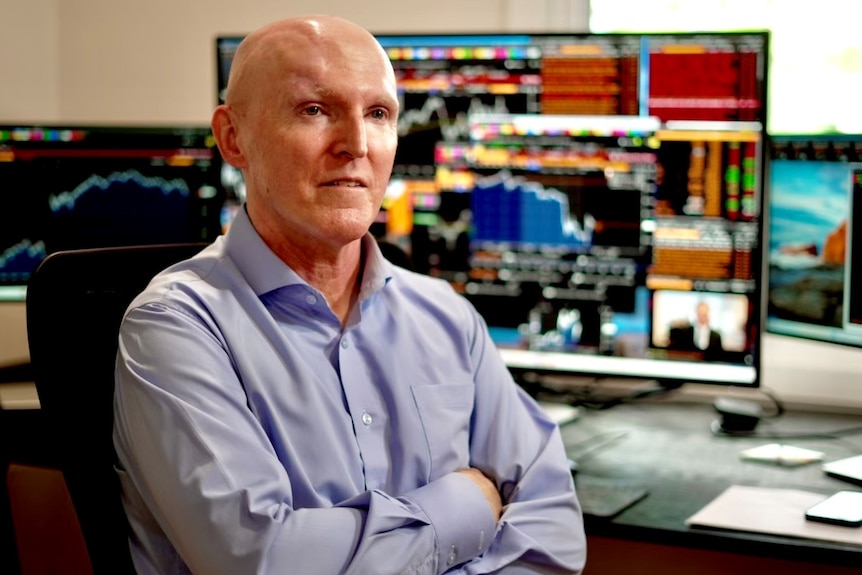
Sean Callow says global investors are not enthused by the Aussie dollar. (ABC News: John Gunn)
“The Aussie dollar is up about 8 per cent for the year while the US dollar index is down about 9 per cent, which highlights that global investors looking for an alternative to the greenback are not enthused by the Aussie, notwithstanding the RBA’s hawkishness,” InTouch Capital Markets senior currency strategist Sean Callow said.
After bottoming again in September, the Australian dollar found further strength for a few months, but since mid-November, a clear narrative has emerged: US interest rates could fall further still, while Australian interest rates may increase.
There’s a positive correlation between a nation’s interest rates and the value of its currency.
The potential for easier US monetary policy and tighter Australian monetary policy is pushing the value of the Aussie dollar higher.

Devika Shivadekar says the Aussie dollar will “likely appreciate … should the RBA remain hawkish”. (Supplied: Devika Shivadekar)
“The Aussie dollar would likely appreciate, especially against low-yield peers, should the RBA remain hawkish amid inflation challenges,” RSM Australia economist Devika Shivadekar said.
But Mr Callow is not expecting the Australian dollar to surge past 70 US cents, for example.
“Further USD decline seems likely in 2026 as President Trump chooses a Federal Reserve chair who will keep downward pressure on interest rates,”
he said.
“But a lacklustre global economy should limit Aussie dollar gains to around 0.69 to 0.70 [US cents].”
Mr Shivadekar thinks China’s economy, which is key to global economic growth, will be front and centre in contributing to that “lacklustre” performance.
“Key risks … stem from a China slowdown hurting commodity demand, global risk-off shocks, and a widening rate gap if the Fed/others stay tighter for longer,” she said.
The Australian dollar’s value also shifts with commodity markets.
While the price of iron ore has been steadily increasing since July, it’s the price of gold and silver that seem to be providing support for the local currency.
While the prices of precious metals have consolidated over the past couple of weeks, their years-long bull run has been impressive.
Gold has surged about 65 per cent in 2025.
Gold is a traditional haven asset that performs well during periods of economic and geopolitical uncertainty and can fall in price when the opposite is true.
Silver rocketed up 182 per cent last calendar year, driven by its critical mineral status, supply shortages and rising industrial and investor demand.
Businesses that import inventory will be hoping the recent ascent of the Australian dollar will continue.
The rising Aussie reduces their costs.
Exporters, however, will likely want to see the Australian dollar remain firmly under 70 US cents.
The sweet spot for exporters, analysts say, is roughly 65 US cents.
Meanwhile, Australians heading overseas will be keen to see the Australian dollar appreciate further.
The Australian dollar performed very well for Australians in the wake of the global financial crisis of 2008/2009 by rising beyond parity with the US dollar.
And in July 2024, the Australian dollar hit a peak against the Japanese yen, which saw many flock to the country.
The dollar is now down roughly 4 per cent from those levels.
So how is the Australian dollar expected to perform against the major currencies in the months ahead?
Movements against the yen will depend on Japan’s fiscal and monetary policies, while changes against the Chinese yuan may depend on Australian, US and Chinese trade policies.
The Reserve Bank and the US Federal Reserve’s interest rate decisions will move the Australian dollar against the US dollar.

Diana Mousina says the Australian dollar could get up to 70 US cents. (Supplied: Paul Pandoulis)
“It’s easy to see further appreciation, as [a] hawkish RBA vs [a] more dovish US Federal Reserve and downward USD pressure could see the Australian dollar even get up to 70 US cents,” AMP deputy chief economist Diana Mousina said.
“Fair value is more like 72 US cents but it’s hard to see significant upside beyond 70 US as euro and yen benefit more from lower USD and [we need to see] stronger global growth, and China to see [a] higher Australian dollar.”
If US interest rates fall significantly from here and Australian interest rates rise, the dollar, analysts say, will likely move convincingly above 70 US cents.
And US President Donald Trump’s foray into Venezuela puts another spanner in the works of the currency market.
Brace for big moves in commodities prices and currencies in the coming days and months.
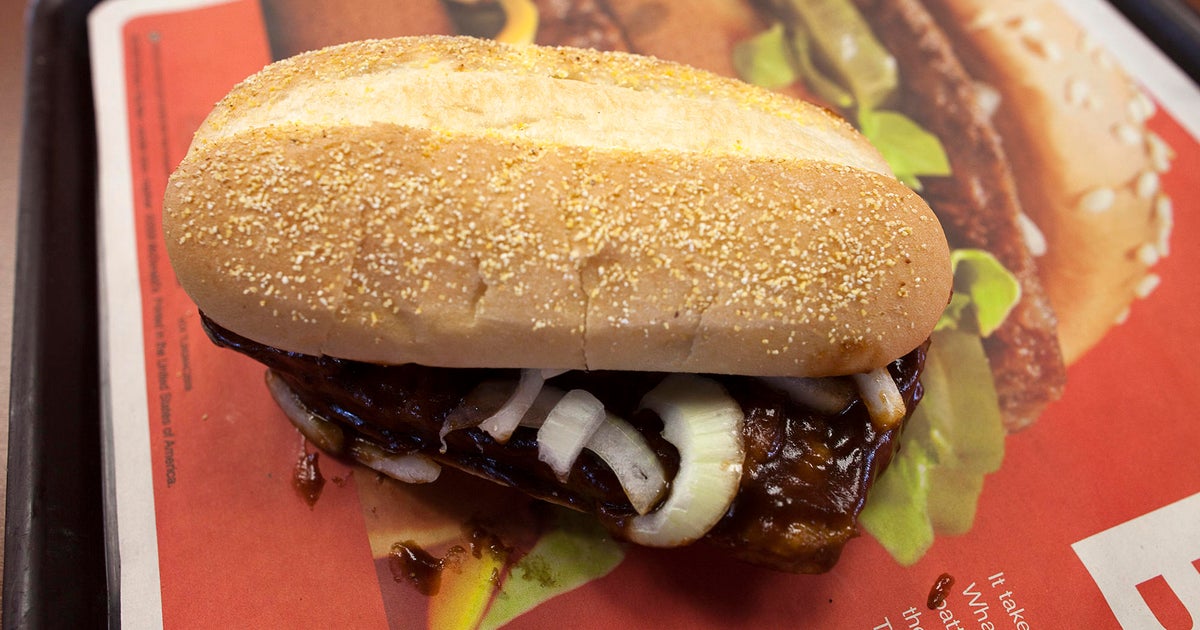
A lawsuit filed late last month took Chicago-based McDonald’s to task over the McRib sandwich, calling its name a form of false advertising.
The lawsuit was filed Dec. 23 in U.S. District Court in Chicago. Plaintiffs Peter Le of Baldwin Park, California; Charles Lynch of Poughkeepsie, New York; Dorien Baker of Chicago; and Darrick Wilson of Washington, D.C., sought class-action status in the lawsuit.
McDonald’s offers the McRib during limited windows with ad campaigns to announce their return each time, most recently starting this past November.
The lawsuit said McDonald’s has “cultivated a sense of anticipation around the McRib, leveraging its scarcity to drive sales across its many locations.”
As CBS News has reported before, the notorious 520-calorie sandwich contains just five simple ingredients: seasoned boneless pork dipped in BBQ sauce, sliced onions, and dill pickles in a toasted homestyle bun.
“When everything combines, you have BBQ pork sandwich perfection,” McDonald’s has said.
But the lawsuit alleged that fans of the sandwich assume they’re biting into pork rib meat, but the McRib does not really contain any.
Despite its name and distinctive shape — its meat patty has been deliberately crafted to resemble a rack of pork ribs—the McRib does not contain any actual pork rib meat at all,” the lawsuit said. “Instead, its meat patty is reconstructed using ground-up portions of lower-grade pork products such as, inter alia, pork shoulder, heart, tripe, and scalded stomach.”
The lawsuit said actual pork rib meat cuts — spareribs and baby back ribs — are premium cuts of pork that are more valuable than lower-quality cuts. Despite not containing any rib meat, the McRib is among the most expensive single-item options offered on the menu at McDonald’s, the lawsuit said.
“The name ‘McRib’ is a deliberate sleight of hand. By including the word “Rib” in the name of the sandwich, McDonald’s knowingly markets the sandwich in a way that deceives reasonable consumers, who reasonably (but mistakenly) believe that a product named the ‘McRib’ will include at least some meaningful quantity of actual pork rib meat, which commands a premium price on the market,” the lawsuit said. “McDonald’s does this despite knowing that the sandwich in fact does not contain any meaningful quantity of actual pork rib meat — indeed, none at all.”
The lawsuit said consumers are led to believe they’re eating rib meat when they’re eating a McRib, but are actually eating “a lower-quality restructured meat product that did not contain any actual pork rib meat.”
“Put simply: consumers have been materially misled en masse as a result of McDonald’s deceptive labeling and marketing into purchasing sandwiches that they would not otherwise have purchased, or would only have paid less for, had they known the truth,” the lawsuit said.
The lawsuit further alleged McDonald’s knows or should know that customers are being misled, given the name “McRib” and the way the sandwich’s patty is shaped to look like a pork rib.
The lawsuit accused McDonald’s of fraudulent omission or concealment, fraudulent misrepresentation, negligent misrepresentation, and other counts. It demanded an order “enjoining McDonald’s to desist from further deceptive naming, marketing and advertising practices with respect to the McRib and such other injunctive relief that the Court deems just and proper,” and an award of damages to the plaintiffs.
A response from McDonald’s was not immediately available.
McDonald’s first added the McRib to menus in Kansas City in 1981, according to CBS News Austin.
The chain pulled it from its menu four years later, but the sandwich has become a cult favorite among McDonald’s loyalists in recent years. It was previously sold regionally before expanding to all of its U.S. restaurants in 2020, CBS News Austin reported.

At times, LJ finds herself struggling to find the right words.
Sometimes her memory feels so bad, she says she copes with it by making fun of herself.
“I would semi-joke with my sister, like have I got a brain tumour, have I got Alzheimer’s?”
Yet…

NEW YORK CITY (WABC) — On this edition of Up Close, we discuss reaction to the inauguration of New York City Mayor Zohran Mamdani and the road that lies ahead for him.
It is the start of a new era in New York City politics. Zohran Mamdani, a…

Scientists reveals never-heard before information about microbes that…
What are you watching in 2026 when it comes to the economy or markets?
That’s the question we put to the ABC’s business journalists, presenters and commentators as we head into the new year.
From the Japanese bond market to intergenerational inequality and from unemployment to electric vehicles, here’s what they’re keeping an eye on in 2026.
Inflation is the indicator to watch in early 2026.
In fact, set an alarm for 11.30am on January 28. That is when the Australian Bureau of Statistics will release the December quarter’s CPI. The Reserve Bank Governor Michele Bullock has already indicated the quarter’s trimmed mean (or core inflation) will be key to the RBA’s deliberations for interest rates in early February.
Bullock could not have been clearer when fronting the media pack for the final time in 2025. She emphasised time and again the RBA is alert to the signs of a more broad-based pick-up in inflation.
The jawboning saw financial markets immediately reprice rate expectations. But was it also a warning to Australians to watch their holiday budgets, as well as the federal government to rein in the public spending of recent years ahead of a rate rise?
We have been given fair warning that the cash rate of 3.6 per cent could move higher in 2026. The likelihood of whether a hike could happen early in February, and at the RBA’s first opportunity for the year, will become much clearer as early as 11.30am on January 28.
Business editor Michael Janda will be interviewing the RBA’s deputy governor Andrew Hauser on January 8. (AAP: Lukas Coch)
What will happen to unemployment in 2026?
Australia’s unemployment rate touched a 50-year low of 3.4 per cent in October 2022, but it has been slowly grinding higher for the last three years.
In November it was 4.3 per cent.
The Reserve Bank thinks it will need to settle around 4.4 per cent for inflation to be under control.
Economists like to point out that an unemployment rate of 4.4 per cent is still low by modern historical standards. Between 1993 (when inflation-targeting began) and the start of 2020 (when the COVID pandemic hit), the unemployment rate averaged 6.3 per cent.
So if inflation can settle back down inside the RBA’s 2-3 per cent target range, and the unemployment rate can stay around 4.4 per cent, the RBA will take that as a win.
But if unemployment keeps rising, and other measures of “spare capacity” in the labour market (underemployment, youth unemployment, etc) keep deteriorating, the RBA’s hopes of “locking in” the hard-won employment gains from the COVID lockdowns may blow away with the wind.
Loading
Like most mortgage borrowers, I’ll be watching interest rates closely in 2026.
But what are they going to do?
After the Reserve Bank’s most recent rate cut in August markets were confident there’d be another two rate cuts by February, which would have taken the cash rate to 3.1 per cent, with a fair chance of a third cut before 2026 was done.
Fast forward past a couple of shockingly high inflation numbers and a press conference where Michele Bullock laid bare on the table that the choice now was between rates on hold and rates rising, and that market pricing has flipped completely.
Traders now collectively think there’s close to a 40 per cent chance of a rate rise in February, a near-certainty of one by June, and a better than 50-50 chance of two before the end of 2026.
I attend almost every one of RBA boss Michele Bullock’s press conferences, sit in all their Statement on Monetary Policy media lock-ups, and even have the odd one-on-one background chat with senior officials. So what do I think?
If I was a betting man, I’d wager on an extended hold because, as my colleague Gareth Hutchens points out, the jobs market looks a little shaky and I think the RBA would want to wait and see how things develop before raising rates.
But, as Kirsten Aiken notes, another couple of shockers for inflation data coming out on January 7 and 28 could force the bank’s hand as early as February.
I’ll be interviewing the RBA’s deputy governor Andrew Hauser on January 8, so maybe he’ll give us a bit of a steer… but I wouldn’t bet on it.
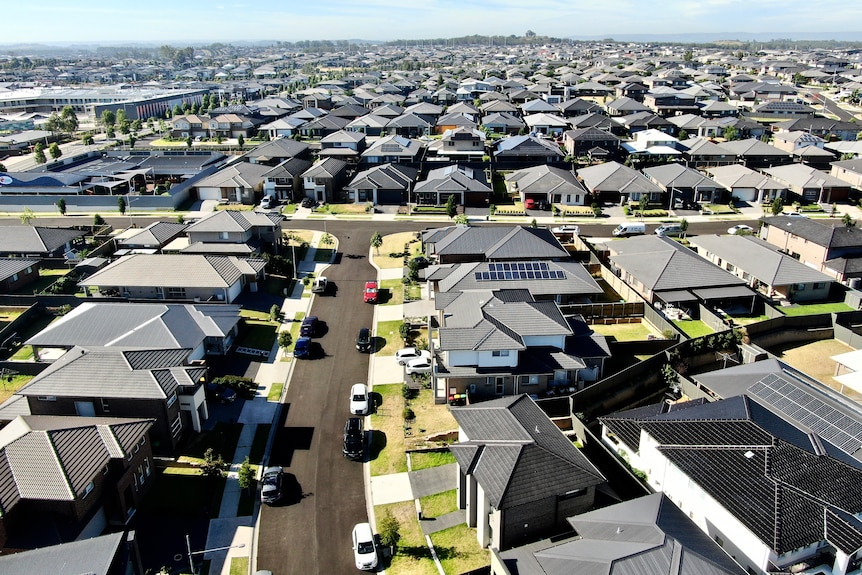
Housing has become increasingly unaffordable for younger Australians. (ABC News: John Gunn)
Intergenerational inequality is the biggest thing.
Younger people are being saddled with debt (personal and government) face the dizzying cost of dealing with the climate crisis and housing… Housing? I’ve only been given 200 words and I’m trying to swear less.
Our tax settings. Our benefits. The divergent ways we treat income from work and income from assets (like homes and shares).
In the second year of a second term, this is the time for Labor to take dramatic shifts to re-balance systems that overwhelmingly preference older and wealthier people.
For the Coalition the choice is much simpler: change or die.
The Australian Electoral Study demonstrates the “conservative maturation” theory — that people vote more conservatively as they age — isn’t happening. Some Millennials (born between 1981 and 1996) are 45-years-old: this year the Coalition won just 21 per cent of that group.
I don’t think anyone, as they gently rub the back of their grizzling baby through a sleepless night, with a long day of work stretching in front of them, thinks: “When my children do this, I hope things are harder for them.”
But that’s what we’ve done. We need to change it.

For the first time, in the inner city it seems feasible to own an EV without at-home charging capacity, with more councils rolling out street charging. (Troy Sincock, ABC)
In 2026 I’m going to be watching how electrification is accelerating in our economy.
I live in inner Sydney, so I’m very aware it’s a particular type of bubble, but it is a very populous one.
The increased number of electric vehicles on our roads is incredibly noticeable.
That’s reflected in the government’s decision to review its Electric Car Discount, citing industry data showing EVs now comprise about 10 per cent of new vehicle sales.
Car manufacturers had been accused of dumping their least efficient petrol cars in Australia, as we trailed other jurisdictions in restrictions on the sale of new combustion engine cars (although it seems Europe may be winding back its planned ban).
Now, there’s talk of China flooding the market with cheap EVs — the number of models available here has skyrocketed.
Whilst you used to only see the odd top-end Tesla, you’d now be hard pressed to take a glance at Parramatta Road and not spot a bunch of BYDs and mid-range EVs from the major manufacturers.
The second-hand EV market will keep gaining more depth too.
For the first time, in the inner city it seems feasible to own an EV without at-home charging capacity, with more councils rolling out street charging.
The government has also said energy retailers will need to offer free power in the middle of the day, to spread the benefits of solar beyond those who can afford panels and batteries, including to renters.
So is 2026 the year of electrification for the masses? Let’s see.
The low interest rate ‘risk on’ environment supported gains in risky assets like equities across the board, particularly in technology stocks. (ABC News: John Gunn)
If rates move higher will investors have to work harder for returns?
Active managers, who focus on the performance and outlook of individual companies have had a tough run in the last few years locally, outpaced by passive money chasing the benchmarks, like index funds.
The low interest rate “risk on” environment supported gains in risky assets like equities across the board, particularly in technology stocks.
Blackrock strategist for APAC and the Middle East Ben Powell says if rates drift higher, investors need an active investment strategy, “having to pick where we have conviction, be that in artificial intelligence or elsewhere. Because the central bankers, they’re still nice people, but they’re constrained by inflation from being quite as supportive for risk and for markets as we all got used to.”
So where to look if rates go up? Citi says AI won’t dominate quite as much in 2026 and expects cyclical stocks (those exposed to economic cycles like miners) to do well.
The investment bank prefers financial stocks over consumer staples (which are typically seen as defensive). It’s possible 2026 will finally be the year of the stock picker.
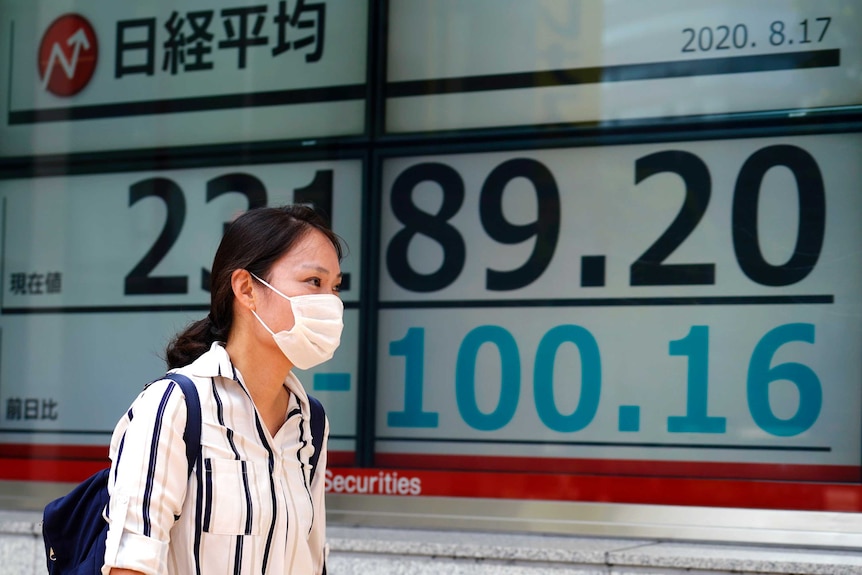
A woman walks past an electronic stock board showing Japan’s Nikkei 225 index at a securities firm in Tokyo Monday, Aug. 17, 2020. Japanese stocks sank while other Asian markets gained Monday after Japan reported a record economic contraction as the coronavirus pandemic weighed on retailing, investment and exports. (AP: Eugene Hoshiko)
All eyes will be on the Bank of Japan in coming weeks and months.
It’s considered a giant funding source to the world’s global financial markets, especially Wall Street.
In past decades Japanese interest rates have been extremely low.
Known as the carry trade, investors would borrow yen from Japan and invest in US assets including Treasury bills and stocks on Wall Street, which offered relatively lucrative returns.
On December 19, the Bank of Japan, keen to hit its inflation target of 2 per cent and with one eye on increased business confidence, hiked its benchmark interest rate by 0.25 percentage points to 0.75 per cent.
In contrast the Reserve Bank of Australia’s cash rate stands at 3.6 per cent.
Immediately following the announcement, the Japan 10-year government bond yield rose above 2 per cent — it’s highest level since 1995.
Trillions of dollars are tied up in and around the carry trade and Japanese investments in the US.
The key question is how high Japanese interest rates need to go before borrowing from Japan becomes too expensive, overriding future returns from US assets.
In this case, large flows of money could return home to Japan, deeply cutting into Wall Street liquidity and, potentially, Australian superannuation funds currently heavily exposed to American markets.

Australian businesses were caught out by US President Donald Trump’s global upheaval in 2025. (Reuters: Jonathan Ernst)
I’ll be watching out for more tariff turmoil.
Australian businesses — from beef producers through to bikini designers — were caught out by US President Donald Trump’s global upheaval in 2025.
We even had Australia Post temporarily suspend most shipping to the US! Many businesses are still recovering from the disruption to their supply chains and pricing structures, especially those that manufacture goods in China and then import them into the US.
I’ll be looking out for how the Australian government, including Austrade, deals with any more disruption, and of course at any more tariff directions out of the White House.