A Google AI product manager’s career advice is unexpectedly crustacean.
Marily Nika, who has worked in AI product roles for over a decade, said in an episode of “The Growth Podcast” by Aakash Gupta published Sunday…

A Google AI product manager’s career advice is unexpectedly crustacean.
Marily Nika, who has worked in AI product roles for over a decade, said in an episode of “The Growth Podcast” by Aakash Gupta published Sunday…

The U.S. Food and Drug Administration today approved the Zycubo (copper histidinate) injection as the first treatment for Menkes disease in pediatric patients.
“With today’s action, children with this devastating, degenerative disease will have an FDA-approved treatment option and the potential to live longer,” said Christine Nguyen, M.D., Deputy Director of the Office of Rare Diseases, Pediatrics, Urologic and Reproductive Medicine in the FDA’s Center for Drug Evaluation and Research. “The FDA will continue to work with the rare disease community to advance drug development for patients with Menkes disease and other rare conditions.”
Menkes disease is a neurodegenerative disorder caused by a genetic defect that impairs a child’s ability to absorb copper. The disease is characterized by seizures, failure to gain weight and grow, developmental delays, and intellectual disability. It leads to abnormalities of the vascular system, bladder, bowel, bones, muscles, and nervous system. Children with classical Menkes (90% of those with the disease) begin to develop symptoms in infancy and typically do not live past three years. It affects approximately one in every 100,000-250,000 live births worldwide and is more common in boys.
Zycubo is a copper replacement therapy given by subcutaneous injection. It delivers copper in a form that bypasses the genetic defect in intestinal absorption, allowing the body to better use the mineral.
The FDA evaluated Zycubo in two open-label, single-arm clinical trials in pediatric patients treated for up to three years. Overall survival was assessed by comparing treated patients to untreated patients from contemporaneous external control groups. The analysis included 66 treated patients and 17 untreated patients, most of whom were from the United States.
Children who began treatment within four weeks of birth had a 78% reduction in the risk of death compared with untreated patients. Nearly half of early-treated patients survived beyond six years, and some survived more than 12 years. No patients in the untreated control group survived beyond six years. Children who started treatment later than four weeks after birth also experienced a substantial survival benefit.
The most common side effects reported with Zycubo included infections, respiratory problems, seizures, vomiting, fever, anemia and injection site reactions. Because copper can accumulate in the body, patients receiving Zycubo should be closely monitored for potential toxicity.
“This approval marks an unprecedented advance for children with Menkes disease,” said Tracy Beth Hoeg, M.D., Ph.D., Acting Director of CDER. “The company demonstrated a large improvement in overall survival compared with untreated patients, using an innovative trial design that addressed the challenges of studying an ultra-rare disease.”
This application received Priority Review, Fast Track Designation, Breakthrough Therapy Designation, and Orphan Drug Designation. The FDA approved Zycubo for Sentynl Therapeutics.
###
Boilerplate
The FDA, an agency within the U.S. Department of Health and Human Services, protects the public health by assuring the safety, effectiveness, and security of human and veterinary drugs, vaccines and other biological products for human use, and medical devices. The agency also is responsible for the safety and security of our nation’s food supply, cosmetics, dietary supplements, radiation-emitting electronic products, and for regulating tobacco products.
Unlock the Editor’s Digest for free
Roula Khalaf, Editor of the FT, selects her favourite stories in this weekly newsletter.
The UK Competition and Markets Authority did not block any deals last year after the agency came under government pressure to be more business-friendly.
The CMA reviewed and cleared 36 mergers in 2025, blocking no deals for the first time since 2017, according to data compiled by US law firm Simpson Thacher & Bartlett and shared with the FT.
The antitrust agency stopped one deal in 2024 and has previously prevented as many as four deals in a year, according to the report.
The lack of prohibitions comes after the UK government decided to oust former chair, Marcus Bokkerink, in January 2025, over concerns the regulator was hampering its pro-growth agenda. Bokkerink was replaced on an interim basis by former Amazon UK boss Doug Gurr, who is still in post.
In February, shortly after Bokkerink’s departure, the CMA cleared the $570mn purchase by American Express Global Business Travel of rival CWT in an unusual reversal of an earlier decision.
The CMA, which investigates where there is a risk a transaction could reduce competition, has sought to appease the government over the past year by simplifying its merger review process and stepping back from looking at global deals where the UK is less relevant.
The number of interventions — when the CMA demands changes for a deal to proceed — was also lower last year. Six deals were cleared subject to conditions, compared with 7 in 2024, when 33 mergers were concluded, and 12 in 2023, when 36 were reviewed.
“The UK government’s shift towards a pro‑growth agenda had an immediate and unmistakable influence on the CMA’s merger control work in 2025,” said Antonio Bavasso, head of European antitrust at Simpson Thacher and the lead author of the report.
Bavasso added: “We now have a full year of data to show how the government’s pressure on the CMA has played out and the data really confirms what we knew was going to happen — that a correction has taken place.”
In a statement, the CMA said: “This data depends on the number of strategic M&A deals taking place which meet our threshold and whether those deals raise competition concerns.
“Every deal that is capable of being cleared, either unconditionally or with effective remedies, should be. But we will block anti-competitive deals where no effective remedy can be found.”
The government is looking at further overhauling how the CMA reviews mergers in 2026, moving away from the use of independent panels of experts and instead using a committee of the CMA board. A consultation on the change is expected to start in the coming weeks.
A lighter touch UK competition approach comes amid a wider politicisation of antitrust enforcement globally following changes in government and agency leadership.
The Simpson Thacher report also found that the number of merger settlements — deals agreed with conditions rather than litigated — in the US increased significantly last year for the first time since 2021.
Under the current administration of US President Donald Trump, merger interference from antitrust authorities has slowed significantly, with 14 enforcement decisions in 2025 compared with more than 20 annually in recent years, the report found.

Unlock the Editor’s Digest for free
Roula Khalaf, Editor of the FT, selects her favourite stories in this weekly newsletter.
The writer is chair of Rockefeller International. His latest book is ‘What Went Wrong With Capitalism’
India is still reporting world-beating economic growth but no longer getting any love for it. Flows of foreign money into the country have dried up, suggesting outsiders believe that the reported GDP growth rate of over 8 per cent masks underlying weaknesses.
Most strikingly, corporate revenue normally grows (or shrinks) with the economy — in any country. But last year corporate revenue growth for listed companies in India decelerated to barely half the GDP growth rate. Rather than taking comfort in the headline real GDP figures, which are likely to be boosted by technical factors related to adjustments for inflation, policymakers would be wise to address some key faultlines.
Among the leading signs of weakness: India is losing more people and attracting a lot less money than it used to. This decade, a net total of 675,000 people emigrated each year, up from 325,000 in the 2010s. Only Pakistan, Bangladesh and Ukraine have seen a larger exodus while China is haemorrhaging people at the same pace as it did in the last decade, 300,000 a year. A chunk of this outflow from India is “brain drain” — a loss of exactly the skilled workers it needs to compete in advanced fields. As a result, one-third of Silicon Valley’s tech workforce is now Indian.
Employment growth continues to be weak; even at the famed Indian Institutes of Technology, 38 per cent graduated without a single job offer from a campus recruiter in 2024. Many Indians are leaving to find work in the few countries still friendly to immigrants, such as the UAE and Saudi Arabia, drawn in by the region’s construction boom.
A sense of limits is reshaping capital flows as well. India has long attracted only modest capital from abroad, thanks in large measure to the lingering “Licence Raj”, which can make it prohibitively expensive to acquire land or hire and fire workers. Asian economies that have sustained rapid growth — such as China and Vietnam more recently — saw net foreign direct investment surge above 4 per cent of GDP during their boom phases.
That figure never surpassed 1.5 per cent in India, and it is now just 0.1 per cent. Over the past decade, India dropped in the rankings for net FDI/GDP, from 12th to 19th among the 25 largest emerging countries. While the net numbers have been depressed recently by foreigners repatriating past profits, gross flows are low too, with India ranking below most emerging markets last year.
In addition to India’s long-standing reputation as a difficult place to do business, new risks have been holding back foreign investors including New Delhi’s deteriorating relations with its neighbours, the tariff battle with Washington and doubts about its tech potential. China and South Korea spend more than 2.5 per cent of GDP on research and development; India’s outlays last year were just 0.65 per cent of GDP. It is no surprise then that it has no serious players in AI.
These shortcomings are souring financial markets. After a long drought, stock markets in the emerging world finally saw net inflows last year. India, however, experienced record net outflows of $19bn. The intense foreign selling was countered by domestic buyers, with households keen to increase their historically low exposure to equities. Nonetheless, the Indian stock market significantly lagged behind its peers last year.
India needs much more foreign capital to grow rapidly because its domestic savings pool is not enough. Unlike the east Asian economic miracles, India has a weak manufacturing sector, so it never became an export powerhouse and has almost always run a current-account deficit. Among other beneficial side effects of foreign capital — particularly of direct investment — is that it brings greater access to new technology.
India’s basic weaknesses point the way forward. Over the past year, New Delhi took significant steps to streamline the labour code, simplify bankruptcy rules and launched an agency devoted to further cuts in red tape. The hope is that these reforms will finally spur new investment.
It is no coincidence that domestic private investment in India has also been anaemic over the past decade, held back by the same regulatory maze and overzealous bureaucracy that foreigners complain about. And boosting investment, both domestic and foreign, is the key to creating jobs and stemming the exodus.
India’s real growth rate will be revealed over time, as the technical factors distorting the economic data wash out. Regardless of what that number is, the tell-tale sign that India is on the miracle path will appear when it starts to import more capital and export fewer workers.
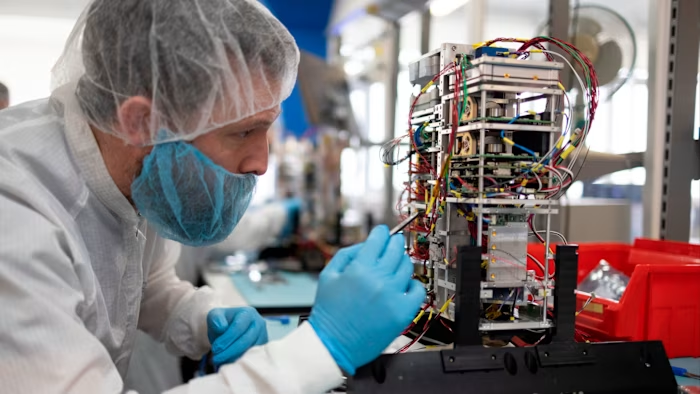
In an anonymous office block towering above the trendy bars of Finnieston, engineers delicately stack guidance devices and solar panels around the “CubeSats” that have turned Glasgow into Europe’s manufacturing capital for these small,…
Unlock the Editor’s Digest for free
Roula Khalaf, Editor of the FT, selects her favourite stories in this weekly newsletter.
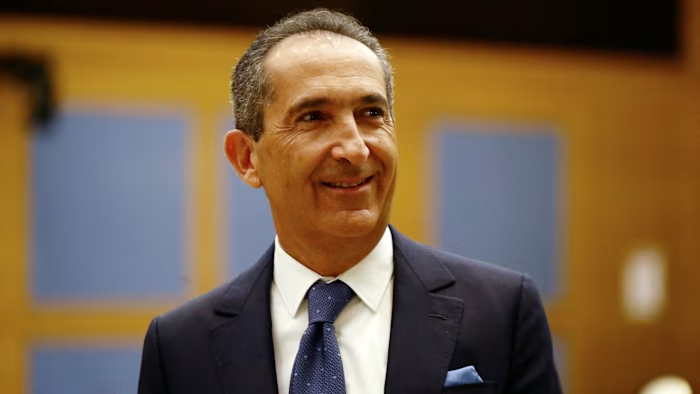
Telecoms tycoon Patrick Drahi has relaunched the sale of his 50 per cent stake in German superfast broadband network OXG Glasfaser, as the French-Israeli billionaire continues to explore ways to cut his debt pile.
Drahi, whose Altice unit partnered with Vodafone’s German operation to launch the network in 2023, sent teaser documents to buyers in recent weeks, according to three people familiar with the matter. OXG is valued at about €2bn, according to estimates from New Street Research.
The attempted sale, which follows an earlier effort to find a buyer last year, comes as Drahi explores options to relieve a debt pile of more than $50bn. The tycoon is considering a sale of his €7bn French fibre network XpFibre and in October rejected a €17bn bid for French mobile operator SFR.
OXG committed to spending €7bn to roll out fibre broadband to more than 7mn homes in Germany over a six-year period following its launch in March 2023. However, progress has been slow, with the network reaching just 500,000 homes by the end of 2025. The speed of the network rollout is expected to accelerate this year.
Infrastructure funds such as Antin Infrastructure Partners, which lost out to Drahi when the network was launched, could be interested in a renewed offer, according to a person familiar with the matter. Antin declined to comment.
However, any agreement to sell his stake will require Drahi to gain approval from Vodafone, which may complicate an attempt at a quick sale process. Vodafone declined to comment.
Drahi, who built a telecoms empire including operations in France, Portugal and the US via a $60bn debt-fuelled acquisition spree a decade ago, has come under increasing pressure to refinance and restructure his debts due to rising interest rates.
Last year he finalised a deal with creditors to Altice France to cut the company’s debt burden from €24bn to €15.5bn, while a similar deal could be struck to reduce the €8bn of debt held against his Altice International operation.
In November the billionaire infuriated Altice International’s creditors by moving the bulk of the group’s assets — including those in Portugal and the Dominican Republic — out of their group of collateral, meaning they could not call on them should the debt not be repaid.
The move was seen by analysts as a threat to creditors ahead of a potential restructuring, in order to generate a more favourable deal for Drahi.
James Ratzer, analyst at New Street Research, said that although investors had been “sceptical” about other German fibre investments, OXG was a more attractive opportunity.
“We are more optimistic of better returns [from OXG] given the potential to build a longer-term monopoly,” he added.
Altice did not immediately respond to a request for comment.

Zanubrutinib combined with rituximab and lenalidomide (ZR2) produced high remission rates and durable survival in adults aged 75 years and older with newly diagnosed diffuse large B-cell lymphoma (DLBCL), according to phase 2…

The Spartans have now won eight-straight games to…

Commonwealth Bank will provide its Emergency Assistance to customers and businesses in areas affected by significant weather events in Queensland.
Retail Banking Services Group Executive, Angus Sullivan, stated “We are continuing to assess the impacts of flooding and severe weather across parts of Queensland. Our focus is on supporting our customers, communities and employees, with a range of measures in place to help customers navigate their recovery and access support if needed. We also recognise and thank emergency services personnel and volunteers for their work to assist and support impacted communities.”
CBA understands each customer will have different needs and we encourage them to discuss their individual circumstances by either contacting the bank in the CommBank app or phoning 1800 314 695. Business customers can also call 1800 314 695 or speak with their dedicated CommBank relationship manager.
For more information on the support we’re providing to impacted communities, visit: commbank.com.au/support/emergency-assistance.
CBA Emergency Assistance includes a range of options for eligible customers, including:
To access this support, customers should contact the bank through the CommBank app. Alternatively, they can call 1800 314 695. Branch availability and further information about CBA’s Emergency Assistance is available online at commbank.com.au/support/emergency-assistance.
For emergency help call the State Emergency Service on 132 500 or visit your State Emergency Service Website
In a life-threatening emergency call 000 (triple zero).
During this time customers should also remain vigilant and be extra cautious of unexpected calls or messages claiming to be from well-known organisations including banks, telecommunications companies and government agencies.
CommBank will never send customers links in text messages directing them to sites that ask for passwords, and customers should never click on any of these they receive.
If customers receive an unexpected call claiming to be from CommBank, they should ask the caller to verify the legitimacy of the call by using CallerCheck which triggers a security message in the CommBank App.
How customers can better protect themselves from scams: