
There are more than 100,000 supplements on the US market – capsules, powders, tablets and gummies sold to improve or maintain health. Supplements can contain vitamins, minerals, botanicals and amino acids on their own or in various…



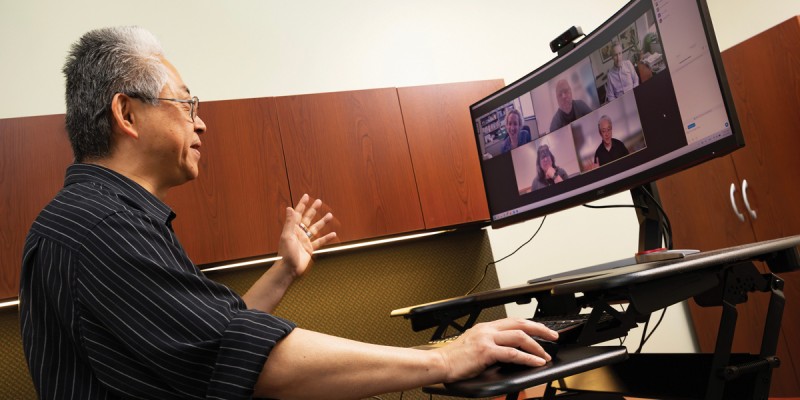
Zoom meetings are piling up in your calendar. Ping! Your supervisor just messaged you, asking for a quick update on a project.
Later, a frustrated co-worker wants to hop on a video call to walk through the process for posting on your organization’s website; it’s too complicated to explain via email.
Does any of that sound familiar?
The COVID-19 pandemic forced many businesses and organizations into remote work. In the years since, what began as a safety measure has, in certain ways, reshaped workplace culture. Many workplaces have restored in-person schedules; in others, remote or hybrid options have had mixed results.
Researchers at Binghamton University are investigating the advantages and challenges of remote-work practices from different angles, leaning into their expertise in areas such as leadership development or navigating complex systems. Keenly aware that students are entering a workforce with new expectations about the dynamics of office life, Binghamton researchers are beginning with basic questions:
- How can we build virtual teams to optimize creativity and the flow of ideas?
- What’s the most effective way to stand out as a leader in virtual workplace settings?
- Can you manage virtual teams as effectively as in-person groups?
- How can companies make work-from-home practices sustainable?
The most obvious benefit of a virtual work environment is enhanced flexibility. It has improved accessibility for employees by reducing travel and encouraging a healthier work–life balance, says Hiroki Sayama, distinguished professor of systems science and industrial engineering and an expert on complex group dynamics.
“There are things you can accomplish more effectively online and things that work better in person,” Sayama says, “so instead of viewing it as one option being better than the other, managers would benefit by looking at which option is best suited to meet the objective.”
A study published in January 2025, co-authored by Sayama and Shelley Dionne, dean of Binghamton’s School of Management, offered insights into how people should be organized to develop the best ideas. Larger teams of people with diverse backgrounds tend to produce more conservative — almost “safer” — ideas because everyone vetted them from their own areas of expertise, according to the study. Those who interacted with fewer group participants felt more isolated, but they also produced stronger ideas.
The U.S. Bureau of Labor Statistics has documented the potential staying power of remote-work practices. It found the percentage of remote workers in 2021 was higher than in 2019, and major industries — including finance, technical services and corporate management — still had more than 30% of their employees working remotely in 2022.
A Pew Research Center survey showed that three years after the pandemic, 35% of workers with jobs that could be performed remotely were still working from home full time.
“How much innovation happens in virtual settings compared to face-to-face settings? It depends; there’s increasing scientific evidence that we’re perhaps missing in virtual meetings many of those ‘serendipity’ moments that could have happened if you’re in the physical office, bumping into people throughout the day and having those smaller conversations that help generate ideas,” Sayama says. “In virtual settings, it’s easy to focus more on the prescribed agenda items, logging off once the meeting is over, instead of those random connections that could lead you in new directions.”
Standing out in a virtual crowd
Sitting around a table as a group makes the banter between team members feel more natural. You can read a person’s facial cues and gauge how others respond to ideas.
The same can’t always be said if you’re in a virtual meeting. Osterhout Associate Professor of Entrepreneurship Chou-Yu (Joey) Tsai, who co-authored a study in 2024 on cultivating leaders in virtual teams, says dominating a team discussion in a virtual setting doesn’t necessarily make a person a better leader. In virtual teams, where people cannot pick up on nonverbal cues as easily, a person’s responsiveness to other team members plays a significant role in whether they’re perceived as a leader.
But for that leadership to be effective and teamwork to be successful, Tsai adds, all the group’s participants must also speak up.
“Hybrid models are probably the most effective, because you still have some people in the same room to directly engage with others in a conversation. That can’t happen in purely virtual teams, so unless you have a specific role assigned to everyone involved in the virtual team collaboration, it might not function as effectively,” Tsai says. “At the same time, we found the best way to mimic those essential social cues in a virtual setting is to directly state your reaction or what you’re thinking instead of just your facial expression.”
But there’s another layer to ensuring remote or hybrid workplaces achieve positive results, and it’s the backbone of research by School of Management doctoral student Yu Wang. By digging into remote-work practices used to varying extents by 200 of the top law firms across the United States, she’s learning how these approaches could impact human capital, firm productivity and employee satisfaction.
As a strategic policy, Wang says, working from home helps companies reduce costs such as rent and operational expenses, which can prove valuable for employers in high-cost city centers.
Wang’s research has led her to believe businesses can benefit from optimizing their remote-work policies, even though there isn’t a “one-size-fits-all” solution. If it’s implemented properly, she says, a remote or hybrid approach could expand job applicant pools and be especially beneficial for some groups, such as pregnant women and people with disabilities.
“Providing remote or hybrid options helps organizations retain talent, especially in industries such as law firms or technology, where employees value autonomy a lot,” Wang says. “Allowing companies to access a broader client base without needing to build new physical offices could also help them unlock new market opportunities while avoiding increasing costs.”
A generational shift and looking ahead
When lockdowns prompted by the pandemic sent employees home, students also had to adapt to learning in remote classroom environments. While this shift reshaped how students approach learning, it also influenced their expectations about flexible work schedules.
Tsai views the continued use of remote or hybrid work as an opportunity for educators to cultivate interpersonal skills that might be conveyed more naturally in person but could make a more substantial impact in virtual settings.
He has also noticed that the current generation of students is more acclimated to socializing online through social media platforms, so it’s no surprise that they might instinctively prefer a meeting on Zoom.
“If we don’t reinforce those skills and show how to integrate those in virtual settings, you could run the risk of people losing a sense of meaning to their work,” Tsai says. “It can be much harder to mimic the close mentorship among colleagues in a virtual space; you don’t learn from your co-workers in the same way, and if you do learn, it’s at a much slower pace.”
This trend could easily continue for a decade or longer as the younger workforce becomes more entrenched, Sayama says, potentially clashing with the viewpoints of older managerial generations.
However, one avenue he’s exploring is how the emergence of artificial intelligence (AI) systems might enhance or exploit virtual work environments.
Whether it’s AI-driven transcription services or using AI in communication algorithms, tools could help improve efficiency in remote workplaces, as long as they don’t completely replace human connections. Sayama says a similar dynamic arose when email became a mainstream asset, and for the younger generation, integrating online technology into the workplace has become routine.
Looking ahead, the trick will be recognizing when AI should serve as an asset and not a replacement.
“If we’re meeting face-to-face, there’s little room for AI to intervene,” Sayama says. “But as online working environments drive more transition in the coming years, we will likely see more automated communication processed by algorithms.”
Organizations could ensure the long-term success of work-from-home practices by establishing effective mentoring and support systems, Wang says. These could include cross-location communication mechanisms to help employees stay connected, build trust and strengthen team cohesion regardless of where they work.
“To make working from home a sustainable strategic practice, organizations need to go beyond simply ‘allowing’ employees to work remotely by also providing strong internal management support,” Wang says. “This includes leveraging human resource systems to ensure that remote employees have equal access to growth and career development opportunities, such as promotions, training, performance management and recognition.”