North Bristol NHS Trust (NBT) has teamed up with players from Bristol Rovers Football Club as part of a collaboration with Bristol Rovers Community Trust (BRCT) to encourage local people to get their flu…

North Bristol NHS Trust (NBT) has teamed up with players from Bristol Rovers Football Club as part of a collaboration with Bristol Rovers Community Trust (BRCT) to encourage local people to get their flu…

White & Case Global Head of Mining & Metals, Rebecca Campbell, and Gabrielle Goodrow, senior associate in White & Case’s Project Development & Finance Group, spoke with IJGlobal as part of its Energy Transition Report 2025, discussing how critical minerals have become a central geopolitical battleground, with countries taking a more active role in the evolution of global supply chains amid ongoing structural and practical challenges.
Many nations today agree they need to take the reins of production, processing and import of these minerals. The US, in particular, has produced a raft of domestic policies that are impacting markets worldwide. Goodrow notes “a growing share of global flows is being directed toward the United States, which is working to position itself as a key anchor market for critical minerals.”
Reproduced with permission from IJGlobal. This article was first published in http://www.ijglobal.com/.
Any views expressed in this publication are strictly those of the authors and should not be attributed in any way to White & Case LLP.
This publication is provided for your convenience and does not constitute legal advice. This publication is protected by copyright.

Global law firm White & Case LLP has advised Pemberton Asset Management on a €150 million private debt financing related to ICG’s investment in Excellera Advisory Group (Excellera), a leading provider of corporate communications and public affairs services in Italy, to support its future growth.
The investment will support Excellera in leveraging its established presence and scale as market leader, positioning it for further consolidation in Italy and international expansion in key geographical hubs.
The White & Case team in Milan which advised on the transaction included partners Stefano Bellani and Luca Maffia and associates Nicola Tosin and Gabriele Costanzo Piccinino.
Press contact
For more information please speak to your local media contact.

Researchers at the School of Engineering and Applied Science have launched Observer, the first multimodal medical dataset to capture anonymized, real-time interactions between patients and clinicians, allowing outsiders to peer…
President Cyril Ramaphosa has this morning, 12 January 2026, arrived in the United Arab Emirates (UAE) at the invitation of His Highness Sheikh Mohammed bin Zayed Al Nahyan, President of the UAE, to participate in the Abu Dhabi Sustainability…
Together with collaborators including lab member Wesley Ingwersen, who created the U.S. EPA model and led work on it until the agency shuttered it in August 2025, Davis is now working to make a global model freely available and easy to use through an effort called Cornerstone. “The reason companies haven’t been using the global models is they’re not as easy to come by. They are a lot more involved to build, and there hasn’t been an easy, open-source version,” said Davis.
The group is integrating the former government database with the multi-region model analyzed in the study, which was developed by a private company called Watershed, where Davis chairs the science advisory board and previously served as head of climate science.
“When available tools neglect international sources of emissions, companies’ sustainability decisions suffer,” said study co-author Michael Steffen, Watershed’s head of climate analytics.
The team aims to release the merged model in late 2026, with ambitions to account for emissions from land-use changes and deforestation in later research and iterations. “If you’re getting soybeans from Iowa, it has a very different footprint than if you’ve cut down some of the Amazon to grow those soybeans,” Davis said.
Scientists from the World Wildlife Fund and CDP, formerly known as the Carbon Disclosure Project, co-authored the paper. “These are NGOs that are really interested in minimizing greenwashing and making sure that corporate climate actions are as beneficial as possible,” Davis said.
Some critics question whether models based on sector-wide averages and spending like those analyzed in the study are the right approach to estimate upstream emissions at all – regardless of whether global or single-region models are used. “I think we could all agree that if you had perfect data about exactly what was going on in your supply chain, you could make even more accurate estimates and leapfrog all of these models,” Davis said. “The reality is, though, that it’s still really difficult to get a lot of that data, and there’s little prospect of getting it without much more stringent regulations than are even on the table.” As a result, he said, there’s value in improving the modeling approach even if the long-term strategy is to get better data.
Corporations seeking to track and reduce emissions in their supply chains have the potential to make a meaningful difference in global carbon pollution, Davis said. “They are making sizable investments. If those dollars are directed to the right places, it could meaningfully reduce global emissions,” he said.
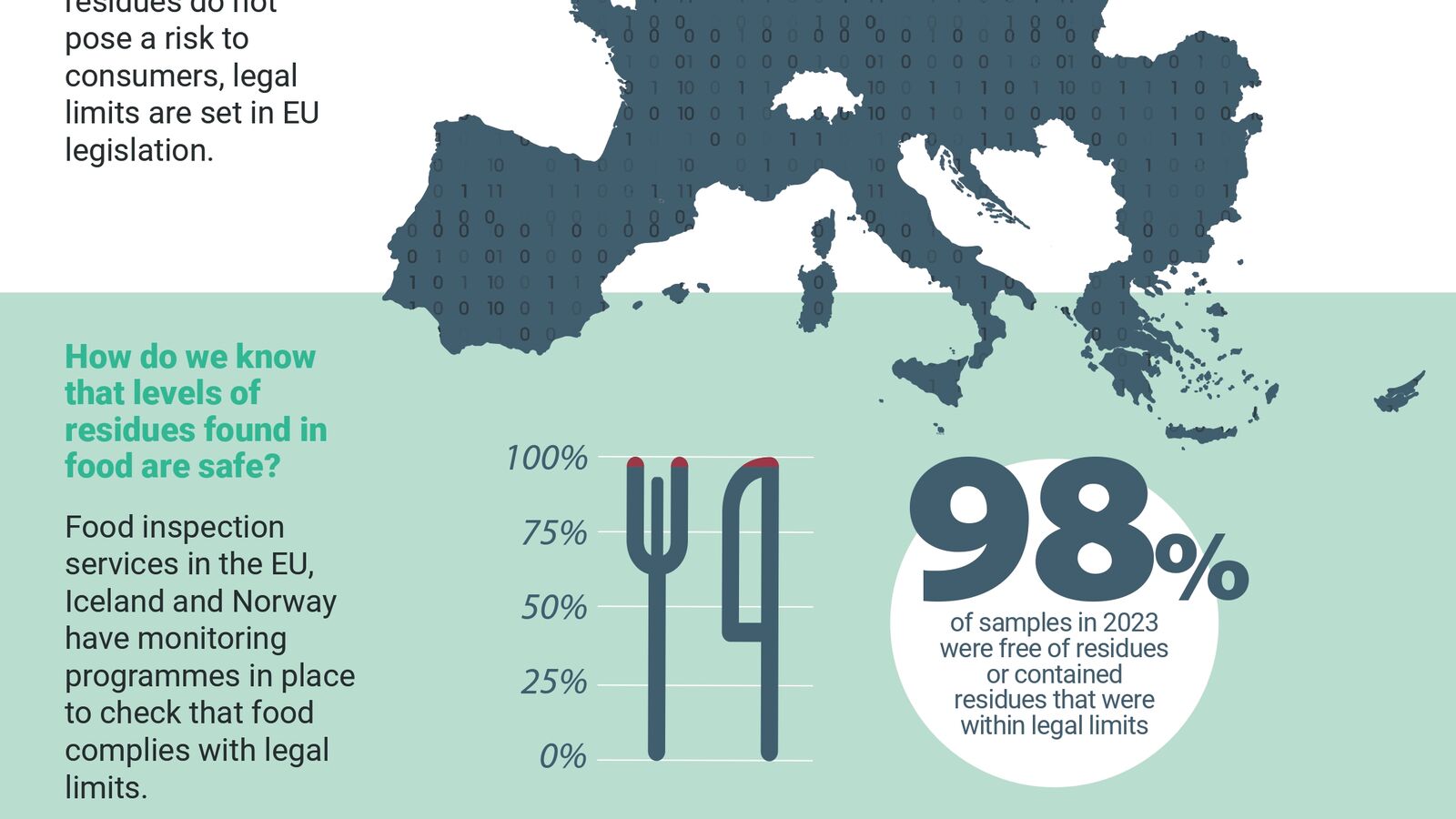
133,000 samples collected in 2023
Crops that have been treated with pesticides may contain residues. To ensure that pesticides are used correctly and their residues do not pose a risk to consumers, legal limits are set in EU legislation,
Food inspection services in the EU, Iceland and Norway have monitoring programmes in place to check that food complies with legal limits.
98% of samples in 2023 were free of residues or contained residues that were within legal limits.
Official laboratories test the food samples for the presence of more than 740 pesticides.
Around 26 million individual test results for pesticide residues
are reported to EFSA per year and summarised in an annual report.
EU decision-makers use EFSA’s conclusions and recommendations to
strengthen future monitoring programmes.
EFSA is the keystone of EU risk assessment regarding food and feed safety. In close collaboration with national authorities in open consultation with its stakeholders, EFSA provides independent scientific advice and clear communication on existing and emerging risks.
© European Food Safety Authority, 2025. Reproduction is authorised, except for commercial purposes, provided that the source is acknowledged.
Photo credits: Shutterstock
Catalogue Number(*): TM-01-25-015-EN-N | ISBN 978-92-9499-752-4 | DOI: 10.2805/0181725

Tuberculosis (TB) is an infectious disease caused by a mycobacterium, Mycobacterium tuberculosis (known as Koch’s bacillus), which most often affects the lungs (pulmonary tuberculosis) but can also affect other organs…
A 14-year-old boy was reportedly shot dead in Balochistan, while six Baloch men have disappeared in separate incidents. According to the Baloch Yakjehti Committee (BYC), 14-year-old Raahi Assa was killed in the main bazaar of Hoshap, Kech….