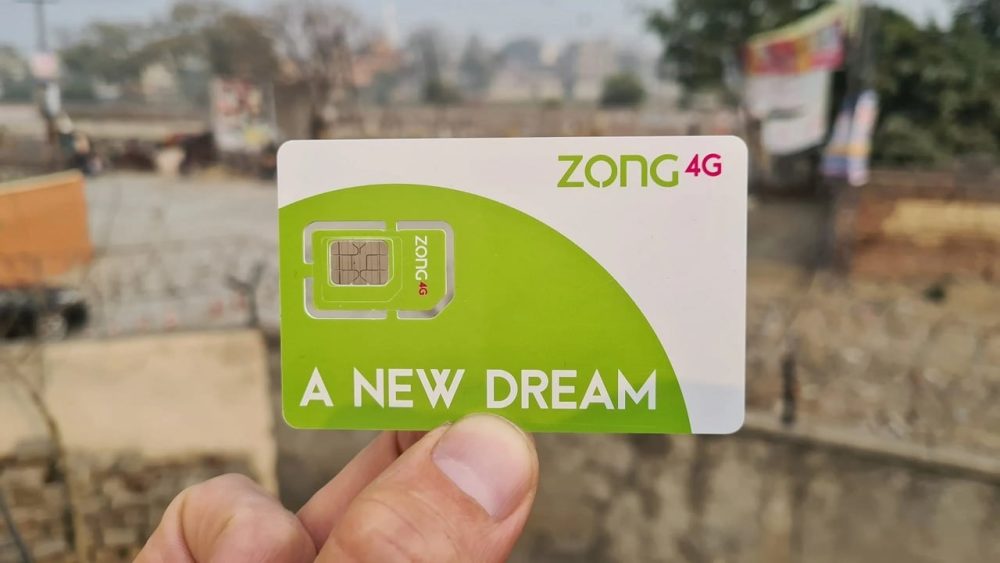
Zong has once again emerged as the top-performing mobile network in Pakistan, according to the Pakistan Telecommunication Authority’s (PTA) independent Quality of Service (QoS) survey for the third quarter of 2025.
The survey, which covered 17 cities and two major roads, and included roughly 46,000 voice calls and SMS tests plus about 0.33 million broadband samples, placed Zong first in several critical categories, including 4G coverage, voice quality, and SMS performance, and multiple broadband throughput metrics.
Jazz was in second place overall, while Ufone and Telenor came in at 3rd and 4th, respectively. Here is a detailed breakdown of network rankings in each performance category.
4G Coverage and Voice Calls
Zong led the chart in mobile network coverage across 15 cities for 4G and in 11 cities for 3G, placing it first in the coverage ranking. By comparison, Jazz recorded 13 compliant 4G city results and Ufone 12, while Telenor lagged with compliance in only six cities for 4G.
In terms of voice calls, which is a composite of Network Accessibility, Call Setup Success Rate (CSSR), Call Connection Time (CCT), Call Completion Ratio (CCR), and Mean Opinion Score (MOS), Zong topped the standings with 86 compliant voice QoS KPIs against 9 non-compliant.
Latency and Web Browsing
Latency results show a more nuanced performance. In the PTA’s auto-mode latency, Zong’s average was higher than the very best performers (the survey summary shows average latencies of Jazz ~68 ms, Telenor ~67 ms, Zong ~77 ms, and Ufone ~98 ms), placing Zong behind Jazz and Telenor on this specific metric. However, in 3rd-party app latency testing, Zong remained broadly compliant across almost all cities (18 compliant, 1 non-compliant), tying it with Ufone for second place in the 3rd-party latency standings.
For web page loading time, Zong trailed leaders Ufone and Jazz (Zong was compliant in 13 cities and non-compliant in 5), indicating that while Zong’s raw throughput and upload performance are ahead of others, web-page QoE still favored some competitors in a handful of locations.
Jazz remained competitive, particularly for auto-mode download throughput (leading in 11 cities), and Telenor and Ufone each led in selected non-service KPIs (latency, web page loading) across parts of the survey footprint.
This is a comparative report and does not cover all of Pakistan. A mobile network winning this survey does not mean it is a flawless performer, but simply ahead of others in the 17 cities covered in the test.
The European Central Bank kept interest rates on hold on Thursday for the third meeting in a row despite concerns that a modest economic recovery across the eurozone will fuel inflation.
The ECB kept its key deposit rate at 2% despite annual price growth rising to 2.2% across the 20-member euro bloc in September, up from 2% in August and 1.7% a year earlier.
In the 27-member EU, annual inflation was 2.6% in September, up from 2.4% in August, according to Eurostat.
The eurozone economy expanded by 0.2% in the third quarter from the previous three months, according to preliminary data from the European Commission published on Thursday.
The increase was higher than the 0.1% City analysts expected of 0.1%, with the rise driven mainly by strong performances in Spain, which expanded by 0.6%, and a 0.5% increase in France.
The ECB rate decision follows a divergence across the eurozone in prices growth, which the central bank is expected to maintain at about 2%.
Cyprus kept inflation at zero, while it increased modestly to 1.1% in France and 1.8% in Italy and Greece. However, Romania reported an inflation rate of 8.6%, to add to Estonia’s 5.3% and Slovakia’s 4.6%.
The ECB has said it is concerned by the high level of inflation from services, food and energy. However, it has trimmed its main deposit rate to 2% over the past year and a half – about half the rate in the UK and US.
skip past newsletter promotion
after newsletter promotion
The Bank of England is widely expected to keep its headline rate at 4% when its policymakers meet on 6 November. On Wednesday the US Federal Reserve trimmed its benchmark rate by a quarter point to a range of 3.75% to 4%, the second cut this year.
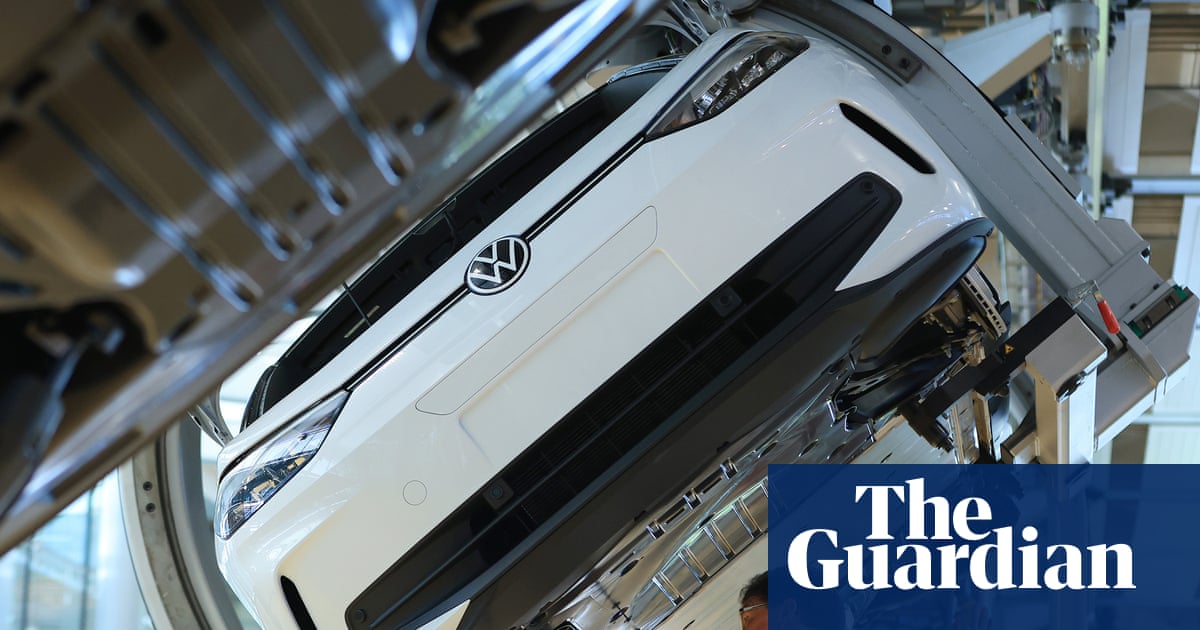
Volkswagen has signalled that its annual profit targets are at risk without sufficient computer chips, in the latest sign that an expected shortage of semiconductors from China could hit carmakers across Europe.
The struggling German automotive firm said a series of cost cuts and new model launches were helping to offset a slump in Chinese demand, but it added that forecasts were based on the “adequate availability of semiconductors”.
Carmakers in the EU have said they may have to close production lines amid dwindling supplies of chips from Nexperia, the Chinese-owned producer.
Beijing banned exports from Nexperia after the Dutch government took over the company, which is based in the Netherlands, at the end of September and suspended its Chinese chief executive after the US raised security concerns.
VW company sold 6.6m cars in the first nine months of 2025, up 1.8% year on year. It forecast an operating profit between 2% and 3% for the full year but said US trade tariffs were dragging on its most popular cars. The levies are expected to cost €5bn (£4.4bn) this year, said Arno Antlitz, VW’s chief financial officer.
Volkswagen reported a €1.3bn operating loss after a U-turn on its EV strategy at its subsidiary Porsche, announced in September, set it back €4.7bn in writedowns.
Antlitz said on Thursday the chip problem was “not a technical shortfall or a capacity shortfall. It’s really induced by political discussion, and this is where we hope that all the relevant parties sit together and find solutions.”
Germany, which counts Volkswagen as one of its manufacturing powerhouses, reported a further stagnation in economic growth on Thursday. Gross domestic product was 0% in the last quarter as weak global demand and US tariffs continued to hit exports from the country.
The European Automobile Manufacturers’ Association (ACEA) said this week that carmakers were days away from closing production lines because of the chip shortage. In 2021 a shortage of chips related to the Covid pandemic hampered car production.
Volkswagen has had some success in countering a slowdown in deliveries to China by launching new models. Its latest electric vehicles, including the Skoda Elroq, which entered production this year, have helped to boost sales.
Antlitz said the product launches were paying off and VW was making progress on a restructuring programme, but “the financial result is significantly weaker compared to the previous year. This is partly due to the ramp-up of lower-margin electric vehicles.”
skip past newsletter promotion
after newsletter promotion
Carmakers are also under pressure from a Chinese ban on rare earth exports. Donald Trump said on Thursday that Beijing had agreed to end a ban on deliveries of the minerals to the US for the next year. Talks are due to take place in Brussels over the issue.
Separately, the Vauxhall and Jeep owner Stellantis reported a 13% jump in third-quarter revenue and shipments compared with last year, in early signs of a turnaround under its new chief executive, Antonio Filosa.
Stellantis said sales rose to 1.3m vehicles, also buoyed up by new product launches. A third of the year-on-year increase in sales came in the US, where it owns the Ram, Chrysler and Dodge brands.
LONDON, Oct 30 (Reuters) – The finance chief of Shell (SHEL.L), opens new tab, the world’s biggest LNG trader, said on Thursday that the exact timing of new LNG projects starting up around the world is in flux, which could create uncertainty about long-term supply.
The comments by Shell CFO Sinead Gorman suggest a note of caution as forecasts point to ample LNG supply in future, although she was not concerned about the European Union’s move this month to ban Russian liquefied natural gas (LNG) imports from January 2027, a year earlier than planned.
Sign up here.
Some estimates see LNG supplies jumping many times over by then, led by U.S. and Qatari volumes. The International Energy Agency expects around 184 million metric tons per year of added global net supply of LNG by 2030.
“We understand why the (EU) proposals have been put in place, and frankly, we think the LNG market is resilient, regardless of what rules are in place as well. We believe the market will find a balance at the end of the day,” Gorman told reporters on a media call after Shell beat third-quarter earnings expectations.
New LNG projects are, however, seeing delays as they face rising construction costs, with U.S. LNG exporters seeking to renegotiate deals to cover higher costs, while some big LNG projects are being delayed due to security concerns, for example in Mozambique.
“Supply growth on the horizon and those timings are uncertain. You’ve seen those move quite a few times between years,” Gorman said.
Shell expects global demand for LNG to grow up 60% by 2040 and wants to boost its LNG sales by 4% to 5% a year throughout this decade. It sold more than 65 million metric tons last year.
Gorman said prices of $11-$12 per million British thermal units (MMBTU) during the third quarter had allowed Europe to restock gas inventories.
TotalEnergies (TTEF.PA), opens new tab, which has sold around 28 million metric tons of LNG this year so far, said on Thursday it expected European gas prices to stay at around $11 per MMTBU throughout the winter.
Talking about the short-term, the finance chief of Norway’s Equinor (EQNR.OL), opens new tab, which overtook Russia as Europe’s biggest gas supplier in 2022, said on Wednesday that Europe’s gas market was tighter than many might think this winter.
Equinor nevertheless lowered its long-term gas price outlook, to $8 per MMBTU in 2030 from around $9 per MMBTU, given its expectations for new volumes coming to market.
Reporting by Shadia Nasralla; Editing by Susan Fenton
Our Standards: The Thomson Reuters Trust Principles., opens new tab
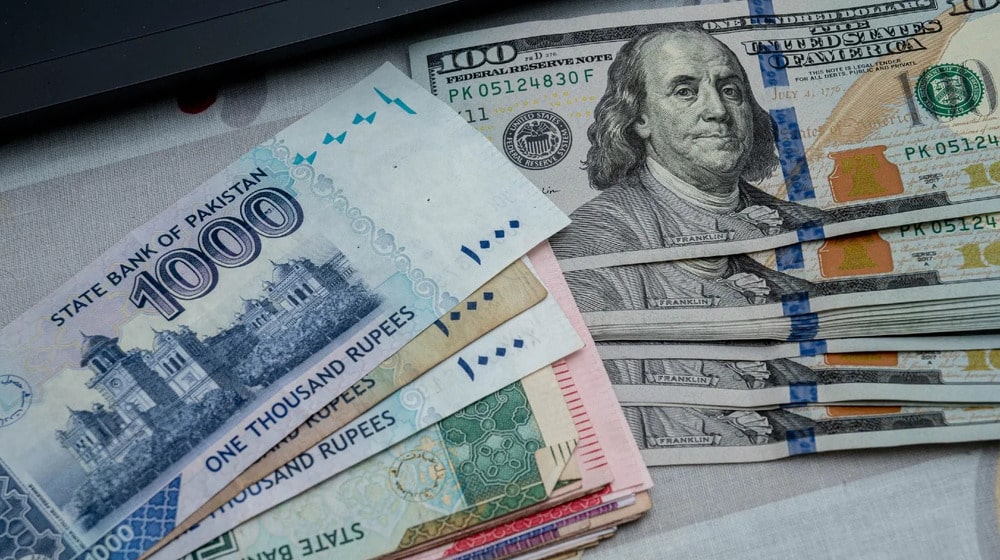
The Pakistani rupee posted a marginal gain against the US dollar on Thursday, appreciating by 0.01% in the inter-bank market.
At the close of trading, the rupee settled at Rs. 280.92, up by Rs. 0.04 from the previous day’s close of Rs. 280.96.
In the open market, exchange companies quoted the dollar at Rs. 281.05 for buying and Rs. 282.05 for selling.
The rupee also strengthened against several major currencies. Against the Euro, the PKR rose by 51.92 paisa or 0.16%, closing at Rs. 326.19 compared to Rs. 326.71 a day earlier. The local unit gained 55.31 paisa or 0.15% against the British Pound, settling at Rs. 370.62 versus Rs. 371.18 previously.
The rupee appreciated by Rs. 1.10 or 0.31% against the Swiss franc, closing at Rs. 351.42. Against the Japanese Yen, the PKR strengthened by 1.82 paisa or 0.99% to close at Rs. 1.8263, up from Rs. 1.8445.
The local currency also gained 5.85 paisa or 0.15% against the Chinese Yuan, ending at Rs. 39.52 from Rs. 39.58. It appreciated by 1.35 paisa or 0.02% against the Saudi Riyal to Rs. 74.91, and by 0.97 paisa or 0.01% against the UAE Dirham to Rs. 76.48.
So far in the current fiscal year, the rupee has gained Rs. 2.84 or 1.01% against the US dollar. However, it has declined by Rs. 2.37 or 0.84% since the start of the calendar year.
WORCESTER, Mass. — Don’t be fooled by the fog machine, spooky lights and fake bats: the robotics lab at Worcester Polytechnic Institute lab isn’t hosting a Halloween party.
Instead, it’s a testing ground for tiny drones that can be deployed in search and rescue missions even in dark, smoky or stormy conditions.
“We all know that when there’s an earthquake or a tsunami, the first thing that goes down is power lines. A lot of times, it’s at night, and you’re not going to wait until the next morning to go and rescue survivors,” said Nitin Sanket, assistant professor of robotics engineering. “So we started looking at nature. Is there a creature in the world which can actually do this?”
Sanket and his students found their answer in bats and the winged mammal’s highly sophisticated ability to echolocate, or navigate via reflected sound. With a National Science Foundation grant, they’re developing small, inexpensive and energy-efficient aerial robots that can be flown where and when current drones can’t operate.
Last month, emergency workers in Pakistan used drones to find people stranded on rooftops by massive floods. In August, a rescue team used a drone to find a California man who got trapped for two days behind a waterfall. And in July, drones helped find a stable route to three mine workers who spent more than 60 hours trapped underground in Canada.
But while drones are becoming more common in search and rescue, Sanket and researchers elsewhere want to move beyond the manually operated individual robots being used today. A key next step is developing aerial robots that can be deployed in swarms and make their own decisions about where to search, said Ryan Williams, an associate professor at Virginia Tech.
“That type of deployment — autonomous drones — that is effectively nil,” he said.
Williams tackled that problem with a recent project that involved programming drones to choose search trajectories in coordination with human searchers. Among other things, his team used historical data from thousands of missing person cases to create a model predicting how someone would behave if lost in the woods.
“And then we used that model to better localize our drones, to search in locations with higher chances of finding someone,” he said.
At WPI, Sanket’s project addresses other limitations of current drones, including their size and perception capabilities.
“Current robots are big, bulky, expensive and cannot work in all sorts of scenarios,” he said.
By contrast, his drone fits in the palm of his hand, is made mostly from inexpensive hobby-grade materials and can operate in the dark. A small ultrasonic sensor, not unlike those used in automatic faucets in public restrooms, mimics bat behavior, sending out a pulse of high-frequency sound and using the echo to detect obstacles in its path.
During a recent demonstration, a student used a remote control to launch the drone in a brightly lit room and then again after turning off all but a faintly glowing red light. As it approached a clear, Plexiglas wall, the drone repeatedly halted and backed away, even with the lights off and with fog and fake snow swirling through the air.
“Currently, search and rescue robots are mainly operational in broad daylight,” Sanket said. “The problem is that search and rescues are dull, dangerous and dirty jobs that happen a lot of times in darkness.”
But development didn’t go completely smoothly. The researchers realized that the noise of the bat robot’s propellers interfered with the ultrasound, requiring 3D printed shells to minimize the interference. They also used artificial intelligence to teach the drone how to filter and interpret sound signals.
Still, there’s a long way to go to match bats, which can contract and compress their muscles to listen only to certain echoes and can detect something as small as a human hair from several meters away.
“Bats are amazing,” Sanket said. “We are nowhere close to what nature has achieved. But the goal is that one day in the future, we will be there and these will be useful for deployment in the wild.”
Simply sign up to the Electric vehicles myFT Digest — delivered directly to your inbox.
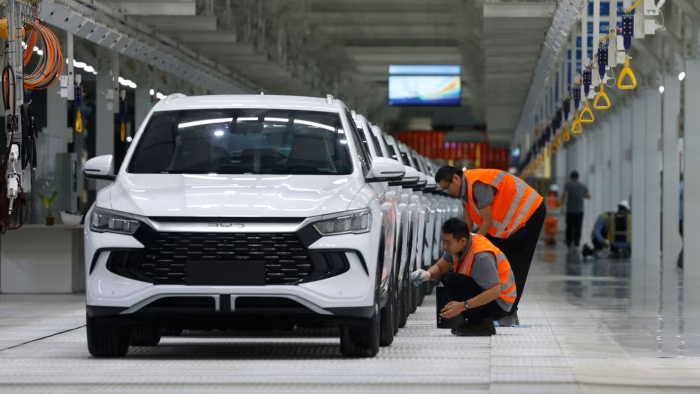
BYD’s profits declined 33 per cent in the third quarter, highlighting the urgency of the Chinese electric vehicle maker’s overseas push following Beijing’s campaign against aggressive competition in the domestic sector.
BYD has become the world’s largest and fastest-growing producer of EVs and the chief global rival to Elon Musk’s Tesla. But the third-quarter results show a continued slowdown for the group after a period of breakneck growth.
The Shenzhen-based group on Thursday reported net income of Rmb7.8bn ($1.1bn), compared with Rmb11.6bn from the same period last year. The result fell short of analysts’ expectation of Rmb9.6bn, but was an improvement from Rmb6.36bn in the second quarter.
The company’s stock hit a record high in May after it made breakthrough announcements on battery charging and driverless technology, but second-quarter earnings came in lower than expected, hit by Beijing’s crackdown on aggressive discounting and supplier payment practices. Share have fallen more than 30 per cent from the May peak.
BYD remains the dominant EV force at home, selling about 30 per cent of new EVs so far this year, but it faces intensifying competition from local rivals such as Geely.
These pressures have forced BYD to double down on plans to rapidly expand sales abroad. Along with factories in Brazil, Hungary, Indonesia, Thailand, Turkey and Uzbekistan, it is constructing a fleet of eight purpose-built vessels to ship its cars.
Still, analysts expect BYD to announce further technological breakthroughs in the coming months, including an EV powered by a semi-solid-state battery. The technology, in which the battery’s electrolyte is a gel-like material rather than liquid, promises to increase energy density.
BYD is also testing “gigacasting”, a manufacturing process pioneered by Tesla in which vehicles are pressed with 9,000 tonnes of pressure to cast the underbody. The company said the process would remove the need to install 72 components and make vehicles lighter.
Analysts said they expected a design revamp in 2026, as Chinese consumers have grown weary of the brand’s signature “dragon face” design, which has been in use for seven years.
“This is a more fundamental cause of BYD’s challenges this year,” said Feng Xiao, co-head of China industrial research at CLSA. “BYD is redesigning the look of its cars.”
Revenue for the July to September quarter came in at Rmb195bn, down 3 per cent from the previous corresponding period and below the Rmb216bn forecast by analysts.
Gross margin was 17.6 per cent, up from 16.27 per cent in the previous quarter but still off the 21.89 per cent reported in the third quarter last year. The margin improvement reflects a higher share of premium models in the company’s product mix, including from overseas markets.
BYD’s exports in the first nine months of the year rose 14 per cent to 705,000 cars, according to data from Automobility, a Shanghai-based consultancy, putting it on track to achieve its forecast of 800,000 to 1mn overseas deliveries this year.
The group, which has forecast total sales of 4.6mn this year, has a long-term annual sales target of 10mn cars, with half coming from outside China.
China overtook Japan in 2023 as the world’s biggest car exporter following a boom in shipments of traditional cars with internal combustion engines to developing countries.
But the export mix is shifting, with battery-only and plug-in hybrid vehicles accounting for 35 per cent of shipments so far this year, up from about 20 per cent in 2023 and 2024.
BYD is the biggest driver of this change, capturing about 40 per cent of China’s total EV exports.
First autonomous vehicle equipped with BorgWarner battery technology
Marks first contract BorgWarner has secured with HOLON, a company of the BENTELER Group
Battery system features the latest generation cell chemistry and benchmark-setting energy density
Auburn Hills, Michigan, October 30, 2025 – BorgWarner, a global product leader in delivering innovative and sustainable mobility solutions, has secured a contract to supply its battery system to the all-new HOLON urban, a 15-person, Level 4 autonomous, fully electric shuttle. The contract marks BorgWarner’s first supply of battery technology for autonomous vehicles produced in North America.
BorgWarner will supply its lithium nickel manganese cobalt oxide (NMC) 5AKM 157 cylindrical cell (CYC) battery system for the HOLON urban. Each vehicle will feature two battery packs, each equipped with an integrated, replaceable contactor box and a multi-pack controller. The 57 kWh battery packs incorporate a modular design with cylindrical NMC cells, which offer the latest generation cell chemistry and benchmark-setting energy density. Additionally, BorgWarner’s NMC battery system is protected by a robust stainless steel battery case and uses a compact, active liquid cooling system.
“BorgWarner has extensive experience with smart and integrated battery management systems and excels in energy density, scalability and robust safety certifications – all key components to this exciting new application,” said Henk Vanthournout, Vice President of BorgWarner Inc. and President and General Manager, Battery and Charging Systems. “Working with an innovator like HOLON is a great fit for our team. They aim to provide safe, sustainable and inclusive transportation solutions, aligning with our overall sustainability strategy and vision to create a clean, energy-efficient world.”
BorgWarner leveraged their battery pack know-how to design a pack that fits the customer’s space and performance needs of the HOLON urban. The pack features the latest BorgWarner-developed software and proven multi-pack controller, which meets cybersecurity and functional safety requirements.
Flavio Friesen, VP Engineering at HOLON confirms: “BorgWarner is a strong fit for HOLON: their battery platform combines benchmark energy density with robust safety, cybersecurity, and serviceability. The modular, liquid-cooled two-pack system integrates perfectly with our shuttle’s packaging and uptime requirements, supporting not only our North American rollout, but also the demands in Europe and the Middle East regions.”
BorgWarner’s battery system is Buy America compliant and satisfies the Foreign Entity of Concern (FEOC) restriction, further supporting its contract with HOLON. Manufacturing is scheduled to start in Q2 2027 in Seneca, South Carolina.