Category: 3. Business

  • Google agrees deal to reopen US nuclear plant with NextEra

    Google agrees deal to reopen US nuclear plant with NextEra

    Unlock the Editor’s Digest for free

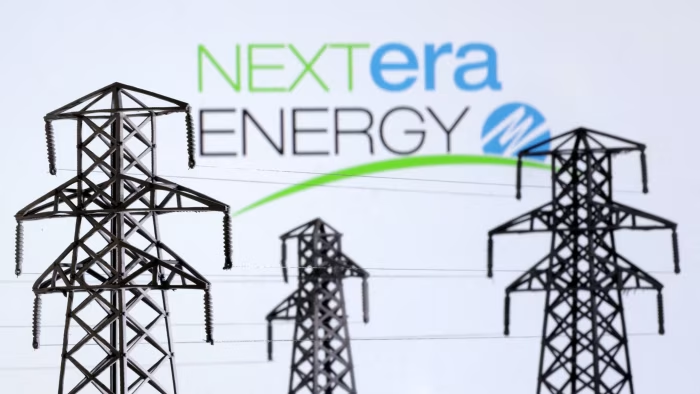
    NextEra has agreed to reopen a nuclear power station in Iowa that will primarily provide power to Google as the tech giant races to secure clean energy to drive its artificial intelligence data centres.

    The largest renewable energy company in the US will lead the redevelopment of Duane Arnold Energy Center after Google signed a 25-year agreement to buy electricity from the power station. After being shut down for five years, it is expected to cost more than $1.6bn to restart.

    Duane Arnold, a 615-megawatt plant, is expected to start delivering power by 2029, according to NextEra. It is the third US nuclear plant to begin the process of restarting operations.

    “This partnership serves as a model for the investments needed across the country to build energy capacity and deliver reliable, clean power, while protecting affordability and creating jobs that will drive the AI-driven economy,” said Ruth Porat, president and chief investment officer of Alphabet and Google.

    Google said it also agreed to explore opportunities with NextEra to deploy new nuclear generation capacity in the US amid soaring demand for electricity linked to the rollout of AI.

    Nuclear power has been enjoying a renaissance in recent years following a move away from the fuel source due to increased competition from low-cost shale gas and the 2011 Fukushima accident in Japan.

    The ability of nuclear energy to provide round-the-clock carbon-free power has pushed it back into the spotlight as the world aims to slash emissions while feeding a rapidly growing need for electricity.

    Google’s power supply deal with NextEra follows a similar agreement between Microsoft and Constellation Energy last year, which is expected to enable the Three Mile Island nuclear plant in Pennsylvania to reopen in 2028.

    The Palisades nuclear power plant in Michigan is scheduled to be the first fully decommissioned US nuclear power plant to reopen later this year.

    It is much more cost effective and faster to reopen a mothballed power plant than build a new facility from scratch, according to nuclear experts.   

    Critics of nuclear energy have warned that any effort to reopen retired power plants must not be rushed and should adhere to strict regulatory standards.  

    Edwin Lyman, a physicist at the Union of Concerned Scientists, said restarting Duane Arnold should proceed with extreme caution, particularly because of damage it sustained in a type of storm known as a derecho.

    “The ageing reactor, which is the same design as the reactors that melted down at Fukushima, Japan in 2011, was shut down after it was struck by a derecho in August 2020 and suffered serious damage, including the destruction of its cooling towers,” Lyman said.

    “Until NextEra presents a realistic estimate of the cost to rebuild the plant and restore it to a safe condition is developed, no one will really know if this reactor will be able to generate affordable electricity.”  

    However, industry regulation is expected to grow and evolve as there are additional efforts to reopen shuttered reactors, according to Adam Stein, director of the nuclear energy innovation programme at The Breakthrough Institute.

    “Thanks to the Palisades restart, there is a regulatory process and a clear understanding of what inspections need to be completed.”

    Climate Capital

    Where climate change meets business, markets and politics. Explore the FT’s coverage here.

    Are you curious about the FT’s environmental sustainability commitments? Find out more about our science-based targets here

    Continue Reading

  • South Korea’s third-quarter GDP grows at fastest pace in over a year

    South Korea’s third-quarter GDP grows at fastest pace in over a year

    A container ship sails past buildings in Busan, South Korea, on Thursday, Sept. 22, 2022. Photographer: SeongJoon Cho/Bloomberg via Getty Images

    Bloomberg | Bloomberg | Getty Images

    South Korea’s economy expanded at its fastest pace in more than a year, with its third-quarter gross domestic product growth topping analysts’ estimates on Tuesday.

    According to advance estimates from Bank of Korea, GDP rose 1.7%, year on year, compared to the 1.5% rise expected by economists polled by Reuters. The economy had grown by 0.6% in the second quarter.

    Data from the Bank of Korea revealed that growth was mostly supported by exports and the manufacturing sector that expanded 6% and 3.3%, respectively, year on year.

    Construction sector was the biggest drag on the economy, contracting 8.1% in the reported quarter compared to a year earlier.

    The growth in exports of goods and services, which came on the back of increased semiconductor and motor vehicle shipments, was the fastest since the third quarter of 2024.

    On a quarter-on-quarter basis, the country’s GDP expanded 1.2%, also beating Reuters poll estimates of a 0.9% growth.

    South Korea’s GDP data comes as the country’s negotiators continue to wrangle over details of a trade deal with the Trump administration. In an interview with Bloomberg last Friday, South Korea’s President Lee Jae Myung said that the two country’s were deadlocked on key details over Seoul’s $350 billion investment pledge.

    “The U.S. will of course try to maximize its interests, but it mustn’t be to the extent that causes catastrophic consequences for South Korea,” Lee said in the interview.

    In July, South Korea reached a trade deal with Trump that featured blanket tariffs on the country’s exports to U.S. at 15% — down from the 25% Trump announced earlier. In return, Seoul had pledged to invest $350 billion in the U.S.

    Lee is set to meet Trump on the sidelines of the Asia-Pacific Economic Cooperation summit being held in Gyeongju, South Korea, later this week.

    The Bank of Korea in its statement last Thursday said that the economy has continued to improve, supported by a sustained recovery in consumption and favorable exports growth.

    “Going forward, domestic demand is expected to continue its recovery, led by consumption, and exports are likely to remain favourable for some time owing to the strong semiconductor sector, but the impacts of U.S. tariffs on exports are likely to expand gradually,” the BOK added.

    The central bank has forecast full-year growth for 2025 at 0.9%, and 1.6% for 2026

    Continue Reading

  • [Next-Generation Communications Leadership Interview ④] Ushering in the 6G Era With AI Innovation and Global Partnerships

    [Next-Generation Communications Leadership Interview ④] Ushering in the 6G Era With AI Innovation and Global Partnerships

    As the 6G era approaches, the telecommunications industry is evolving through the integration of diverse technologies. Networks are no longer simple connection infrastructure — they’re becoming AI-driven platforms powering the future of service innovation.

    In line with this transformation, Samsung Electronics is building a next-generation technology ecosystem through AI-native networks and strengthening global partnerships to prepare for the 6G era.

    ▲ JinGuk Jeong, Head of Advanced Communications Research Center at Samsung Electronics

    In the final part of this interview series, Samsung Newsroom spoke with JinGuk Jeong, Executive Vice President and Head of Advanced Communications Research Center (ACRC) at Samsung Electronics, about the company’s strategy to drive the convergence of telecommunications and AI for the 6G era through global partnerships.

    Defining a New 6G Paradigm With AI-Native Networks

    Ahead of the 6G era, the integration of AI and telecommunications is creating new value beyond performance gains. “The fusion of AI and telecommunications will deliver two core benefits — innovation in user experience and greater network efficiency through automation,” said Jeong. “To achieve this, Samsung is leading research on AI-native networks that embed AI across every layer of the telecommunications network.”

    “AI native doesn’t mean applying AI to specific equipment or functions — it means embedding AI technologies throughout the entire process, from design to operation,” he continued. “For example, in the physical layer (L1), AI reduces noise in radio signals, while in the data link layer (L2), it efficiently allocates network resources for each user.” This approach enhances network performance while reducing power consumption, paving the way for a more sustainable telecommunications environment.

    Advancing 6G Through Open Innovation and Collaboration

    Through its AI-native approach, Samsung is developing intelligent networks that learn and optimize themselves. “Close collaboration with global telecom operators is essential to realizing the user experience innovations and operational efficiencies enabled by AI,” said Jeong. “Samsung is pursuing joint initiatives to bring these technologies to real-world network environments.”

    “These efforts are driven by our open innovation strategy,” he added. “By diversifying collaborations with partners — from field trials with telecom operators to advanced research with academia and partnerships with global industry alliances — Samsung is expanding the ecosystem and taking a leading role in standardization.”

    ▲ Samsung’s partnership strategy for the 6G era

    Since 2024, Samsung has strengthened its global partnerships. The company has worked with NTT DOCOMO on user-specific network optimization technologies and with KT to improve coverage and data transmission speeds in potential 6G frequency bands.

    Samsung is also enhancing user experience through collaboration with KDDI Research on distributed multiple-input multiple-output (MIMO) technology. With Verizon, the company is expanding global discussions on next-generation telecommunications through the Verizon 6G Innovation Forum. In addition, Samsung has begun research with SoftBank on AI-based network performance enhancements. Moving forward, the company plans to continue strengthening its partnerships with telecom operators worldwide.

    Beyond these partnerships, Samsung is expanding the AI-driven telecommunications ecosystem through global collaborations. As part of the NextG Initiative Corporate Affiliates Program, the company is co-developing next-generation 6G technologies with Princeton University. Samsung is also broadening its collaboration with leading chip vendors, including Qualcomm, Intel, Arm and NVIDIA.

    ▲ Samsung’s global partnerships for AI and telecommunications convergence

    “The expansion of our partnerships with major telecom operators shows our commitment to turning the technological direction outlined in our 6G white paper earlier this year into concrete research agreements,” said Jeong. “In particular, AI-RAN has moved beyond general simulations and lab-based testing and can now be validated in real-world network environments — allowing global telecom operators to directly experience its benefits. This will be a key driver in accelerating global standardization discussions.”

    Global Leadership Toward 6G

    Samsung is also leading technical discussions within global industry alliances, shaping the transition to the 6G era.

    Since the founding of the AI-RAN Alliance in 2024, Samsung has served as vice chair of the board and chair of Working Group 3 (AI-on-RAN) — spearheading efforts to explore new services through the convergence of AI and wireless technologies. As vice chair of the board for the Next G Alliance, the company also plays a key role in driving research, development and standardization for 6G across North America. “Leveraging our industry-leading expertise in semiconductors, hardware, and software, Samsung is helping lead technical discussions and decision-making within these global alliances,” said Jeong.

    Building on its strengths, Samsung continues to demonstrate leadership on the global stage by showcasing proven technologies. At international exhibitions such as Mobile World Congress (MWC) 2025, the company drew significant attention with its latest AI-RAN innovations. Through its own Silicon Valley Future Wireless Summit, Samsung invites telecom operators, manufacturers, government agencies, and academic experts from around the world to share the latest research and achievements in AI-powered telecommunications.

    ▲ Silicon Valley Future Wireless Summit 2024

    Under the theme “Future Wireless for the AI Era,” last year’s Silicon Valley Future Wireless Summit featured a live demonstration of AI-RAN technologies and explored AI integration, sustainability and user experience innovation. “This year’s summit, scheduled for November, will take place under the theme Unlocking New Possibilities With AI-Centric Networks,’” said Jeong. “We plan to showcase AI-RAN technologies validated in real network environments, along with innovative real-world applications.”

    Transforming Everyday Life Through Next-Generation Communications

    Samsung’s ongoing participation in global alliances and international forums is ultimately aimed at creating meaningful user experiences in everyday life. “In the 6G era, we’ll go beyond improving network performance. Services such as AR and XR will become more widespread, and entirely new ones will emerge,” said Jeong. “Events like the 6G Innovation Forum will also focus on these new services.”

    Mobile communications technology has evolved in roughly 10-year cycles, with each generation delivering leaps in performance. The 6G era, however, will redefine network performance and serve as a catalyst for transformative services across industries and everyday life. With ultra-high speeds, ultra-low latency and massive connectivity, 6G is expected to deliver unprecedented communication quality and differentiated user experiences.

    Samsung is ushering in a new paradigm through the convergence of telecommunications and AI. By working closely with telecom operators, global industry alliances and academia, the company is leading next-generation communications innovation through ongoing technical collaboration and shared achievements.

    With this fourth and final installment, the Next-Generation Communications Leadership series has explored Samsung’s 6G standardization vision, global leadership initiatives, AI-RAN research achievements and global partnership strategy. As Samsung prepares for the 6G era with its unrivaled leadership, the company is poised to bring meaningful change to everyday life.

    Continue Reading

  • More than a million people every week show suicidal intent when chatting with ChatGPT, OpenAI estimates | Technology

    More than a million people every week show suicidal intent when chatting with ChatGPT, OpenAI estimates | Technology

    More than a million ChatGPT users each week send messages that include “explicit indicators of potential suicidal planning or intent”, according to a blogpost published by OpenAI on Monday. The finding, part of an update on how the chatbot handles sensitive conversations, is one of the most direct statements from the artificial intelligence giant on the scale of how AI can exacerbate mental health issues.

    In addition to its estimates on suicidal ideations and related interactions, OpenAI also said that about 0.07 of users active in a given week – about 560,000 of its touted 800m weekly users – show “possible signs of mental health emergencies related to psychosis or mania”. The post cautioned that these conversations were difficult to detect or measure, and that this was an initial analysis.

    As OpenAI releases data on mental health issues related to its marquee product, the company is facing increased scrutiny following a highly publicized lawsuit from the family of a teenage boy who died by suicide after extensive engagement with ChatGPT. The Federal Trade Commission last month additionally launched a broad investigation into companies that create AI chatbots, including OpenAI, to find how they measure negative impacts on children and teens.

    OpenAI claimed in its post that its recent GPT-5 update reduced the number of undesirable behaviors from its product and improved user safety in a model evaluation involving more than 1,000 self-harm and suicide conversations. The company did not immediately return a request for comment.

    “Our new automated evaluations score the new GPT‑5 model at 91% compliant with our desired behaviors, compared to 77% for the previous GPT‑5 model,” the company’s post reads.

    OpenAI stated that GPT-5 expanded access to crisis hotlines and added reminders for users to take breaks during long sessions. To make improvements to the model, the company said it enlisted 170 clinicians from its Global Physician Network of health care experts to assist its research over recent months, which included rating the safety of its model’s responses and helping write the chatbot’s answers to mental-health related questions.

    “As part of this work, psychiatrists and psychologists reviewed more than 1,800 model responses involving serious mental health situations and compared responses from the new GPT‑5 chat model to previous models,” OpenAI said. The company’s definition of “desirable” involved determining whether a group of its experts reached the same conclusion about what would be an appropriate response in certain situations.

    AI researchers and public health advocates have long been wary of chatbots’ propensity to affirm users’ decisions or delusions regardless of whether they may be harmful, an issue known as sycophancy. Mental health experts have also been concerned about people using AI chatbots for psychological support and warned how it could harm vulnerable users.

    The language in OpenAI’s post distances the company from any potential causal links between its product and the mental health crises that its users are experiencing.

    skip past newsletter promotion

    “Mental health symptoms and emotional distress are universally present in human societies, and an increasing user base means that some portion of ChatGPT conversations include these situations,” OpenAI’s post stated.

    OpenAI’s CEO Sam Altman earlier this month claimed in a post on X that the company had made advancements in treating mental health issues, announcing that OpenAI would ease restrictions and soon begin to allow adults to create erotic content.

    “We made ChatGPT pretty restrictive to make sure we were being careful with mental health issues. We realize this made it less useful/enjoyable to many users who had no mental health problems, but given the seriousness of the issue we wanted to get this right,” Altman posted. “Now that we have been able to mitigate the serious mental health issues and have new tools, we are going to be able to safely relax the restrictions in most cases.”

    Continue Reading

  • UK’s Eastern Airways suspends operations with all flights cancelled | Transport

    UK’s Eastern Airways suspends operations with all flights cancelled | Transport

    The UK domestic airline Eastern Airways has suspended operations and all of its flights have been cancelled.

    Customers of the airline, which operated regional services from airports across the UK, are urged not to go to the airport as flights will not be operating, the UK Civil Aviation Authority said.

    The airline flew to destinations including Aberdeen, Humberside, Gatwick, Newquay, Teesside International and Wick John O’Groats, according to its website.

    On Monday morning the company filed a notice of intention to appoint an administrator at the insolvency and companies court within the high court.

    Selina Chadha, consumer and markets director at the UK Civil Aviation Authority, said: “We urge passengers planning to fly with this airline not to go to the airport as all Eastern Airways flights are cancelled.

    “Eastern Airways customers should visit the Civil Aviation Authority’s website for the latest information.”

    In response to the suspension of Eastern Airways operations, London North Eastern Railway, ScotRail, TransPennine Express and Northern would offer free standard-class travel to Eastern Airways staff and customers on 28 and 29 October on suitable routes operated, the UK Civil Aviation Authority said.

    To access this support, people should show an Eastern Airways employee ID, boarding pass or flight confirmation to station staff.

    Continue Reading

  • Macrobond Trends | Macro Trends: Policy Rate Decisions across the Atlantic: Blindfolded Easing and Reluctant Doves

    Macrobond Trends | Macro Trends: Policy Rate Decisions across the Atlantic: Blindfolded Easing and Reluctant Doves

    Explore this week’s Macro Trends insights from Macrobond with the first installment below.

    The US government remains in shutdown, leaving markets with very limited access to official economic data. Still, there is broad expectation that the Fed will move ahead with a rate cut this week:

    • Data Blackout: With official releases paused, investors rely on alternative data sources to gauge the state of the US economy.​
    • New Fed Voice: Recently appointed Fed member Stephen Miran has argued for significant rate cuts, potentially pushing the Committee toward a more dovish stance.​
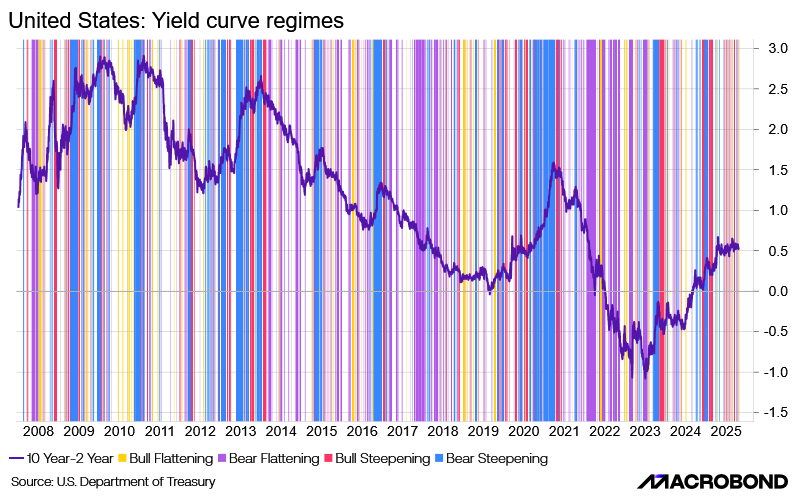
    • Bull Steepening: As the Fed shifts toward easing, short-term yields have dropped faster than long-term rates. ​How should investors position for this new dynamic?

    Markets brace for a Fed rate cut as the US data blackout leaves investors searching for signals.

    Diverging Views on the Path of Rates

    Insights:

    Markets are fully pricing a 25 bp rate cut, with attention shifting to forward guidance rather than the decision itself. ​

    ​The Fed’s dot plot still signals a gradual easing path, while Fed funds futures expect a faster decline toward ~3% by 2026. That divergence will drive the market reaction.

    The Miran Effect

    Insights:

    Stephen Miran was sworn in as a member of the Federal Reserve Board of Governors on September 16, 2025. ​

    With Miran joining the FOMC, the dot plot took on a new shape — as he stood out as the only member projecting a Fed funds rate below 3%, signaling significant cuts. ​

    ​The new Fed governor will likely attract extra attention, especially as discussions around Powell’s eventual successor gain momentum.

    Bull or Bear Steepener?

    Insights:

    The Federal Reserve is in a rate-cutting cycle, while Trump’s fiscal policies are pushing longer-term yields higher through expectations of larger deficits and increased Treasury issuance. This mix of monetary easing and fiscal expansion is steepening the yield curve.​

    ​A key debate now is whether the steepening will be bearish or bullish:​

    • A bear steepener if long-term yields rise faster due to inflation and fiscal concerns​
    • A bull steepener if short-term rates fall more sharply as markets price in deeper Fed cuts

    Average Asset Performance Across Yield Curve Regimes

    Insights:

    The direction this steepening takes will be crucial for market positioning, as equity valuations and fixed-income returns tend to react very differently under bear versus bull steepening regimes. ​

    ​In this chart, you can see the historical performance of various equity sectors, fixed income, and gold across these different yield-curve environments.

    Alternative Data Takes the Lead on U.S. Labor Trends

    Insights

    With the U.S. government shutdown halting operations at the Bureau of Labor Statistics (BLS), official labor market data — including the monthly Nonfarm Payrolls report — will not be released. ​​This data blackout leaves policymakers and markets without one of their most important economic indicators. In the absence of BLS data, attention will turn to ADP’s private-sector employment report as a key alternative gauge of labor market momentum ahead of the Fed’s upcoming policy decisions.

    Inflation Holds Firm Amid Policy Uncertainty

    Insights

    Last Friday, despite the ongoing government shutdown, markets received fresh economic data — the Consumer Price Index (CPI) for September. ​

    The report showed that inflation remains stubbornly high at 3 percent, reinforcing concerns that price pressures are proving more persistent than the Federal Reserve had hoped. ​

    ​This resilience in inflation is likely to weigh on the Fed’s upcoming policy discussions, as it complicates the path toward potential rate cuts and raises questions about how long restrictive monetary conditions will need to stay in place.

    Continue Reading

  • Hit by AI, edtech firm Chegg slashes jobs and names new CEO in major overhaul – Reuters

    1. Hit by AI, edtech firm Chegg slashes jobs and names new CEO in major overhaul  Reuters
    2. Chegg Earnings: Big Quarter Sends Shares Higher  24/7 Wall St.
    3. Chegg to Remain a Standalone Public Company to Maximize Shareholder Value  Business Wire
    4. Chegg Announces Major Workforce Reduction and Restructuring  TipRanks
    5. Chegg (CHGG) Announces Restructuring Plan and Leadership Change  GuruFocus

    Continue Reading

  • Barbie, Monopoly makers see bright holiday season despite tariffs

    Barbie, Monopoly makers see bright holiday season despite tariffs

    President Donald Trump’s tariffs are hitting toy giants Mattel and Hasbro as the critical holiday season nears. Still, both companies see a successful year end ahead.

    “This quarter, our U.S. business was again challenged by industry-wide shifts in retailer ordering patterns,” CEO Ynon Kreiz said on Mattel’s recent earnings call. “That said, consumer demand for our products grew in every region, including in the U.S.”

    During the most recent quarter, which ended Sept. 30, Mattel said sales slipped 6% globally, led by a 12% decline in North America. International sales rose 3%.

    Some of the company’s top performing categories included Hot Wheels and action figures, primarily from the “Jurassic World,” Minecraft and WWE franchises.

    Other Mattel brands saw a drop in sales, however, including Barbie and Fisher-Price.

    With retail stores waiting until the last minute to assess the level of tariffs that would apply to their holiday orders, Kreiz said “since the beginning of the fourth quarter, orders from retailers in the U.S. have accelerated significantly.”

    Retailers “expect strong demand for the holiday and they are restocking,” he added.

    Meanwhile, rival toy giant Hasbro’s revenue jumped 8% in the quarter and it raised its financial guidance for the rest of the year.

    Key drivers of that included “Peppa Pig” and Marvel franchise toys, as well as the Wizards of the Coast games.

    Hasbro “managed tariff volatility with agility” and used price hikes to protect its margins, said Gina Goetter, the company’s chief financial officer and chief operating officer.

    The company remains “firmly on track” to achieve its financial targets.

    “As we calculate the various scenarios of where that absolute rates will play out, we’re really putting all of our levers to work,” she said on the company’s recent earnings call.

    “From how we think about pricing, how we’re thinking about our product mix, how we’re thinking about our supply chain, and how we’re managing all of our operating expenses to mitigate and offset the impact” of tariffs, she said.

    For its part, Hasbro also saw “softness” in the U.S. during the quarter due to retail chains waiting longer to place holiday orders, but said momentum is accelerating as the season gets underway.

    In July, Mattel’s chief financial officer, Paul Ruh, said that the company was raising prices because of tariffs.

    “We have implemented a variety of actions that will help us withstand some of those headwinds and those include … supply chain efficiencies and some pricing adjustments, particularly in the U.S.,” Ruh said on the company’s earnings conference call.

    “So with that array of actions, we’re able to withstand some of the uncertainty that is mostly coming in the top line,” Ruh said. “Our goal is to keep prices as low as possible for our consumers.”

    Still, Kreiz said that “consumers are buying our products and the toy industry is growing.”

    He also said that consumers are taking price hikes in stride and those increases haven’t hurt demand: “We are not seeing any slowdown in consumer demand so far.”

    Hasbro CEO Chris Cocks said the company has also raised some prices, but it was “pretty surgical” in what it chose to adjust.

    “In terms of ongoing pricing, I think we just kind of have to see how the holiday goes and the consumer holds up,” he told analysts on the company’s earnings call.

    Cocks also cautioned that there may be a two-tier economy forming, something other executives and economists have observed in recent months.

    “Right now, I think it’s really kind of a tale of two consumers. The top 20%, particularly in the U.S., continue to spend pretty robustly,” he said. “The balance of households are watching their wallets a bit more.”

    On Friday, the Labor Department released the latest consumer price index data, which showed that inflation is rising at a 3% annual pace, up from August’s 2.9%.

    In May, Kreiz told CNBC that approximately half of the company’s toys were sourced from China.

    Beijing has faced some of the steepest tariffs from Washington of any U.S. trade partner, as Trump has rolled out his disruptive trade agenda this year.

    Mattel’s Ruh said the company continued to adjust its supply chains in response to shifting global tariff policies.

    “We will be continuing to work with our retailers to make sure that the product is on the shelf,” he said.

    At the same time, Hasbro’s Goetter said the company is diversifying its supply chains away from high-tariff countries.

    “By 2026, we expect approximately 30% of our total Hasbro toy and game revenue will be sourced from China and 30% of our revenue will be based in the U.S., as we opportunistically lean into our U.S. manufacturing capacity,” she said.

    Continue Reading

  • Two Major Trials Support Drug-Coated Balloons in PCI – Medscape

    1. Two Major Trials Support Drug-Coated Balloons in PCI  Medscape
    2. Sirolimus-eluting balloon strategy matches drug-eluting stents in large international PCI trial  News-Medical
    3. REC-CAGEFREE I: DCB vs. DES For Treating de Novo CAD at 3 Years  American College of Cardiology
    4. Selution’s 1-Year Data Push Drug-Coated Balloons Further Into the Mainstream  MedPage Today
    5. New Drug-Eluting Balloon May Be as Safe and Effective as Conventional Metal Stents for Repeat Percutaneous Coronary Interventions  Mount Sinai

    Continue Reading

  • Wealthsimple Announces $750 Million Equity Round at $10 Billion Post-Money Valuation to Accelerate Growth

    Wealthsimple Announces $750 Million Equity Round at $10 Billion Post-Money Valuation to Accelerate Growth

    • Dragoneer and GIC co-lead investment alongside CPP Investments, Power Corporation of Canada, IGM Financial Inc., ICONIQ, Greylock and Meritech reinforcing growing global conviction in Wealthsimple’s mission to build the financial platform of the future.
    • With a profitable and growing business, new capital will accelerate Wealthsimple’s product roadmap and deepen the value it delivers to Canadians.

    TORONTO, ON [Oct 27, 2025] – Wealthsimple, Canada’s leading financial innovator, today announced it has signed an equity round of up to CAD $750 million at a post-money valuation of CAD $10 billion. The round, which includes both a $550-million primary offering and a secondary offering up to $200 million, is co-led by Dragoneer Investment Group and GIC, and signals deep conviction from world-renowned investors in Wealthsimple’s role as the future of financial services in Canada. Other investors include new investor Canada Pension Plan Investment Board (CPP Investments), and existing investors Power Corporation of Canada, IGM Financial Inc., ICONIQ, Greylock and Meritech.

    Since 2014, Wealthsimple has consistently set the pace for innovation in Canadian finance and reimagined how Canadians build wealth. The company broke down barriers to the markets for a new generation of investors with its managed and self-directed investing platforms and led the charge on many investing firsts for the country, including commission-free trading, regulated crypto trading and 24/5 trading. It has also redesigned everyday banking, with features such as bank draft delivery and automatic paycheque allocation, and a competitive chequing account with no monthly, foreign exchange or ATM withdrawal fees. What began as a simple investing app has become a trusted financial platform that millions of Canadians use to grow and manage their money, whether they’re just starting out, or managing complex portfolios.

    The equity round comes after an explosive few years for Wealthsimple and the company continues to scale from a position of strength. Wealthsimple shared that it was profitable in 2024 and the company continues to be profitable in 2025. The company reached $50 billion in assets under administration in 2024, and in one year has doubled it to $100 billion in assets. The company’s latest capital raise will accelerate its roadmap across investing, banking and credit, support strategic opportunities to expand its platform, and deepen the value it delivers to Canadians.

    “This raise reflects deep confidence from new and returning investors in our mission and our role as a defining Canadian company,” said Michael Katchen, CEO and co-founder, Wealthsimple. “We were intentional in choosing partners committed to the long-term future of Wealthsimple. These are well-respected, global leaders with a proven track record scaling category leaders, and who believe in our vision for the future of financial services.”

    Guided by its mission to help everyone achieve financial freedom, Wealthsimple offers an expansive suite of smart, low-cost financial tools that empower Canadians to build wealth in whatever way works for them. The platform brings together self-directed investing, managed portfolios, cryptocurrency, banking services, tax filing, and advisor services into one simple, integrated experience. The company is also responsible for building Canada’s most-read financial newsletter, TLDR, educating four million weekly subscribers on money and market news.

    This year, the company launched a waitlist for its first credit card, surpassing 300,000 Canadians in the first six months. The company also launched Wealthsimple Presents, a bi-annual, live product showcase featuring its latest financial innovations. Nearly 350,000 Canadians registered to attend the 2025 livestream events.

    “Few companies have achieved what Wealthsimple has in the last few years,” said Christian Jensen, Partner at Dragoneer Investment Group. “The Wealthsimple team has built an expansive financial platform that millions of Canadians trust. They’re not just participating in Canada’s financial services industry; they’re redefining it. Wealthsimple’s product velocity, customer obsession, and category leadership remind us of some of the most enduring global companies and we’re thrilled to be partnering with them in this next phase of growth.”

    Dragoneer is focused on investing in leading growth businesses and recently led OpenAI’s $8.3 billion raise in August 2025 as its largest contributor. The firm previously participated in Wealthsimple’s 2021 funding raise.

    “We look for companies that will transform industries for decades to come, and Wealthsimple is one of them,” said Choo Yong Cheen, Chief Investment Officer, Private Equity, GIC. “Their track record of innovation, from investing to trading to banking, combined with deep trust from Canadians, positions them to build a defining, generational company in Canadian financial services.”

    GIC is a leading global investment firm delivering long-term, sustainable returns across diverse market landscapes. GIC is one of two new investors this raise, alongside CPP Investments.

    “Wealthsimple has built a strong foundation as a trusted financial platform in Canada, combining innovation with disciplined growth,” said Afsaneh Lebel, Managing Director, Head of Funds, CPP Investments. “Alongside our partner Dragoneer, we’ve seen the company’s innovative approach to making financial products more accessible to Canadians, consistent with our strategy to back technology-driven businesses that deliver lasting value for CPP contributors and beneficiaries.”

    Meritech and Greylock co-led Wealthsimple’s raise in May 2021 alongside best-in-class investors DST Global, Sagard, ICONIQ, Dragoneer, TCV and iNovia, among others. This raise builds on Wealthsimple’s 2021 financing round — one of the largest in Canadian history at that time — and marks the next chapter in its mission to transform financial services.


    Continue Reading