Category: 3. Business

  • A new era for the construction sector

    A new era for the construction sector

    This article was co-authored by Karim El Sayegh, Paralegal.

    On 8 July 2025, the government of Dubai introduced Law No. 7 of 2025 Regulating Contracting Activities in the Emirate of Dubai (“the New Law”). This important piece of legislation will come into force on 8 January 2026, six months after its publication, and will govern all contracting activities and Contractors operating within the Emirate of Dubai, including those in special development zones and free zones, such as the Dubai International Financial Centre (DIFC). 

    The New Law represents a major step forward in how Dubai regulates its construction and engineering sectors.  It establishes the framework for a supervisory hierarchy, with the Dubai Municipality (the “Municipality”) as the ultimate authority, below (or alongside) which sits the “Competent Authority” (i.e. “any other government entity legally competent to supervise and control any contracting activities in the Emirate”, along with the Municipality itself).  There is also provision for the establishment of a “Committee for Regulating and Developing Construction Activities” (“the Committee”).  Each of these authorities has specified competencies, tasks and powers.  The New Law aims to establish a standardised, digital, and unified regulatory framework for all construction activities (e.g. construction, demolition, infrastructure, engineering). It provides a new framework for contractor registration, classification, and oversight, overseen by the Municipality, and aims to improve standards, promote transparency, and support Dubai’s sustainable development and investment confidence in the construction industry.

    The New Law complements the existing laws and regulations related to building and planning, and is part of Dubai’s broader ambition to modernise and professionalise the sector, in line with international best practices.

    Scope of application

    The New Law applies to:

    • all contractors working in the Emirate of Dubai; and
    • to all contracting activities – including construction, demolition, engineering, roads, bridges, utilities, and more.

    Importantly, it extends to contractors operating in free zones and special development zones (including the DIFC), closing previous regulatory gaps.

    Only contracting activities related to airports and their associated infrastructure are specifically exempted. However, further exemptions may be granted by the Chairman of the Executive Council, acting on recommendations from the Committee. 

    The New Law comprises 29 Articles and sets out the foundational framework. Much of the detail on how the New Law will be implemented will come from regulations and decisions yet to be issued by the Committee or other Competent Authorities, such as the Municipality. In the meantime, existing regulations issued prior to the enforcement of the New Law (such as Dubai Local Order No. 89 of 1994 Concerning the Practice of Engineering Consultancy in the Emirate of Dubai (Order No. 89/1994) and Dubai Local Order No. 3 of 1999 Regulating Construction Works in the Emirate of Dubai (Order No. 3/1999)) will continue to apply until the issuance of substituting regulations, provided they do not conflict with the New Law.

    Key features of the new law

    While some of the provisions build on existing practices, the New Law consolidates and formalises them in a more structured and enforceable format. Notable features include:

    Mandatory contractor registration

    All contractors must be licensed and registered in a new central Register managed by the Municipality, and linked to the “Invest in Dubai” digital platform.  Employers will be prohibited from engaging contractors not registered and classified in accordance with the law, and contractors will (as mentioned below) be prohibited from engaging in contracting activities outside the classification category assigned to them.

    New classification system

    Contractors will be assigned a classification based on their technical, financial and administrative capabilities. This classification will determine the nature and scope of the projects they are authorised to undertake. Contractors can apply to upgrade their classification by meeting enhanced requirements.

    This classification system will build upon, and ultimately supplant, the existing framework under:

    • Order No. 89/1994, in which engineering offices were classified into categories based on experience and specialisation; and
    • Order No. 3/1999, which regulates the issuance of construction permits and addresses technical standards.

    Professional competency standards

    Contractors must employ a minimum number of qualified technical staff, each of whom must hold a “Professional Competency Certificate” issued by the Municipality. 

    Subcontractor and consortium (JV) regulation

    The appointment of subcontractors is not prohibited, but will now be subject to approval by the Municipality or the Committee. Both the main contractor and subcontractor must be appropriately licensed and classified. For larger or more complex projects, contractors may form consortia or joint ventures, but all members must be registered and approved, and one must act as the group’s authorised representative.

    Consortia and joint ventures were not previously regulated by Order No. 89/1994.

    Recognition of turnkey projects

    The New Law formally recognises “turnkey” projects, allowing contractors to undertake design, supervision, and execution under a single agreement.  Turnkey projects are said to be subject to conditions which will be set out in future regulations issued by the Municipality. 

    Conduct and enforcement

    A Code of Conduct and Ethics will be introduced. Contractors will be required to comply with applicable laws, avoid exceeding their approved scope or capacity, and notify the Municipality of any changes or incidents. Breaches may result in penalties, suspensions, downgrades, or even de-registration.

    Establishment of a permanent oversight committee

    The Committee is yet to be established, but when it is, it will proactively oversee implementation and propose further policies and regulations. It will also handle approval of all contracting activities, and the classification of Contractors. It is likely that this committee effectively replaces the Committee of Registration and Licensing established under the Municipality’s resolution No. 32 of 2006.

    Compliance timetable

    The New Law will take effect on 8 January 2026. All contractors must regularise their status within one year; that is, by 8 January 2027.

    This includes completing registration on the new system, complying with classification requirements, and ensuring all technical staff are properly certified. The Committee, or the Municipality, may extend this deadline, but contractors are strongly encouraged to act early.

    Achieving compliance

    Contractors should begin preparations without delay. All contractors must:  

    • Hold a valid commercial licence issued by the appropriate authority;
    • Register on the Municipality Register;
    • Ensure all technical employees hold a valid Professional Competency Certificate;
    • Follow prescribed standards and maintain accurate and current records;
    • Ensure subcontracting and consortium arrangements comply with the new legal framework.

    Enforcement and penalties

    The New Law introduces a clear enforcement regime:

    • Fines ranging from AED 1,000 to AED 100,000 as determined by the Chairman of the Executive Council, on the recommendation of the Committee. Repeat violations can see fines rising to AED 200,000.
    • Suspension of the contractor’s licence, or construction activities, for up to one year
    • Downgrading of the Contractor’s classification;
    • Cancellation of the Contractor’s registration (rendering it unable to trade);
    • Deregistration of technical staff and/or cancellation of competency certificates. 

    The Municipality will retain a right to inspect premises and project sites, seize and review records and enforce penalties.

    Market impacts and broader consequences

    The New Law is intended to bring significant change to Dubai’s construction landscape:

    Higher standards, fewer risks

    With stronger classification and competency requirements, the law aims to reduce unsafe practices, technical failures, and project delays. Over time, this should also help curb disputes and improve project delivery.

    Enhanced professionalisation and market consolidation

    Tighter regulation may raise barriers to entry, particularly for smaller or informal contractors. Some may struggle, ultimately exiting the market, merging, or being absorbed, leading to greater consolidation and a more competitive, professionalised sector.

    Increased costs, greater predictability

    While compliance may increase operational costs in the short term, the resulting standardisation and oversight should deliver longer-term benefits in terms of reliability, safety, and investor confidence.

    Digital transformation and transparency

    Integration with the “Invest in Dubai” platform will streamline approvals, allow for performance tracking, and simplify due diligence. Employers and developers will have more data to assess contractor capability before awarding work.

    Alignment with global best practice

    The New Law represents a further shift toward internationally recognised standards in respect of credentialing, licensing and transparency, and should enhance Dubai’s reputation as a world-class construction hub.

    What contractors should do now

    Immediate steps (within Rectification Period)

    • Review your current registration, classification, and technical workforce;
    • Submit necessary declarations if your licence expires during the transition;
    • Engage with the Municipality to begin the registration process.

    Organizational readiness

    • Update internal HR systems;
    • Review subcontracting practices;
    • Prepare for new record-keeping and compliance protocols;
    • Begin drafting or revising joint venture or consortium agreements, where applicable.

    Final thoughts

    The New Law marks a new chapter in the governance of contracting activities in Dubai. It consolidates existing frameworks, introduces new safeguards, and sets a clear path for regulatory modernisation; a significant evolution in the governance of construction activities in Dubai. While it presents initial compliance burdens, particularly for small and mid-sized contractors, it ultimately lays the groundwork for a more professional, reliable, and scalable construction sector.

    For contractors, the message is clear: prepare now. Those who act early and invest in compliance will not only reduce risk but also position themselves to thrive in an increasingly structured and competitive market.

    This reform comes at a time when Dubai’s project pipeline is expanding through ongoing residential and mixed-use builds, repurposing legacy developments, green building initiatives, and large-scale infrastructure and development projects, under the 2040 Urban Master Plan. The New Law will likely have the overriding effect of ensuring that only competent, well-structured contractors are awarded critical work, thus reducing the risk of delay and overspend.

    Continue Reading

  • Sharper rules, stronger compliance: MAS updates AML/CFT Guidelines for insurers : Clyde & Co

    Sharper rules, stronger compliance: MAS updates AML/CFT Guidelines for insurers : Clyde & Co

    Sharper rules, stronger compliance: MAS updates AML/CFT Guidelines for insurers

    The Monetary Authority of Singapore recently revised its notices and guidelines on anti-money laundering and countering the financing of terrorism (“AML/CFT”), applicable to financial institutions (“FIs”), including direct life insurers,1  direct general insurance business, and foreign insurers operating in Singapore.2  The revisions took effect from 1 July 2025

    Here is what you need to know 

    The main revisions relevant to insurance businesses (including direct life insurers, direct general insurance business, and foreign insurers) involve mandating proliferation financing (“PF”) assessments as well as clarifying and updating the requirements for filing of suspicious transaction reports (“STRs”).

    Additionally, specifically for direct life insurers, the Guidelines to Notice 314 also include amendments to clarify MAS’ supervisory expectations on AML/CFT measures, including on screening and Source of Wealth and Source of Funds establishment.

    The purpose of the revisions is to enhance the financial sector’s AML/CFT regime, with reference to global standards set by the Financial Action Task Force (“FATF”).

    (A) Mandating proliferation financing assessments

    Notice 314 and both sets of guidelines now expressly refer to PF, when they previously did not. Insurers are now expressly required to carry out PF risk assessments, as part of their AML risk assessments. 

    In practice, insurers should have already been covering PF risks as part of their existing AML/CFT or sanctions compliance controls. 

    Offences under MAS’ sanctions regulations for financial institutions against the proliferation of weapons of mass destruction have been designated as predicate offences for money laundering, under the Corruption, Drug Trafficking and Other Serious Crimes (Confiscation of Benefits) Act 1992.

    (B) Amendments to clarify and update the requirements for filing of STRs

    (i) Timelines

    All persons, including insurers, must file a suspicious transaction report (“STR”) with the Suspicious Transaction Reporting Office (“STRO”), when it knows or has reasonable grounds to suspect that any property represents the proceeds of, was used in connection with or is intended to be used in connection with criminal conduct.3

    Under the previous AML/CFT notices and guidelines, insurers were expected to file STRs with STRO promptly.  MAS’ previous expectation was that companies take not more than 15 business days to evaluate internally whether an STR should be filed, from the time the case was first flagged by an employee/officer. 

    MAS has now clarified its expectations that:

    • The filing of an STR should not exceed 5 business days after the suspicion was first established, unless there are exceptional circumstances.4 
    • IIn cases involving sanctioned parties, and parties acting on behalf of or under the direction of sanctioned parties, the STR should be filed as soon as possible, and no later than 1 business day after the suspicion was first established.5

    MAS has not prescribed timelines for the conclusion of internal investigations, to determine whether there is a suspicion that property represents or is used in connection with criminal conduct. In refraining from setting out such precise timelines, MAS acknowledged the wide-ranging nature and complexity of cases, as well as the range of financial institutions’ profiles, scale and complexity of operation.6

    (ii) Requirement to provide copies of STRs to MAS

    As MAS can already access the STRs filed with STRO directly, MAS has removed the requirement for direct life insurers to extend copies of all STRs filed to MAS for information. However, MAS has clarified that direct life insurers will need to do so upon request by MAS.7 

    (C) Changes to the AML/CFT guidelines to clarify and reflect supervisory expectations for direct life insurers when addressing higher ML/TF risks

    MAS emphasised its supervisory expectations that financial institutions, including insurers, should implement robust controls and processes to ensure the:

    • Timely review of suspicious transactions, and 
    • Mitigation of ML/TF/PF concerns.

    These supervisory expectations are outlined in MAS’ Consultation Paper8, and they are of general application to all financial institutions and variable capital companies.

    In addition, specifically for direct life insurers, the Guidelines to MAS Notice 314 has been amended to require direct life insurers to ensure that there are processes in place to:9

    • Identify and prioritise the review of concerns of higher ML/TF risks;10
    • Ensure that such concerns of higher ML/TF risks are reviewed promptly; and
    • Require any such concerns of higher ML/TF risks that cannot be reviewed promptly to be escalated to senior management or a similar oversight body, for appropriate ML/TF risk mitigation measure to be applied. 

    We highlight some of the key amendments. 

    (i) Screening 

    MAS clarified that where necessary, ML/TF information sources used for screening should include pertinent search engines used in countries or jurisdictions closely associated with the person screened, and screening should be conducted in the native language(s) of the person screened.11

    (ii) Source of wealth information obtained by a direct life insurer

    Source of wealth generally refers to the origin of the customer’s and beneficial owner’s entire body of wealth (i.e. total assets). MAS has clarified in the Guidelines to Notice 314 that a customer’s source of wealth includes seed money and gifts. 

    The source of wealth information obtained by the direct life insurer should give an indication about:

    • the entire body size of wealth that the customer and beneficial owner would be expected to have; and 
    • how the customer and beneficial owner acquired the wealth.

    This is to enable the direct life insurer to make an assessment as to whether a customer or beneficial owner present a higher risk for ML/TF.12

    (iii) Corroboration of information regarding the source of wealth and source of funds 

    Direct life insurers are expected to corroborate the information regarding source of wealth and source of funds. In this regard, direct life insurers should take a risk-based approach and focus on the more material and riskier sources, and exercise prudence in the use of non-independent sources of information such as customer representations, assumptions and benchmarks.13

    (iv) Ongoing monitoring where risks have increased 

    For direct life insurers, MAS expects that, where there are indications that the risks associated with existing business relations have increased (e.g. anomalies in the control or conduct of an account or discrepancies relating to a customer’s source of wealth), the direct life insurer should promptly implement commensurate risk mitigation measures, including enhanced ongoing monitoring such as:14

    • enhanced monitoring of transactions (including pre-transaction checks); and 
    • impositions of restrictions on the account. 

    The direct life insurer should also request additional information and conduct a review of the customer’s risk profile in order to determine if further measures are necessary.

    (v) Processes regarding indicators of fraudulent or tampered data

    In relation to processes regarding fraudulent or tampered data, documents or information, MAS expects a direct life insurer to ensure that:15

    • Staff are provided with adequate guidance on how to identify indicators of fraudulent or tampered data, documents or information.
    • Processes are in place to ensure that such indicators are escalated.
    • Processes are in place to ensure that the appropriate ML/TF risk mitigation measures are applied in a timely manner. 

    Examples of indicators of fraudulent or tampered data, documents, or information set out by MAS include:16

    • significant discrepancies in a customer’s representations (e.g. relating to material sources of wealth or significant transactions) that are found when these representations are checked against independent sources of information, such as corporate data reports;
    • anomalies in financial statements that are not in line with the direct life insurer’s understanding of the customer’s profile; and
    • lack of sign-off by relevant certifying parties such as an auditor or notary public.

    The recent amendments to MAS’ AML/CFT Guidelines demonstrate MAS’ continued effort to strengthen Singapore’s AML/CFT regime, to ensure it remains clear and aligned with international standards. Financial institutions should keep an eye on future updates and check that their present policies, processes and controls are in line with MAS’ expectations. 


    1For direct life insurers, the relevant documents are: (a) MAS’ Notice 314 on the Prevention of Money Laundering and Countering the Financing of Terrorism – Direct Life Insurers, dated 30 June 2025 (“Notice 314”); and (b) MAS’ Guidelines to MAS Notice 314 on Prevention of Money Laundering and Countering the Financing of Terrorism, dated 1 July 2025 (“Guidelines to Notice 314”).

    2For other MAS licensed insurers (under s 11 of the Insurance Act 1966), foreign insurers operating in Singapore under a foreign insurer scheme, and direct life insurers writing accident and health policies, the relevant document is the MAS’ Guidelines on Prevention of Money Laundering and Countering the Financing of Terrorism – Direct General Insurance Business, Reinsurance Business and Direct Life Insurance Business (Accident & Health Policies), dated 1 July 2025 (“Guidelines for non-life insurers”).

    3S 45(1) of the Corruption, Drug Trafficking and Other Serious Crimes (Confiscation of Benefits) Act 1992.

    4For Non-Life Insurers, see Guidelines for non-life insurers at paragraph 7.6. For Life Insurers, see Guidelines on Notice 314, paragraph 12-1.

    5For Non-Life Insurers, see Guidelines for non-life insurers at paragraph 7.6. For Life Insurers, see Guidelines on Notice 314, paragraph 6-15-2.

    6MAS Consultation Paper on Proposed Amendments to AML/CFT Notices and Guidelines, paragraph 2.13.

    7Notice 314, paragraph 12.2.

    8MAS Consultation Paper on Proposed Amendments to AML/CFT Notices and Guidelines at paragraph 2.13.

    9Guidelines to Notice 314, paragraph 12-A.

    10MAS has also amended the Guidelines to Notice 314 to include characteristics of higher-risk shell companies that require enhanced customer due diligence, see Guidelines to Notice 314, paragraph 8-2.

    11Guidelines to Notice 314, paragraph 6-15-3.

    12Guidelines to Notice 314, paragraph 8-5-6.

    13Guidelines to Notice 314, paragraph 8-5-8.

    14Guidelines to Notice 314, paragraph 6-10-3.

    15Guidelines to Notice 314, paragraph 6-5-5A.

    16Guidelines to Notice 314, paragraph 6-5-5A.

    Continue Reading

  • Fitch Removes Bally's Corporation from Rating Watch Negative – Fitch Ratings

    1. Fitch Removes Bally’s Corporation from Rating Watch Negative  Fitch Ratings
    2. Bally’s (BALY) Moves 17.8% Higher: Will This Strength Last?  Yahoo Finance
    3. Bally’s Corporation Soars to New Heights on Transformative Intralot Deal  FinancialContent
    4. Why Are Bally’s (BALY) Shares Soaring Today  TradingView
    5. Bally’s (BALY) Surges on Intralot Deal and Expansion Plans  GuruFocus

    Continue Reading

  • Enhancing viral dynamics modeling: reliable initial estimation and validity conditions for quasi-steady state approximation (QSSA) | BMC Biology

    Enhancing viral dynamics modeling: reliable initial estimation and validity conditions for quasi-steady state approximation (QSSA) | BMC Biology

    The basic viral model consists of three variables, as defined in Eq. 1. This model is typically simplified into a two-variable system of ordinary differential equations (ODEs) using QSSA. Two QSSA models were considered: ({text{QSSA}}_{text{il}}) (Eq. 2) and our revised QSSA model (Eq. 3, see the “Methods” section). Although the basic viral model includes three state variables and four parameters, applying QSSA reduces the system to two differential equations with three parameters. However, this reduction assumes that the initial conditions of infected cells are not explicitly considered, which can lead to inaccurate results. To address this, a rigorous derivation of the initial conditions of infected cell estimation in the QSSA model and its parameterization are detailed in the Methods section.

    For numerical simulations, we adopted initial conditions and parameter values from the study [24]. The initial target cell concentration was set to ({T}_{0}=text{100,000}) (text{cells}/text{ml}). The initial viral concentration was ({V}_{0}=text{10,000 RNA copies/ml}). The initial infected cell concentration was assumed to be (I_{0}=0) (text{cells}/text{ml}). The parameter values were (beta =3.15e-7) ml/((text{RNA copies}cdot text{day})), (delta =2.1/text{day}), (p=text{11,000 RNA copies/(cell}cdot text{day})), and (c=10/text{day}). These parameters were selected because they were derived from a macaque study that provided well-characterized viral dynamic data on Zika infection. This study offers a comprehensive set of parameter estimates, including the viral clearance rate, infected cell death rate, and other key parameters essential for evaluating the validity condition ({C}_{v}) and initial conditions of (I) in the QSSA model. This setup enables a direct comparative analysis between the basic viral model, ({text{QSSA}}_{text{il}}), and our revised QSSA model, demonstrating the significance of correctly estimating the initial condition of infected cell count and ensuring the validity of the QSSA assumption.

    Comparison of the viral model, QSSAil, and QSSA model

    To evaluate the validity of QSSA in modeling viral dynamics, we compared the basic viral model with two reduced models: QSSAil and QSSA under the condition of viral clearance rate (c=100), representing strong timescale separation (Fig. 2). Our objective was to assess how well each reduced model approximates the time-course behavior of (T, I), and (V), even under an exaggerated clearance rate (c). While this value may exceed typical biological ranges, it serves as a conceptual example to illustrate how increased timescale separation (cgg delta) improves QSSA model approximation.

    Fig. 2

    Comparison of viral, QSSAil, and QSSA models. a Viral model vs. QSSAil. Time-course comparison of the basic viral model (solid blue) and QSSAil (dashed red) for (c=100). QSSAil exhibits large deviations from the viral model, with relative errors for target cells ((text{Rel}.text{Err}=0.284)), infected cells ((text{Rel}.text{Err}= 0.996)), and viral load ((text{Rel}.text{Err}=1.090)). These discrepancies indicate that the QSSAil fails to accurately approximate the basic viral model. b Viral model vs. properly initialized QSSA model. Comparison of the basic viral model (solid blue) with QSSA model (dashed blue, red and orange) initialized using analytically derived values of ({I}_{0}approx beta {T}_{0}{V}_{0}{e}^{eta }/c). Three values were tested: ({I}_{text{0,1}}=1.16) ((text{Rel}.text{Err}=0.242)), ({I}_{text{0,5}}=1.80) ((text{Rel}.text{Err}=0.087)), and ({I}_{text{0,10}}=3.08) ((text{Rel}.text{Err}=0.118)), corresponding to different choice of (eta). Among them, the QSSA model with ({I}_{text{0,5}}) (dashed red) yields the best approximation

    QSSAil exhibited substantial discrepancies from the basic viral model, as shown in Fig. 2a. While the relative error for target cells was moderate (Rel.Err = 0.284), the errors for infected cells (Rel.Err = 0.996) and viral load (Rel.Err = 1.090) were markedly high, highlighting the poor approximation accuracy. These discrepancies stem from the inaccurate representation of infected cell dynamics in QSSAil, leading to the loss of essential viral replication dynamics. As a result, QSSAil fails to serve as a reliable reduced representation of the basic viral model.

    In contrast, the QSSA model provided a much more accurate approximation of the basic viral model (Fig. 2b). One critical factor in the performance of the QSSA model is the choice of the initial condition for the infected cell population ((I({t}_{c}))). In our derivation, (Ileft({t}_{c}right)) was approximated under timescale separation assumptions, yielding three possible values used for simulation: (I({t}_{c})=1.16)(I({t}_{c})=1.80), and (I({t}_{c})=3.08). These values were derived from

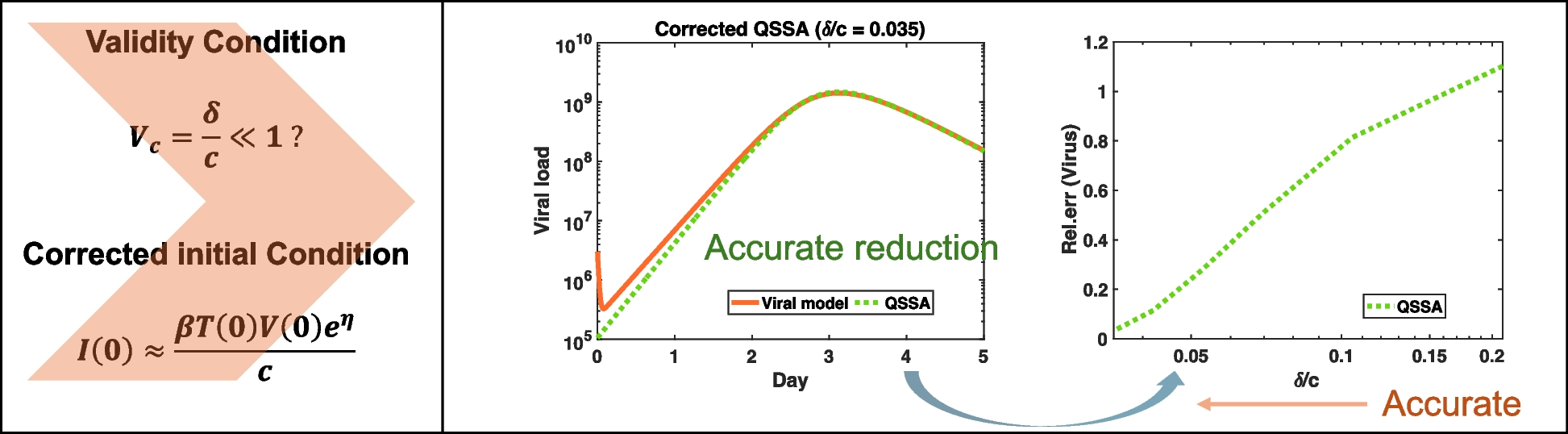
    $$Ileft({t}_{c}right)approx frac{beta {T}_{0}{V}_{0}{e}^{eta }}{c},$$

    where (eta) is bounded between (left(beta {V}_{0}{e}^{-1}-cright)/c) and (left(-beta {V}_{0}+beta {V}_{0}{e}^{-1}-delta right)/c) (Methods section). To systematically investigate how (eta) affects the approximation quality on (I({t}_{c})), we discretized (eta) into 10 evenly spaced values and selected three representative points: the first value (left(beta {V}_{0}{e}^{-1}-cright)/c), last value (left(-beta {V}_{0}+beta {V}_{0}{e}^{-1}-delta right)/c), and midpoint ((Ileft({t}_{c}right)=1.80)) between these two extremes. These selections ensured that the selected initial conditions remained consistent with the underlying system dynamics while capturing the range of possible QSSA approximations.

    Among these three values, (Ileft({t}_{c}right)=1.80) yields the lowest relative errors across all variables ((text{Rel}.text{Err }= 0.087)), indicating the best alignment with the basic viral model. The other two cases, (Ileft({t}_{c}right)=1.16) and (I({t}_{c})=3.08), resulted in slightly larger relative errors ((text{Rel}.text{Err }= 0.242) and (text{Rel}.text{Err }= 0.118), respectively) but still provided significantly better approximations than QSSAil. This demonstrates that the QSSA model can closely approximate the full model, but its accuracy depends critically on the initial condition of (Ileft({t}_{c}right).)

    These findings suggest that with proper initialization, the QSSA model serves a robust and accurate reduction of the basic viral model. Unlike QSSAil, which fails to maintain consistency in infected cell and virus dynamics, the QSSA model preserves the essential features of the viral replication process. These results support using the QSSA model as a reliable reduced-order representation of the viral system, especially when the initial conditions for infected cells are carefully determined.

    Comparison of QSSA and QSSAil models in approximating the basic viral model across different clearance rates

    To generalize these findings, we extended the comparison to a wider range of clearance rates. As shown in Fig. 3, the accuracies of the QSSA and QSSAil models vary significantly with the clearance rate ((c)). In this case, (eta) was fixed as (left(-beta {V}_{0}+beta {V}_{0}{e}^{-1}-delta right)/c). The QSSA model consistently approximated the basic viral model closely, with relative error decreasing as (c) increased. This pattern suggests that the QSSA model captures viral dynamics more accurately under strong timescale separation achieved by a sufficiently high clearance rate.

    Fig. 3
    figure 3

    Accuracy of the QSSA and QSSAil models across different values of (c). a Time-course comparison of the basic viral model (solid blue), the corrected initialized QSSA model (dashed orange), and QSSAil (dashed red) for varying values of (c) (5 to 40). As (c) increases, reflecting stronger timescale separation, the relative error (Rel.Err) of the QSSA model systematically decreases, indicating improved accuracy in approximating the basic viral model. Notably, when (c=40), the QSSA model achieves a relative error below 0.2. In contrast, the QSSAil model consistently exhibits larger deviations, regardless of (c). b Comparison for higher value of (c) (60 to 120). This QSSA model maintains its accuracy, achieving substantially lower errors than the QSSAil model, confirming the validity and robustness of the QSSA model under conditions of sufficient timescale separation

    The viral clearance rate ((c)) for influenza has been reported within a wide range for estimation, with lower and upper bounds of 1/day (({t}_{1/2})=16.7 h) and 103/day (({t}_{1/2})=1 min), respectively [25]. Similarly, the reported clearance rates for Zika virus range from 2 to 25/day [26]. To assess the effect of timescale separation, we explored a broader range of (c) values beyond those reported in previous studies. This was primarily because when (c) is relatively small, the validity condition is not well satisfied given a fixed (delta)=2.1. In such cases, the ratio ({C}_{v}=delta /c) is not sufficiently small, resulting in a poor approximation of the basic viral dynamics by the QSSA model. For moderate clearance rates (e.g., (c=10)), QSSAil yielded results similar to the QSSA model; however, its predictions became increasingly inaccurate as (c) increased, especially for target cells, infected cells, and viral load. These discrepancies become especially pronounced for (cge 20), where improper linearization in the derivation of QSSAil leads to systematic inaccuracies. Relative error analysis (Fig. 3b) supports this, showing that the QSSA model remains accurate across a wider range of (c) values and consistently outperforms QSSAil as timescale separation increases.

    Local sensitivity analysis reveals a similar pattern in parameter influence between the basic viral and QSSA models

    Building on the accuracy comparison, we next assessed whether the QSSA model exhibits comparable robustness to the basic viral model under parameter perturbations. Figure 4 presents a local sensitivity analysis comparing how the basic viral and QSSA models respond to parameter perturbations. Although both models exhibited similar qualitative patterns, notable differences appeared in the magnitudes of their sensitivity responses. As shown in Fig. 4a, the target cells ((T)) varied more in the QSSA model than in the basic viral model. By contrast, Fig. 4b shows that both models shared similar sensitivity patterns across parameters. However, Fig. 4c shows that the infected cells and viral load had lower mean sensitivity in the QSSA model. To test if the observed sensitivity patterns depended on the perturbation level, we repeated the analysis with 10% and 30% changes (Additional file 1: Fig. S1 a–b). Both models maintained similar sensitivity profiles across all perturbation levels, confirming the robustness of conclusions from Fig. 4a–c.

    Fig. 4
    figure 4

    Local sensitivity analysis of the basic viral and QSSA models. a Time-course analysis of target cells ((T)), infected cells ((I)), and viral load ((V)) under parameter perturbations in the basic viral model (left) and QSSA model (right). Each subplot shows the dynamics (solid black) alongside those resulting from a 20% increase in parameters: (p) (blue), (beta) (red), (delta) (green), or (c) (purple). The QSSA model maintains similar pattern of the basic viral model, though a slight deviation is observed in (T). b Relative changes in (V) over time after following perturbations to (p), (beta), (delta), and (c). Both the basic viral model (top) and QSSA model (bottom) show comparable responses, indicating similar dynamic sensitivity to parameter values. c Mean relative changes in (T, I,) and (V) for each parameter perturbations. The QSSA model captures the similar sensitivity patterns of the basic viral model

    These results indicate that the QSSA model does not always show reduced sensitivity across all state variables. However, its low sensitivity to viral load suggests it offers a stable representation of viral replication, especially when only viral load is observed. This highlights the importance of evaluating sensitivity when applying QSSA reductions, especially when models are used for parameter estimation.

    Validity condition and its impact on QSSA model accuracy

    To evaluate the validity of the QSSA model across different levels of timescale separation, we analyzed the relative error between the QSSA and viral models for varying combinations of the infected cell death rate ((delta)) and viral clearance rate ((c)), focusing on the role of the validity condition ({C}_{v}=delta /c) (Fig. 5).

    Fig. 5
    figure 5

    Evaluation of QSSA approximation accuracy based on the validity condition ({C}_{v}=delta /c). a Simulation results comparing the basic viral and QSSA models for two ((delta , c)) pairs that yield the same ({C}_{v}=0.1). While both cases maintain the same validity ratio, the QSSA model shows non-negligible deviations from the full model, indicating insufficient timescale separation. b Same comparison as in a, but with a stronger validity condition ({C}_{v}=0.01). The QSSA model closely approximates the full model across all compartments, with smaller relative errors. Notably, Fig. 5a reveals that identical ({C}_{v}) values do not guarantee identical approximation accuracy, suggesting that the absolute values of (delta) and (c) also play a role. However, as ({C}_{v}) becomes sufficiently small (b), the QSSA model consistently achieves low relative errors, supporting its use under stronger timescale separation. c Relationship between ({C}_{v}) and the relative error in viral load for four fixed (delta) (0.1, 0.4, 1, 2.1), with (c) varied from 10 to 100. A threshold of acceptable error (RE = 0.2, dashed purple line) is used to determine the minimum (c) value (red) needed for accurate QSSA performance. The analysis shows that smaller (delta) requires a less stringent (c) to achieve sufficient separation

    In Fig. 5a, we examined three (δ, c) pairs with the same validity condition ({C}_{v}=0.1): ((delta), (c)=(1, 10), (4, 40), (10, 100)). Although the validity condition remains fixed, the QSSA model yields different levels of approximation accuracy depending on the absolute values of (delta) and (c). For example, (delta =10) and (c=100) produces the lowest relative error across all compartments, indicating that accuracy may still vary even when ({C}_{v}) is fixed.

    To assess the impact of stronger timescale separation, we repeated the analysis using a smaller validity condition ({C}_{v}=0.01) (Fig. 5b). As expected, the QSSA model’s accuracy improves substantially under this condition, with relative errors consistently reduced across all compartments. These results confirm that smaller ({C}_{v}), indicating more pronounced timescale separation between infected cell dynamics and viral clearance, enhances the validity of the QSSA approximation.

    To further quantify the relationship between ({C}_{v}) and model accuracy, we systematically varied (c) from 10 to 100 while fixing (delta) at four values (0.1, 0.4, 1, and 2.1), and plotted the relative error of viral load (V) against the corresponding ({C}_{v}) (Fig. 5c). For each (delta), we defined a QSSA-valid regime as the region where the relative error of (V) falls below a threshold of 0.2 (horizontal dashed line). The vertical dashed lines mark the corresponding threshold ({C}_{v}) values and indicate the minimum required (c) values to satisfy the condition. As (delta) increases, the threshold ({C}_{v}) values also increase, suggesting that greater viral clearance is needed to maintain sufficient timescale separation. This analysis reveals a correlation between ({C}_{v}) and relative error, providing practical guidance on when the QSSA model can be reliably applied.

    Parameter estimation and model selection under varying timescale separation

    To assess model performance under different timescale separations, we performed in silico simulations using the basic viral model to generate viral load data with 5% noise. The infection rate (beta) was fixed, and the remaining parameters ((delta , p)) were estimated using both the basic and QSSA models. The validity condition ({C}_{v}=delta /c) was used to modulate the degree of timescale separation.

    As shown in Fig. 6a, b, when ({C}_{v}) was large, the QSSA model failed to fit the data, whereas the viral model performed well. When ({C}_{v}) was small, both models achieved accurate data fits, even under partial observability (six time points, viral load only) shown in Additional file 1: Fig. S2. This highlights that QSSA-based reductions require strong timescale separation for validity. However, parameter estimation results reveal deeper differences. Despite good data fits, the viral model failed to recover the true parameter values when ({C}_{v}) was small (Fig. 6c), leading to high relative errors. In contrast, the QSSA model produced more accurate estimates across all ({C}_{v}), particularly when timescale separation was strong.

    Fig. 6
    figure 6

    Parameter estimation and model fitting under different validity conditions. a Dynamics comparison for large ({C}_{v}=0.21). The QSSA model exhibits significant deviations from the basic viral model, particularly for infected cells ((text{Err}=1.35)) and viral load ((text{Err}=1.29)), indicating poor approximation accuracy under weak timescale separation. b Dynamics comparison for small ({C}_{v}=0.035). Both models closely align with the data, with small relative errors in target cells ((text{Err}=0.09)), infected cells ((text{Err}=0.19)), and viral load ((text{Err}=0.20)). c Parameter identifiability. Although the basic viral model provides a better data fit, it tends to underestimate parameters, particularly in (p) and (c), when ({C}_{v}) is small (0.035). In contrast, the QSSA model maintains consistent parameter estimates across different validity conditions, suggesting improved robustness in inference

    These observations were further supported by detailed analysis in Additional file 1: Fig. S2. In this scenario, we estimated three parameters (beta , delta) and (p). For two representative clearance rates ((c=10) and (c=60)), we randomly sampled six time points to simulate partial data availability. In the weak time separation (({C}_{v}=0.21)), the QSSA model produced a poor fit (Rel.Err ≈ 0.67), while the viral model fit the data well (Rel.Err ≈ 0.01). Under stronger time separation (({C}_{v}=0.035)), both models accurately fit the data, but QSSA yielded more accurate parameter estimates. Trace plots (Additional file 1: Fig. S2 e) revealed accurate convergence of QSSA estimates for (delta). In addition, 2D profile-likelihood contours (Additional file 1: Fig. S2 f) demonstrated better parameter identifiability in the QSSA model. Notably, the viral model failed to identify the (beta -p) pair, whereas QSSA produced compact confidence regions for all parameter pairs.

    Taken together, these findings suggest that the viral model is more robust for data fitting, but its parameter estimates may be biased when timescale separation is weak. In contrast, the QSSA model offers superior identifiability and reliability when the separation is strong, making it the preferable approach in such regimes.

    Continue Reading

  • Basel III risk-based capital ratios increase while leverage ratio and Net Stable Funding Ratio remain stable for large internationally active banks, latest Basel III monitoring exercise shows

    Basel III risk-based capital ratios increase while leverage ratio and Net Stable Funding Ratio remain stable for large internationally active banks, latest Basel III monitoring exercise shows

    • Basel III risk-based capital ratios increased in the second half of 2024.
    • Banks’ leverage ratio and Net Stable Funding Ratio remain stable while Liquidity Coverage Ratio decreased.
    • Dashboards offer new features to explore results.

    Basel III risk-based capital ratios increased while leverage ratios and Net Stable Funding Ratios (NSFRs) remained stable for large internationally active banks in the second half of 2024, according to the latest Basel III monitoring exercise, published today.

    The report, based on data as of 31 December 2024, sets out trends in current bank capital and liquidity ratios and the impact of the fully phased-in Basel III framework, including the December 2017 finalisation of the Basel III reforms and the January 2019 finalisation of the market risk framework. It covers both large internationally active banks (Group 1) and other smaller banks (Group 2). See note to editors for definitions.

    The implementation of the final elements of the Basel III minimum requirements began on 1 January 2023. At the end of the second half of 2024, the average impact of the fully phased-in final Basel III framework on the Tier 1 minimum required capital (MRC) of Group 1 banks was +2.1%, compared with +1.8% at end-June 2024. Group 1 banks report no regulatory capital shortfall, compared with €0.9 billion at end-June 2024.

    The monitoring exercise also collected bank data on Basel III liquidity requirements. The weighted average Liquidity Coverage Ratio (LCR) decreased compared with the previous reporting period to 134.8% for Group 1 banks. Three Group 1 banks reported an LCR below the minimum requirement of 100%.

    The weighted average NSFR was stable at 123.7% for Group 1 banks. All banks reported an NSFR above the minimum requirement of 100%.

    The report is accompanied by interactive Tableau dashboards, offering users an intuitive way to explore results. New features enhance usability, while expanded explanatory text provides deeper insights into topics such as risk-based capital and operational risk. For the first time, users can also download the underlying data directly from the dashboards.


    Note to editors

    Through a rigorous reporting process, the Basel Committee regularly reviews the implications of the Basel III standards for banks and has been publishing the results of such exercises since 2012.

    The results shown for “current Basel III framework” reflect the current jurisdictional standards that apply to the reporting banks as of 31 December 2024, which reflect different degrees of implementation of the Basel III reforms. The Basel III implementation dashboard provides an overview of Basel III implementation status across jurisdictions. The results shown for “fully phased-in final Basel III framework (2028)” assume that the positions as of 31 December 2024 were subject to the full application of the Basel III standards. That is, they do not account for transitional arrangements set out in the Basel III framework, which expire on 1 January 2028. No assumptions were made about bank profitability or behavioural responses, such as changes in bank capital or balance sheet composition. For that reason, the results of the study may not be comparable with industry estimates.

    Data are provided for 176 banks, including 116 large internationally active banks. These “Group 1” banks are defined as internationally active banks that have Tier 1 capital of more than €3 billion and include 29 institutions that have been designated as global systemically important banks (G-SIBs). The Basel Committee’s sample also includes 59 “Group 2” banks (ie banks that have Tier 1 capital of less than €3 billion or are not internationally active).

    The values for the previous period may differ slightly from those published in the previous report. This is caused by data resubmissions for previous periods to improve the underlying data quality and enlarge the time series sample.

    Continue Reading

  • Unused labour potential in the EU: 11.7% in 2024 – News articles

    Unused labour potential in the EU: 11.7% in 2024 – News articles

    In 2024, labour market slack in the EU accounted for 11.7% of the extended labour force, representing 26.7 million people aged 15 to 74 available for work but not participating in the labour market to their potential. This included unemployed and underemployed people, those seeking a job even though they are not immediately available to work and those immediately available to work but not seeking a job. With minor fluctuations, labour market slack in the EU has been decreasing over the decade, falling from 18.6% in 2015.

    Among EU countries, Spain recorded the highest labour market slack in 2024 (19.3% of the extended labour force), followed by Finland (17.9%) and Sweden (17.8%)

    In contrast, labour market slack was the lowest in Poland (5.0%), Malta (5.1%) and Slovenia and Hungary (both 6.3%).

    Source dataset: lfsi_sla_a

    Unemployment: the largest part of labour market slack

    A detailed breakdown of labour market slack shows that 5.7% of the extended labour force was unemployed, 2.7% was available to work but not seeking employment, 2.4% of people were underemployed part-time workers and 0.9% were seeking employment but not immediately available to work.

    Unemployed people made up most of the labour market slack in 23 EU countries, with the highest shares in Spain (10.9%), Greece (9.9%), Finland and Sweden (7.9% each). 

    However, there were some exceptions. In Ireland and the Netherlands, the majority of slack came from underemployed people working part-time (4.4% and 4.9%, respectively). In Czechia, the highest share was among people seeking work but not immediately available to start (3.1%), while in Italy, most were available to work but not seeking employment (7.3%).

    Source dataset: lfsi_sla_a

    Continue Reading

  • Volvo Cars shares skyrocket on profit beat, on track for best day ever

    Volvo Cars shares skyrocket on profit beat, on track for best day ever

    Mikael Sjoberg | Bloomberg | Getty Images

    Sweden’s Volvo Cars on Thursday posted stronger-than-expected third-quarter profit, prompting shares to rally by around 40% and putting the stock on track for its best-ever trading day.

    Volvo Cars, which is owned by China’s Geely Holding, posted operating income for the July-September period of 6.4 billion Swedish kronor ($680.4 million), well above analysts’ expectations and up from 5.8 billion kronor a year earlier.

    Its margin on earnings before interest and taxes (EBIT) came in at 7.4% for the third quarter, compared to 6.2% in the same period last year.

    Volvo Cars said the result was largely driven by its ongoing 18 billion kronor cost-saving program, as well as certain one-off items.

    The Stockholm-listed stock price jumped as much 41% on Thursday morning, before paring gains. It reflects the firm’s biggest intraday gain since it started trading four years ago.

    “In a tough market we delivered a solid third-quarter result and our cost and cash actions are delivering,” Volvo Cars CEO Håkan Samuelsson said in a statement.

    “We returned to a slight sales growth in September and we are now ramping up sales of our BEV cars. We are fully on track towards the very important January launch of the EX60 in the largest and most popular electric segment,” he added.

    Looking ahead, Volvo Cars said it expects to see more positive effects from its cost-cutting drive in the final three months of the year.

    It noted, however, that the short-term outlook appears to be increasingly challenging, citing persistent macroeconomic challenges, including price competition and the effects of U.S. import tariffs.

    Continue Reading

  • English water firms’ ratings hit record low after sewage pollution soars | Water industry

    English water firms’ ratings hit record low after sewage pollution soars | Water industry

    England’s water company ratings have fallen to the lowest level on record after sewage pollution last year rose to a new peak, with eight of nine water companies rated as poor and needing improvement by the Environment Agency.

    The cumulative score of just 19 stars out of a possible 36 is the lowest since the regulator began auditing the companies using the star rating system in 2011.

    Only one water company, Severn Trent, achieved full marks. The company did so despite having presided over 62,085 sewage spills, averaging seven hours each, in 2024.

    Struggling Thames Water was the only company to be awarded just one star for its performance. In 2023-24, its serious sewage pollution incidents more than doubled from 14 to 33.

    Thames is on the brink of collapse as the company struggles to secure a deal to write off its debt and secure its future. It has been crippled by huge debts built up over two decades by owners who have been criticised for paying out dividends without investing enough in its leaking pipes and malfunctioning treatment works.

    The report blames the wet and stormy weather in 2024, underinvestment and poor maintenance of infrastructure, and also increased monitoring and inspection, for the decrease in performance.

    Ofwat’s performance report was also published on Thursday and the regulator found pollution incidents remained at unacceptable levels, with only two companies having reported a reduction in incidents over the five-year period.

    It found that so far during the 2020-25 period, water companies had increased the amount of sewage spilled despite having promised to cut it by 30%.

    The report says: “Companies committed to reduce pollution incidents by 30% in the 2020-25 period. Companies achieved a reduction of 15% in the first three years, but the increase in the final two years has led to an overall 27% increase in numbers across the 2020-25 period.”

    The Environment Agency’s ratings have been criticised as not fit for purpose by pollution experts because they allow top marks to be awarded to companies that illegally spill sewage.

    Bosses presiding over companies found to “recklessly” discharge sewage have been able to justify their large pay packets because of being awarded the top rating, while companies that preside over sewage spills can call themselves “industry leaders”.

    From 2027 the Environment Agency will introduce new ratings, replacing the star system with a descriptor and number rating.

    At present, companies are given one to four stars. As part of the new methodology, they will instead be given a numeric rating from one to five, with only those that achieve the highest standards across the board rated “excellent” and the worst performers rated as “failing”.

    skip past newsletter promotion

    The Environment Agency chair, Alan Lovell, said: “This year’s results are poor and must serve as a clear and urgent signal for change. What is needed now from every water company is bold leadership, a shift in mindset and a relentless focus on delivery. We will support them however we can but will continue to robustly challenge them when they fall short.”

    Companies are judged on seven metrics, including drought resilience and transparency over sewage spills. If they score highly on some of these, they can get top marks even if they have discharged large amounts of untreated waste into England’s rivers and seas.

    Severn Trent has used the company’s four-star rating to justify the pay packet and bonus of its chief executive. Last year, Liv Garfield was awarded a £3.2m pay deal, including a £584,000 bonus, despite the company being fined £2m for spilling 260m litres of sewage into the River Trent.

    This week the chancellor, Rachel Reeves, told regulators to focus on helping businesses achieve economic growth rather than enforcing regulations. She announced that the government would set growth targets and publish a league table.

    The government plans to overhaul regulation by abolishing Ofwat and creating a “super regulator” by merging the powers of the existing bodies.

    Campaigners have questioned how effective this will be, as the privatised water system has allowed large bonuses and dividends to be paid by water companies at the expense of investment in sewage infrastructure. This has led to increasing sewage pollution into England’s rivers and seas.

    Continue Reading

  • MERS-CoV virus isolate added to the WHO BioHub System, enabling further research and pandemic preparedness

    MERS-CoV virus isolate added to the WHO BioHub System, enabling further research and pandemic preparedness

    An isolate of Middle East respiratory syndrome coronavirus (MERS-CoV), one of three high-impact coronaviruses with pandemic potential to have emerged in recent years, has been added to the WHO BioHub System.

    Through the BioHub, countries can voluntarily share and request biological materials with epidemic or pandemic potential. This initiative, set up by the Director-General of WHO during the COVID-19 pandemic, directly supports pathogen characterization and research, surveillance and risk assessments, and in the future will contribute to the development of medical countermeasures such as diagnostics, vaccines, and therapeutics by enabling rapid access to verified biological materials and data essential for advancing research, validation, and product development.

    MERS-CoV is a zoonotic virus and can be transmitted between dromedary camels and humans. Infection in people may lead to acute respiratory disease and even death, with a fatal outcome in 37% of cases reported to date. There are currently no licensed vaccines or therapeutics against MERS.

    “Since its identification, outbreaks caused by MERS-CoV have been sporadic. As such MERS-CoV isolates have been challenging to obtain, making it all the more important that the WHO BioHub System provides researchers with access to this virus isolate,” said Dr Maria Van Kerkhove, Acting Director of WHO’s Epidemic and Pandemic Management Department. “By supporting timely and transparent sharing of biological materials like the MERS-CoV isolate, the WHO BioHub is supporting research that helps the world prepare for epidemics and, potentially, pandemics.”

    Most MERS research to date has used clade A isolates, which are believed tohave been extinct since 2015. The isolate now available in the BioHub was derived from a camel and is of clade C, which is the clade found to be widely circulating in African camel populations.

    Recent pandemics and emergencies underscored the urgent need for faster, fairer, and more reliable sharing of pathogens to accelerate global response efforts. In an increasingly interconnected world where new infectious threats continue to emerge, timely access to biological materials is essential for science and public health action.

    The WHO BioHub System provides a functional, trusted, and scalable mechanism that minimizes administrative burdens through standardized agreements and procedures, ensuring rapid exchange while maintaining biosafety, supporting research and equity. Since its establishment, the BioHub has grown significantly in both participation and impact. To date, 76 laboratories from 30 countries across all WHO regions have engaged in the system through sharing and requesting biological materials with epidemic or pandemic potential. The BioHub has already played a key role in supporting global responses to major public health events – for example by supporting the sharing of SARS-CoV-2 variants isolates during the COVID-19 pandemic, and by facilitating access to mpox materials during the 2023-2024 outbreak, which enabled diagnostic validation and basic research across multiple laboratories worldwide.

    In line with its guiding principles, the BioHub has also served as a bridge for scientific collaboration, fostering equitable partnerships between providers and requestors of biological materials with epidemic or pandemic potential. This has enabled the inclusion of providers in joint scientific projects and publications, reinforcing acknowledgement and co-authorship, transparency, equity and fairness, collaboration and cooperation as well as ensuring shared benefits across the system.

    Today, the BioHub’s collection includes 33 variants of SARS-CoV-2, the virus that causes COVID-19; mpox clades Ia, Ib, IIb; the Oropouche virus; and now MERS-CoV. These additional pathogens reflect the evolving capacity of the WHO Biohub System to support preparedness for known and emerging pathogens.

    Currently, the Spiez Laboratory in Switzerland serves as the central WHO BioHub Facility, responsible for storing, characterizing, and distributing materials. Looking ahead, WHO aims to expand the network by establishing BioHub Facilities in each WHO region, ensuring all regions have equitable access and the capacity to respond rapidly to future health threats.

    This next phase will build on the BioHub’s strong foundation – advancing regional scientific collaboration, strengthening biosafety and biosecurity capacities, and enhancing global health security.

    Continue Reading

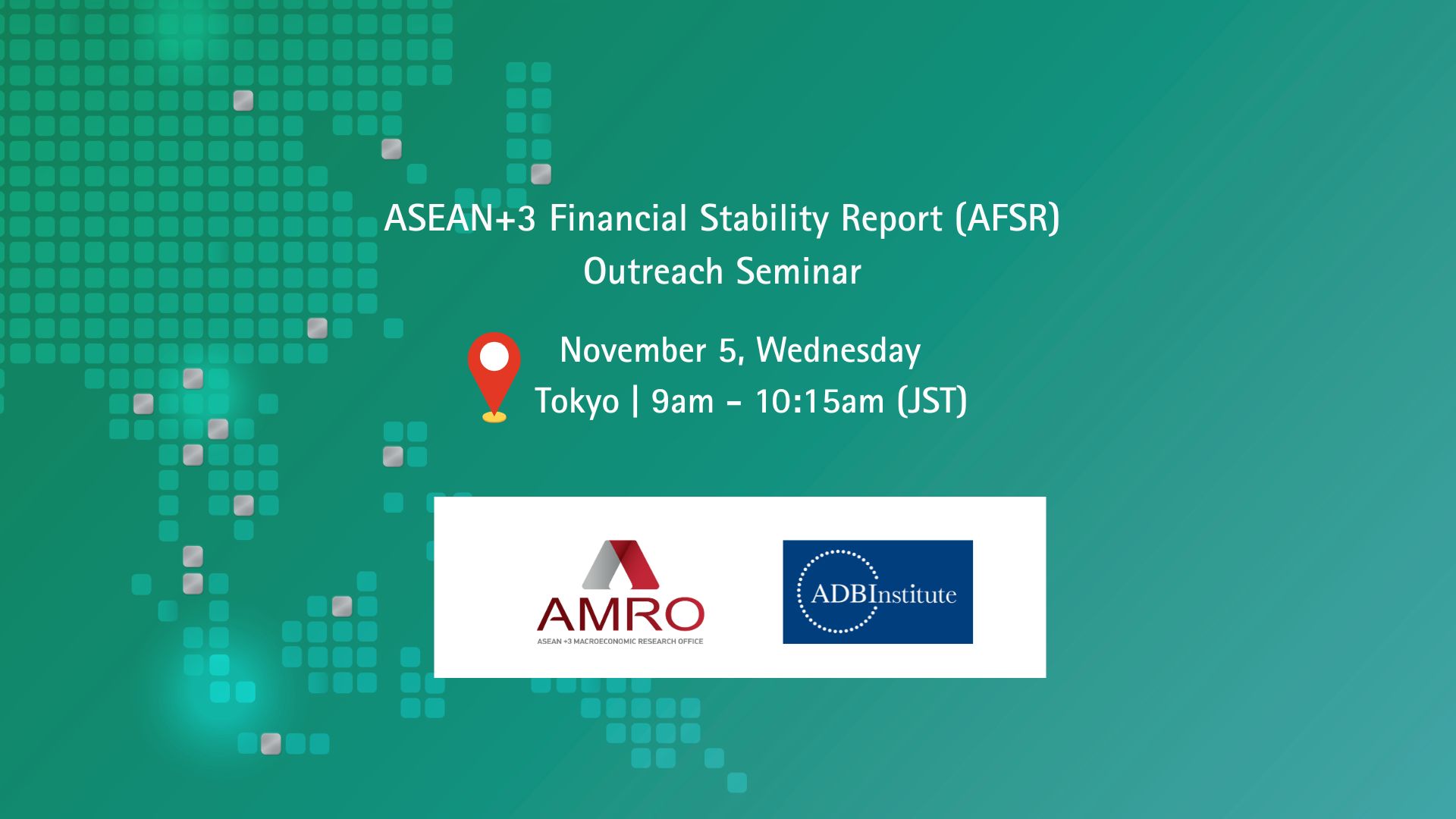
  • ASEAN+3 Financial Stability Report (AFSR) Outreach Seminar 2025 – ASEAN+3 Macroeconomic Research Office

    ASEAN+3 Financial Stability Report (AFSR) Outreach Seminar 2025 – ASEAN+3 Macroeconomic Research Office

    Panel Discussion

    Moderator: Prashant Pande, Senior Financial Specialist, AMRO

    Panelists:
    • Dong He, Chief Economist, AMRO
    • Arief Ramayandi, Senior Research Fellow, ADBI
    • Ayako Fujita, JP Morgan

    The objective of the session is to (1) exchange views on the AFSR 2025’s key findings, and (2) gather perspectives from panellists and participants on how Japan and other ASEAN+3 economies can strengthen financial resilience and stability amid heightened global uncertainties.

    Questions for discussion:

    1. How are global uncertainties and monetary policy shifts affecting financial stability in Japan and the broader region, and what key risks lie ahead?

    2. With the region’s reliance on the US dollar and its recent weakening, what policy options can help reduce vulnerabilities and build resilience?

    3. In the digital age, how can ASEAN+3 economies, including Japan, strike the right balance between fostering financial innovation and safeguarding stability?


    Continue Reading