Category: 3. Business

  • ‘The wire began to smoke’: how to avoid counterfeits scams on Vinted and other resale sites | E-commerce

    ‘The wire began to smoke’: how to avoid counterfeits scams on Vinted and other resale sites | E-commerce

    When Maheen found a brand-new Dyson Airwrap for the bargain price of £260 on the resale website Vinted, she was thrilled. The seller’s reviews were all five-star, and she trusted in the buyer-protection policy should something go wrong.

    Sold new, an Airwrap costs between £400 and £480, but Maheen did not suspect anything was amiss. “I had used Vinted many times and it was simple and straightforward. Nothing had ever gone wrong,” she says.

    However, after two weeks – and about four uses – she spotted a problem. “I noticed the wire began to smoke and the product seemed unsafe,” she says. Maheen contacted Dyson and was told to send in the Airwrap.

    Its response confirmed her fears. “I got a letter from [Dyson] confirming the product was counterfeit. It was unsafe and they wouldn’t return it to me,” she says.

    Maheen’s experience is far from unique. Almost two-fifths (37%) of Britons have been scammed while buying or selling on online marketplaces such as Facebook Marketplace, eBay and Vinted, according to research from the credit reference agency Experian.

    Victims of this type of crime tend to skew younger, with more than half of gen Z (58%) telling researchers they had been scammed compared with just 16% of people over the age of 55.

    For almost a quarter of people losses were in the region of £51 to £100, while 13% had lost more than £250. A small number said the scam had cost them between £501 and £1,000.

    The most common type of scam respondents encountered – being sent fake or counterfeit products (34%) – is the one Maheen fell prey to. Next up was requests to pay off-platform (31%), and items never arriving after payment (22%).

    What the scam looks like

    It looks like the legitimate item and the description suggests it is – more than half of scam victims (51%) told Experian they only realised they had been scammed once their item was delivered and turned out to be fake, or failed to arrive.

    Photos may be low resolution or look too good – like a catalogue photo – because they have been taken from other websites.

    The price will be less than you would expect and if you start asking questions the seller may try to rush you into a purchase and may ask you to pay them outside the Vinted platform.

    What to do

    Always review a seller’s profile closely and read customer reviews before purchasing an item on a marketplace. Try to obtain as much information about the product as possible before buying – for instance, ask the seller to send a video of the product. To protect yourself, stick to secure payment methods and avoid bank transfers.

    If the worst happens, report the incident to the marketplace and ask for a refund. They may ask for screenshots of messages and the details of the seller or buyer, plus any bank transfer details.

    Maheen was outside the Vinted two-day buyer protection window, but assumed she would get her money back because the product was dangerous. However, she found that it “was really hard to talk to someone”.

    She says: “It felt like I was talking to a bot.”

    With Guardian Money’s help, she has now got her money back.

    A Vinted spokesperson said: “The vast majority of transactions on Vinted take place without issue, and our teams work hard to ensure a smooth trading experience for all our Vinted members.

    “When a dispute does occur between a buyer and a seller, we will mediate, working closely with our delivery partners and potentially asking for additional information or evidence, before issuing a final decision.”

    If appealing to the marketplace directly goes nowhere, there are other things you can do.

    If you used a debit card ask your bank to make a chargeback claim. Alternatively, if you paid by credit card, try a section 75 claim – this is only an option if you have spent more than £100. If you paid by bank transfer it is more complicated, but you may be entitled to a refund under new fraud refund protections.

    Continue Reading

  • Global week ahead: ‘Cockroaches’ crawling toward Europe?

    Global week ahead: ‘Cockroaches’ crawling toward Europe?

    Europe’s banks take center stage this week as earnings season gets underway, but with heavy losses across the sector on Friday, credit concerns appear to be making their way across the Atlantic at a particularly tricky time for the region’s lenders.

    Stock Chart IconStock chart icon

    Credit concerns hit European banks

    Last week, the biggest names in American finance battled it out to make the most alarming quote of the week. The contenders: JPMorgan CEO Jamie Dimon, Citi Group CEO Jane Fraser and Apollo boss Marc Rowan.

    Dimon started the week with a stark warning about the private credit market, saying “when you see one cockroach, there’s probably more.”

    Fraser was up next, warning of “pockets of valuation frothiness.” While Rowan was more explicit, suggesting that “there’s been a willingness to cut corners,” in a recent appearance with the Financial Times.

    With the sirens sounding stateside, what does this mean for Europe, and how will the continents’ bankers narrate their concerns as earnings season kicks off in earnest next week?

    iNueng | iStock | Getty Images

    European earnings season kicks off

    Unicredit, Barclays, Lloyds Banking Group and Natwest will lead the financial names reporting in Europe and the U.K.

    Head of Financials for Credit at Federated Hermes, Filippo Alloatti, told CNBC that he expects CEOs to “shift from macro to micro risk” as a focus in their earnings calls this week, amid concerns around the private credit markets. Meanwhile, Johann Scholtz from Morningstar told CNBC that while he does not see a material deterioration of credit quality appearing in third-quarter results, “it will be interesting how candid management teams will be when discussing the future evolution of credit quality.”

    Scholtz highlighted concerns about corporate and small-to-medium sized company loan books, saying “the market is underestimating the impact that (trade) tariffs could have on certain pockets of European banks’ lending books.”

    On Friday, bank stocks across Europe sold off sharply as credit concerns drove big declines for the likes of Deutsche Bank, Société Générale, UBS and its peers across the sector.

    Margin of error

    CNBC’s Silvia Amaro will speak to Unicredit CEO Andrea Orcel as the bank publishes its latest set of earnings, with S&P Global predicting a subdued third quarter amid narrowing net interest margins and higher funding costs.

    The Italian lender is continuing it’s M&A ambitions, increasing its stake in Greece’s Alpha Bank to 26%, with Orcel saying “we are grateful to the Greek government, the central bank and other Greek institutions for welcoming us and encouraging our investment.” The reception to Unicredit’s expansion plans in Germany remains cooler.

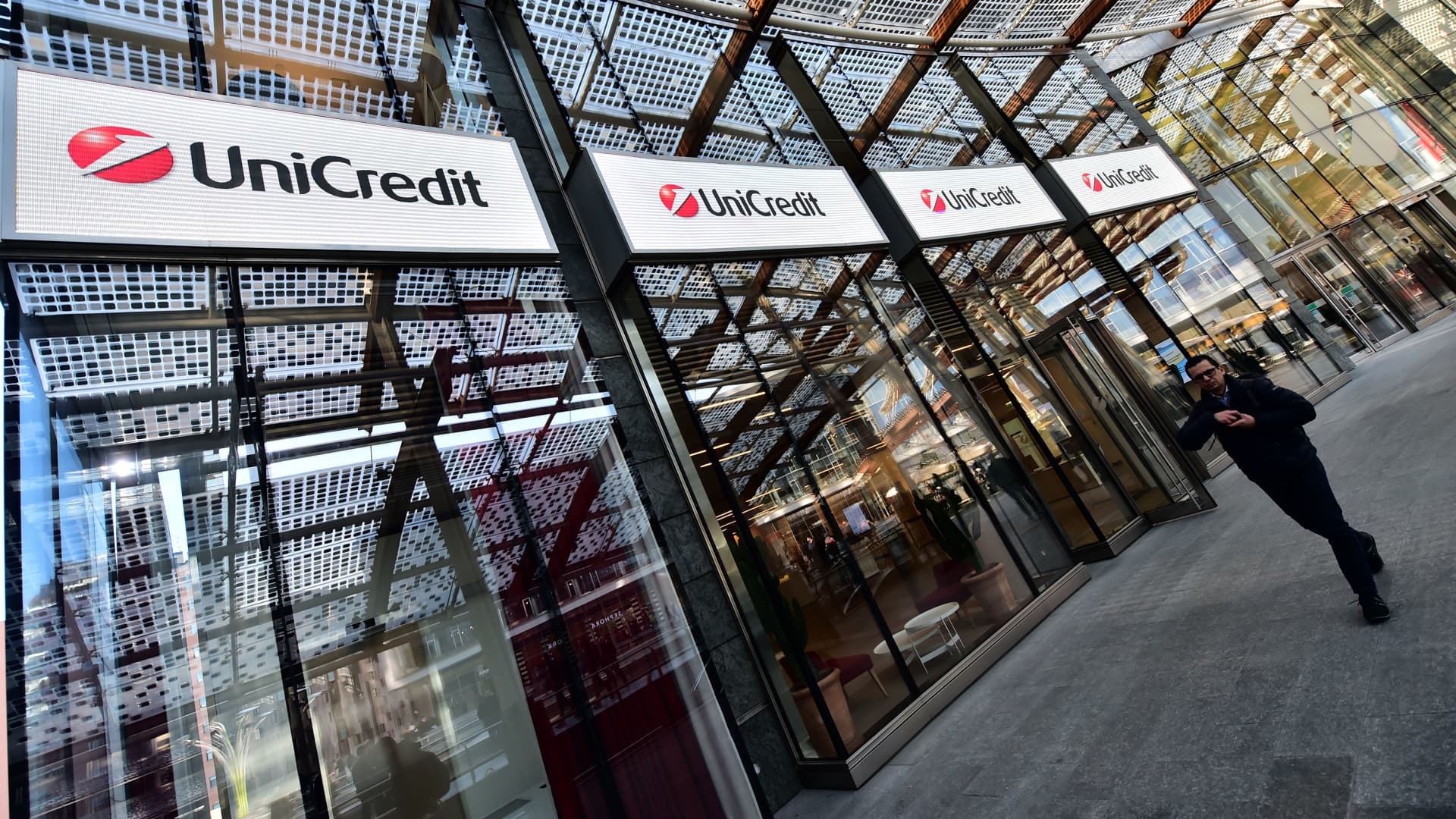
    The UniCredit SpA headquarters in Milan, Italy, on Jan. 22, 2022.

    Bloomberg | Getty Images

    Car trouble

    British lender Lloyds Bank will also report next week, having just announced a new £1.95 billion hit to its balance sheet following a regulatory ruling over the mis-selling of car finance loans. The Financial Conduct Authority estimates the scandal will cost U.K. lenders up to £11 billion. IG predicts this charge will offset what would have been a strong quarter for the bank, as unlike some of it European rivals, net interest income continues to rise.

    Lloyds Banking Group said it was stopping people buying cryptocurrencies using credit cards.

    Simon Dawson | Bloomberg | Getty Images

    Economic data and earnings this week:

    Monday: China GDP data

    Tuesday: L’Oreal, Coca Cola, Netflix earnings

    Wednesday: U.K. inflation data, Unicredit, Barclays, Tesla earnings

    Thursday: Unilever, Lloyds Banking Group, SAP, Intel earnings

    Friday: France, Germany, U.K. PMI data, Natwest, Procter & Gamble earnings

    Continue Reading

  • Jabil (JBL) Margin Drops on $300M Loss, Pressures Bullish Growth Outlook

    Jabil (JBL) Margin Drops on $300M Loss, Pressures Bullish Growth Outlook

    Jabil (JBL) posted net profit margins of 2.2%, a notable drop from last year’s 4.8%, following a one-off, non-recurring loss of $300 million that affected results through August 2025. However, the company’s EPS and top line are forecast to rebound, with earnings expected to grow at a robust 20.3% per year, which outpaces the US market’s 15.6% estimate. This dynamic has investors weighing a strong growth outlook against recent profit margin compression and episodic losses.

    See our full analysis for Jabil.

    Next, we will compare these fresh numbers with the most widely watched narratives in the market, examining which perspectives are supported and where assumptions might be tested.

    See what the community is saying about Jabil

    NYSE:JBL Revenue & Expenses Breakdown as at Oct 2025
    • Jabil expects its AI-related markets to deliver 40% year-on-year revenue growth, making this the fastest-growing segment highlighted in recent filings.

    • Analysts’ consensus view notes that diversification into high-growth AI and technology sectors is central to Jabil’s long-term upside, especially as these areas are projected to expand margin and revenue potential.

      • Consensus highlights robust expansion into India, boosting photonics capacity for next-generation tech demand.

      • Analysts also flag the $20 billion pharmaceutical solutions market, entered via acquisition, as another driver that could contribute to improved future margins and scale.

    • Latest results demonstrate real traction in AI and pharma, two catalysts for revenue momentum that the balanced narrative says could define Jabil’s next phase of growth. 📊 Read the full Jabil Consensus Narrative.

    • The Regulated Industries segment reported an 8% year-on-year revenue decline, while inventory days have inched above the company’s target range, placing added pressure on short-term margin recovery.

    • Consensus narrative flags that persistent weakness in regulated and renewables-facing businesses stands out as the sharpest risk to profitability, particularly given recent episodic cash flow pressures.

      • Analysts point to elevated inventory levels as an immediate challenge that could squeeze net margins if left unchecked going forward.

      • Persistent softness in consumer-driven segments, especially following the Mobility divestiture, presents further obstacles to regaining margin levels seen in prior years.

    • Jabil’s current price-to-earnings ratio stands at 34.2x, lower than the peer average of 35.5x but notably higher than the US electronic industry’s 26.2x. The stock trades 19.4% below its DCF fair value estimate of $259.90 per share.

    • According to the analysts’ consensus view, this mix of valuation signals prompts debate. While the discount versus DCF fair value and peer PE offers upside for buyers, the premium versus the broader industry and slower projected revenue growth (5.8% for Jabil versus 10.1% for the US market) keeps expectations in check.

      • Consensus commentary treats the 8% gap between the current share price ($209.34) and the latest analyst price target as a sign the market sees Jabil as fairly valued for now.

      • With only a modest gap to the analyst target, upside likely depends on the company proving that AI and pharma expansion can restore margins and achieve more aggressive profit targets than peers anticipate.

    Continue Reading

  • Assessing Value After Recent Share Price Momentum

    Assessing Value After Recent Share Price Momentum

    Subaru (TSE:7270) shares are catching some attention, and recent moves in the stock have investors taking a closer look. Over the past month, the stock has climbed about 1%, with a more pronounced 22% jump in the past 3 months.

    See our latest analysis for Subaru.

    After a solid stretch of upward momentum, Subaru’s one-year total shareholder return of 23.5% signals investors are seeing real value buildup, not just in the short bursts but sustained over recent quarters. Momentum looks to be holding strong, with its recent rally supporting investor optimism despite the occasional dip.

    If Subaru’s performance has caught your attention, now is an ideal time to see what’s happening across the auto space. Check out See the full list for free.

    With Subaru delivering steady returns and strong momentum, the real question for investors is this: Are shares trading below their true value, or is the market already accounting for all the future growth potential?

    Subaru’s current price tag comes with a price-to-earnings ratio of just 7.2x, which is notably low compared to both the broad JP market and regional peers. At ¥3,073 per share, investors are acquiring earnings at a significant discount compared to others in the auto sector.

    The price-to-earnings ratio measures how much investors are willing to pay for each yen of Subaru’s profit. For auto makers like Subaru, it serves as a shorthand for market expectations regarding earnings quality and growth prospects.

    Despite recent share price gains, the market appears to be underpricing Subaru’s consistent underlying profits, as indicated by its ratio being well below market and peer averages. The figure of 7.2x stands out when compared to the Asian Auto industry average of 21.8x and its closest rivals at 15.3x. Even the estimated fair ratio is higher at 11.5x, suggesting a considerable margin for potential revaluation if investor sentiment shifts toward fundamentals.

    Explore the SWS fair ratio for Subaru

    Result: Price-to-Earnings of 7.2x (UNDERVALUED)

    However, sluggish annual revenue growth and a recent dip in net income highlight ongoing challenges. If these issues persist, they could slow Subaru’s impressive momentum.

    Find out about the key risks to this Subaru narrative.

    While Subaru’s low price-to-earnings ratio hints at an undervalued stock, our DCF model arrives at a different conclusion. According to this approach, shares are trading above the estimated fair value. This suggests the price might not offer much room for long-term upside. Could the market be expecting more than the fundamentals support?

    Look into how the SWS DCF model arrives at its fair value.

    7270 Discounted Cash Flow as at Oct 2025

    Simply Wall St performs a discounted cash flow (DCF) on every stock in the world every day (check out Subaru for example). We show the entire calculation in full. You can track the result in your watchlist or portfolio and be alerted when this changes, or use our stock screener to discover undervalued stocks based on their cash flows. If you save a screener we even alert you when new companies match – so you never miss a potential opportunity.

    If you see things differently or want to dig deeper, you can quickly shape your own Subaru view in just a few minutes: Do it your way

    A great starting point for your Subaru research is our analysis highlighting 2 key rewards and 3 important warning signs that could impact your investment decision.

    Smart investors never stop at one stock. Use Simply Wall Street’s powerful screeners to spot standout opportunities and build a portfolio focused on growth and resilience.

    This article by Simply Wall St is general in nature. We provide commentary based on historical data and analyst forecasts only using an unbiased methodology and our articles are not intended to be financial advice. It does not constitute a recommendation to buy or sell any stock, and does not take account of your objectives, or your financial situation. We aim to bring you long-term focused analysis driven by fundamental data. Note that our analysis may not factor in the latest price-sensitive company announcements or qualitative material. Simply Wall St has no position in any stocks mentioned.

    Companies discussed in this article include 7270.

    Have feedback on this article? Concerned about the content? Get in touch with us directly. Alternatively, email editorial-team@simplywallst.com

    Continue Reading

  • A mushroom farm in Kenya and fungi-based panels give hope for sustainable building

    A mushroom farm in Kenya and fungi-based panels give hope for sustainable building

    NAIROBI, Kenya — NAIROBI, Kenya (AP) — A large mushroom farm near the Kenyan capital of Nairobi is one of a kind: It grows fungi on an industrial scale — not as food for restaurants but as a building material that some Kenyans say could make more people homeowners.

    The farm produces mycelium, the root structure of mushrooms that a local company then uses to make building materials it says are more sustainable than regular brick and mortar.

    The company, MycoTile, combines the roots with natural fibers and agents to make panels that can be used for everything from roof and wall insulation to interior decor, at a fraction of the cost of building with standard clay bricks. It currently produces about 3,000 square meters (yards) of such materials every month.

    Street vendor Jedidah Murugi, whose house was made with fungi-based construction materials, said she believes “there is no huge difference in the quality of the houses made from brick and these boards.”

    “The only difference,” she said, is in the cost. Her house, she added, “is not cold at night and neither is it hot during the day.”

    MycoTile’s work could be a boon for Nairobi, where local leaders cite a housing crisis that has left many homeless or living in informal settlements and dwelling enclaves, prone to fires and sanitary issues. Official figures say there is a housing deficit of at least 2 million units in this metropolis of over 5 million people.

    Most Kenyans are renters and those who are homeowners build from the ground up over many years instead of hiring contractors. It is common to find people living in badly finished or incomplete homes to avoid paying rent elsewhere.

    “Introducing affordable materials like ours taps into an existing huge market and contributes to providing affordable housing solutions,” said Mtamu Kililo, MycoTile’s founder.

    Kililo said his company’s insulation products cost roughly two-thirds of the price of standard materials.

    Building a one-bedroom unit in Nairobi using materials such as brick, timber and tin sheets typically costs up to 150,000 Kenyan shillings (about $1,000), for a simple structure, and the figure can double depending on the quality of finishes, according to estimates from builders.

    Using mushroom-root panels could shave off a third of the cost of building a house with bricks and mortar. Murugi, the street vendor, spent about 26,880 Kenyan shillings ($208) on the panels for her 15 square meter (161 square feet) home.

    Kenyan authorities have recently started working on a national plan for decarbonizing construction and building, with local-led innovation at its center.

    As part of the plan, the government allows MycoTile to use facilities at the Kenya Industrial Research and Development Institute in Nairobi, where it has access to machinery.

    MycoTile’s fungi-based construction panels are more sustainable than traditional ones because they are biodegradable and harmless to the environment, Kililo told The Associated Press.

    His idea was not novel — others elsewhere have experimented with mycelium. The first mycelium house in the southern African nation of Namibia was built by the nonprofit group MycoHAB in May 2024, using technology developed for NASA.

    In the Netherlands, one inventor makes mushroom coffins by binding mycelium with hemp fiber in a special mold that ends up resembling an unpainted sarcophagus from ancient Egypt.

    Sustainable products from biogenic materials are desirable because they have a low carbon footprint and potentially contribute no emissions, Nickson Otieno, an architect and sustainability expert in Nairobi, said.

    Construction “is one of the major emitters,” he added.

    The Global Buildings Performance Network, a think tank, earlier this year warned that Kenya “risks locking in decades of carbon-intensive construction” without targeted intervention.

    Kililo said his company also uses agricultural waste in its production process, reducing potential pollutants and easing pressure on waste disposal systems.

    “We go to western Kenya where there are many sugar manufacturing factories and collect the waste matter,” he said.

    The pasteurized agricultural waste is introduced to the mycelium composite from the farmed mushrooms, binding it into dense panels. MycoTile uses up around 250 tons of agricultural waste annually, Kililo said.

    For Kililo, the idea came during a research fellowship in the Rwandan capital of Kigali, home to one of the largest mushroom farms in east Africa. Kililo said he learned the process of mushroom farming there.

    “The used substrates looked like brick and I thought I could use those in the building industry,” he said.

    Returning to Kenya, he decided to create small blocks in his kitchen as part of his research into the fungal basis of sustainable building — never imagining it could someday become commercial.

    “I started doing a similar process, growing them in my pantry, baking them in my oven,” he said. “Initially it was purely research.”

    ___

    The Associated Press’ climate and environmental coverage receives financial support from multiple private foundations. AP is solely responsible for all content. Find AP’s standards for working with philanthropies, a list of supporters and funded coverage areas at AP.org.

    Continue Reading

  • Assessing Valuation After Recent Share Price Momentum

    Assessing Valuation After Recent Share Price Momentum

    Koninklijke Philips (ENXTAM:PHIA) has experienced some shifts in stock performance over the past month, catching the attention of investors who are looking for companies navigating dynamic markets. Shares have moved up nearly 2% in the past month.

    See our latest analysis for Koninklijke Philips.

    After a challenging twelve months, Koninklijke Philips has been making up some ground, most recently with a positive 14.4% 90-day share price return. While the past year’s total shareholder return sits in negative territory, upside momentum has picked up, suggesting a shift in risk sentiment and possibly renewed confidence in the company’s growth potential.

    If you’re interested in discovering what else is trending in healthcare and medtech, take the next step and check out See the full list for free.

    With Philips trading nearly 10% below analyst targets and showing strong recent gains, the key question is whether the market is still undervaluing its long-term prospects or if future growth is now fully reflected in the price.

    Philips trades at a price-to-earnings (P/E) ratio of 135.7x, which is far higher than both the sector and peer averages. The latest close of €24.26 places it firmly in the expensive camp relative to comparable medical equipment companies in Europe.

    The price-to-earnings ratio measures what investors are willing to pay today for each euro of the company’s earnings. A high P/E can reflect optimism about future growth or profitability improvements, but it can also suggest overenthusiasm if not backed by strong fundamentals.

    The implication here is clear: the market is pricing in ambitious profit growth for Philips, likely in response to its return to profitability and positive near-term momentum. However, when compared to the European industry average P/E of 29.1x and the peer average of 31.6x, Philips’ premium suggests investors expect more rapid earnings expansion, margin gains, or both.

    See what the numbers say about this price — find out in our valuation breakdown.

    Result: Price-to-Earnings of 135.7x (OVERVALUED)

    However, still, a slowdown in revenue growth or any stumbles in profitability could quickly reverse recent optimism and put pressure on Philips’ lofty valuation.

    Find out about the key risks to this Koninklijke Philips narrative.

    While Philips looks overvalued based on its price-to-earnings ratio, our DCF model presents a different perspective. The stock is trading at a 52.9% discount to our estimated fair value of €51.56, which suggests potential upside. Does this fundamental valuation challenge the market’s skepticism?

    Look into how the SWS DCF model arrives at its fair value.

    PHIA Discounted Cash Flow as at Oct 2025

    Simply Wall St performs a discounted cash flow (DCF) on every stock in the world every day (check out Koninklijke Philips for example). We show the entire calculation in full. You can track the result in your watchlist or portfolio and be alerted when this changes, or use our stock screener to discover undervalued stocks based on their cash flows. If you save a screener we even alert you when new companies match – so you never miss a potential opportunity.

    If you would like to analyze the numbers with your own perspective or dig deeper into the details, it’s quick and easy to craft your own narrative in minutes. Do it your way

    A great starting point for your Koninklijke Philips research is our analysis highlighting 3 key rewards and 2 important warning signs that could impact your investment decision.

    Staying ahead means seeking smart opportunities beyond a single stock. Uncover fresh investment angles and gain an edge with cutting-edge screeners built for results.

    This article by Simply Wall St is general in nature. We provide commentary based on historical data and analyst forecasts only using an unbiased methodology and our articles are not intended to be financial advice. It does not constitute a recommendation to buy or sell any stock, and does not take account of your objectives, or your financial situation. We aim to bring you long-term focused analysis driven by fundamental data. Note that our analysis may not factor in the latest price-sensitive company announcements or qualitative material. Simply Wall St has no position in any stocks mentioned.

    Companies discussed in this article include PHIA.enxtam.

    Have feedback on this article? Concerned about the content? Get in touch with us directly. Alternatively, email editorial-team@simplywallst.com

    Continue Reading

  • China accuses US of cyber breaches at national time centre

    China accuses US of cyber breaches at national time centre

    BEIJING, Oct 19 (Reuters) – China has accused the U.S. of stealing secrets and infiltrating the country’s national time centre, warning that serious breaches could have disrupted communication networks, financial systems, the power supply and the international standard time.

    The U.S. National Security Agency has been carrying out a cyber attack operation on the National Time Service Center over an extended period of time, China’s State Security Ministry said in a statement on its WeChat account on Sunday.

    Sign up here.

    The ministry said it found evidence tracing stolen data and credentials as far back as 2022, which were used to spy on the staff’s mobile devices and network systems at the centre.

    The U.S. intelligence agency had “exploited a vulnerability” in the messaging service of a foreign smartphone brand to access staff members’ devices in 2022, the ministry said, without naming the brand.

    The national time centre is a research institute under the Chinese Academy of Sciences that generates, maintains and broadcasts China’s standard time.

    The ministry’s investigation also found that the United States launched attacks on the centre’s internal network systems and attempted to attack the high-precision ground-based timing system in 2023 and 2024.

    The U.S. embassy did not immediately respond to a request for comment.

    China and the U.S. have increasingly traded accusations of cyberattacks in the past few years, each portraying the other as its primary cyber threat.

    The latest accusations come amid renewed trade tensions over China’s expanded rare earths export controls, and the U.S. threatening to further raise tariffs on Chinese goods.

    Reporting by Liz Lee; Editing by Michael Perry

    Our Standards: The Thomson Reuters Trust Principles., opens new tab

    Continue Reading

  • INTERVIEW: Sumitomo Life to Mull Using AI Tech to Support Sales Agents

    INTERVIEW: Sumitomo Life to Mull Using AI Tech to Support Sales Agents

    Economy

    Bellevue, Washington, Oct. 18 (Jiji Press)–Sumitomo Life Insurance Co. will consider using digital technologies including generative artificial intelligence to support its sales agents, Yukinori Takada, president of the Japanese insurer, said in a recent interview with Jiji Press.

    The comment followed a series of scandals in the industry that called into question the relationships between life insurance companies and their sales agents and highlighted the need to review the practice of supporting agents by dispatching employees on loan.

    Takada, also chairman of the Life Insurance Association of Japan, said, “We are currently in a major turning point” for building appropriate relationships with sales agents.

    The interview was held in Bellevue in the U.S. state of Washington, where Takada attended a two-day meeting with the heads of two overseas subsidiaries of Sumitomo Life through Thursday.

    Japanese life insurance companies have dispatched employees to their sales agents such as banks to provide support in selling their insurance products.

    [Copyright The Jiji Press, Ltd.]

    Jiji Press

    Continue Reading

  • Apple’s biggest iPhone overhaul in years ignites upgrade frenzy

    Apple’s biggest iPhone overhaul in years ignites upgrade frenzy

    Unlock the Editor’s Digest for free

    Apple’s new iPhone 17 is kick-starting the company’s strongest growth in smartphone sales since the Covid-19 pandemic, as the biggest redesign of its flagship product in years proves a hit.

    Early momentum for the redesigned versions of its mobile device has proven stronger than expected before its September launch, according to industry insiders who monitor Apple’s supply chain, mobile operators and the length of time customers must wait for deliveries.

    Analysts forecast that smartphone revenues will return to 4 per cent growth in the latest fiscal year, hitting $209.3bn, according to Visible Alpha data. The growth rate will rise to almost 5 per cent in fiscal 2026, with iPhone revenues hitting $218.9bn.

    That has led to market confidence building as Apple heads into the crucial holiday sales season, despite delays to releasing artificial intelligence features and Donald Trump’s tariffs weighing on the Silicon Valley giant’s share price over the past year.

    “It’s fair to describe the iPhone 17 launch as surprising versus where Wall Street expectations were at the end of August” before launch, said Gene Munster at Deepwater Asset Management.  

    Apple’s smartphone revenues fell 2 per cent in its 2023 financial year, which ends in September, and were flat last year, after consumers splurged on consumer electronics during the pandemic.

    But significant upgrades to the iPhone’s cameras, displays and batteries this year are tempting more customers to upgrade ageing devices.

    Citing Apple’s own store data as well as carrier data, Bank of America analysts this week said shipping times shown for the iPhone 17 are longer than in previous years, which “could indicate strong demand”.

    “When lead times are longer, it’s usually a better product cycle,” Munster said. Wait times on the new iPhone are about 13 per cent longer than last year, he added, possibly signalling a broader “upgrade cycle”.

    On 30 October Apple will report its fiscal fourth quarter to the end of September, including the first few weeks of iPhone 17 sales.

    “Clearly it’s a very strong quarter for Apple,” said the IDC’s Francisco Jeronimo. “I don’t remember the last time I saw queues outside the Apple store like I’ve seen this year.”

    Checks of Apple’s supply chain suggested orders of the iPhone 17 were “much stronger” than last year’s iPhone 16, he added.

    Tracked by unit volumes, iPhone sales remain broadly flat. Between Apple’s fiscal 2024 and 2026, units are expected to hover around 235mn, according to Visible Alpha data.

    Line chart of Share price and index rebased in $ terms showing Apple shares on the rise after hits from trade war and AI concerns

    By 2027, analysts predict the company’s flagship product will start selling more than 240mn units, before rising to almost 260mn by the end of the decade, with market rumours pointing to the launch of a foldable iPhone next year.

    Apple no longer discloses unit sales and prefers to focus investor attention on revenues, with much of its overall growth from its existing user base.

    The latest iPhone line-up has been boosted by generous trade-in programmes. The base model has benefited from government subsidy policies for cheaper phones in China.

    iPhones continue to account for more than half of Apple’s approximately $390bn in annual revenue. A hit could help Apple turn around a difficult 2025, marked by trade tensions that disrupted its global supply chains.

    Apple’s shares hit a new yearly high in September around the iPhone 17 launch, but recently dipped with the broader market as Trump threatened 100 per cent tariffs on China.

    Despite speculation of tariff-driven cost increases, Apple opted not to raise prices for the device.

    Some analysts warn market expectations for the new iPhone have got ahead of themselves. Earlier this month Jefferies downgraded Apple shares to “underperform” citing “excessive expectations” for iPhone demand.

    Continue Reading

  • ‘Shoestring’ R&D budgets force India to rely on Chinese tech, says steel tycoon

    ‘Shoestring’ R&D budgets force India to rely on Chinese tech, says steel tycoon

    Stay informed with free updates

    India’s “shoestring” research and development budgets leave it dependent on strategic rival China for the technology it needs to boost manufacturing, said steel billionaire Sajjan Jindal as he prepares to launch an electric vehicle brand.

    The 65-year-old chair of JSW Group, which owns India’s largest steelmaker, said his company was in talks with several Chinese manufacturers, including BYD and Geely, to bring technology to India in preparation for an EV launch by June next year.

    “The technology rests in China. Even Europe is taking the technology from China,” Jindal told the Financial Times. “China has taken a huge leap versus the European auto companies, so we don’t have any option.”

    Indian Prime Minister Narendra Modi has sought to boost domestic manufacturing, with a focus on EVs, smartphones and semiconductors. His government has offered corporate tax incentives and consumer subsidies.

    The risks of India’s reliance on China were made stark in 2020, when the nuclear-armed neighbours reignited a decades-long dispute along their Himalayan border and Beijing “started to clamp down on sharing technology with India”, said Jindal.

    New Delhi in turn increased scrutiny of Chinese investments, denied most visas and blocked partnerships with manufacturers, including BYD.

    While ties have begun to improve and Modi made his first visit to China since 2019 in August, New Delhi remains sceptical of Chinese technology and investment. It also wants to gain some of the business stemming from western companies trying to diversify their supply chains away from China.

    However, Indian companies, including JSW, are not investing enough in R&D because they are focused on building up their capacity, said Jindal. India spends just 0.66 per cent of its GDP on R&D, compared with China’s 2.4 per cent and 3.5 per cent for the US.

    “The government is trying to encourage the domestic industry, but it’s also shoestring budgets,” he said.

    Sajjan Jindal, chair of JSW Group said: ‘The technology rests in China. Even Europe is taking the technology from China’ © Kanishka Sonthalia/FT

    JSW, which has interests in ports, cement, energy and defence, entered the EV sector in 2023, producing MG Motor-branded cars as part of a joint venture with Chinese state-owned SAIC Motor.

    The Chinese company is now looking to reduce its stake, said Jindal. The joint venture needs “more cash to be injected” but SAIC is “reluctant”, he said, adding that JSW would infuse more capital.

    “I told the [SAIC] chairman . . . we want to own a 100 per cent stake in a new venture where we will do a lot of innovation ourselves,” he said, but SAIC wants “everything to be developed in China and then to be produced in India”.

    SAIC did not respond to a request for comment.

    Batteries — a core component of EVs — are one of the biggest hurdles. India mostly imports cells from China, Japan and South Korea, and domestic production is forecast to meet just 13 per cent of the country’s EV battery cell demand by 2030, according to S&P Global Mobility.

    “Eventually our goal is to manufacture, design and develop the technology in India,” said Jindal, but until then they would have to use Chinese technology.

    China on Wednesday said it had filed a complaint with the World Trade Organization over India’s EV and battery subsidies, arguing that they “give Indian industry an unfair competitive advantage and harm Chinese interests”.

    JSW Groups made $23bn in revenue in the fiscal year to March 2025, of which steel accounted for $19bn. The EV joint venture, which is privately held, last reported revenue of less than $1bn in the fiscal year to March 2024.

    JSW Steel on Friday reported a Rs16.2bn ($185mn) net profit in the quarter to September, jumping almost fourfold from the same period a year earlier.

    Jindal expressed optimism that ties with China would continue to improve, especially after President Donald Trump’s 50 per cent tariffs on India showed the risks of a trade relationship with the US.

    “Either bullets will talk or business will talk,” he said of India-China relations. “Both cannot talk simultaneously.”

    Additional reporting by Gloria Li in Hong Kong

    Continue Reading