Category: 3. Business

  • Stock Rally Pauses on Tech Valuations, Dollar Dips: Markets Wrap

    Stock Rally Pauses on Tech Valuations, Dollar Dips: Markets Wrap

    (Bloomberg) — The blistering rally in global equities halted amid rising concern that technology valuations have run too far.

    Asian shares fell 0.8%, tracking declines in the US, with technology firms dragging in Japan and China. Semiconductor Manufacturing International Corp. slumped 7% after reports that brokerages have cut the stock’s margin financing ratio to zero, citing high valuations. A gauge of Chinese tech shares in Hong Kong was set for its worst week since early August. Equity-index futures for Europe and the US were flat.

    The dollar slipped after a four-day rally took it to the strongest since the beginning of August. A Bloomberg gauge of the currency was set for its best weekly gain since mid-November 2024. Gold extended its losses, while oil held the biggest decline in a week.

    Global shares were set for a second decline in three weeks as investors took a pause following a robust rebound from April’s lows, when tariff announcements shook markets. The surge in AI-focused technology companies has fueled a debate over whether prices are running ahead of fundamentals.

    “Some areas of the market appear overheated,” said Keith Lerner at Truist Advisory Services Inc. “The extended stretch without a meaningful pullback leaves the market more sensitive to negative surprises.”

    Chip stocks in Asia, especially in Japan, had rallied earlier this month after companies such as Hitachi Ltd. and Fujitsu Ltd. formed alliances with OpenAI and Nvidia Corp. South Korean shares rose upon return from a week-long holiday with Samsung Electronics Co. jumping 5.4%.

    “China tech is starting the fourth quarter with some profit-taking by investors after a stellar 3Q run, and that’s weighing down the index,” said Marvin Chen, a strategist with Bloomberg Intelligence.

    In other corners of the market, Treasuries steadied after falling across the curve Thursday.

    The yen headed for its biggest weekly loss in a year even as Japan’s new ruling-party leader Sanae Takaichi — a pro-stimulus lawmaker — said she wasn’t in favor of an excessively weak currency.

    Takaichi will meet with her ruling coalition counterpart on Friday afternoon, amid fears of a possible rupturing of the 26-year partnership that has been the bedrock of political stability in Japan.

    The Argentine peso rebounded after the US rushed to stabilize the country’s economy, offering $20 billion in financing and carrying out a rare intervention in currency markets after weeks of sharp declines.

    Meanwhile, India’s Prime Minister Narendra Modi spoke with US President Donald Trump to review progress on trade talks, signaling renewed efforts by both sides to break the impasse.

    What Bloomberg strategists say…

    “The growing momentum for the greenback is spurring a fresh squeeze for overstretched dollar bears. There seems to be still plenty of money hanging on to bearish dollar positions in the hope that the ‘sell America’ narrative from early 2025 makes a return. If that’s so then further dollar squeezes are on the cards.”

    — Garfield Reynolds, MLIV Asia Team Leader. Click here for the full analysis.

    Investors are also focused on the recent strength of the dollar.

    The world’s primary reserve currency is around a two-month high, even as the US government shutdown drags on, and traders in Asia and Europe say hedge funds are adding options bets that the rebound versus most major peers will extend into year-end.

    “While further dollar upside may be limited without a notable rise in real yields, another leg higher in US Treasury yields could spark broader risk-asset corrections,” wrote Dilin Wu, a strategist at Pepperstone Group.

    Corporate News:

    Samsung Electronics Co. shares jumped, on track to close at an all-time high, riding investor enthusiasm for its potential in artificial intelligence chips and renewed confidence in its conventional memory business. Chinese battery stocks fell as the nation will impose export controls on some lithium batteries, critical materials, and related technology and equipment effective Nov. 8, according to a statement Thursday. Seven & i shares dropped after the company lowered its full-year outlook below analyst expectations, citing weakness in its domestic convenience store business. SoftBank Group Corp. is in talks to borrow $5 billion from global banks, refilling its coffers at a time Masayoshi Son is accelerating the Japanese investment firm’s bets on artificial intelligence. Apple Inc. is preparing to expand the roles of some top executives in response to the pending departure of longtime Chief Operating Officer Jeff Williams. Some of the main moves in markets:

    Stocks

    S&P 500 futures were little changed as of 2:03 p.m. Tokyo time Japan’s Topix fell 2% Australia’s S&P/ASX 200 fell 0.1% Hong Kong’s Hang Seng fell 1.1% The Shanghai Composite fell 0.6% Euro Stoxx 50 futures were little changed Currencies

    The Bloomberg Dollar Spot Index fell 0.1% The euro was little changed at $1.1573 The Japanese yen rose 0.2% to 152.74 per dollar The offshore yuan rose 0.1% to 7.1290 per dollar Cryptocurrencies

    Bitcoin was little changed at $121,217 Ether rose 0.1% to $4,344.01 Bonds

    The yield on 10-year Treasuries declined one basis point to 4.13% Japan’s 10-year yield was little changed at 1.695% Australia’s 10-year yield advanced two basis points to 4.37% Commodities

    West Texas Intermediate crude fell 0.4% to $61.28 a barrel Spot gold fell 0.2% to $3,969.82 an ounce This story was produced with the assistance of Bloomberg Automation.

    –With assistance from Kelly Li and Carmeli Argana.

    ©2025 Bloomberg L.P.

    Continue Reading

  • Vitol caught in crossfire as UAE blocks Sudan oil shipments

    Vitol caught in crossfire as UAE blocks Sudan oil shipments

    Stay informed with free updates

    An escalating dispute between the United Arab Emirates and Sudan has ensnared the commodities trader Vitol and disrupted supplies to one of the world’s busiest marine fuel hubs.

    The UAE has refused to accept any cargoes to and from Sudan’s main port since early August amid deteriorating relations with the country’s military government, which accuses Abu Dhabi of meddling in the brutal Sudanese civil war.

    The blockade of Port Sudan has prevented Vitol, the world’s biggest independent oil trader, from shipping the preferred crude to its refinery in the emirate of Fujairah to be made into the low sulphur fuel used to power tankers.

    The crude originates in South Sudan, an independent and landlocked country that sends much of its daily output to Port Sudan and on to Vitol’s terminal for processing.

    But that arrangement has been upended by the conflict in Sudan that has pitted Abdel Fattah al-Burhan’s military government against the paramilitary Rapid Support Forces.

    Sudan has accused the UAE of arming the RSF, led by the warlord Mohamed Hamdan Dagalo, known as Hemedti, and fuelling a two-year civil war that is estimated to have killed more than 150,000 people.

    The Sudanese government severed diplomatic ties with Abu Dhabi in May after RSF drones struck Port Sudan, base for the wartime government, an attack that it partly blamed on the wealthy Gulf state.

    The UAE energy and infrastructure ministry then issued an August 7 decree that prohibited the handling of any cargoes to or from the Sudanese port, according to notices sent to harbourmasters and shipping clients.

    Some content could not load. Check your internet connection or browser settings.

    The UAE has strongly denied supporting any of Sudan’s warring parties, and the foreign affairs ministry did not respond to requests for comment on why it imposed the blockade.

    However, its action came amid an intensifying war of words with Sudan’s armed forces that have aligned with Islamist militias on the battlefield.

    South Sudan produces about 149,000 barrels of crude a day, according to the US Energy Information Administration, although a shutdown of the pipeline to Port Sudan had disrupted the trade even before the blockade. 

    Much of the crude is taken to Vitol’s Fujairah terminal to be refined into so-called bunker fuel, used to power tankers and other marine vessels.

    Facilities in the UAE — close to the Strait of Hormuz, one of the world’s busiest shipping lanes — specialise in this type of marine fuel, with Vitol saying its product powers about 1,800 ships in the region a year.

    The Vitol refinery, in which the Fujairah government is a minority owner, mainly uses crude shipped from Port Sudan to produce bunker fuel.

    The Geneva- and Rotterdam-headquartered company has been the only regular importer of Port Sudan crude into the UAE for at least a year, according to data from analytics company Kpler.

    However, no South Sudanese cargoes have arrived in the UAE since July 30, according to the data, requiring a facility with a daily capacity of about 100,000 barrels to operate without its preferred feedstock. 

    Other types of crudes can be used to make bunker fuel, although it is more expensive to source cargoes at short notice. The Kpler data showed Vitol was the buyer of about 2mn barrels of the alternative crudes that arrived in the UAE in August. 

    Vitol declined to comment on activities at its Fujairah refinery, but denied that the absence of South Sudanese crude had forced it to halt refining. 

    The crude that South Sudan’s government relies on for much of its revenues has been redirected to other destinations, according to the Kpler data, notably Malaysia, where Vitol has an alternative bunker fuel refinery.

    While no crude from Sudan was offloaded in the UAE in August, just over 100,000 barrels from the country instead arrived in Malaysia. This was a big increase in the monthly average of 27,000 barrels over the past five years.

    Additional reporting by Tom Wilson and William Wallis in London, cartography by Steven Bernard

    Continue Reading

  • China launches customs crackdown on Nvidia AI chips

    China launches customs crackdown on Nvidia AI chips

    Unlock the Editor’s Digest for free

    China has stepped up the enforcement of its controls on chip imports, as Beijing seeks to wean the country’s technology companies away from US products such as Nvidia’s artificial intelligence processors.

    Teams of customs officers have been mobilised at major ports across the country in the past few weeks to carry out stringent checks on semiconductor shipments, according to three people with knowledge of the matter.

    The inspections started with the goal of ensuring that local companies stop ordering Nvidia’s China-specific chips following guidance from Chinese regulators to discourage their purchase, said the people.

    The targeted processors — Nvidia’s H20 and RTX Pro 6000D — are designed to adhere to US export controls and maintain the Silicon Valley chipmaker’s market share in China.

    But one person said the checks had been extended more recently to all advanced semiconductor products, to also better target the smuggling of high-end chips that breach US export curbs.

    Chinese customs had previously done little to prevent chip imports as long as appropriate duties were paid at the border. The Financial Times reported that at least $1bn worth of Nvidia’s top AI chips were smuggled and sold in China in the three months from May.

    The border crackdown further marks Beijing’s determination to ensure its tech companies break free from relying on American technology and help the country win the AI race against the US.

    China is seeking to put its resources behind domestic chipmakers, so they catch up in product performance and manufacturing capacity.

    In addition to tightened border controls, some customs officials also looked at whether companies had made false declarations in the past about the import of advanced semiconductor products, said two of the people familiar with the inspections.

    US quants trading giant Tower Research has been investigated for alleged smuggling of hardware including advanced chips, the FT reported last week. The probe was part of this new wave of import controls.

    China’s regulators led by Cyberspace Administration of China (CAC), the internet watchdog, told tech companies led by ByteDance and Alibaba in mid-September to terminate their orders and testing for all Nvidia products. The new border controls have been carried out as a co-ordinated effort alongside the CAC.

    The regulator’s guidance came just two months after Nvidia announced an earlier US export ban on H20 had been lifted by the Trump administration, while also introducing the RTX Pro 6000D, another watered-down AI chip for China.

    The latest moves have occurred as senior officials in Beijing have determined that domestic chips have reached performance standards that compare with Nvidia’s China-specific chips.

    China also aims to triple its production of advanced semiconductors next year, in a move designed to fill the demand left by Nvidia, the FT reported last month.

    While Nvidia no longer includes China in its future revenue projection, it recorded $4.6bn in the first quarter of this fiscal year from selling H20 to China, its fourth-largest market, before the US temporarily restricted sales.

    China’s customs did not respond to requests for comment. Nvidia declined to comment.

    Continue Reading

  • WA network expansion plans ‘an opportunity’ for infrastructure firms

    WA network expansion plans ‘an opportunity’ for infrastructure firms

    The South West Interconnected System Transmission Plan (SWIS plan) sets out the transmission infrastructure that needs to be built to facilitate the phase-out of coal generation, support the widespread electrification of existing industries and enable the new load connections needed to diversify and strengthen WA’s economy.

    Amber-Jade Sanderson, WA’s energy and decarbonisation minister, said: “The SWIS Transmission Plan is our blueprint for infrastructure upgrades that will support our energy transition and ensure WA becomes a renewable energy powerhouse.”

    Developed by Energy Policy WA and Western Power, the SWIS plan builds on extensive modelling and system planning carried out in previous government reports, including the Whole of System Plan 2020, the South West Interconnected System Demand Assessment: 2023 to 2024, and the South West Interconnected System Planning Update.

    David Ulbrick, an expert in infrastructure at Pinsent Masons, said: “The SWIS plan makes it clear that Western Australia is strategically positioning itself to be a global leader in the clean energy transition, and both construction and energy industry participants will be central to delivering that vision.”

    “There are three distinct phases of development outlined in the SWIS plan. Phase one upgrades, from 2025 to 2030, include the Kwinana Strategic Industrial Area and Western Trade Coast, Coolangatta Industrial Estate, and Kemerton SIA, to make a combined 1,500 megawatts (MW) available to support future industry growth,” he said.

    “Phase two projects, from 2030 to 2035, include delivering transmission infrastructure in Chittering, Moora, Collie, and around metropolitan Perth. Phase three, covering 2035 and beyond, will involve expanding Western Power’s network to support economic diversification through the development of new green industries.”

    WA currently plans to retire all state-owned coal plants by 2030. Renewables already make up roughly 39% of energy output in the state, with another 1.5 gigawatts (GW) of grid-scale batteries expected by end of 2025.

    Toby Evans, an expert in infrastructure at Pinsent Mason, said: “The SWIS plan will create a multi-decade pipeline of infrastructure work in WA.”

    “The plan will create high demand for heavy engineering contractors, line builders, substation specialists, steel fabricators and concrete suppliers, and skilled trades and apprentices,” he said.

    “The long-term, sequential project pipeline allows for strategic workforce planning, supply chain mobilisation, joint ventures and risk-sharing partnerships and the roll out of priority projects will offer early tendering opportunities for construction firms.”

    Thomas Coleman of Pinsent Masons said: “Firms should consider scaling up workforce and supply chains now to meet 2025–2030 peak, focus on gaining entry onto Western Power’s approved contractor lists, consider form strategic alliances and joint ventures to share risk and access larger packages, and engage early with corridor siting and design briefs.” 

    Continue Reading

  • Revenue Surge Amid Strategic Expansion

    Revenue Surge Amid Strategic Expansion

    This article first appeared on GuruFocus.

    • Revenue: $64.2 million, up 84% from $34.8 million in the fiscal first quarter of 2025.

    • Tenant Fit-Out Revenue: $26.3 million from HPC hosting business.

    • Cost of Revenues: $55.6 million, up from $22.7 million.

    • SG&A Expenses: $29.2 million, increased due to $16.6 million in stock-based compensation and $3.9 million in personnel expenses.

    • Net Loss: $27.8 million or $0.11 per share.

    • Adjusted Net Loss: $7.6 million or $0.03 per share.

    • Adjusted EBITDA: $0.5 million, compared to $6.3 million in the prior year.

    • Cash and Cash Equivalents: $114.1 million.

    • Debt: $687.3 million.

    Release Date: October 09, 2025

    For the complete transcript of the earnings call, please refer to the full earnings call transcript.

    • Applied Digital Corp (NASDAQ:APLD) expanded its long-term lease agreements with CoreWeave, increasing the total contract value to approximately $11 billion.

    • The company broke ground on a new campus, Polaris Forge 2, with initial construction funding secured and plans to scale to 1 gigawatt.

    • Applied Digital Corp (NASDAQ:APLD) secured an initial $112.5 million draw from a $5 billion preferred equity facility with Macquarie Asset Management, ensuring financing alignment for future projects.

    • The company reported a significant increase in revenues for the first fiscal quarter of 2026, up 84% from the previous year.

    • Applied Digital Corp (NASDAQ:APLD) has a robust multi-gigawatt pipeline and is actively evaluating new sites across additional states and regions to meet accelerating demand.

    • The company reported a net loss of $27.8 million for the first fiscal quarter of 2026.

    • Stock-based compensation expenses increased significantly, contributing to higher SG&A costs.

    • The cloud services business is under strategic review and classified as held for sale, indicating potential divestment.

    • Interest expenses increased compared to the previous year, impacting overall financial performance.

    • The company faces challenges in scaling development and construction to meet the high demand for AI infrastructure.

    Q: What are the largest remaining factors for project financing, and should we expect financing for the first $150 million or all $400 million? A: Saidal Mohmand, CFO: We expect the project financing to entail both buildings due to their size and timing. This is one of the largest CoreWeave tenant financings in the market, and we aim for a facility in line with or more optimal than competitors.

    Continue Reading

  • Week Ahead Economic Preview: Week of 13 October 2025

    Week Ahead Economic Preview: Week of 13 October 2025

    The following is an extract from S&P Global Market
    Intelligence’s latest Week Ahead Economic Preview. For the full
    report, please click on the ‘Download Full Report’ link.

    Download Full Report

    US shutdown prompts more data worries as policy clues are
    sought

    Clues as to the path of US interest rates will hopefully be
    provided from updated inflation numbers and economic activity data,
    but a prolonged government shutdown would mean a lack of key US
    data releases, engendering more uncertainty in the markets and
    heightened growth worries. US tariff impact will, however, be
    monitored via industrial production numbers for the US as well as
    trade numbers out of mainland China and the eurozone. In the UK,
    labour market and GDP come under scrutiny.

    At the time of writing, an ongoing federal government shutdown
    is set to affect US data releases in the coming week, including
    consumer and producer price inflation numbers, as well as retail
    sales data. The markets are expecting consumer prices to have risen
    0.3% after a 0.4% rise in August, but for core inflation to hold
    steady at 0.3%. Producer prices are meanwhile anticipated to have
    risen 0.3% after a surprise 0.1% drop in August. Weakening price
    trends will add to the odds of a further FOMC rate cut, but the
    case for lower rates will also likely hinge on the activity data.
    Fed-compiled industrial production data could therefore prove the
    US data highlight of the week, alongside New York and Philly Fed
    surveys.

    Trade and inflation data are meanwhile issued for mainland
    China, as are industrial production and trade data for the
    eurozone. The data will be scoured for clues as to the impact of US
    tariffs, though to also see whether domestic factors such as
    increased fiscal spending may be offsetting some of the dampening
    impact of the levies.

    GDP data for August and the latest official labour market data
    will be digested by UK economy watchers keen to gauge fiscal
    implications ahead of November’s Budget. Prior data showed the
    economy flatlining in July and ongoing steep job losses, the latter
    largely blamed on last year’s Budget.
    Recent PMI survey data have also disappointed, likewise
    signalling a stagnating economy and falling employment. More weak
    data could tip the scales further toward rate cuts by the Bank of
    England. The Bank held rates steady at 4.0% at its last meeting,
    but two of the nine policymakers voted to cut rates due to growth
    concerns.

    S&P Global will also be publishing the Investment Manager
    Index (IMI) survey, revealing how institutional US equity investor
    sentiment trends have changed in October.
    Last month’s survey showed heightened risk aversion amid
    worries over valuations and the political environment.

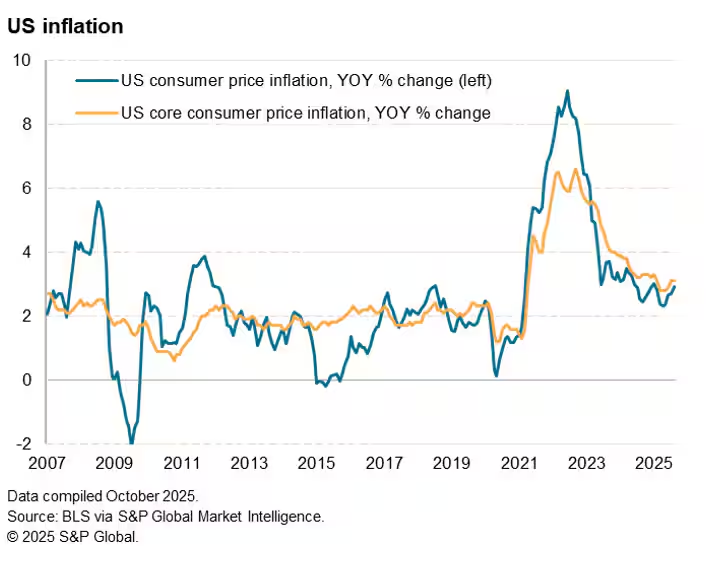
    If released, US inflation numbers will be watched for signs
    of tariff levies being passed through to end consumers. So far, the
    inflation numbers have not risen as much as many analysts had
    feared, but headline inflation was up to 2.9% in August with core
    at 3.1%, and it remains early days in terms of the degree to which
    the import levied might be expected to impact high street
    prices.

    Key diary events

    Monday 13 Oct

    Americas
    Canada Market Holiday
    – Brazil Business Confidence (Oct)

    EMEA
    – Germany Current Account (Aug)

    APAC
    Japan, Thailand Market Holiday
    – China (Mainland) Trade (Sep)
    – India Inflation (Sep)

    Tuesday 14 Oct

    S&P Global Investment Manager Index* (Oct)

    Americas
    – Canada Building Permits (Aug)

    EMEA
    – UK BRC Retail Sales Monitor (Sep)
    – Germany Inflation (Sep, final)
    – UK Labour Market Report (Aug)
    – France IEA Oil Market Report
    – Eurozone ZEW Economic Sentiment (Oct)
    – Germany ZEW Economic Sentiment (Oct)

    APAC
    – Singapore GDP (Q3, adv)
    – Australia NAB Business Confidence (Sep)
    – Australia RBA Meeting Minutes (Oct)
    – India WPI (Sep)
    – China (Mainland) New Yuan Loans, M2, Loan Growth (Sep)

    Wednesday 15 Oct

    Americas
    – Brazil Retail Sales (Aug)
    – Canada Manufacturing Sales (Aug, final)
    – US Inflation (Sep)
    – US NY Empire State Manufacturing Index (Oct)

    EMEA
    – Germany Wholesale Prices (Sep)
    – France Inflation (Sep, final)
    – Spain Inflation (Sep, final)
    – Eurozone Industrial Production (Aug)

    APAC
    – China (Mainland) Inflation (Sep)
    – Japan Industrial Production (Aug, final)
    – India Unemployment (Sep)
    – India Trade (Sep)

    Thursday 16 Oct

    Americas
    – Canada Housing Starts (Sep)
    – US PPI (Sep)
    – US Retail Sales (Sep)
    – US Initial Jobless Claims
    – US Philadelphia Fed Manufacturing Index (Oct)
    – US Business Inventories (Aug)
    – US NAHB Housing Market Index (Oct)

    EMEA
    – UK monthly GDP, incl. Manufacturing, Services and Construction
    Output (Aug)
    – Italy Inflation (Sep, final)
    – Eurozone Balance of Trade (Aug)
    – Italy Balance of Trade (Aug)

    APAC
    – Japan Machinery Orders (Aug)
    – Australia Employment Change (Sep)

    Friday 17 Oct

    Americas
    – US Building Permits (Sep, prelim)
    – US Housing Starts (Sep)
    – US Industrial Production (Sep)
    – US Capacity Utilization (Sep)

    EMEA
    – Eurozone Inflation (Sep, final)

    APAC
    – South Korea Export and Import Prices (Sep)
    – South Korea Unemployment Rate (Sep)
    – Singapore Non-Oil Domestic Exports (Sep)
    – Malaysia Balance of Trade (Sep)
    – Malaysia GDP (Q3, prelim)

    * Access press releases of indices produced by S&P Global
    and relevant sponsors
    here.

    Download Full Report

    © 2025, S&P Global. All rights reserved. Reproduction in whole
    or in part without permission is prohibited.


    Purchasing Managers’ Index™ (PMI®) data are compiled by S&P Global for more than 40 economies worldwide. The monthly data are derived from surveys of senior executives at private sector companies, and are available only via subscription. The PMI dataset features a headline number, which indicates the overall health of an economy, and sub-indices, which provide insights into other key economic drivers such as GDP, inflation, exports, capacity utilization, employment and inventories. The PMI data are used by financial and corporate professionals to better understand where economies and markets are headed, and to uncover opportunities.

    Learn more about PMI data

    Request a demo


    This article was published by S&P Global Market Intelligence and not by S&P Global Ratings, which is a separately managed division of S&P Global.

    Continue Reading

  • Climate Solutions Already Exist – Here’s How to Speed Up Adoption

    Climate Solutions Already Exist – Here’s How to Speed Up Adoption

    By Dr. Hao Xu, Head of Climate Innovation, Tencent

    We already have the technologies to fight climate change – so why aren’t we deploying them faster?

    That was the question I explored in my TED Countdown Talk. As Head of Climate Innovation at Tencent and an environmental engineer by training, I believe the biggest barrier to decarbonization isn’t the lack of technology – it’s how we work together.

    The good news? There’s a way forward. Many scalable climate solutions are available today. From bacteria that turn CO₂ into fuel, to cooling materials that help save glaciers, we can make real impact now. The key is accelerating them by uniting science, engineering, and business to turn bold ideas into real-world solutions that help decarbonize the planet.

    Catalyzing emerging low-carbon technology

    “I’m more optimistic than ever that we have the answer to accelerating climate innovation, and it’s simple.”

    Dr. Hao Xu, Head of Climate Innovation, Tencent

    Although Tencent is not a major emitter, we are deeply committed to sustainability and tackling climate change. We have pledged to achieve carbon neutrality in our operations and supply chain by 2030 and are leveraging our capabilities to fulfil our mission of creating tech for good.

    Beyond improving data center efficiency and sourcing renewable energy, we’re focused on how to catalyze the next generation of climate technology. That’s why we launched our CarbonX program in partnership with industry, investors and innovators. Three years in, I’m more optimistic than ever, because we think the right answer is not so complicated.

    Through CarbonX, we’ve learned that successful climate tech acceleration happens when four key areas work in harmony.

    1. Scientific innovation: saving decades of climate tech R&D

    Let’s start with the science, which is in advanced stages. We can capture solar energy, store it using cutting-edge chemistry, and convert CO₂ into valuable products – shaving decades off development.

    Take Gasgene, a startup we work with through CarbonX. Using CRISPR – a gene editing tool – to reprogram clostridium bacteria, they’ve essentially taught these microorganisms to “eat” carbon dioxide and produce butanol instead. Butanol is found in clothing, paint, water bottles, toys and the like. With engineered clostridium, we can make these everyday products from captured carbon instead of fossil fuels.

    2. Engineering expertise: scaling the science from lab to real world

    Next is engineering, which acts as the bridge from lab to production, bringing scientific ideas to life at scale.


    Imagine building a facility to produces 20,000 tons of butanol a year from captured CO₂. Engineers must decide: what size reactors are needed? Can we use standard equipment, or must systems be customized? How do we optimize for cost, safety and energy?

    Think of it like LEGO – you use existing blocks wherever possible to build something new quickly and efficiently.

    Feynman Dynamics, another CarbonX innovator, faced this challenge. Their goal: produce sustainable aviation fuel by combining captured CO₂ with green hydrogen. Their breakthrough? A catalyst that blends these ingredients at the molecular level, like a smoothie machine. Inspired by pharmaceutical chemistry, they created a reactor that delivers consistent, scalable performance, cutting waste and boosting efficiency.

    3. Business knowhow: turning innovation into industry

    However, even the best-engineered solution can fail without a viable business model. Markets, costs and customer demand drive adoption and innovations must make commercial sense.

    Yuanchu, a startup that captures CO₂ and turns it into calcium carbonate – used in paper, makeup, and toothpaste – found a smart market fit. Instead of mining limestone, they repurpose steel and industrial by-products, cutting both emissions and costs.

    Another example is Moguang, which developed cutting-edge radiative cooling material that reflects over 90 percent of sunlight. It cools objects naturally without using electricity. We piloted this technology on the endangered Dagu Glacier in southwestern China. After three years, melting slowed by 80 percent.

    Today, that same material is used in hundreds of thousands of smartphone screens and sports cameras. From glaciers to gadgets, climate tech innovation is full of possibilities.

    4. Integration: solving the bottlenecks

    So, what’s holding us back? It’s not invention, it’s isolation.

    Scientists focus on discovery. Engineers optimize performance. Businesses look at balance sheets. But rarely do they work together from day one.

    To accelerate climate solutions, however, these disciplines must collaborate from the start. That means:

    • Scientists asking: how much energy does it take to capture one ton of CO₂?
    • Engineers asking: can this be deployed at industrial levels?
    • Business leaders asking: when can we make this cost effective?

    These aren’t easy conversations. But such cross-disciplinary tensions are essential to speed up progress and get us closer to decarbonization.

    We’ve already seen this model succeed. With Gasgene, we helped form a clean chemical consortium, linking startups, chemical companies, and consumer brands to make carbon-based products a reality. That alignment enabled pilot deployment and scaling.

    To recap, we don’t need to wait for new inventions. We need to work faster, and work together. That’s how we can accelerate the transition to a low-carbon world!

    Continue Reading

  • SBP chief stresses economic stability – Dawn

    1. SBP chief stresses economic stability  Dawn
    2. Rate cut unlikely this month, says SBP governor  Dawn
    3. Pakistan Central Bank Says Further Rate Cuts Hinge on IMF Review  Bloomberg.com
    4. SBP sees recovery, analysts disagree  The Express Tribune
    5. Inflation projected to remain 5–7% despite flood pressures, says SBP governor  Profit by Pakistan Today

    Continue Reading

  • Newly developed eAxle adopted for TOYOTA’s new “bZ4X” | Newsroom | News

    Newly developed eAxle adopted for TOYOTA’s new “bZ4X” | Newsroom | News

    BluE Nexus Corporation (Headquarters: Anjo City, Aichi Prefecture; President: Hidetoshi Uchiyama, hereinafter “BluE”) and AISIN Corporation (Headquarters: Kariya City, Aichi Prefecture; President: Moritaka Yoshida, hereinafter “AISIN”), and DENSO CORPORATION (Headquarters: Kariya City, Aichi Prefecture; President: Shinnosuke Hayashi, hereinafter “DENSO”) have jointly developed an eAxle that achieves high power performance in a compact size, contributing to improved vehicle energy efficiency. This product will be installed in the new Toyota bZ4X.
      
    The newly adopted eAxle, new inverter with a flat, double-sided cooling structure that incorporates advanced SiC (silicon carbide) power semiconductors and cooling technology, thereby enhancing output density and efficiency. Furthermore, transmission efficiency has been improved by enhancing gear precision and reducing oil agitation resistance through casing shape optimization.
    Through these technological advancements in eAxle, we are supporting the creation of vehicles that not only enhance practicality, such as extending driving range, but also pursue the pleasant driving experience and comfort that defines the bZ4X. Furthermore, it contributes to TOYOTA’s “multi-pathway” approach, which addresses the diverse needs of customers in every country and region as we strive to achieve carbon neutrality.
     
    Moving forward, BluE, AISIN, and DENSO will continue to leverage our respective strengths and expertise to provide valuable technologies and products and contribute to a carbon-neutral society by having our products equipped in all types of electric vehicles.

    Continue Reading

  • Inflation projected to remain 5–7% despite flood pressures, says SBP governor

    Inflation projected to remain 5–7% despite flood pressures, says SBP governor

    The Governor of the State Bank of Pakistan (SBP), Jameel Ahmad, said that inflation has declined sharply and is projected to remain within the government’s target range of 5 to 7% over the medium term, although recent floods may exert temporary upward pressure on prices. 

    Addressing the 9th Annual Microfinance Conference on Thursday, organised by the Pakistan Microfinance Network under the theme “Renaissance of Microfinance,” Governor Ahmad reiterated that achieving inclusive economic growth requires durable macroeconomic stability that uplifts communities and ensures prosperity for all. He reaffirmed the central bank’s commitment to expanding financial inclusion and narrowing the gender gap.

    The governor said that the policy and regulatory measures implemented in recent years have established a period of macroeconomic stability, reflected in significant improvements in key economic indicators. 

    He noted the remarkable growth in Pakistan’s foreign exchange reserves since February 2023 and strategic interbank purchases, which have strengthened reserves and enabled the government to make timely debt repayments without borrowing at higher interest rates.

    Governor Ahmad emphasised that the SBP’s monetary policy and regulatory efforts have been complemented by sustained fiscal consolidation by the government, helping to contain demand-side pressures on inflation and the external account. 

    He pointed out that Pakistan’s debt dynamics have considerably improved over the past three years and that economic growth is on track to recover and is expected to accelerate further in the current fiscal year. Reflecting on two decades of progress, the Governor reaffirmed SBP’s commitment to microfinance as a driver of inclusive growth and explained that the central bank has revised the Prudential Regulations for Microfinance Banks, transitioning from a rules-based to a principles-based approach. These reforms have removed restrictions on microenterprise lending, allowed greater operational flexibility, introduced a dedicated Agriculture and Livestock loan category, and increased loan limits up to Rs 5 million for agriculture, microenterprise, and housing loans, and Rs 500,000 for general loans.

    He further highlighted the launch of the Climate Risk Fund under the World Bank-funded Resilient and Accessible Microfinance Project, which aims to support two million borrowers through liquidity facilities to mitigate the impact of climate shocks. 

    In collaboration with the government, SBP has also introduced a Risk Coverage Scheme for Small Farmers and Underserved Areas, providing 10% first-loss coverage and operational incentives to expand lending in underserved regions such as Balochistan, Khyber-Pakhtunkhwa, Azad Jammu & Kashmir, and Gilgit-Baltistan.

    Governor Ahmad underscored the progress under the National Financial Inclusion Strategy (NFIS) 2028, noting that financial inclusion rose from 47% in 2018 to 67% in June 2025, while the gender gap in financial access narrowed from 47% to 30%. He credited transformative digital initiatives including Raast, Asaan Mobile Account, Roshan Digital Account, the launch of Digital Banks, and the Banking on Equality Policy. He also reiterated the NFIS 2028 targets, which aim to expand financial inclusion in Pakistan to 75% and reduce the gender gap to 25% by 2028.

    The Governor urged microfinance institutions to strengthen risk management practices by utilizing alternative data sources, digital tools for credit scoring, conducting internal audits, training staff to prevent fraud, and maintaining adequate liquidity buffers. He emphasized that good corporate governance, transparent communication, and climate-risk mapping are essential to fostering long-term sustainability.


    Continue Reading