
Category: 3. Business

  • CHANGE-seq-BE finds off-target changes in the genome from base editors

    CHANGE-seq-BE finds off-target changes in the genome from base editors

    To do so, CHANGE-seq-BE starts with a whole genome, but instead of immediately sequencing it, scientists split the genome into tiny circles of DNA. They then take those circles and expose them to the base editor being tested. Afterward, they treat the DNA with a special enzyme that detects if base editing occurred, opening those — and only those — DNA circles with evidence of base editing into linear strands. The linear strands of DNA are then selectively sequenced, requiring far fewer resources than competing techniques. They optimized it for both major types of base editors (adenine and cytosine base editors). After developing the method, the scientists wanted to know if it truly was both more comprehensive and resource-efficient than conventional approaches, so they tested them head-to-head.

    “When we directly compared it to other methods, CHANGE-seq-BE found almost all sites nominated by those methods, as well as many that it was exclusively able to detect,” Tsai said. “We showed that this unbiased approach was more sensitive while using only about 5% of the sequencing reads.”

    Given the technique’s sensitivity, ease of use and efficient resource utilization, others have already begun adopting it. Full experimental protocols and software to enable CHANGE-seq-BE are described in the study, enabling this adoption. For example, in addition to the clinical application reported in the paper, clinical trials at St. Jude and beyond have integrated the technique into their planning, using it as a safety and efficiency evaluation tool. CHANGE-seq-BE was also recently used to characterize the first patient-specific in vivo genome editing treatment. Fundamental research labs investigating base editing have also begun using it to test for off-targets early in their process, better identifying the most promising approaches to pursue than existing screens. These early adopters show the technique’s appeal to researchers and clinicians alike, and its promise to push forward the future of base editing.

    “We’ve enabled those developing these therapies to quickly understand and find the base editors with the highest potential activity and specificity,” Tsai said. “We hope that methods like CHANGE-seq-BE will open the door toward more genome editing therapies being developed for and reaching the patients who need them.”

    Authors and funding

    The study’s co-first authors are Cicera Lazzarotto, formerly of St. Jude; and Varun Katta, St. Jude. The study’s other authors are Yichao Li, Garret Manquen, Rachael Wood, Jacqueline Chyr and Azusa Matsubara, St. Jude; Elizabeth Urbina and GaHyun Lee, formerly of St. Jude; Xiaolin Wu, Frederick National Laboratory of Cancer Research; and Suk See De Ravin, National Institutes of Health.

    The study was supported by grants from the National Institutes of Health Somatic Cell Genome Editing Consortium Program through National Institutes of Allergy and Infectious Diseases (U01AI176470 and U01AI176471), National Heart Lung and Blood Institute (U01HL163983), St. Jude Collaborative Research Consortium on Novel Gene Therapies for Sickle Cell Disease, St. Jude PARADIGM Blue Sky Project, the Doris Duke Charitable Foundation (2020154) and the American Lebanese Syrian Associated Charities (ALSAC), the fundraising and awareness organization of St. Jude.


    Continue Reading

  • Drifting towards deflation in the Euro zone

    Drifting towards deflation in the Euro zone

    In yesterday’s preview of 2026, one of my four predictions was that the Euro zone will resume its drift back towards deflation. The main reason for this is that the currency union is stuck in the same kind of paralysis that has reigned since the sovereign debt crisis in 2011/12. That crisis was papered over by the ECB, which has morphed into a fiscal bailout vehicle for high-debt countries, while nothing was ever actually done to bring down debt overhangs in Italy and Spain. As a result, neither country has fiscal space, which means every shock descends into wrangling over joint EU debt issuance. That’s an inherently deflationary equilibrium. Speed and magnitude of policy stimulus will always be too small. This dysfunction compounds into chronic underperformance and deflation over time.

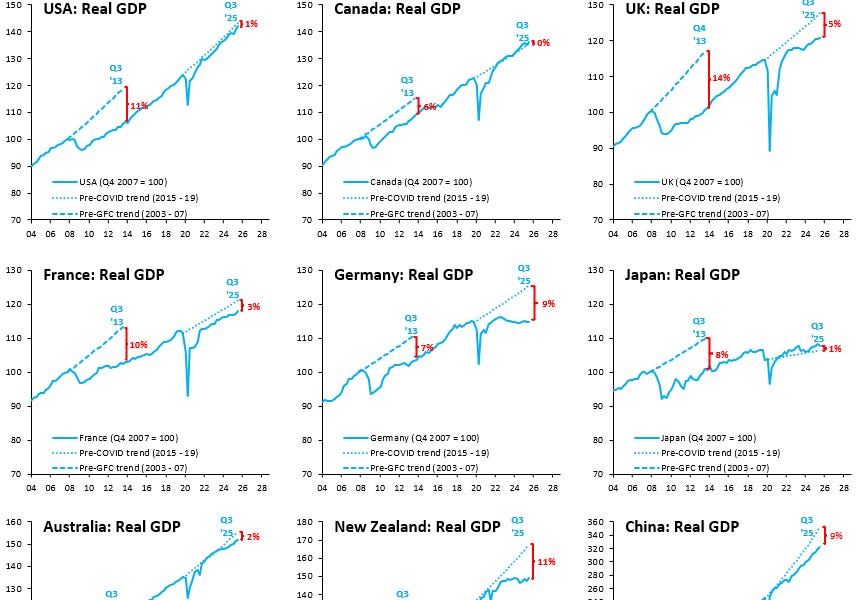
    There’s one big difference from the sovereign debt crisis in 2011/12 however. At the time, Germany was chalking up solid growth rates, while it’s really struggling at the moment. This means that deflationary pressure is radiating out from Germany now, while the opposite was true after the sovereign debt crisis. In today’s post, I take a look at economic slack across the world’s major economies. Germany is the only country where economic slack is now bigger than after 2008.

    Before I get into the weeds, an important caveat: no one has any clue how to estimate economic slack. People often calculate output gaps as the difference between GDP and “potential,” which is usually some kind of time-series moving average. The issue is that time-series averages follow actual GDP much too closely, so when a country goes into a prolonged downturn, output gap estimates are small because potential GDP follows actual GDP down. To avoid this issue, I calculate a linear trend for GDP based on the average quarterly growth rate in the five years before COVID and do the same thing for the five years before the 2008 crisis. Of course, my linear trends can hardly be thought of as potential either. But they’re a better approximation of slack – in my view – than some kind of moving average.

    As the panel of charts above shows, Germany’s GDP as of Q3 ‘25 was nine percent below its pre-COVID trend, a bigger gap than after the global financial crisis on a comparable time scale. In Q3 ‘13, this gap was seven percent. Germany is the only place where the gap is currently bigger than it was then. Deflationary pressure will be radiating out from Germany to the rest of the Euro zone.

    It’s also worth noting that essentially no country has GDP currently above its pre-COVID trend, while many countries have GDP substantially below, including China, France and the UK. The global equilibrium we’re slipping into is a deflationary one, much like in the decade after the global financial crisis.

    Continue Reading

  • FTSE 100 index hits 10,000 milestone in new year rally

    FTSE 100 index hits 10,000 milestone in new year rally

    The FTSE 100 tracks the performance of the the 100 largest companies on the London Stock Exchange. That includes mining firms Antofagasta, Rio Tinto and Peers Endeavour which have been boosted by surging metals prices.

    Defence firms also performed strongly, with Bae Systems, Babcock and Rolls-Royce all saw their value increase, as did large banks, including Lloyds, Barclays, Standard Chartered and HSBC.

    Dan Coatsworth, head of markets at AJ Bell, said: “This is a historic moment and already makes 2026 one of the most significant years for the blue-chip index since its launch in 1984.”

    He said crossing the 10,000-point threshold was “the best New Year’s present Chancellor Rachel Reeves could want”.

    “The FTSE 100’s achievements just go to show what’s possible when buying UK shares.

    “It also proves to cynics that the UK market is not stuck in the mud, and that the US stock market is not the only place to make money.

    Continue Reading

  • First independent businesses confirmed for Town Hall Place retail hub

    • New town centre shops include pottery painting, haberdashery, a health and wellness café and a multicultural grocery store
    • Shops expected to open January or February 2026
    • Significant milestone in Tamworth’s regeneration programme

    An exciting variety of independent businesses have been selected to join Tamworth town centre’s brand new retail hub, bringing things like pottery painting, craft workshops and healthy food to the high street.

    Tamworth Borough Council is delighted to welcome the first tenants to its affordable retail space – Town Hall Place – who are all busy fitting out their shops ready for opening next year.

    Town Hall Place has been designed to improve the choice and appeal of the town centre in line with what shoppers want, while providing opportunities for more niche businesses to set up and grow.

    The first successful applicants for the seven units have therefore been carefully chosen in line with those ambitions.

    Brew health and wellness café 

    Brew is a new health and wellness café which will offer a selection of healthy food and drink including bagels, salads, acai bowls, fruit sorbets, matcha, iced teas, protein and collagen shakes.

    It’s being opened by Amy Collins, who had been looking for the perfect location to bring her business dream to life for a couple of years.

    She said: “I’ve always been health conscious, especially with food, and I think there’s an opportunity for something like this in Tamworth. I’ve had the dream of owning a café here for a long time, but I haven’t found the right place at an affordable price. When this opportunity came up, I had to go for it!”

    Castle Notions haberdashery 

    Castle Notions aims to merge traditional haberdashery retail with community engagement, offering a place where people can buy their fabric, wool, buttons, thread and sewing machine accessories, but also learn new skills.

    Alongside a retail offering of premium products, owner of the business, Novel Wust, plans to host workshops and social sessions in sewing, knitting, children’s crafts, sustainable fashion, upcycling, heritage crafts and theatre costume making.

    For Novel, opening Castle Notions also represents a dream come true. While coming from a corporate background, Novel has had a passion for crafting since she was a child, inspired by her parents who work as tailors. 

    “This is about creating a community that transcends conventional shopping. I want to offer a personal service, somewhere people can join with others and be creative, or get help with a project they are stuck on. To teach children a skill away from computers and screens,” Novel said.

    The Paint Pot Studio

    Kate Watts has a vision to create a welcoming space for people of all ages to relax with cake and refreshments while trying their hand at a variety of different creative pursuits.

    The Paint Pot Studio will offer ceramic pot painting sessions throughout the year, alongside a rotating programme of additional arts and crafts activities, such as painting in different mediums, bubble art, T-shirt making and more.

    Further down the line, Kate hopes to include themed events, birthday parties, painting parties and after school clubs.

    “This will be a space where people can chill out and be creative, while enjoying a coffee and cake,” Kate said. “One of my main drives is the price point; I want to be able to offer something for all budgets, where families can have fun away from screens, without spending a fortune.

    “This has always been bubbling in the background and I decided to just go for my dreams. I want something to pass on. It is scary, but the support I’ve had from the council so far has been amazing.”

    Tropical Market

    The Tropical Market will offer a variety of authentic raw African and Caribbean foods and cooking ingredients, including plantain, beans, yam, cassava, frozen fish and meats, herbs and spices.

    This grocery store venture is the brainchild of Fred Borson who recently moved to Tamworth from Birmingham and spotted a gap for authentic ingredients in the local area.

    As well as providing produce from different cultures, Fred is also hoping to bring the community together through cultural events at the shop, such as cooking classes on how to use the various ingredients.

    Fred, who currently works as a contractor for the civil service, said: “These are ingredients that you can’t buy in the local area. It’s a dream to have my own business, to serve the community and bring people together. 

    “People are trying to eat healthier with less reliance on ready meals, so we will provide the raw ingredients to help them do that. It’s about bringing the sunshine to your home.”

    Final stages of town centre regeneration

    The official opening of Town Hall Place marks the final stages of the multi-million-pound Future High Streets Fund regeneration project, which has seen the opening of a brand new college, a revitalised St Editha’s Square, the widening of the Castle Gateway, and the creation of a second enterprise centre in the town.

    Extensive community engagement carried out prior to the original funding bid being submitted five years ago, revealed ‘niche shops’ as the number one thing people would like to see more of in the town centre. 

    Councillor Carol Dean, Leader of Tamworth Borough Council, said: “We know people want to see more variety in the town centre, and we hope Town Hall Place will help provide that. The units are small and affordable, with favourable terms to attract more creative, niche business.

    “This isn’t just about filling the units; it’s about getting the right type of businesses in there that genuinely add to the town and provide new reasons for people to visit. With these first confirmed tenants, we believe we’ve done that, so it’s now over to shoppers to come and support these new businesses, which will hopefully have a snowball effect on the rest of the town centre.

    “With the advice and support of our business team, the aim would be to help the new ventures grow to the point they can move to a more permanent vacant unit in the town.”

    While the council is in discussions with various other potential tenants, expressions of interest in the remaining units are still welcomed as we seek to get the right mix of businesses.

    More information is available on the Town Hall Place webpage.

    For more information about the Future High Streets Fund project and all the different elements that have been delivered so far, please visit www.transformingtamworth.gov.uk. 

    Continue Reading

  • German manufacturing sector ends 2025 in deepening downturn, PMI shows – Reuters

    1. German manufacturing sector ends 2025 in deepening downturn, PMI shows  Reuters
    2. European factory activity ends 2025 in deeper contraction but Asia shines on improved demand  Reuters
    3. German manufacturing sees recovery in early 2025 but slumps again by year-end  Bitget
    4. Industrial Activity in the EU Closes 2025 Lower After Nine-Month Low  FXLeaders
    5. Germany: Production contracts for first time in ten months in December  Forex Factory

    Continue Reading

  • Monetary developments in the euro area: November 2025

    Monetary developments in the euro area: November 2025

    02 January 2026

    Components of the broad monetary aggregate M3

    The annual growth rate of the broad monetary aggregate M3 increased to 3.0% in November 2025 from 2.8% in October, averaging 2.9% in the three months up to November. The components of M3 showed the following developments. The annual growth rate of the narrower aggregate M1, which comprises currency in circulation and overnight deposits, decreased to 5.0% in November from 5.2% in October. The annual growth rate of short-term deposits other than overnight deposits (M2-M1) was ‑0.8% in November, compared with -1.8% in October. The annual growth rate of marketable instruments (M3-M2) increased to 1.6% in November from 1.4% in October.

    Chart 1

    Monetary aggregates

    (annual growth rates)

    Data for monetary aggregates

    Looking at the components’ contributions to the annual growth rate of M3, the narrower aggregate M1 contributed 3.2 percentage points (down from 3.3 percentage points in October), short-term deposits other than overnight deposits (M2-M1) contributed -0.3 percentage points (up from -0.5 percentage points) and marketable instruments (M3-M2) contributed 0.1 percentage points (as in the previous month).

    Among the holding sectors of deposits in M3, the annual growth rate of deposits placed by households increased to 3.3% in November from 3.0% in October, while the annual growth rate of deposits placed by non-financial corporations stood at 3.4% in November, unchanged from the previous month. Finally, the annual growth rate of deposits placed by investment funds other than money market funds decreased to 0.5% in November from 2.7% in October.

    Counterparts of the broad monetary aggregate M3

    The annual growth rate of M3 in November 2025, as a reflection of changes in the items on the monetary financial institution (MFI) consolidated balance sheet other than M3 (counterparts of M3), can be broken down as follows: claims on the private sector contributed 3.2 percentage points (up from 2.7 percentage points in October), net external assets contributed 1.9 percentage points (up from 1.7 percentage points), claims on general government contributed 0.3 percentage points (up from 0.2 percentage points), longer-term liabilities contributed -1.2 percentage points (down from -1.0 percentage points), and the remaining counterparts of M3 contributed -1.1 percentage points (down from -0.9 percentage points).

    Chart 2

    Contribution of the M3 counterparts to the annual growth rate of M3

    (percentage points)

    Data for contribution of the M3 counterparts to the annual growth rate of M3

    Claims on euro area residents

    The annual growth rate of total claims on euro area residents increased to 2.6% in November 2025 from 2.3% in the previous month. The annual growth rate of claims on general government stood at 0.7% in November, compared with 0.6% in October, while the annual growth rate of claims on the private sector increased to 3.4% in November from 2.9% in October.

    The annual growth rate of adjusted loans to the private sector (i.e. adjusted for loan transfers and notional cash pooling) increased to 3.4% in November from 3.0% in October. Among the borrowing sectors, the annual growth rate of adjusted loans to households stood at 2.9% in November, compared with 2.8% in October, while the annual growth rate of adjusted loans to non-financial corporations increased to 3.1% in November from 2.9% in October.

    Chart 3

    Adjusted loans to the private sector

    (annual growth rates)

    Data for adjusted loans to the private sector

    Notes:

    • Data in this press release are adjusted for seasonal and end-of-month calendar effects, unless stated otherwise.
    • “Private sector” refers to euro area non-MFIs excluding general government.
    • Hyperlinks lead to data that may change with subsequent releases as a result of revisions. Figures shown in annex tables are a snapshot of the data as at the time of the current release.

    Continue Reading

  • Quebec City skydivers help set new world record for largest parachute formation

    Quebec City skydivers help set new world record for largest parachute formation

    Listen to this article

    Estimated 4 minutes

    The audio version of this article is generated by AI-based technology. Mispronunciations can occur. We are working with our partners to continually review and improve the results.

    Leaping out of a plane more than 4,200 metres in the air, Simon-Pierre Bouchard can’t control his excitement as he opens his parachute and wonders if everyone has gotten into place. 

    “When we exit the plane, the first few seconds are in free fall, so we see the plane going away,” said Bouchard. “This is exhilarating, this is what [gets] me to fly.”

    Bouchard was one of 17 Canadians who travelled to Lake Whales, Fla., on Nov. 22 to attempt to beat the world record for largest canopy formation. 

    Some 104 skydivers from around the world jumped out of eight airplanes at various heights, each trying to make sure they didn’t cross parachutes with those next to them, as doing so could be deadly. 

    A group of people kneel on the ground and secure their parachutes into their packs.
    Simon-Pierre Bouchard, centre, has been skydiving for more than 30 years. (Submitted by Simon-Pierre Bouchard)

    Those jumping from the highest plane, more than 5,700 metres the air, need to breathe in from an oxygen tank to avoid the risk of hypoxia, or lack of oxygen.

    The group only has about 11 minutes to dock their parachutes onto each other and get into the diamond-shaped formation.

    ‘It was hard to believe at first’

    Bouchard has been a skydiver for more than 30 years and, as a pilot in Quebec City, spends most of his time in the sky.

    But he’s never experienced anything quite like this.

    “I couldn’t stop smiling,” he said. “We need to trust, individually, everyone that is in this formation, even though we don’t know them personally.”

    Quebec City police officer Jean-François Denis was also one of the 104 parachutists who took part in the canopy formation.

    He trained for nearly five years to qualify and underwent a strict diet and exercise to lose the 15 pounds required for him to participate.

    I didn’t get any cheat days or cheat meals,” Denis said.

    He and his teammates waited for two hours for the international judges to declare that they had made it and beat the record set in 2007.

    “People were giving hugs, high fives and shouting with joy,” said Denis. “It was hard to believe at first.”

    The International Skydiving Commission then also needs to approve the record for largest canopy formation before it can be recorded in the Guinness Book of World Records.

    “We have to demonstrate … that we all have proper lines to hold and the canopies of every jumper needs to be at a certain height above them,” Denis said.

    With more than 1,600 jumps under his belt, Denis hoped he and the group would manage to break their new 104-person record the following day, but it wasn’t meant to be.

    “We were so close to get 111 but there were some mistakes,” said Denis, adding he still hopes to try again someday soon.

    A rare art

    The selection process just to participate in the record-breaking event was a rigorous one, having to qualify at one of eight selection camps around the world, including one in the province.

    The act of creating a canopy formation goes against what most skydivers are taught when they first start out, Denis explained, having been an instructor himself.

    “The first thing you learn is to stay away from other [parachutes] because getting entangled or wrapped in someone else’s at low altitude can be really dangerous,” he said. “It creates a bond with the people you’re jumping with.”

    Parachute Montréal owner Gregory Perrimond says canopy formations have become a rare art.

    While there is a tight-knit community for it in the province, he knows that just finding enough people with the experience to participate in such a large formation must have been “really complicated for the organizers.”

    While the group travelled to Florida because of the weather, Perrimond says the wind remains unpredictable and that can be a challenge in events like this.

    “Imagine the wind isn’t stable on such a huge formation, it takes a lot of work to keep it in place,” he said.

    Continue Reading

  • Access Denied


    Access Denied

    You don’t have permission to access “http://www.spglobal.com/energy/en/news-research/latest-news/agriculture/010226-commodities-2026-biodiesel-feedstocks-to-seek-stability-amid-blend-uncertainty-tariff-risks” on this server.

    Reference #18.c8a0d517.1767422557.652e17da

    https://errors.edgesuite.net/18.c8a0d517.1767422557.652e17da

    Continue Reading

  • PTCL Group approves Rs15bn investment in U Microfinance Bank

    PTCL Group approves Rs15bn investment in U Microfinance Bank

    PTCL Group has approved an equity investment of Rs15 billion (around $53 million) in U Microfinance Bank Limited (U Bank), its microfinance subsidiary.

    The group said the investment is intended to support U Bank’s growth plans and accelerate the development of its digital banking platform to broaden outreach.

    U Microfinance Bank Chairman and PTCL Group CEO Hatem Bamatraf said the investment reaffirmed the group’s commitment to financial inclusion and digital transformation in the microfinance sector.

    Read: PTCL-backed MergeCo eyes 5G rollout

    U Microfinance Bank President and CEO Toran Asif said the capital injection comes as the bank prepares for the next phase of its digital transformation strategy in 2026, acknowledging support from PTCL Group and the State Bank of Pakistan.

    He said the strategy centres on new digital products and services designed to expand access to financial services across the country.

    The bank has received the first tranche of Rs4 billion, which was disbursed on December 31, 2025.

    Separately, the planned integration of Ufone and Telenor Pakistan into a merged operator known as MergeCo is expected to alter the competitive landscape ahead of Pakistan’s first full-scale 5G rollout, according to industry officials.

    Speaking at the announcement, Bamatraf said the merger would enable the group to deliver “seamless, secure and digitally enabled services” in line with Pakistan’s digital agenda.

    Industry observers said the consolidation could enhance PTCL-backed operators’ capacity to invest in next-generation infrastructure at a time when high spectrum costs and fragmented holdings have constrained sector growth.

    Continue Reading

  • Holiday giving embodies spirit of credit union movement

    Holiday giving embodies spirit of credit union movement

    Credit unions across the country have launched creative holiday initiatives, redefining holiday giving with creative, community-centered initiatives that go beyond traditional toy and food drives. From doorstep food collection in California to member-directed donations in the Midwest, these efforts highlight how the cooperative model turns seasonal generosity into lasting community partnerships.

    Among the examples shared in a new America’s Credit Unions Blog post, Redwood Credit Union in California launched a “porch-to-pantry” food drive that removed barriers to participation, while FourLeaf Federal Credit Union in Long Island held its 17th annual Turkey Drive, collecting thousands of turkeys and tens of thousands of pounds of food in a single day.

    Other credit unions activated their full branch networks as collection sites; partnered with hospitals, nonprofits, and even professional athletes; or worked to empower their members and employees to decide where donations should go.

    The blog highlights how these holiday initiatives illustrate what sets credit unions apart from other financial institutions. As member-owned cooperatives, credit unions reinvest in the communities they serve through authentic partnerships rooted in local needs.

    Read the full blog post

    Continue Reading