Mr Nundy said: “There were people staying in the room above the bar, but luckily we had rooms available to relocate them to in case there was anything wrong structurally.
“They were ok about it all, but they were quite shocked. They were woken around 05:20 with a big bang.”
The crash took a radiator off the wall and shut down the heating system at the pub, but it was quickly repaired and heating and hot water was back in the building by 11:00.
Mr Nundy said it was “lucky” the incident had not happened at a different time as, a few hours earlier on Christmas Eve, that part of the 430-year-old pub had been “full of people”.
He said: “I dread to think what could have happened if it had happened when it was busy.”
Cook County will host a countywide scavenger hunt for middle and high school students during winter break.
The scavenger hunt will include nine participating businesses from Grand Portage to the Gunflint Trail to Tofte. Each business will provide students with one word from a larger phrase. After contacting all nine businesses, students are instructed to email Youth Prevention Coordinator Rocio Rivas to receive the final clue.
Students may contact participating businesses by phone if they are unable to visit in person.
“We don’t want the businesses to have problems with helping their clients during this activity,” Rivas told WTIP. “So we chose several businesses that we knew have more than one employee, or are not that busy at this time of the year.”
Rivas said the idea for the scavenger hunt came directly from students, who were asked what activities they wanted during winter break.
The scavenger hunt will run from Dec. 26 through Jan. 3. A wrap-up gathering will be held Jan. 8 at North Point, where students can share what they learned. All participants will receive a prize, with an additional prize awarded to those who complete the phrase correctly.
Rivas assembled a scavenger hunt packet that includes a list of participating businesses, a suggested script for calling or visiting, and space for students to record what they learn from each interaction. Posters with a QR code linking to the packet are posted throughout the community. Students and families may also contact Rivas directly at Rocio.Rivas@co.cook.mn.us for more information or to participate.
“This is all with the purpose to have the youth feel seen, supported and welcome across the community and increase the positive interactions between the youth and the adults in our community,” Rivas said.
Additional activities for students are also scheduled during winter break. The Art Colony hosted an arts and crafts class featuring origami, figurines and magnets on Dec. 26 and will host another session on Dec. 30 from 10:30 a.m. to 1 p.m.
North House Folk School will host drop-in crafts and handmade games on Jan. 3 from 10 a.m. to 4 p.m.
WTIP’s Josh Hinke spoke to Rocio Rivas about these winter break activities. The audio of that conversation can be found below.
China challenges Google in quantum error correction with Zuchongzhi 3.2 processor
In an experimental demonstration using a superconducting processor named Zuchongzhi 3.2, China has announced a significant advancement in quantum error correction, dubbed “quantum supremacy 2.0.”
Zuchongzhi 3.2 processor successfully operates a surface-code logical qubit at a distance 7.
The noteworthy factor is that as the code distance increases, the logical error rate decreases. This inverse relation is a critical aspect of China’s latest quantum error correction technique that rivals Google’s earlier achievements with its Willow results.
What sets China’s claim apart is an all-microwave leakage suppression architecture designed to minimise “leakage,” where qubits escape the computational states assumed by error-correcting codes.
Addressing leakage is crucial, as it can lead to correlated failures that traditional decoders struggle to manage. This new method makes leakage control a vital design consideration, as previous research also advocated for its importance in maintaining clean surface-code cycles.
While China’s results aim to match Google’s benchmarks, they do not yet demonstrate the capability to run large computations on multiple interacting logical qubits.
Transitioning from a single logical qubit to many brings complex engineering challenges and new error pathways.
IBM’s roadmap emphasises that scaling to practical fault-supressing systems will require efficient codes and real-time decoding pipelines.
As the industry is adopting the “error correction era,” the focus is shifting to make error correction repeatable, automatable, and economically scalable.
With multiple groups achieving below-threshold behaviour, the next challenge is expected to lie in efficiently stacking logical qubits and maintaining manageable error budgets during actual computations.
Patrick Borunda and his dog Rosemary at his home in Yacolt, Wash., on Dec. 2, 2025. A PacifiCorp transmission line is planned to be built next to Borunda’s property in the coming years.
Erik Neumann / OPB
Patrick Borunda lives off a winding road under the shadow of tall Douglas fir trees in the rural town of Yacolt, Washington, in northeast Clark County. His modest house overlooks a small pasture and barn, once inhabited by 30 alpacas he raised for fiber and breeding. Today, the herd has been winnowed down to four geriatric animals along with Borunda’s Anatolian shepherd Rosemary, who keeps the coyotes away at night.
“For the most part, people pretty much stay to themselves,” Borunda said of the community. “People enjoy their solitude.”
Borunda and his partner Marit Federcell moved to Yacolt in the mid-1990s. When they bought their home, they took a gamble. PacifiCorp, one of the region’s largest electric utilities, owned an easement on the edge of their property. Nothing had happened with the adjacent land since it was set aside 50 years earlier, so they figured the purchase was a reasonable risk.
That all changed in the past year, when word got out that PacifiCorp had plans to develop the easement, which fell on the path of a 40-mile transmission line stretching from the Swift Reservoir dam, just south of Mount St. Helens, through Clark County to Camas, where it would then cross the Columbia River to feed electricity to Troutdale, Oregon.
Borunda and his neighbors have a range of worries if the approximately 100-foot-tall power lines go in: wildfire risks, contamination of their groundwater from herbicides in the power line buffer, lost property values from living under buzzing lines. And they wonder how the development will change the character of their community.
“Essentially, we’re in the woods right now,” Borunda said. “All of a sudden, we’re going to be in the middle of a huge clearing.”
Patrick Borunda looks at a map of the proposed PacifiCorp power line across Clark County on Dec. 2, 2025.
Erik Neumann / OPB
The Clark County project is just one example of the conflicts emerging between communities and utility companies as the Pacific Northwest electric grid expands to serve the growing need for power across the region.
Borunda and his neighbors are trying to stop the power line or lobby the electric company to reroute its path. Their group of about a dozen people goes by the name “Move the Line East,” and that’s just what they hope to do.
Their hope is that PacifiCorp will shift the transmission line east, where they believe it could travel south on federally managed land in the Gifford Pinchot National Forest with less impact on private property owners.
Electricity demand is increasing in Washington and Oregon due to the growth of data centers, increases in electric vehicle use and the shuttering of coal-fired power plants.
The TransAlta power plant in Centralia is the last coal-fired power plant in Washington state. It was set to close at the end of 2025 before being ordered to continue operating for 90 days by the Trump administration in mid-December.
The need for electricity has increased so much that one 2025 estimate by the consulting firm Energy + Environmental Economics warned the region could see rolling blackouts during extreme weather events as soon as next year.
There are also major limitations in current transmission lines owned by the Bonneville Power Administration, according to an analysis by OPB and ProPublica. PacifiCorp’s proposed transmission line across Clark County would create a new route for electricity that currently runs through BPA lines to Portland.
PacifiCorp’s proposed project will help meet the region’s future electricity needs, while lowering costs for customers, according to company spokesperson Simon Gutierrez.
An analysis by the utility showed it will save money by building its own transmission lines, rather than paying Bonneville Power for its infrastructure, he said. And the company already owns easements on most of the proposed transmission route.
“Nobody wants any disturbance in their neighborhood, but this is a need that we’ve identified to continue providing safe, reliable electricity to our customers,” Gutierrez said.
The project is still in its early stages, with construction set to begin in 2028 at the earliest. Gutierrez said he will begin public presentations about the plan in 2027 and that he’s currently meeting with residents upon request to address their safety concerns.
“Part of the route is pretty much sealed because it’s an existing easement the company purchased many, many years ago,” Gutierrez said. “Property owners should have been aware of that easement, so this shouldn’t have been a surprise for folks.”
Power lines for people – or for data centers?
The electricity will be for residential use in the Portland area, according to Gutierrez. The question of whether it could provide power for more controversial data centers is “ongoing and fluid.”
PacifiCorp has made similar arguments that its work has a public benefit before, only to have its plans change over time.
The company’s proposed 300-mile Boardman-to-Hemingway power line project was, for years, pitched as a way to get power to 805,000 customers in Idaho. But according to the Oregonian/Oregonlive, this summer, after years of planning, the project’s intended user was changed to an unnamed private industrial customer that is likely a data center.
The shift has raised questions about whether PacifiCorp can legally seize land through eminent domain it needs for a project that would have to benefit the public.
After years of raising alpacas at their home in Yacolt, Borunda and his wife now only have four of the animals. Dec. 2, 2025.
Erik Neumann / OPB
County Councilor Sue Marshall represents the largest district that would be affected by the transmission line in Clark County. She shares the concerns of residents over wildfire risk and the potential use of eminent domain if the company wants to site transmission lines on property it doesn’t own.
But even the community members’ idea of moving the development onto federally managed land would threaten forests, streams and wetlands, she said.
“Each potential path, you’d have to really look at the pros and cons of all that, and the least impactful,” Marshall said. “I would imagine PacifiCorp is looking at the least costly.”
Concerns over the electric utility’s role in wildfires are far from unfounded. In November, PacifiCorp said it had settled 4,200 wildfire claims since the 2020 Labor Day fires at a $1.6 billion price tag for the company, with more settlement payments on the way.
In recent years, the company has continued to beef up its safety protocols to guard against wildfires, Gutierrez said. Those protocols include heightened safety settings for electrical equipment to immediately de-energize power lines in case of interference or if there’s a wildfire burning near equipment. PacifiCorp proactively shuts off power during times of extreme fire risk, and the company has meteorologists that monitor fire conditions around the clock, he said.
At this stage, Marshall said, she’s trying to understand the facts surrounding the power line project.
“There’s fears of the unknown,” she said. “There’s fears seeing what’s happened to other places.”
Alida Cantor, an associate professor of geography at Portland State University, is familiar with the tension faced by local communities put in the crosshairs of energy projects. Her work focuses on how changes to our energy systems impact communities, especially when it comes to grid transitions to renewables.
There are three categories of concerns that often come up with energy siting projects across the West, she said. Do people feel like they’re adequately involved in the process? Are there less-impactful places where energy projects can be sited? And how can communities be compensated for the changes?
The Swift Reservoir transmission line traveling through parts of rural Clark County to deliver electricity to Portland is another example of a common tension: rural communities that feel they’re “bearing the burdens so that urban communities can keep on using power,” Cantor said.
Residents in Clark County likely will have limited options to negotiate, since PacifiCorp owns the right to the land it plans to develop.
Cantor said it could, however, be in the utility’s interest to create an agreement with affected community members simply to maintain goodwill.
“They do rely on communities thinking of them as a good neighbor,” she said.
Patrick Borunda stands next to his house in Yacolt, Wash., on Dec. 2, 2025.
Erik Neumann / OPB
At this point, Borunda and his group are mostly trying to educate residents about what the project could mean for Clark County. They hope other entities that have more leverage, like the county or state, will step in to decide if a company like PacifiCorp or a group of concerned citizens know what’s best for the region.
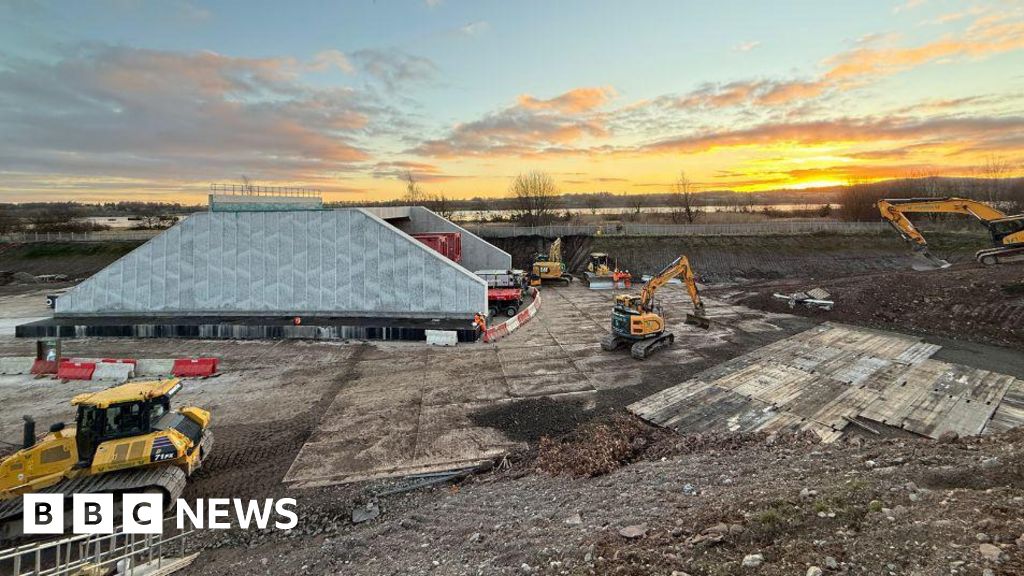
A new £5.9m railway bridge has been rolled into position in West Dunbartonshire while the line is closed until the new year.
Network Rail said teams faced an “intense nine-day engineering sprint” to complete the work near Bowling harbour after trains stopped on Christmas Eve.
The 1,860 tonne concrete structure was moved into position on Boxing Day.
Replacement buses are running from Dalmuir and Balloch/Helensburgh Central and between Glasgow and Crianlarich until trains resume on 2 January.
The new bridge will open up additional direct road access in the area – a former Exxon industrial site on the banks of the Clyde.
It is hoped the project will aid development of the Bowling Strategic Development Site, led by West Dunbartonshire Council.
Laura Craig, scheme project manager at Network Rail Scotland, said: “Building such a huge bridge on site and then moving it into position is an incredible task, and it’s been amazing to see the planning and teamwork come together so successfully.
The £5.9m project is being funded as part of the Glasgow City Region Deal, a package agreed between the UK and Scottish governments with local authorities in a bid to improve infrastructure and economic growth.
Councillor David McBride, West Dunbartonshire Council’s infrastructure convener, said: “This is a landmark moment in this major project and I am delighted to see such significant progress on the site.
“While there has been some disruption on the trains, this has been minimised by the work being carried out over the festive period.”
Rail services on a route between Kent and East Sussex are being disrupted by a signalling system fault, a rail operator said.
Southern said services travelling between Ashford International and Hastings/Eastbourne are delayed by up to 30 minutes while engineers carry our repairs.
The incident was first reported by the company shortly after 07:00 GMT, stating the issue lay with track circuits used to detect trains.
It said some trains on the single-track route may run to a revised calling pattern, or terminate/restart at Hastings.
Dozens of new electric buses are now in service as part of a multi-million-pound project, a transport firm said.
Plymouth Citybus and Go Cornwall Bus said 50 zero-emission double-deckers were operating across routes in Plymouth and the Rame peninsula as part of a project to replace almost half of its fleet with “cleaner, quieter and more accessible vehicles”.
The vehicles were added to the fleet through a £31.87m project jointly funded by bus operators, the Department for Transport, Plymouth City Council and Cornwall Council.
Richard Stevens, managing director of Plymouth Citybus and Go Cornwall Bus, said the electric buses marked an “important moment” for the firms.
“This fleet brings cleaner air, quieter streets and an improved travel experience for our passengers,” Mr Stevens said.
The project has also provided an upgrade to Milehouse bus depot in Plymouth.
Wrightbus, the manufacturer of the double-deckers, has also funded the planting of 500 trees – 10 for each electric bus – across Plymouth and south east Cornwall as part of the project.
Dozens of new electric buses are now in service as part of a multi-million-pound project, a transport firm said.
Plymouth Citybus and Go Cornwall Bus said 50 zero-emission double-deckers were operating across routes in Plymouth and the Rame peninsula as part of a project to replace almost half of its fleet with “cleaner, quieter and more accessible vehicles”.
The vehicles were added to the fleet through a £31.87m project jointly funded by bus operators, the Department for Transport, Plymouth City Council and Cornwall Council.
Richard Stevens, managing director of Plymouth Citybus and Go Cornwall Bus, said the electric buses marked an “important moment” for the firms.
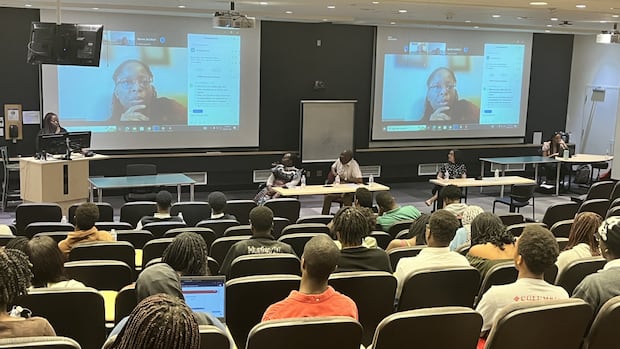
Before joining the Black Youth Mentorship and Leadership Program, nursing student Joel Isu says he wasn’t sure what direction his future would take.
“I felt a little bit lost,” he said. “But with the workshops and guidance I received from the program, I’ve been on a better path.”
He says what mattered most was feeling safe in a space that was built for Black youth.
Before joining the Black Youth Mentorship and Leadership Program, nursing student Joel Isu says he wasn’t sure what direction his future would take. (Joel Isu)
Isu is one of hundreds of Black students in Alberta who have participated in the program since its launch in 2020.
The grassroots initiative connects students entering Grades 11 and 12 and undergraduates with mentors, providing leadership workshops, and bringing participants onto university campuses to gain exposure to academic and professional opportunities.
Strong interest but limited capacity
Since it started, the program has mentored roughly 300 high school students and 35 undergraduate students across Canada.
Two years ago it expanded to Calgary, where it has worked with an additional 150 students. Alumni have gone on to medical school, graduate studies, and leadership roles, reflecting the program’s reach and influence.
Despite this growth, demand far exceeds capacity.
In 2024, the program served 44 students in Alberta — 27 in Calgary, 12 in Edmonton, and five online. In 2025, more than 180 students applied, but funding constraints meant only 82 could be accepted: 52 in Calgary, 19 in Edmonton and 11 online.
The program is designed not just to provide guidance, but to address the long-term effects of generational systemic anti-Black racism, barriers that many Black families have faced for decades.
Dr. Bukola Salami, founder of the program and a University of Calgary professor, says the goal is to ensure that “the experience of anti-Black racism parents faced does not limit their children, and that young people have the tools to excel academically, socially and professionally.”
Racism and its ripple effects
The program’s design reflects a broader context in which Black Canadians experience discrimination and barriers that can affect personal, educational and economic outcomes.
According to Statistics Canada, data from 2021 to 2024 shows that approximately 51 per cent of racialized Canadians aged 15 and older reported experiencing discrimination or unfair treatment in the previous five years, which is nearly double the rate for non-racialized individuals (27 per cent).
Discrimination based on race or skin colour was identified as the leading perceived driver of these experiences.
“Anti-Black racism is real. The challenge with anti-Black racism is that it’s not stuck in the past. It also exists now,” said Dr. Salami.
Dr. Bukola Salami’s research on Black youth mental health directly informed the creation of Western Canada’s first mental health clinic for Black Canadians. ( Canadian Nurses Association)
Among racialized groups, Canadian-born Black people reported the highest incidence of discrimination (71 per cent), significantly higher than recent or established Black immigrants.
This pattern highlights the persistent challenges many Black youth face in various daily settings, including school, health care, work and community environments, and underscores the need for robust supports to build confidence, skills and opportunity.
These patterns of discrimination can have real consequences. Research has found disparities in employment, earnings and academic experiences for Black Canadians relative to other groups, reflecting structural barriers that mentorship and support programs aim to mitigate.
Dr. Salami’s 2016 research project on parenting and the mental health of African children in Canada revealed a major gap: mentorship.
Program structure and experience
Students participate in a combination of workshops, mentorship and campus experiences. High school participants focus on academic planning, leadership development, cultural identity and exploring post-secondary pathways.
Undergraduates in the program receive guidance on navigating university challenges, internships and early career decisions. Mentors come from universities, professional fields and community leadership, providing a range of perspectives and advice.
“I felt I was passing down knowledge to them,” said Victoria Fajenyo, the Calgary program co-ordinator and mentor.
“The structure is key, you always have a faculty mentor and community mentor. Someone that is a medical doctor or pharmacist. You get access to what is done at the university and they get to see how the career path is in real life.”
A transformative experience
The mentorship model is designed to help students develop both hard and soft skills, everything from study and time‑management techniques to the confidence to advocate for themselves in academic and professional settings.
Students set goals with their mentors, track progress and participate in events that build community and networks.
Another participant, Beluchi Okeke, now studying global health and bioethics at the University of Toronto, says the program helped her design and lead initiatives such as corporate anti‑racism seminars and programs on vaccine hesitancy in the Black community.
“This program leads to concrete, tangible differences in your life that that you’ll feel for years and years after,” said Okeke.
Beluchi Okeke participated in the program in 2021. ( Beluchi Okeke)
Calls for sustained investment
Dr. Salami says sustained government and private funding is essential to expand the program and meet rising demand.
“We’re seeing what mentorship can do when students have access to structured support,” she said. “With more resources, we could offer this to many more young people who are ready to succeed.”
Applications for the 2026 cohort are open until Feb. 6, 2026. Students interested in joining must submit transcripts and a short essay about why they want to participate. Those accepted receive a $1,000 stipend to help cover transportation and program‑related costs once they successfully complete the program. Mentors can also apply to be part of the next cohort.
As Alberta’s Black youth continue to navigate a society where discrimination and bias persist in everyday life, programs like this offer structured guidance and opportunities that students and educators say make a real difference.
“Its never too late to pick yourself up and move forward,” said Isu.
A new study in the journal ‘American Psychologist’ links swearing to “state disinhibition,” a psychological state where you’re less likely to hold back.
SCOTT SIMON, HOST:
Scientists have determined that uttering curse words can offer pain relief, make you a little stronger. A study published in American Psychologist last week links that boost in brawn to state disinhibition, a psychological state where you’re less likely to hold back. Nicholas Washmuth co-authored the study. He’s a Ph.D. student at the University of Alabama. He joins us now. Thanks so much for being with us.
NICHOLAS WASHMUTH: Absolutely.
SIMON: Tell me about your research. Did you just tell a number of people, start swearing and try to pick up that chair?
WASHMUTH: No. It’s – what we did in this most recent study was we had 300 participants complete a chair push-up task. Basically, we asked these participants to sit in a chair, using their hands and hands alone to lift their bottom off the chair for as long as possible. They did this while swearing and while also repeating a neutral word. And when they were swearing, they could hold that position longer. The reason why you can hold that position longer was because you are in a more disinhibited state. You’re more willing to give yourself physically and mentally to that task after swearing.
SIMON: Any curse words work better than others?
WASHMUTH: The prompt we used was, share a swear word that you would use if you hit your head or stubbed your toe. And they also selected their neutral word using the prompt, share a word that you would use to describe this table. So when you ask a participant to choose a swear word they would use, that’s a word that is likely powerful to them or they would use in certain situations where they need that boost. The most common words that were selected were the F-word and the S-word.
SIMON: Now – all right. My late aunt Izetta would not swear in front of us, but when something happened, she would say sugar – I think to replace the S-word. Would that have had the same effect?
WASHMUTH: Evidence would suggest made-up swear words or euphemisms for swear words do not have the same impact. So you can’t say sugar or fudge or even say, the F-word. There’s a line that needs to be crossed to enter that taboo realm. We don’t know exactly where that line is yet. But right now evidence would suggest that you actually need to say the word to get that boost in performance.
SIMON: So what do we do with this information?
WASHMUTH: That is an excellent question. Our hope is that people would be engaged with this line of research and, if it is something that they are interested in, play around with this tool themselves in a safe, comfortable area where they’re not going to offend somebody. But our research is transitioning more into this broader idea that if swearing helps you go for it or not hold back, can swearing as a tool be generalized to other situations where success depends on overcoming hesitancy? People tend to second-guess themselves during public speaking and when approaching a potential romantic partner. So can swearing privately just before public speaking or privately just before you ask someone out on a date – can that be a tool you can use to help you essentially be more successful in these situations where we tend to hold ourselves back?
SIMON: Nicholas Washmuth, co-author of the study “Don’t Hold Back: Swearing Improves Strength Through State Disinhibition.” You know, I get extra strength just from saying that BJ Leiderman does our theme music. Thanks so much for being with us.
Accuracy and availability of NPR transcripts may vary. Transcript text may be revised to correct errors or match updates to audio. Audio on npr.org may be edited after its original broadcast or publication. The authoritative record of NPR’s programming is the audio record.