Retailers are anticipating a boost in activity during today’s Boxing Day sales, despite tough economic conditions across Australia.
Australians are expected to spend a record $1.6 billion today, supported by higher demand from population growth and revived household spending after three interest rate cuts from the Reserve Bank.
Chief Industry Officer with the Australian Retailers Association (ARA), Fleur Brown, said there were encouraging signs for the retail sector.
“We’re anticipating a record result this year, up about 4 per cent over last year, which is good for retailers,” she said.
The Australian Retailers Association is predicting a 4 per cent increase in Boxing Day spending this year. (ABC News)
“The economic climate we’re in means that people are bargain hunting more. It is really about Australians trying to get their household budgets balanced.
“Australians are trying to have a lift and make sure they’re spending money wisely at times when things might be lower in price.”
Online shopping may keep many people at home, but the ARA said 80 per cent of purchases on Boxing Day were still made in store.
Boxing Day sales face competition from Black Friday sales, but are still a major driver of retail spending. (ABC News)
The emergence of Black Friday sales has not yet made the Boxing Day sales redundant, but has helped refine its purpose for retailers.
“It’s a true clearance event, Boxing Day, so retailers really have to move that stock out the door,” Ms Brown said.
“Black Friday is growing in popularity, but it’s also serving a role as that gift-buying period for Australians before Christmas.”
Ms Brown also said shoppers were more likely to find a true bargain on Boxing Day than they would during the Black Friday sales.
“If you’re looking for the pure percentage decrease, you might find Boxing Day in some categories is a higher percentage [reduction] and that’s because those items have to move,” she said.
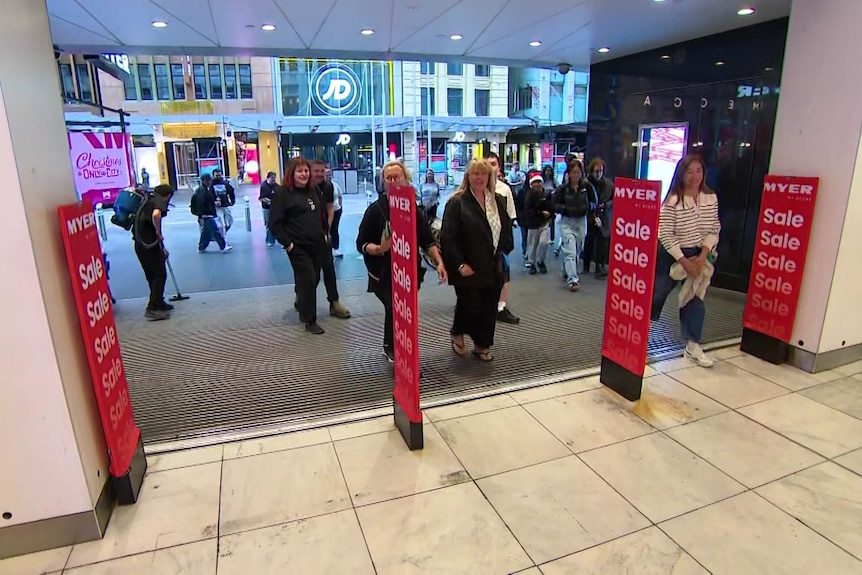
There was only a modest trickle of shoppers when the Myer in Melbourne’s Bourke Street Mall opened its doors on Boxing Day. (ABC News)
It was a slow start to the shopping day in Melbourne’s Bourke Street Mall, with a polite trickle of shoppers entering stores rather than the stampedes of yesteryear.
“I haven’t come the last few years because of the kids, COVID and all that,” one shopper told the ABC.
“Normally, I used to come here around 5 o’clock in the morning and there used to be a queue outside and all that, but this year is a little bit quieter,”
he said.
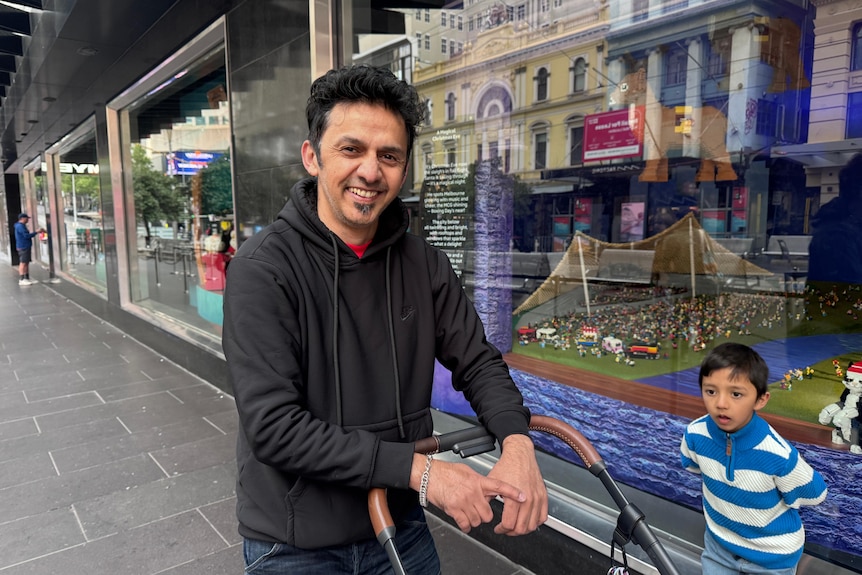
This Melbourne shopper was out early to grab a bargain in the Boxing Day sales. (ABC News: Nate Woodall)
Another shopper said she left the family at home and came into the CBD early to get a head start on other shoppers.
“The girls are a little bit older now so they’re still sleeping off the excitement of yesterday, so I came in nice and early to beat the rush,” she said.
“There wasn’t much of a rush anyway. I think everyone is shopping online.”
Shoppers have also been warned not to rush in to spending money on Boxing Day on something they might regret purchasing later.
University of Melbourne Professor of Law, Jeannie Paterson, said it was important to consider if an advertised discount was really what it seemed.
“The first thing to do is to slow down. I think Boxing Day sales, if we’ve got through Christmas, often we’re exhausted and we’re also in a hurry to find a good deal,” she said.
“So it’s worth just stopping and thinking and considering whether it really is a discount.
“The other thing that sometimes happens of course, is that old products or lower quality products are rolled out, and there’s a lot of fake products around online as well.”
New research from the Competition and Consumer Protection Commission shows that one third (32%) of consumers would regift an unwanted Christmas present if they didn’t have a receipt. It also showed that 42% of consumers never include a gift receipt when giving presents at Christmas. This rises to more than half (52%) of men surveyed.
The research also shows:
Only 5% would ask for a receipt in order to exchange an unwanted gift
Men are almost twice as likely as women to use an unwanted gift (19% vs 10% respectively)
17% of consumers surveyed are likely to donate an unwanted gift to charity or fundraising events
Consumers aged 55+ are three times more likely to donate unwanted gifts than those under 35 (24% vs 7%)
10% of consumers will either leave an unwanted gift unopened in storage or dump it
Consumer rights for unwanted gifts
While consumers in Ireland have strong rights when something goes wrong, this does not apply to unwanted gifts. For gifts bought online, consumers have a right to cancel for up to 14 days but it’s important to note that this window begins when the gift is delivered by the retailer, not from when it’s gifted. There are also exceptions to this, such as customised clothing.
While businesses are not legally obligated to accept an unwanted gift due to a change of mind, many stores have returns policies that allow gifts to be returned, with some offering extended return periods throughout January. However, it’s important to remember that they will usually require proof of purchase when returning a gift.
Grainne Griffin, director of communications at the CCPC said:
“While over half of consumers said they include a gift receipt at least some of the time, that still leaves a significant number who never include a receipt. This makes it harder to return or exchange unwanted gifts and can leave many unsure about what to do with their unwanted presents.
“While it’s great to see many consumers regifting, swapping or donating their unwanted gifts to avoid waste, 10% will leave it unopened or dump it and only 5% will ask for a receipt.”
Faulty goods
Irish consumers are protected for up to six years after buying a faulty good, with the original retailer responsible for resolving the issue. These rights are strongest in the first 30 days and the first year after making the purchase. However, you will often still need a proof of purchase when taking it back.
Gift vouchers
In the lead up to Christmas, CCPC research showed that almost one in four consumers had not used the gift vouchers they received last Christmas.
Grainne Griffin added:
“Since our pre-Christmas research showed that almost a quarter of consumers still had unused vouchers from nearly a year ago, we’re strongly advising anyone who has received a gift voucher this year to make a plan to spend it as early as possible.”
To find out more read the full post-Christmas 2025 report.
Police say altercation between two men led to shooting
Police lights. (WDIV)
DETROIT – A 30-year-old man is in critical condition after being shot during an altercation with another man on Christmas Day in Detroit.
Police say the shooting happened around 4 p.m. in the 18000 block of Russell Street on the city’s east side.
According to Detroit police, the two men got into a fight before one of them fired a gun.
The suspect is in custody as the investigation continues.
The victim remains in critical condition.
No additional details have been released at this time.
We will provide updates as more information becomes available.
Copyright 2025 by WDIV ClickOnDetroit – All rights reserved.
About the Author
Arianna Heyman headshot
Arianna Heyman
Arianna Heyman is a Red Wings enthusiast and a Beatles superfan since birth. She writes stories for ClickonDetroit and both produces and stars in videos for Local 4’s social media platforms.
India gets plenty of sunlight throughout the year, which makes solar power highly efficient
India’s rapid solar energy expansion is widely hailed as a success. But without a plan to manage the waste it will generate, how clean is the transition?
In just over a decade, India has become the world’s third-largest solar producer, with renewables now central to its climate strategy. Solar panels are everywhere – from vast solar parks to blue rooftops across cities, towns and villages.
Alongside large solar parks, millions of rooftop systems now feed power into the electricity grid. Government data show nearly 2.4 million households have adopted solar under a subsidy scheme.
Solar growth has cut India’s reliance on coal. Though thermal and other non-renewables still supply over half of installed capacity, solar now contributes more than 20%. Yet the achievement carries a challenge: while clean in use, solar panels can pose environmental risks if not properly managed.
Solar panels are mostly recyclable, made of glass, aluminium, silver, and polymers – but trace toxic metals like lead and cadmium can pollute soil and water if mishandled.
Solar panels typically last about 25 years, after which they are removed and discarded. India currently has no dedicated budget for solar-waste recycling and only a few small facilities to process old panels.
Bloomberg via Getty Images
Thermal power plants continue to dominate India’s energy generation capacity
India has no official data on solar waste, but a study estimated around 100,000 tonnes by 2023, rising to 600,000 tonnes by 2030. For now, the volume is small, but experts warn the bulk is yet to come – and without rapid recycling investment, India could face a growing waste crisis.
A new study by the Council on Energy, Environment and Water (CEEW) estimates that India could generate more than 11 million tonnes of solar waste by 2047. Managing this would require almost 300 dedicated recycling facilities and an investment of $478 (£362m) over the next two decades.
“Most of India’s large solar parks were built in the mid-2010s, so the real wave of waste is coming in 10 to 15 years,” says Rohit Pahwa of energy company Targray.
India’s solar-waste projections mirror global patterns: the US may generate 170,000–1 million tonnes and China nearly one million tonnes by 2030, following rapid solar expansion in the 2010s.
The policy landscape, however, differs significantly.
In the US, solar-panel recycling is mostly market-driven under a patchwork of state rules. China’s system, like India’s, is still developing and lacks a dedicated regulatory framework.
In 2022, India brought solar panels under e-waste rules, making manufacturers responsible for collecting, storing, dismantling and recycling them at end of life.
Experts say enforcement is uneven, especially for home and small-scale panels, which make up 5–10% of installations. Though modest, these panels can still generate substantial waste, as they are harder to track, collect, and recycle.
Damaged or discarded panels often end up in landfills or with unauthorised recyclers, where unsafe methods can release toxic materials. The BBC has contacted India’s renewable energy ministry for comment.
Hindustan Times via Getty Images
Damaged and ageing rooftop panels are rarely recycled
“Solar power gives an illusion of clean energy for two decades, but without a serious plan for recycling panels it risks leaving behind a graveyard of modules and not much of a legacy,” says environment expert Sai Bhaskar Reddy Nakka.
Despite the challenges, experts say the problem is not without opportunities.
“As waste rises, so will the demand for companies that know how to process it,” Mr Pahwa says.
Efficient recycling could reclaim 38% of materials for new panels by 2047 and prevent 37 million tonnes of carbon emissions from mining, says CEEW.
India already has markets for glass and aluminium, and metals found in solar cells – silicon, silver, and copper – can be recovered for new panels or other industries, says Akansha Tyagi, co-author of the study.
Currently, most solar waste is processed with basic methods that recover only low-value materials like glass and aluminium, while precious metals are lost, damaged or extracted in tiny amounts.
Experts say the next decade will be decisive for India’s solar goals. The country must act fast – building a regulated, self-sustaining recycling system, raising household awareness, and integrating waste collection into solar business models.
Companies that profit from solar power should also be responsible for what happens to panels once they stop working, says Mr Nakka.
“Without proper recycling, clean energy today could mean more waste tomorrow,” he warned.
Follow BBC News India on Instagram, YouTube,X and Facebook.
Home appliances build value and trust the longer they are used. Especially for products powered by advanced technologies such as artificial intelligence (AI), which are closely integrated into users’ everyday lives, reliability becomes a core element of the user experience. This is why Samsung is strengthening the reliability of its home appliances through innovations based on AI technology along with hardware (HW) and software (SW).
Samsung’s quality and reliability are increasingly being recognized by media outlets worldwide. In the U.K., independent review outlet ‘Trusted Reviews’ selected the Samsung Series 9 Bespoke AI Washing Machine1 as its “Best Washing Machine” at the Trusted Reviews Awards 2025, highlighting its cleaning performance and smart features. The publication has also reviewed Bespoke AI Jet Ultra, noting its impressive boost in suction power and excellent battery life.
In the third edition of the global “Why Samsung” campaign, Samsung Newsroom spoke with Miyoung Yoo, Executive Vice President and Head of the Global CS Team, DA Business at Samsung Electronics, about how the company is advancing quality, innovation and the reliability benefits customers experience — and where Samsung is headed next.
▲ Miyoung Yoo, Executive Vice President and Head of the Global CS Team, DA Business at Samsung Electronics
Bringing SW Seven-Year Upgrade and Strengthening the Durability of Core Components
Q1. What efforts is Samsung making to strengthen user trust in its home appliances?
Home appliances are used over long periods of time, making it crucial that they remain safe and reliable after purchase. This means product design must account not only for how appliances are used today, but also for how users’ lifestyles may evolve in the future.
Samsung is working to enhance the quality and reliability of its AI appliances by leveraging software, hardware and advanced AI technologies. First, Samsung provides software upgrades for smart home appliances, enabling them to continue evolving over time.2 We are also helping customers use their appliances more reliably and for longer through our Home Appliance Remote Management (HRM)3 service.
On the hardware side, we use our manufacturing know-how that we’ve built up over half a century and a vigorous verification system to continuously enhance the durability and competitiveness of our compressors and motors — which are “the heart of home appliances.” We also conduct long-term, high-intensity reliability testing to ensure stable performance, even in extreme environments around the globe.
Most recently, Samsung has further enhanced product quality and reliability by incorporating AI capabilities. For example, we use AI in our digital inverter compressor to help save energy while creating optimal cooling. We further apply AI to our HRM service to detect early signs of abnormal operation and proactively notify users.
Upgrading Both Appliance Performance and Security Through AI and Software
Q2. What is Samsung’s software update policy for its home appliances to improve reliability?
Samsung AI appliances are evolving into advanced devices capable of receiving real-time feature upgrades and, through software innovation, resolving certain issues remotely.
Samsung supports software upgrades for up to seven years for its smart home appliances released since 2024. This enables the addition of new convenience features and the latest security technologies to appliances users already own, allowing products to continue evolving over time.
For example, the AI Vision Inside feature on the Family Hub refrigerator has been upgraded this year. AI Vision Inside recognizes food items being put in or taken out of the refrigerator using a camera and creates a food list on the product’s screen, enhancing the convenience of food management. The number of fresh foods recognized has increased to 37, and users can now additionally register and manage up to 50 types of processed and packaged foods.4
Q3. Besides the SW updates, are there ways to improve reliability through SW?
Samsung is continuously improving product durability and reliability by providing its HRM service.
Samsung’s HRM is a system that collects and analyzes data from SmartThings-connected appliances in real time. Based on the analysis results, advisors can assess the product’s status and guide customers on the most appropriate actions — or resolve issues by remotely adjusting settings. This allows users to receive professional care without having to describe issues in detail and in some cases, resolve them quickly without the need for a service engineer visit — saving both time and repair costs.5
For instance, if a washing machine is not dispensing fabric softener, a consultant can remotely adjust the detergent box mode. If a refrigerator does not feel cool enough due to overstocking, a consultant can remotely set the temperature lower than the minimum available to the users.
Samsung has continued to advance its HRM service by incorporating AI technologies that proactively detect early signs of potential issues and notify users in advance. For example, by analyzing factors such as laundry room and outdoor temperatures, the system can predict frost risks in washing machines and dryers and notify users in advance via smartphone alerts. It can also detect low refrigerant levels in air conditioners and refrigerators early on, helping prevent issues from escalating into major failures.6
Meanwhile, Samsung Electronics Canada received an award for excellence at the 2025 CIO Awards Canada, presented by IDC in November, recognized for its HRM project, providing reliable services to customers and setting new industry standards. The CIO Awards specifically honor organizations that demonstrate exceptional innovation and business value through IT solutions.
This year, we plan to significantly expand this service by supporting 17 languages in around 120 countries.
The Heart of AI Appliances: Innovating Core Components With AI
Q4. From a hardware perspective, what sets Samsung’s appliance quality apart?
Building on its capabilities in AI appliances, Samsung is now dedicated to solidifying its competitive edge in core components by pushing the boundaries of hardware reliability.
Compressors and motors are often called “the heart of home appliances” because they are directly linked to product performance and durability. Since 1976, Samsung has been manufacturing compressors for nearly 50 years, continuously advancing both technology and durability. Today, its eighth-generation compressor incorporates innovations that directly enhance energy efficiency and reliability, including ultra-precision machining to a tolerance of one-tenth the thickness of a human hair (5 μm=0.005 mm), friction-reduction technology and high-rigidity coatings. For washing machine7 motors, Samsung applies 3D high-speed balancing technology to ensure stable operation even during spin cycles reaching 270 rotations per second. This significantly reduces vibration and noise.
To ensure seamless performance across diverse environments — from the heat and humidity of Southeast Asia and the Middle East to the extreme cold and heavy snowfall of polar regions — the company conducts rigorous stress testing on core components. Refrigerator compressors undergo extensive testing in a dedicated testing space, including continuous operation for 1,500 hours at 85°C and 500 hours at 100°C, to ensure core component reliability.
In addition, AI is being applied to further strengthen the performance and reliability of these core components. Samsung compressors have evolved from digital inverters to AI digital inverter compressors, which use AI to adjust the operation of the compressor’s internal motor to help save energy and improve durability.
Q5. Going forward, how will Samsung further strengthen the reliability of its home appliances?
We plan to continue enhancing the reliability of our home appliances by strengthening the three pillars of software, hardware and AI. Our ultimate goal is to deliver an excellent user experience throughout the entire product lifecycle, from purchase to long-term use, while continuing to innovate more trustworthy appliances.
On the software side, we are improving the convenience and accuracy of features by combining them with AI. For example, the HRM service is evolving its functions to enable more precise product diagnosis and user support by analyzing product status and error history with AI. Ultimately, with AI, we aim to transform the appliance use and care paradigm from repair to prevention, thereby strengthening reliability.
On the hardware side, we are accelerating innovation focused on core components. We have rapidly transitioned our compressors from fixed-speed designs — where operating speed remains constant — to digital inverter technology, significantly improving energy efficiency and stability. Samsung has driven further transformation with AI Hybrid Cooling, which uses an AI digital inverter compressor in normal situations and gets a Peltier cooling unit to work additionally when intensive cooling is required.
By continuously advancing AI-driven core component technologies and delivering ongoing software upgrades, Samsung plans to continue its efforts to deliver “appliances that remain reliable over time.”