
Category: 3. Business

  • EBRD acquires minority stake in Polish company Unilogo Robotics

    EBRD acquires minority stake in Polish company Unilogo Robotics

    The European Bank for Reconstruction and Development (EBRD) has acquired an indirect minority stake in Unilogo Robotics, a robotics company based in Poland. The Bank has invested alongside private equity fund Resource Partners, in which the EBRD is also a limited partner.

    Operating at the intersection of industrial automation and software, Unilogo is a fast-growing Polish business offering robotic assembly line solutions. It provides integrated robotic lines that are controlled by proprietary software and tailored to short production runs primarily for personal care and household products segments. The company’s systems are used by global players in the fast-moving consumer goods (FMCG) industry.

    The EBRD’s investment has supported Resource Partners’ acquisition of Unilogo, paving the way for the company to grow further in Poland and beyond. As new shareholders, the EBRD and Resource Partners will help Unilogo develop and expand its highest-speed robotic lines as well as improve its proprietary software and corporate governance.

    Tamas Nagy, EBRD Co-Head of Private Equity, said: “We are pleased to support Unilogo in its expansion and to continue our strong cooperation with Resource Partners, initially through the fund investment and now through this first joint co-investment. This transaction is a perfect example of how the EBRD adds value to the Polish market through private equity ecosystem development and by supporting forward-thinking companies such as Unilogo.”

    Frederic Lucenet, EBRD Global Head of Manufacturing and Services, added: “Unilogo’s obotics solutions are very important to keep manufacturing competitive, including for many of our FMCG clients in central and eastern Europe. The EBRD will support the ambitious growth plans of the company. Congratulations to the Unilogo and Resource Partners teams.”

    Andreea Moraru, EBRD Director for Poland and Baltic States, said: “We focus on supporting innovative, high-growth companies in Poland, and Unilogo is precisely that. We’re delighted to join forces with Resource Partners to help this Polish tech champion grow. This will not just benefit its clients but also strengthen Poland’s industrial competitiveness.”

    The EBRD is one of the leading institutional investors in Poland. Since the start of its operations in the country in 1991, the Bank has invested more than €16 billion across 584 projects. Last year, the EBRD invested a record €1.4 billion in the country, with 12 per cent of this in direct equity and equity-like instruments.

    Continue Reading

  • CP25/41: Regulating cryptoassets: Admissions & disclosures and market abuse regime for cryptoassets

    Read CP25/41 (PDF)

    Why we are consulting

    In December 2025, the government laid the draft Financial Services and Markets Act 2000 (Cryptoassets) Regulations 2025 (the Cryptoasset Regulations), to bring cryptoasset activities within our regulatory remit.

    Our remit is currently limited to overseeing how cryptoassets are promoted and ensuring firms meet anti-money laundering standards.

    This CP is published alongside CP25/40, which sets out our proposed rules and guidance for firms conducting regulated cryptoasset activities, and CP25/42 which contains proposed prudential rules applying to all regulated cryptoasset activities. 

    We will consider responses to all the consultations as part of the Crypto Roadmap and we intend to set out our final rules and guidance in policy statements in 2026. 

    Who this applies to

    This CP will primarily interest firms that participate in, or support the services of, regulated cryptoasset activities such as cryptoasset trading platforms, cryptoasset intermediaries and others. It will also be relevant to anyone who has bought (or sold), or may in the future buy (or sell), cryptoassets from an entity providing services or making offers of cryptoassets in the UK or to persons in the UK. 

    It will also interest a wide range of organisations and individuals, both domestically and internationally, that participate in the cryptoasset sector. 

    This document should be read by:

    • cryptoasset firms (including potentially firms based overseas) providing services to UK consumers
    • traditional finance firms and market participants  
    • industry groups/trade bodies
    • professional advisors
    • law firms and consulting firms advising on cryptoassets
    • consumer groups and individual consumers
    • policy makers and other regulatory bodies
    • industry experts and commentators
    • academics and think tanks
    • other firms or professional bodies involved in cryptoassets

    How to respond

    Online response form

    We are asking for comments on this CP by 12 February 2026. You can send them to us using the online form. Or in writing to: Wholesale Cryptoasset Policy, Financial Conduct Authority, 12 Endeavour Square, London, E20 1JN

    Email: [email protected]

    Background

    The A&D and MARC regimes form a central part of the UK’s broader future financial services regulatory regime for cryptoassets. Together, they are designed to:

    • strengthen safeguards and protection by improving the quality and reliability of information available at the point of admission to trading
    • enhance market integrity by tackling fraud, scams and abusive practices such as insider dealing and market manipulation, and
    • raise standards across cryptoasset markets, supporting fair competition and clean, well-functioning cryptoasset markets.

    Introducing these regimes will establish a base level of rules that will build consumer confidence, enable firms to compete on a level playing field, and reinforce the UK’s position as a jurisdiction that combines high regulatory standards with support for innovation.

    Continue Reading

  • ESMA maintains recognition of two UK central counterparties under EMIR

    The European Securities and Markets Authority (ESMA), the EU’s financial markets regulator and supervisor, confirmed it will maintain the recognition of LCH Limited and LME Clear Limited, two central counterparties (CCPs) established in the United Kingdom (UK). 

    This decision is taken under Article 25(5)(b) of the European Market Infrastructure Regulation (EMIR), that requires ESMA to assess if the conditions under which LCH Limited and LME Clear Limited were originally recognised continue to be met, considering recent regulatory, market, and business developments.

    Following its review, ESMA determined that maintaining the recognition of LCH Limited as Tier 2 CCP and LME Clear Limited as Tier 1 CCP is appropriate.

    The decisions of ESMA regarding the determination of tiering and recognition of LCH Limited and LME Clear Limited remain applicable until 30 June 2028.

    Background

    ICE Clear Europe Limited was not within the scope of this review, as its tiering and recognition were reviewed and confirmed in 2023.


    Further information:

    Cristina Bonillo

    Senior Communications Officer
    press@esma.europa.eu


    Tayfun Yilmaz

    Communications Officer
    press@esma.europa.eu

    Continue Reading

  • AkzoNobel extends Chinese marine coatings partnership to accelerate transition to sustainable shipping

    “The outstanding performance of International has been fully validated in our existing fleet, delivering significant fuel savings and enhancing our market competitiveness,” says Yu Shan, General Manager of Qingdao Winning International Ship Management Co., Ltd.

    “This is why we’ve chosen to extend and deepen our partnership. Through this drydocking cooperation, we look forward to more vessels benefiting from these more sustainable advanced technologies, jointly contributing to a greener future for the industry.”

    Following the International Maritime Organization’s introduction of emission reduction regulations, shipping companies are addressing their carbon footprint and actively adopting measures to optimize energy efficiency. China is also speeding up the implementation of its “Dual Carbon” strategy in the maritime sector, promoting the widespread adoption of more sustainable technologies.

    “We’re honored to continue and deepen our strategic cooperation,” adds Rob Leslie, Commercial Director of AkzoNobel Marine and Protective Coatings in Greater China. “Winning Shipping’s unwavering pursuit of more efficient operations aligns perfectly with our philosophy of helping customers through sustainable innovation. We look forward to providing solid support for the long-term operational efficiency and sustainable development goals of its fleet.”

    In addition to Intersleek 1100SR, International will also supply the project with its Intercept® 8500 LPP antifouling coating, which combines linear polishing with an optimized biocide package. This is the highest performing antifouling product within the International range, specifically designed for deep sea vessels.

    The agreement was signed during the recent Marintec China 2025 event, one of the world’s leading maritime industry exhibitions.

    Learn more about AkzoNobel’s marine coatings.


    About AkzoNobel
    Since 1792, we’ve been supplying the innovative paints and coatings that help to color people’s lives and protect what matters most. Our world class portfolio of brands – including Dulux, International, Sikkens and Interpon – is trusted by customers around the globe. We’re active in more than 150 countries and use our expertise to sustain and enhance everyday life. Because we believe every surface is an opportunity. It’s what you’d expect from a pioneering and long-established paints company that’s dedicated to providing more sustainable solutions and preserving the best of what we have today – while creating an even better tomorrow. Let’s paint the future together.

    Continue Reading

  • FCA seeks feedback on proposals for UK crypto rules

    We want a market where innovation can thrive, but where people understand the risks. Regulation cannot – and should not – remove all risk. Instead, it should make sure anyone investing in crypto does so with their eyes open.

    Our proposals apply a similar approach to crypto as we do in traditional finance: clear information for consumers, proportionate requirements for firms, and flexibility to support innovation.

    What we’re consulting on

    • Admissions and disclosures – Rules for listing cryptoassets and what firms must tell investors, so people have the facts before they invest.
    • Market abuse – Measures to stop insider trading and manipulation, so markets are fair.
    • Cryptoasset trading platforms – Standards for exchanges to keep trading safe and reliable.
    • Intermediaries – Requirements for brokers and other middlemen, so they act responsibly.
    • Staking – Making sure the risks are clear when firms offer staking – a service that lets you lock up your crypto for a reward.
    • Lending and borrowing – Rules to protect both crypto lenders and borrowers.
    • Decentralised finance (DeFi) – DeFi lets people trade, lend and borrow using crypto without a middleman. We’re asking if the same rules that apply in traditional finance should also apply here.
    • Prudential requirements – Financial safeguards for firms, so they can better manage risk.

    These proposals build on feedback from earlier discussions and new research published today. They are aligned with new government legislation laid yesterday and reflect our commitment to getting the balance right.

    David Geale, executive director for payments and digital finance at the FCA, said:

    ‘Regulation is coming – and we want to get it right. We’ve listened to feedback, and now we’re setting out our proposals for the UK’s crypto regime.

    ‘Our goal is to have a regime that protects consumers, supports innovation and promotes trust. We welcome feedback to help us finalise these rules.’

    We’ve made significant progress in delivering our crypto roadmap and are helping firms meet our standards and become registered while we wait for further legislation.

    While we work closely with partners to deliver the UK’s crypto rules, people should remember crypto is largely unregulated – except for financial promotions and financial crime purposes.

    Consultation responses are open until 12 February 2026.

    To share your views, please see our CP25/40, CP25/41 and CP25/42 pages.

    Notes to editors

    1. Read CP25/40, CP25/41 and CP25/42.
    2. Read our Cryptoassets consumer research 2025 and Cryptoasset regulation and consumer decision-making: Evidence from an online experiment research notes.
    3. These publications mark the next milestone in crypto regulation in the UK closely engaging with the Government’s proposals including the statutory instrument laid at the Parliament yesterday (15 December).
    4. We have considered how these consultation papers will apply the UK issuers of stablecoins and have introduced specific rules and guidance where necessary. UK issuers of stablecoins will not be able to pass interest from their own backing assets to holders; we are considering how further financial incentives could be shared with holders when UK issued stablecoins are used.
    5. The FCA has previously set out the timeline for crypto regulation in its crypto roadmap.
    6. Earlier this year, the FCA consulted on key topics such as stablecoins, cryptoasset custody and conduct of business and high-level standards. Soon, the FCA will consult further on Consumer Duty and other consumer protection matters for cryptoassets, including our approach to financial promotions.
    7. Find out more about existing rules firms must comply with.
    8. If firms want to become registered under the Money Laundering Regulations 2017, we offer pre-application support. It’s a free meeting with a case officer who can talk them through any questions they might have.  We also run webinars and in person events with industry and compliance teams to educate crypto firms specifically on our rules. There will be more of these in the coming months aimed at specific areas of our rules.
    9. We provide firms with lots of resources to help them understand our rules and how to meet expectations. Find out more.
    10. The FCA enables a fair and thriving financial services market for the good of consumers and the economy. Find out more about the FCA.

    Continue Reading

  • Provisional Tender Results for Land Parcel at Hougang Avenue 10/ Hougang Central for Mixed Commercial and Residential Development

    About Us

    The Housing & Development Board (HDB) is Singapore’s public housing authority and a statutory board under the Ministry of National Development. We develop public housing to provide Singaporeans with affordable, quality homes, and a better living environment. Focusing on nurturing a strong family and community spirit, public housing policies and schemes are formulated to meet changing needs and aspirations.

    Residential

    Whether you are buying, selling, or already living in an HDB flat, everything you need to know about residential properties is housed here.

    Community

    More than homes, our HDB towns are vibrant places to enjoy to the fullest. There is so much in place for you to bond with your neighbours and create an active and cohesive community.

    Business

    Get the information you need for any business involving HDB homes, properties, commercial spaces, or land under our management.

    Car Parks

    You can find out more about the types of HDB car parks, important car park information, and parking offences.

    e-Services

    Transact with us at your convenience. You can submit an application, submit an online enquiry, or make an appointment with us.


    Continue Reading

  • Single Collateral Management Rulebook for Europe (SCoRE)

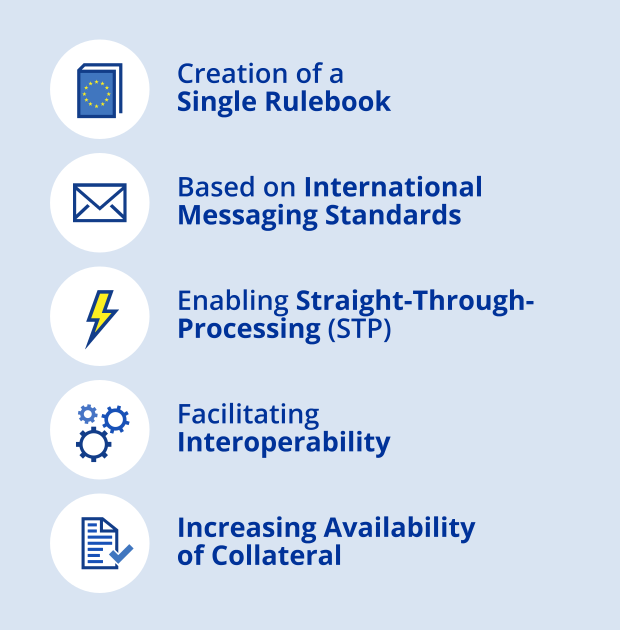
    In order to address this fragmentation, the Eurosystem’s Advisory Group on Market Infrastructures for Securities and Collateral (AMI-SeCo) is working towards developing a Single Collateral Management Rulebook for Europe (SCoRE), which defines common rules for managing collateral.

    Harmonised collateral management processes

    Harmonised collateral management processes

    The harmonised collateral management processes laid down in SCoRE will ultimately make it easier for:

    • market participants to move their securities and collateral safely and efficiently between EU countries, without friction or restrictions;
    • investors to buy securities in any EU country and use them as collateral in the same or any other EU country;
    • banks to move collateral and securities quickly to where they are needed.

    It will also lead to:

    • increased efficiency, by enabling collateral management across Europe from a single account using the same procedures;
    • lower costs, as a single rulebook will allow market participants to implement a single set of procedures;
    • interoperability, resulting from common messaging based on a common set of data across financial market infrastructures;
    • lower risk in managing securities and collateral as a result of the standardisation of processes;
    • a level playing field for all market participants across Europe;
    • increased reach beyond domestic markets.

    Continue Reading

  • Single Collateral Management Rulebook for Europe (SCoRE)

    Nicht auf Deutsch verfügbar.

    In order to address this fragmentation, the Eurosystem’s Advisory Group on Market Infrastructures for Securities and Collateral (AMI-SeCo) is working towards developing a Single Collateral Management Rulebook for Europe (SCoRE), which defines common rules for managing collateral.

    Harmonised collateral management processes

    Harmonised collateral management processes

    The harmonised collateral management processes laid down in SCoRE will ultimately make it easier for:

    • market participants to move their securities and collateral safely and efficiently between EU countries, without friction or restrictions;
    • investors to buy securities in any EU country and use them as collateral in the same or any other EU country;
    • banks to move collateral and securities quickly to where they are needed.

    It will also lead to:

    • increased efficiency, by enabling collateral management across Europe from a single account using the same procedures;
    • lower costs, as a single rulebook will allow market participants to implement a single set of procedures;
    • interoperability, resulting from common messaging based on a common set of data across financial market infrastructures;
    • lower risk in managing securities and collateral as a result of the standardisation of processes;
    • a level playing field for all market participants across Europe;
    • increased reach beyond domestic markets.

    Continue Reading

  • SRB publishes modernised expectations on valuation for banks in crisis

    • The guidance, published after extensive public consultation, provides details on an updated valuation data framework.

    • Banks are expected to have a high-quality dataset available, to facilitate valuation in the case of failure, boosting crisis readiness.

    The SRB today publishes its Expectations on Valuation Capabilities. Crisis readiness and, in particular, valuation in crisis, is a key component of the SRM Vision 2028 strategy. Banks are expected to ensure the availability of a standardised high-quality dataset to independent valuers, enabling robust and timely valuations, while strengthening crisis readiness.

    “As we navigate the complexities of an evolving financial landscape, the SRB’s updated valuation framework is crucial in ensuring banks are crisis-ready. High quality datasets are key to making effective resolution decisions,” said Dominique Laboureix, SRB Chair.

    The final expectations reflect extensive feedback from a public consultation held between 2 April and 2 July 2025. In response, and in line with its efforts on simplification, the SRB streamlined and simplified the proposed framework by reducing certain documents and data attributes, removing the continuous access requirement to data repositories for resolution, and clarifying the role of valuation playbooks. A feedback statement summarises how comments were addressed. 

    The expectations replace previous guidance published in 2020. Banks are expected to progressively implement them by the end of 2029. 

    See here for more information on the requirements and timeline.


    Continue Reading

  • FDA says ByHeart baby formula recall response was too slow : NPR

    FDA says ByHeart baby formula recall response was too slow : NPR

    FILE – A sign for ByHeart, a manufacturer of organic baby formula, is displayed outside a building that houses a plant for the company on Tuesday, Nov. 11, 2025, in Portland, Ore.

    Jenny Kane/AP


    hide caption

    toggle caption

    Jenny Kane/AP

    Four of the nation’s top retail stores failed to promptly pull contaminated infant formula tied to a dangerous botulism outbreak from their shelves, federal health officials said in warning letters posted Monday.

    The U.S. Food and Drug Administration sent letters to leaders at Walmart, Target, Kroger and Albertsons, saying the companies continued to sell ByHeart infant formula for days or weeks, despite a Nov. 11 recall of all products in the outbreak that has sickened more than 50 babies in 19 states.

    “As a participant in the supply chain, your firm should take prompt and effective action when notified of a product recall,” FDA officials said in warning letters sent to the companies on Dec. 12 and posted online Monday.

    The formula was found at Target stores in 20 states “well after the recall was initiated,” one letter said. In addition, it was sold at a Target store in New Hampshire on Nov. 16, despite an electronic block on the product’s sales code, the FDA noted. And at a Target store in Arkansas, single-serve packs of ByHeart formula were promoted with a “Sale!” sign and a $2 discount from Nov. 16 to Nov. 22.

    Information from state and local health officials said ByHeart formula was found at Walmart stores in 21 states from Nov. 12 to Nov. 26. The formula was found in Albertsons stores in 11 states from Nov. 12 to Nov. 19, and at Kroger stores in 10 states from Nov. 12 to Nov. 19.

    In addition, the companies failed to provide FDA with evidence that corrective actions have been put in place, despite multiple requests, the agency said. The companies have 15 working days to respond to the letters.

    Walmart officials said in a statement that no ByHeart formula was sold after cash registers were blocked from selling the formula following the recall.

    “We moved swiftly to issue a sales restriction and removed this product from our impacted stores and clubs and online,” a company spokesperson said in an email. “We take all reports of inaction seriously and will respond to the letter.”

    Albertsons officials said the company worked closely with suppliers and regulators to identify and remove the products and communicate to customers.

    “ByHeart infant formula products have been removed from our store shelves,” the company said in a statement.

    All of the babies in the outbreak have been hospitalized and treated with an IV medication to stop the progress of the disease. The U.S. Centers for Disease Control and Prevention expanded the outbreak to include all babies treated for botulism after consuming ByHeart formula since it was first produced in 2023.

    Steven Mandernach, executive director at the Association of Food and Drug Officials, said the FDA itself was slow to distribute information about the recall with state and local food safety officials. The agency didn’t fully share product lists until Nov. 14 — nearly a week after the initial recall of two lots of ByHeart formula on Nov. 8.

    He said it was “disappointing” in an outbreak involving the sole source of nutrition for vulnerable infants.

    “There probably wasn’t the sense of urgency to ensure the product was off the market that I would expect,” Mandernach said.

    Continue Reading