WASHINGTON— The Commodity Futures Trading Commission announced today the U.S. District Court for the District of Oregon entered a consent order against Robert L. Adams and SimTradePro Incorporated, both of Oregon, for fraud involving multiple commodity pools.
The order requires the defendants to pay $2,072,986 in restitution to defrauded victims. It also permanently bans them from trading and registering with the CFTC and prohibits further violations of the Commodity Exchange Act and CFTC regulations, as charged.
The consent order resolves a CFTC enforcement action filed Sept. 30, 2024 [See CFTC Press Release No. 8993-24].
According to the court’s findings, Adams and SimTradePro fraudulently solicited and accepted more than $2.3 million from at least 100 customers, many of whom were planning for retirement, to trade leveraged foreign currency exchange and leveraged gold and silver contracts in the defendants’ commodity pools. The defendants misrepresented the amount of fees charged, falsely claiming to only be paid if their customers made money, and hid trading losses. The court also found that SimTradePro unlawfully acted as a commodity pool operator and commodity trading advisor.
In a related criminal action involving the same misconduct, Adams was sentenced Aug. 12 to 2.5 years in prison and ordered to pay restitution. United States v. Adams (No. 6:23-cr-00211-MC D. Or.).
The CFTC cautions that orders requiring repayment of funds to victims may not always result in the recovery of any money because the wrongdoers may not have sufficient funds or assets. The CFTC will continue to fight vigorously for the protection of customers and to ensure the wrongdoers are held accountable.
The CFTC thanks the United Kingdom Financial Conduct Authority for its assistance. The Division of Enforcement also appreciates the support of the Oregon Division of Financial Regulation, the Australian Securities and Investments Commission, and the Central Bank of Ireland.
CFTC Division of Enforcement staff responsible for this action are Harry E. Wedewer, Mary Lutz, Patrick Marquardt, Chris Giglio, Lenel Hickson, and Chuck Marvine.
While Wall Street and Silicon Valley are obsessed with artificial intelligence, many businesses don’t have the luxury to fixate on AI because they’re too busy trying to grind out more revenue.
At the Fortune Brainstorm AI conference in San Francisco on Monday, Intuit CEO Sasan Goodzari acknowledged the day-to-day priorities of users of his company’s products, such as QuickBooks, TurboTax, Mailchimp and Credit Karma.
“I remind ourselves at the company all the time: customers don’t care about AI,” he told Fortune’s Andrew Nusca. “Everybody talks about AI, but the reality is a consumer is looking to increase their cash flow. A consumer is looking to power their prosperity to make ends meet. A business is trying to get more customers. They’re trying to manage their customers, sell them more services.”
Of course, AI still powers Intuit’s platforms, which help companies and entrepreneurs digest data that’s often stovepiped across dozens of separate applications they juggle. So Intuit declared years ago that it would focus on delivering “done-for-you experiences,” Goodzari said.
On the enterprise side, it means helping businesses manage sales leads, cash flow, accounting, or taxes. On the consumer side, it entails helping users build credit and wealth. Expertise from a real person, or human intelligence (HI), is an essential component as well.
“Customers don’t care about AI,” Goodzari added. “What they care about is ‘Help me grow my business, help me prosper.’ And we have found the only way to do that is to combine technology automating everything for them with human intelligence on our platform that can actually give you the human touch and the advice. And we believe that will be the case for decades to come. But the role of the HI, the human, will change.”
For example, an Intuit AI agent can hand off tasks to humans by helping them follow up with business clients who have overdue invoices or identify which ones typically pay on time.
Ashok Srivastava, Intuit’s chief AI officer, noted that the AI agents on average save customers 12 hours per month on routine tasks. In addition, users get paid five days sooner and are 10% more likely to be paid in full.
“As a person who’s run small businesses in the past, I can tell you numbers like that are very meaningful,” he said. “Twelve more hours means 12 more hours that I can spend building my products, understanding my customers.”
Read more from Fortune Brainstorm AI:
Cursor developed an internal AI help desk that handles 80% of its employees’ support tickets, says the $29 billion startup’s CEO
OpenAI COO Brad Lightcap says ‘code red’ will force the company to focus, as the ChatGPT maker ramps up enterprise push
Amazon robotaxi service Zoox to start charging for rides in 2026, with ‘laser focus’ on transporting people, not deliveries, says cofounder
Notes: Anglo American is a leading global mining company focused on the responsible production of copper, premium iron ore and crop nutrients – future-enabling products that are essential for decarbonising the global economy, improving living standards, and food security. Our portfolio of world-class operations and outstanding resource endowments offers value-accretive growth potential across all three businesses, positioning us to deliver into structurally attractive major demand growth trends.
Our integrated approach to sustainability and innovation drives our decision-making across the value chain, from how we discover new resources to how we mine, process, move and market our products to our customers – safely, efficiently and responsibly. Our Sustainable Mining Plan commits us to a series of stretching goals over different time horizons to ensure we contribute to a healthy environment, create thriving communities and build trust as a corporate leader. We work together with our business partners and diverse stakeholders to unlock enduring value from precious natural resources for our shareholders, for the benefit of the communities and countries in which we operate, and for society as a whole. Anglo American is re-imagining mining to improve people’s lives.
Anglo American is currently implementing a number of major structural changes to unlock the inherent value in its portfolio and thereby accelerate delivery of its strategic priorities of Operational excellence, Portfolio simplification, and Growth. The sale of our steelmaking coal and nickel businesses and the separation of our iconic diamond business (De Beers) continue to progress and once completed, will focus Anglo American on its world-class resource asset base in copper, premium iron ore and crop nutrients.
www.angloamerican.com
Group terminology In this document, references to “Anglo American”, the “Anglo American Group”, the “Group”, “we”, “us”, and “our” are to refer to either Anglo American plc and its subsidiaries and/or those who work for them generally, or where it is not necessary to refer to a particular entity, entities or persons. The use of those generic terms herein is for convenience only, and is in no way indicative of how the Anglo American Group or any entity within it is structured, managed or controlled. Anglo American subsidiaries, and their management, are responsible for their own day-to-day operations, including but not limited to securing and maintaining all relevant licences and permits, operational adaptation and implementation of Group policies, management, training and any applicable local grievance mechanisms. Anglo American produces group-wide policies and procedures to ensure best uniform practices and standardisation across the Anglo American Group but is not responsible for the day to day implementation of such policies. Such policies and procedures constitute prescribed minimum standards only. Group operating subsidiaries are responsible for adapting those policies and procedures to reflect local conditions where appropriate, and for implementation, oversight and monitoring within their specific businesses.
Disclaimer This document is for information purposes only and does not constitute, nor is to be construed as, an offer to sell or the recommendation, solicitation, inducement or offer to buy, subscribe for or sell shares in Anglo American or any other securities by Anglo American or any other party. Further, it should not be treated as giving investment, legal, accounting, regulatory, taxation or other advice and has no regard to the specific investment or other objectives, financial situation or particular needs of any recipient.
Forward-looking statements and third party information This document includes forward-looking statements. All statements other than statements of historical facts included in this document, including, without limitation, those regarding Anglo American’s financial position, business, acquisition and divestment strategy, dividend policy, plans and objectives of management for future operations, prospects and projects (including development plans and objectives relating to Anglo American’s products, production forecasts and Ore Reserve and Mineral Resource positions) and sustainability performance related (including environmental, social and governance) goals, ambitions, targets, visions, milestones and aspirations, are forward-looking statements. By their nature, such forward-looking statements involve known and unknown risks, uncertainties and other factors which may cause the actual results, performance or achievements of Anglo American or industry results to be materially different from any future results, performance or achievements expressed or implied by such forward-looking statements.
Such forward-looking statements are based on numerous assumptions regarding Anglo American’s present and future business strategies and the environment in which Anglo American will operate in the future. Important factors that could cause Anglo American’s actual results, performance or achievements to differ materially from those in the forward-looking statements include, among others, levels of actual production during any period, levels of global demand and product prices, unanticipated downturns in business relationships with customers or their purchases from Anglo American, mineral resource exploration and project development capabilities and delivery, recovery rates and other operational capabilities, safety, health or environmental incidents, the effects of global pandemics and outbreaks of infectious diseases, the impact of attacks from third parties on our information systems, natural catastrophes or adverse geological conditions, climate change and extreme weather events, the outcome of litigation or regulatory proceedings, the availability of mining and processing equipment, the ability to obtain key inputs in a timely manner, the ability to produce and transport products profitably, the availability of necessary infrastructure (including transportation) services, the development, efficacy and adoption of new or competing technology, challenges in realising resource estimates or discovering new economic mineralisation, the impact of foreign currency exchange rates on market prices and operating costs, the availability of sufficient credit, liquidity and counterparty risks, the effects of inflation, terrorism, war, conflict, political or civil unrest, uncertainty, tensions and disputes and economic and financial conditions around the world, evolving societal and stakeholder requirements and expectations, shortages of skilled employees, unexpected difficulties relating to acquisitions or divestitures, competitive pressures and the actions of competitors, activities by courts, regulators and governmental authorities such as in relation to permitting or forcing closure of mines and ceasing of operations or maintenance of Anglo American’s assets and changes in taxation or safety, health, environmental or other types of regulation in the countries where Anglo American operates, conflicts over land and resource ownership rights and such other risk factors identified in Anglo American’s most recent Annual Report. Forward-looking statements should, therefore, be construed in light of such risk factors and undue reliance should not be placed on forward-looking statements. These forward-looking statements speak only as of the date of this document. Anglo American expressly disclaims any obligation or undertaking (except as required by applicable law, the City Code on Takeovers and Mergers, the UK Listing Rules, the Disclosure Guidance and Transparency Rules of the Financial Conduct Authority, the Listings Requirements of the securities exchange of the JSE Limited in South Africa, the SIX Swiss Exchange, the Botswana Stock Exchange and the Namibian Stock Exchange and any other applicable regulations) to release publicly any updates or revisions to any forward-looking statement contained herein to reflect any change in Anglo American’s expectations with regard thereto or any change in events, conditions or circumstances on which any such statement is based.
Nothing in this document should be interpreted to mean that future earnings per share of Anglo American will necessarily match or exceed its historical published earnings per share. Certain statistical and other information included in this document is sourced from third party sources (including, but not limited to, externally conducted studies and trials). As such it has not been independently verified and presents the views of those third parties, but may not necessarily correspond to the views held by Anglo American and Anglo American expressly disclaims any responsibility for, or liability in respect of, such information.
Merger of Equals with Anglo American plc approved by both classes of Teck shareholders
Vancouver, B.C. – Teck Resources Limited (TSX: TECK.A and TECK.B, NYSE: TECK) (“Teck”) announced today the voting results from its Special Meeting of Shareholders held on Tuesday, December 9, 2025 (the “Meeting”). Teck shareholders overwhelmingly voted to approve the special resolution (the “Arrangement Resolution”) approving the plan of arrangement under the Canadian Business Corporations Act, involving, among other things, the “merger of equals” of Anglo American plc (“Anglo American”) and Teck (the “Merger”). 99.7% of the votes cast by Class A common shareholders at the Meeting were in favour of the Arrangement Resolution and 89.7% of votes cast by Class B subordinate voting shareholders were in favour of the Arrangement Resolution.
“This resoundingly positive vote marks an important milestone in creating Anglo Teck—a global leader in critical minerals headquartered in Canada,” said Jonathan Price, President and CEO, Teck. “Anglo Teck will be positioned to deliver long-term value through a world-class copper growth portfolio, operational and functional synergies, and a stronger platform to meet growing demand for critical minerals essential to global economic growth and the energy transition. We look forward to advancing the necessary regulatory approvals and completing the merger for the benefit of our shareholders, employees, communities, and partners.”
The Arrangement Resolution required the approval of at least (a) two-thirds of the votes cast by Class A common shareholders present or represented by proxy at the Meeting, voting separately as a class; and (b) two-thirds of the votes cast by Class B subordinate voting shareholders present or represented by proxy at the Meeting, voting separately as a class. A total of 6,329,767 Class A common shares, representing 83.3% of the votes attached to all outstanding Class A common shares, and 380,842,347 Class B subordinate voting shares, representing 79.4% of the votes attached to all outstanding shares, were voted at the Meeting. Detailed voting results for the Meeting will be available under Teck’s profiles on SEDAR+ (www.sedarplus.ca) and EDGAR (www.sec.gov).
As announced earlier today by Anglo American, at the General Meeting of Anglo American held earlier on December 9, 2025, shareholders of Anglo American overwhelmingly approved (i) the allotment and issue of new ordinary shares of Anglo American to Teck shareholders in connection with the Merger; and (ii) the change of the name of Anglo American to “Anglo Teck plc” with effect from the completion of the Merger.
The Merger remains subject to customary closing conditions, including approval under the Investment Canada Act and applicable competition and regulatory approvals in various jurisdictions globally and final approval by the Supreme Court of British Columbia. Further information about the Merger can be found in Teck’s management information circular dated November 3, 2025 (the “Circular”) for the Meeting, which is available under Teck’s profile on SEDAR+ and on EDGAR. As disclosed in the Circular, prior to the deadline for eligible Canadian Teck shareholders to make an election to receive the exchangeable share consideration under the Merger, Teck will provide to registered Teck shareholders a letter of transmittal and election form (the “Letter of Transmittal and Election Form”). The Letter of Transmittal and Election Form will explain how to exchange Teck shares for the consideration under the Merger and, for eligible Canadian Teck shareholders, how to elect to receive the exchangeable share consideration under the Merger. Teck will issue a news release announcing once the Letter of Transmittal and Election Form has been made available and providing details on the relevant exchange and election procedures.
Forward Looking Statements This news release contains certain forward-looking information and forward-looking statements as defined in applicable securities laws (collectively referred to as forward-looking statements). These statements relate to future events or future performance. All statements other than statements of historical fact are forward-looking statements. The use of any of the words “anticipate”, “can”, “could”, “plan”, “continue”, “estimate”, “expect”, “may”, “will”, “would”, “project”, “predict”, “likely”, “potential”, “should”, “believe” and similar expressions is intended to identify forward-looking statements. These statements involve known and unknown risks, uncertainties and other factors that may cause actual results or events to differ materially from those anticipated in such forward-looking statements. These statements speak only as of the date of this news release. These forward-looking statements include, but are not limited to, statements concerning the anticipated benefits and synergies from the proposed Merger, the expected effects of the Merger on Anglo American and Teck, future production levels, the expected timing of completion of the Merger, and other statements that are not historical facts.
These statements are based on a number of assumptions, including, but not limited to, assumptions regarding general business and economic conditions, future outlook and anticipated events, such as the ability of Anglo American and Teck to complete the Merger, the ability of Teck and Anglo American to obtain all required regulatory and court approvals, the ability of Teck and Anglo American to satisfy all other conditions to the Merger, the strategic vision of the merger between Teck and Anglo American following the closing of the Merger, expectations regarding exploration, production and operational potential, expectations with respect to production capabilities and future financial or operating performance of Teck and Anglo American following the Merger, expectations with respect to Teck’s current production and cost guidance and previously disclosed updates, the potential valuation of the merger of Teck and Anglo American, the expected synergies between Teck and Anglo American, the expected revenue from the synergies between Teck and Anglo American, expectations regarding integration and synergy capture; the accuracy of the pro forma financial position and outlook of Teck and Anglo American following the closing of the Merger, the success of the new board and management team, the satisfaction of the conditions precedent to the Merger, the future financial or operating performance of the merged Teck and Anglo American, the expected EBITDA uplift, the expectations around the headquarters of the combined entity being in Canada, the expectations of the results and success of the Investment Canada Act commitments, the expectations with respect to receiving Investment Canada Act approval, the assumptions surrounding the proposed Investment Canada Act commitments, the expectations with respect to the proposed investments by the combined company in Canada, the potential of Teck and Anglo American following the Merger to meet industry target, public profile expectations, future plans, projections, objectives, estimates and forecasts and the timing related thereto and the expectations surrounding the combined companies long-term strategy. The foregoing list of assumptions is not exhaustive. Events or circumstances could cause actual results to vary materially.
Forward-looking information is based on the information available at the time those statements are made and are of good faith belief of the officers and directors of Teck and Anglo American as of the time with respect to future events and are subject to risks and uncertainties that could cause actual results to differ materially from those expressed in the Forward-looking information. Factors that may cause actual results to vary materially include, but are not limited to, the possibility that the Merger will not be completed on the terms and conditions, or on the timing, currently contemplated, and that it may not be completed at all, due to a failure to obtain or satisfy, in a timely manner or otherwise, required regulatory and court approvals and other conditions to the closing of the Merger or for other reasons, public perception of the Merger, market reaction to the Merger, the negative impact that the failure to complete the Merger for any reason could have on the business of Anglo American or Teck, the ability of Anglo American and Teck to successfully integrate and capture expected synergies, general economic and market conditions, including interest and foreign exchange rates, global financial markets, changes in government regulations or in tax laws, industry competition, technological developments and other factors described or discussed in Anglo American’s or Teck’s disclosure materials filed with applicable securities regulatory authorities from time to time. Teck assumes no obligation to update forward-looking statements except as required under securities laws. Further information concerning risks, assumptions and uncertainties associated with these forward-looking statements, the Merger and Teck’s business can be found in Teck’s Circular in respect of the Meeting filed under Teck’s profile on SEDAR+ (www.sedarplus.ca) and on EDGAR (www.sec.gov).
About Teck Teck is a leading Canadian resource company focused on responsibly providing metals essential to economic development and the energy transition. Teck has a portfolio of world-class copper and zinc operations across North and South America and an industry-leading copper growth pipeline. We are focused on creating value by advancing responsible growth and ensuring resilience built on a foundation of stakeholder trust. Headquartered in Vancouver, Canada, Teck’s shares are listed on the Toronto Stock Exchange under the symbols TECK.A and TECK.B and the New York Stock Exchange under the symbol TECK. Learn more about Teck at www.teck.com or follow @TeckResources.
Investor Contact: Emma Chapman Vice President, Investor Relations +44.207.509.6576 emma.chapman@teck.com
Media Contact: Dale Steeves Director, External Communications 236.987.7405 dale.steeves@teck.com
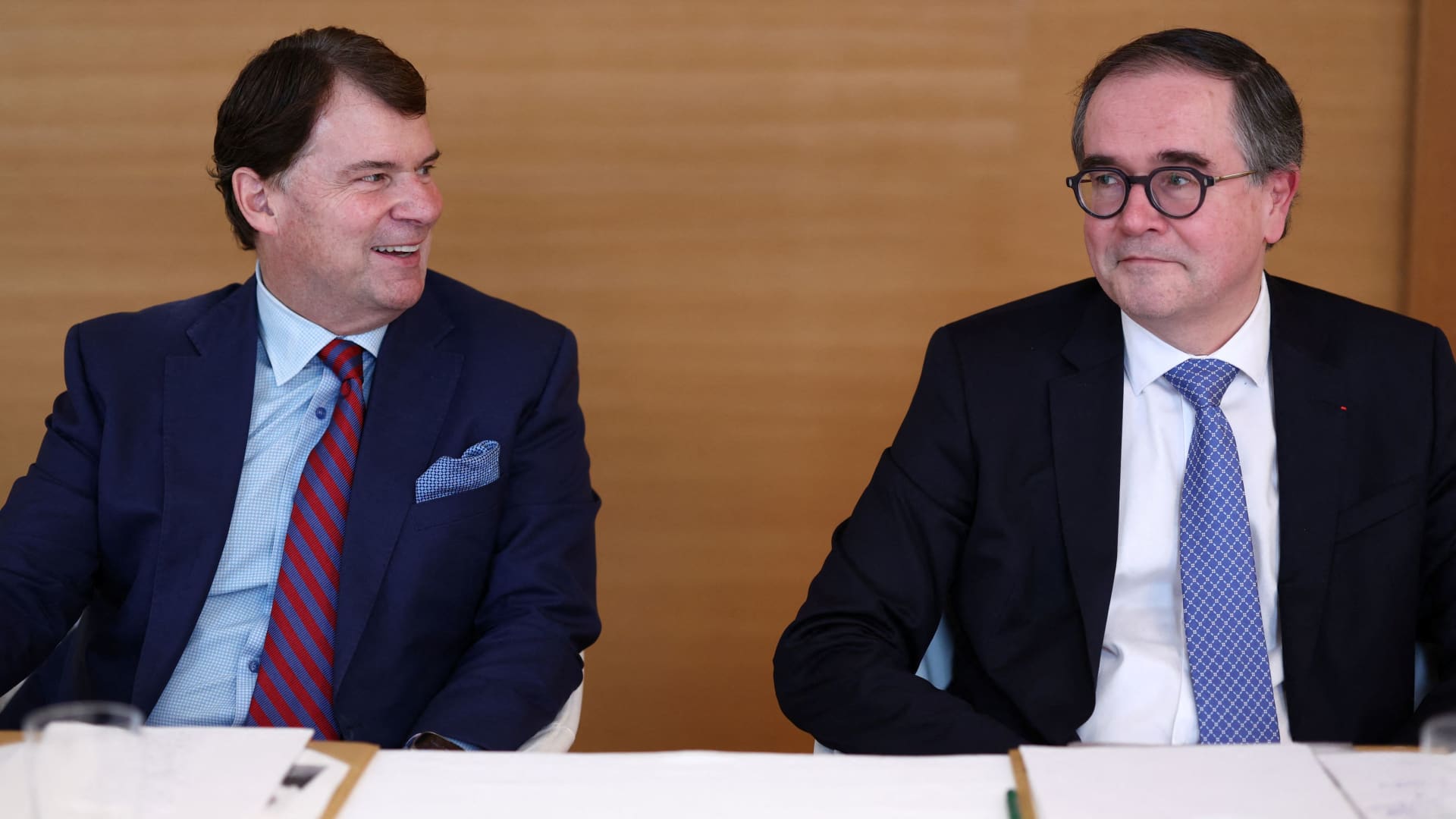
CEO of Ford Jim Farley and CEO of Renault Group Francois Provost react during a press conference as Renault Group and Ford announce the formation of a strategic partnership for passenger and commercial vehicles, in Paris, France, Dec. 8, 2025.
Tom Nicholson | Reuters
Renault will jointly develop small, cheaper electric vehicles for Ford for the European market and will also team up to produce commercial vans to cut costs and fend off rising competition from Chinese rivals, the companies said on Tuesday.
“We know we’re in a fight for our lives in our industry,” Ford CEO Jim Farley told reporters in Paris on Monday ahead of the announcement, when describing Ford’s response to the threat posed by cheaper Chinese competition. “There is no better example than here in Europe.”
Europe’s traditional automakers face an influx of Chinese rivals from BYD to Changan and Xpeng.
Filling a gap in the lineup
As part of the Ford-Renault partnership, the first of two planned small EVs – to be produced at a Renault plant in northern France – will reach European car showrooms in 2028. They will be smaller than any Ford plans for the U.S. market and fill a gap in the automaker’s lineup, Farley said.
The two automakers will also jointly develop Renault and Ford brand vans for Europe.
In a client note, Oddo-BHF analyst Michael Foundoukidis wrote that the deal allowed Renault to offset its fixed costs and generate revenue while offering “a capital-efficient route to market for affordable EVs” for Ford.
“More broadly, this partnership underscores the growing necessity for ‘pragmatic cooperation’,” between traditional automakers to counter lower-cost Chinese competition, he wrote.
A powerhouse for light commercial vehicles
“Together we can create a powerhouse of LCV in Europe that would be very difficult for the Chinese to compete with,” Farley said.
Although there are few Chinese brand vans on sale in Europe, Farley said the two companies “compete with them directly every day” in emerging markets.
“The Chinese will come soon and that’s why I don’t want to wait,” said Renault CEO Francois Provost.
The partnership was formed after a Renault team visited Ford’s Detroit headquarters in March. Both Farley and Provost said the two automakers do not plan to merge.
Ford’s share of the European passenger car market has almost halved in Europe from 6.1% in 2019 to 3.3% in the first 10 months of this year as it has pulled back from passenger vehicle sales. As part of a series of restructurings, the company has cut jobs and this year closed its Saarlouis plant in Germany.
Given the withdrawal of EV support from U.S. President Donald Trump’s administration, the No. 2 U.S. automaker faces the dual expense of investing in combustion-engine models and expensive new EV technology.
Using Renault’s EV platforms with Ford designs should help the U.S. automaker to compete in Europe’s electric car market against traditional automakers such as Volkswagen as well as the Chinese.
Ford already produces two EV models in Europe on a Volkswagen platform and makes vans with the German automaker. Ford CEO Farley said the Renault partnership will complement its existing one with Volkswagen.
The French automaker also develops vans with Nissan and Volvo Group.
Europe’s smallest mainstream automaker
Renault is Europe’s smallest mainstream automaker and does not sell vehicles in China or the United States – the world’s two biggest car markets – so the Ford partnership boosts its manufacturing scale to lower costs.
The French carmaker is actively seeking partnerships to make fuller use of its factories and reduce the burden of developing new EVs.
In 2026, Renault will produce two vehicles using platforms from China’s Geely in Brazil and is in talks with more automakers, including China’s Chery, to jointly produce and sell cars.
“Our ambition … is to show that in Europe we can produce EV cars in Europe as competitively as anyone, including the Chinese,” Renault’s Provost said.
Silver prices rose to a record high Tuesday, surpassing the $60 milestone for the first time as the precious metal has outpaced gold this year amid a global supply squeeze and another expected interest rate cut by the Federal Reserve.
The price for the precious metal has doubled this year amid a global inventory squeeze.
dpa/picture alliance via Getty Images
Key Facts
Spot silver rose about 4% over the last day to around $60.82 per troy ounce on New York’s Commodity Exchange as of Tuesday afternoon, while silver futures jumped more than 4% to nearly $61, after earlier hitting an intraday high of $61.06.
The latest surge in silver prices comes as traders are pricing in 87% odds of the Federal Reserve lowering interest rates by a quarter-point Wednesday, according to CME’s FedWatch tool, which would cut rates to between 3.5% and 3.75%—an uptick in precious metal prices often coincides with reduced interest rates and a weaker U.S. dollar.
The U.S. dollar index has dropped 8.5% this year, including a 0.5% decline over the last month.
Silver was added to the U.S. Geological Survey’s list of critical minerals in November, indicating the metal is “vital” to the U.S. economy and faces potential risks from disrupted supply chains, reportedly signaling to investors that silver may face tariffs in the U.S. amid dwindling global inventories.
Supply in silver’s global trading hub, London, disappeared earlier this year: Anant Jatia, Greenland Investment Management’s chief investment officer, told Bloomberg there was “no liquidity available” in October, adding, “What we are seeing in silver is entirely unprecedented.”
Big Number
Nearly 109%. That’s how much spot silver has increased this year, outpacing gold, which has surged 60% while setting several milestones. Spot gold has increased just 0.4% over the last day to around $4,226, after hitting an all-time high above $4,381 in October. Spot platinum has also outpaced gold, rallying 86% as demand for electric vehicles has lifted platinum’s value in recent years, while global supply declines.
Pew Research Center conducted this study to better understand teens’ use of social media, the internet and artificial intelligence (AI) chatbots.
The Center conducted an online survey of 1,458 U.S. teens from Sept. 25 to Oct. 9, 2025, through Ipsos. Ipsos recruited the teens via their parents, who were part of its KnowledgePanel. The KnowledgePanel is a probability-based web panel recruited primarily through national, random sampling of residential addresses. The survey was weighted to be representative of U.S. teens ages 13 to 17 who live with their parents by age, gender, race and ethnicity, household income, and other categories.
Here are the questions used for this report, along with responses, and the survey methodology.
This research was reviewed and approved by an external institutional review board (IRB), Advarra, an independent committee of experts specializing in helping to protect the rights of research participants.
Even as teens express mixed feelings about social media’s impact, these sites remain a key part of their lives, with some using them “almost constantly.”
Now, AI chatbots, like ChatGPT and Character.ai, are getting teens’ attention. Roughly two-thirds report using chatbots, including about three-in-ten who do so daily, according to a new Pew Research Center survey of 1,458 U.S. teens ages 13 to 17.
Which online platforms teens use
Young people turn to a variety of platforms, but YouTube stands out for being used by nearly all teens. Roughly nine-in-ten report ever using it.
Teens widely use three other platforms:
About six-in-ten or more say they use TikTok and Instagram.
A somewhat smaller share say they go on Snapchat (55%).
Fewer use Facebook (31%) and WhatsApp (24%). And no more than about one-in-five say the same of Reddit or X (formerly Twitter).
Changes over time
Today’s online landscape for teens is marked by both stability and new trends.
WhatsApp is one platform that stands out for its growth in recent years. Today, roughly a quarter of teens say they use WhatsApp, up from 17% in 2022.
X and Facebook have declined in use over the past decade. Today, 16% of teens use X, down from 23% in 2022 and 33% in 2014-15. And Facebook, once the go-to platform for teens, is used today by about three-in-ten teens. This is far lower than the 71% in 2014-15, though on par with 2022.
The shares of teens who use other sites or apps, like YouTube, TikTok and Instagram, have stayed relatively stable in recent years.
Jump to read about teens’ online experiences: Online platform use by demographic groups | Frequency of online platform use | Use of AI chatbots | Frequency of chatbot use | Internet use
Online platform use by demographic groups
Teen use of specific online platforms varies across demographic groups – including when it comes to gender, race and ethnicity, age and household income.
By gender
Teen girls are more likely to use Snapchat and Instagram. For example, 61% of girls say they use Snapchat, compared with 49% of boys.
Meanwhile, boys are more likely to use Reddit (21% vs. 12%) and YouTube (94% vs. 89%).
By race and ethnicity
There are differences in use by race and ethnicity across all the platforms asked about except Reddit. Black teens are more likely than their White or Hispanic peers to use Instagram, TikTok, X, Snapchat and YouTube. For example, 82% of Black teens say they use Instagram. This drops to 69% among Hispanic teens and is even lower for White teens (55%). And Black teens are more likely than Hispanic teens to use Facebook.
WhatsApp is used by a larger share of Hispanic and Black teens than White teens.
By age
Older teens stand out from younger teens in using nearly every platform we ask about. For instance, three-quarters of 15- to 17-year-olds say they use Instagram, compared with 44% of 13- to 14-year-olds.
YouTube is the only site measured that older and younger teens are equally likely to use.
By household income
Teens in households with lower and middle incomes are more commonly using TikTok and Facebook, a largely similar pattern to previous years.
For instance, 46% of teens living in households earning less than $30,000 a year say they use Facebook. Similarly, 39% of those in households with incomes between $30,000 and $74,999 say the same. However, this drops to 27% among teens in households earning $75,000 or more.
By party
In a pattern seen in previous Center surveys, a larger share of teens who identify as Democrats than Republicans say they use TikTok, Instagram, Reddit and YouTube.
For example, there is a large partisan gap for TikTok: 75% of Democratic and Democratic-leaning teens say they use TikTok, compared with 60% of Republicans and Republican leaners.
Frequency of online platform use
YouTube is not only widely used, but it’s also the platform the most teens visit on a daily basis. Roughly three-quarters of teens say they use it every day.
Somewhat smaller shares report going on two other platforms daily: TikTok (61%) and Instagram (55%).
Just under half say they visit Snapchat every day (46%), while far fewer say the same of Facebook (20%).
Overall, teen daily use of these platforms remains relatively stable from past years.
Social media is not only a daily feature in the lives of teens, some report using these platforms “almost constantly.” About one-in-five teens say this of TikTok and YouTube.
Fewer describe their use of Instagram and Snapchat as almost constant (12% for each). And just 3% say this of Facebook.
Across these five platforms, 36% of teens use at least one of these sites almost constantly.
Changes over time
The share of teens who say they are on TikTok almost constantly ticked up slightly to 21% this year, from 16% in 2022. The shares who report using YouTube, Instagram, Snapchat and Facebook almost constantly have changed little since 2022.
By gender
There are some gender differences in frequency of using these sites or apps.
Slightly larger shares of teen girls than boys report being on TikTok and Instagram almost constantly. Teen boys are more likely than girls to visit YouTube this often (20% vs. 13%).
Similar rates of girls and boys say they use Snapchat and Facebook almost constantly.
By race and ethnicity
Black and Hispanic teens are particularly likely to report being on TikTok, YouTube and Instagram almost constantly.
For example, 35% of Black teens say they’re on YouTube almost constantly, compared with 23% among Hispanic teens. Both groups are much more likely than White teens (8%) to say this.
There are only small or no racial or ethnic differences in visiting Snapchat or Facebook almost constantly.
Use of AI chatbots
AI chatbots have become more common in daily life, from education to entertainment. For the first time, we asked teens about their overall use of chatbots, how often they use them and which ones they turn to.
A majority of teens say they use chatbots. Roughly two-thirds of teens (64%) say they ever use an AI chatbot. Fewer (36%) do not use this tool.
While many teens use chatbots, there are some differences across demographic groups:
Race and ethnicity: Roughly seven-in-ten Black and Hispanic teens say they use chatbots, higher than among White teens (58%).
Age: 68% of teens ages 15 to 17 use chatbots, compared with 57% among teens 13 to 14 years old.
Household income: Teens living in households earning $75,000 or more are more likely than those in households with incomes of less than $30,000 to use chatbots (66% vs. 56%). Those living in households earning $30,000 to $74,999 do not differ from either group.
Frequency of chatbot use
About three-in-ten teens say they use AI chatbots every day, including 16% who do so several times a day or almost constantly.
Daily use of chatbots differs somewhat by race and ethnicity as well as age:
Race and ethnicity: About a third of Black (35%) and Hispanic teens (33%) report using AI chatbots daily. A smaller share of White teens (22%) say the same.
Age: 31% of teens ages 15 to 17 say they use chatbots on a daily basis, compared with about a quarter of those ages 13 to 14 (24%).
Which chatbots do teens use?
In addition to understanding their overall use, we also asked teens about their use of six specific chatbots.
ChatGPT (59%) is by far the most widely used chatbot and the only one we measured that a majority of teens use.
This is more than twice the rate of the next most commonly used chatbots: Gemini (23%) and Meta AI (20%).
Fewer say they use Copilot,Character.ai and Claude.
By race and ethnicity
Black and Hispanic teens are more likely than their White peers to say they use Gemini and Meta AI.
Black and White teens differ modestly in their use of ChatGPT and Character.ai.
There are no significant differences in use for Copilot or Claude.
By age
Teens ages 15 to 17 are more likely than those 13 to 15 to report using ChatGPT and Meta AI.
By household income
ChatGPT use is more common among teens in higher-income households. About six-in-ten teens living in households earning $75,000 or more (62%) say they use it. That compares with 52% of teens living in households earning less than $75,000.
Meanwhile, lower- and middle-income teens are more likely to use Character.ai. Some 14% of teens in households with incomes of less than $75,000 report using it. This is double the rate among teens in households with incomes of $75,000 or more (7%).
Go to the appendix for a full breakdown of AI chatbot use by demographic groups.
Teens’ internet use
The survey also explores how often teens use the internet.
Nearly all U.S. teens (97%) say they use the internet daily, including four-in-ten who say they are almost constantly online.
The share of teens who say they’re online almost constantly is much higher today than a decade ago, though it’s a slight dip from last year.
By race and ethnicity
Black (55%) and Hispanic teens (52%) are about twice as likely as White teens (27%) to say they’re online almost constantly.
By age
Being online almost constantly is more common for older teens. While 43% of 15- to 17-year-olds report being online almost constantly, 34% of 13- and 14-year-olds report this.
By household income
Teens living in households that earn less than $75,000 annually are more likely than those in households earning $75,000 or more to say they use the internet almost constantly.
There are no significant differences in internet use by gender.
Every weekday, the CNBC Investing Club with Jim Cramer releases the Homestretch — an actionable afternoon update, just in time for the last hour of trading on Wall Street. Market moves : Stocks were chopping around for a second straight session as Wall Street braces for the Federal Reserve’s interest rate decision on Wednesday afternoon. It’s widely expected that the central bank, in a split vote, will cut interest rates by 25 basis points. It would be the third Fed rate cut this year and the sixth since central bankers started easing monetary policy back in September 2024. Financials : The bank trade has been one of the strongest in the market since New York Fed President John Williams said on Nov. 21 that a rate cut at the December meeting was possible. The Invesco KBW Bank ETF has gained about 10% since then, which is roughly double the return of the S & P 500 . The exchange-traded fund hit a new high early Tuesday. The banks lost some steam, however, after JPMorgan ‘s CEO of consumer and community banking, Marianne Lake, called the consumer environment “a little bit more fragile.” She was speaking at the Goldman Sachs Financial Services Conference. Lake did, however, guide fourth-quarter investment banking fees up low single-digits year over year and markets revenue up in the low-teens year over year. She also expects expenses next year to total $105 billion, which is slightly higher than the FactSet consensus estimate of about $101.4 billion. Lake’s comments sent JPMorgan shares lower by about 4% in the afternoon. JPMorgan CEO Jamie Dimon is usually pretty conservative in his discussion about the economy, so it’s not surprising to see one of his top lieutenants offer a similar take. It’s important to note that not every bank executive is gloomy. Wells Fargo CEO Charlie Scharf, for example, described a resilient consumer at the same conference earlier as did Capital One CEO Rich Fairbank, calling the consumer “a source of strength in the economy.” Life sciences: Goldman Sachs initiated coverage of the life-sciences tools group, and Club holding Danaher was one of three stocks that analysts started with a buy rating. Goldman is much more bullish on Danaher’s biotechnology business next year than the Street is giving it credit for. The firm estimates organic revenue growth of 9.2% in 2026 compared to the consensus expectation of about 6.1% growth. Driving this out-of-consensus-outlook are signs that the pharmaceutical industry will start placing more bioprocessing equipment orders. Danaher shares have dropped about 2% in 2025, trailing the broader health-care sector’s gain of about 9%. But Goldman is not the only analyst predicting a better year for Danaher. Morgan Stanley started Danaher with a buy-equivalent rating and named it a top pick earlier this month. Up next: AeroVironment and Cracker Barrel report earnings after the closing bell. Club holding GE Vernova is hosting an investor day later Tuesday. Chewy reports before Wednesday’s opening bell. (See here for a full list of the stocks in Jim Cramer’s Charitable Trust.) As a subscriber to the CNBC Investing Club with Jim Cramer, you will receive a trade alert before Jim makes a trade. Jim waits 45 minutes after sending a trade alert before buying or selling a stock in his charitable trust’s portfolio. If Jim has talked about a stock on CNBC TV, he waits 72 hours after issuing the trade alert before executing the trade. THE ABOVE INVESTING CLUB INFORMATION IS SUBJECT TO OUR TERMS AND CONDITIONS AND PRIVACY POLICY , TOGETHER WITH OUR DISCLAIMER . NO FIDUCIARY OBLIGATION OR DUTY EXISTS, OR IS CREATED, BY VIRTUE OF YOUR RECEIPT OF ANY INFORMATION PROVIDED IN CONNECTION WITH THE INVESTING CLUB. NO SPECIFIC OUTCOME OR PROFIT IS GUARANTEED.

 ™ are trademarks of Anglo American Services (UK) Ltd.