Category: 3. Business

  • Online shopping from 22% to 91% across EU regions – News articles

    Online shopping from 22% to 91% across EU regions – News articles

    In 2024, there were 23 EU regions at level 2 of the nomenclature of territorial units for statistics (NUTS 2) where at least 80% of the population aged 16 to 74 years ordered goods or services over the internet in the 3 months preceding the survey.

    Approximately half of these 23 regions were in the Netherlands (all 12 regions). The remainder was in Denmark (4 regions), Ireland (all 3 regions), Sweden (3 regions) and the Czech capital region of Praha.

    The central Dutch region of Utrecht had the highest share of people ordering goods or services over the internet (91.5%). Its neighbouring region of Flevoland (89.5%) had the next highest share, followed by the Irish region of Northern and Western (88.3%).

    Source datasets: isoc_r_blt12_i and isoc_ec_ib20

    In 21 EU regions, less than 40% of the population ordered goods or services over the internet. Most of these regions are located in eastern and southern EU, including Romania (6 regions), Bulgaria (5) and southern Italy (6). This category also included 3 outermost regions of France and 1 autonomous region of Portugal.

    The south-eastern Bulgarian region of Yugoiztochen had the lowest share of people ordering goods and services over the internet (21.7%). There were 2 other regions in the EU with shares below 25%: the Caribbean region of Guadeloupe (24.2%) and the north-western Bulgarian region of Severozapaden (24.9%).

    Would you like to learn more about the digital society at the regional level? 

    You can read more about the digital society in the Eurostat regional yearbook – 2025 edition, also available as a set of Statistics Explained articles, as well as in the digital society section of the interactive publication Regions in Europe and the Statistical Atlas.

    Continue Reading

  • US regulators ‘taking seriously’ allegations of bankers’ support for Epstein | Banking

    US regulators ‘taking seriously’ allegations of bankers’ support for Epstein | Banking

    US regulators say they are taking allegations that top banks may have facilitated Jeffrey Epstein’s criminal activity “very seriously”, as they faced calls to investigate executives including the former Barclays boss Jes Staley.

    In correspondence seen by the Guardian, bosses from the Office of the Comptroller of the Currency (OCC) and the Federal Deposit Insurance Corporation (FDIC) said they had reviewed a letter from the Democratic senator Elizabeth Warren, which raised concerns over bankers’ alleged support for the convicted child sex offender Epstein.

    That includes Staley, who Warren said had allegedly protected Epstein’s access to the banking system while working at JP Morgan in the early 2000s. Staley has already been banned from the UK banking sector for playing down his relationship with Epstein.

    While the regulators would not publicly confirm whether they were opening formal inquiries, their directors assured Warren they would take action over any potential misconduct.

    “While it would be inappropriate to comment on any specific ongoing supervisory matter, I take very seriously any allegations of wrongdoing or abuse by banks and bank executives,” the comptroller of the currency, Jonathan Gould, said in a letter to Warren, who is the lead Democrat on the US Senate committee on banking, housing and urban affairs.

    “We appreciate the seriousness of this matter and will continue to examine banks, including JP Morgan Chase Bank, NA, within the scope of our authority, including to ensure banks address safety and soundness concerns and violations of law under our jurisdiction,” Gould added.

    Warren’s original letter raised questions over JP Morgan’s wider banking relationship with the sex offender, noting that Epstein was one of the bank’s most profitable clients before being dropped in 2013, five years after he was jailed for soliciting prostitution from a minor. The well-connected financier died in prison in July 2019, while awaiting trial over child sex trafficking charges.

    The FDIC’s acting chair, Travis Hill, said the regulator took “unlawful activity involving the banking sector, including possible insider involvement in illicit activity, very seriously”.

    His letter, dated 17 November, said “if this type of activity is identified” the watchdog would follow standard protocol: collecting and reviewing potential evidence, before escalating the matter to the FDIC’s inspector general’s office, which has law enforcement powers.

    Wrongdoing could result in a fine and a potential ban from working in the US banking sector.

    The FDIC and OCC declined to comment. The Guardian contacted Staley’s legal representative for comment.

    Warren said in a statement: “Regulators need to investigate and hold accountable Epstein’s enablers – and I’ll believe they’re taking action when I see it. Americans deserve to know that their banking system isn’t facilitating the disturbing crimes of the rich and powerful.”

    A spokesperson for JP Morgan did not directly comment on Warren’s correspondence with regulators but in relation to Epstein said: “We regret any association we had with the man, but did not help him commit his heinous acts. We ended our relationship with him six years before his arrest on sex trafficking charges. The federal government had damning information about his crimes that they failed to share with us or other banks.”

    Last week Warren used an appearance on The Late Show with Stephen Colbert to urge the JP Morgan chief executive, Jamie Dimon, to testify in front of the US Senate banking committee.

    skip past newsletter promotion

    “They opened about 134 different accounts for Jeffrey Epstein over these years. They did more than a billion dollars in transactions for Jeffrey Epstein … He literally could walk into the bank and get $50m from JP Morgan Chase.

    “So, what I’d like to do, over on the banking committee, is I’d like to have Mr Dimon and some of those other bankers come in and, under oath, testify about exactly what the financial trail is that kept Jeffrey Epstein afloat for so long.”

    JP Morgan said in a statement: “Jamie never met with Epstein, spoke with him, emailed with him, and was not involved in any decisions about his account, to which he testified under oath. There are over a million pages of emails and other documents produced in this case, and not one comes even close to suggesting otherwise.”

    The bank’s spokesperson added: “We will follow the law, including responding to a subpoena. Our involvement with Epstein is largely a matter of public record, with millions of pages of discovery from litigation already publicly available.”

    The correspondence between Warren and US financial regulators comes days after Donald Trump was pressed into signing a bill that will lead to the US justice department releasing all of its unclassified records, documents, and communications related to Epstein and the co-conspirator Ghislaine Maxwell.

    It follows initial backtracking by the US president, who had come under fire for his own ties to the sex offender, having been friends with Epstein before the pair fell out in 2004, before Epstein’s conviction. The documents are expected to be released within 30 days, on or about 19 December.

    Continue Reading

  • SFO Guidance on Evaluating a Corporate Compliance Programme : Clyde & Co

    SFO Guidance on Evaluating a Corporate Compliance Programme : Clyde & Co

    Fifteen years on from the UK Bribery Act 2010, the United Kingdom’s corporate crime framework has matured into a cohesive ‘failure to prevent’ regime. That journey continued with the Economic Crime and Corporate Transparency Act 2023 (ECCTA), which introduced the new offence of failure to prevent fraud for large organisations.

    Against this backdrop, the Serious Fraud Office (SFO) has refreshed its Guidance on Evaluating a Corporate Compliance Programme (published on 26 November 2025). The updated Guidance clarifies when, why and how the SFO will examine an organisation’s compliance arrangements across investigations, prosecution decisions, Deferred Prosecution Agreements (DPAs), potential defences to bribery and fraud charges, and sentencing. 

    This article explains what the Guidance means in practice, integrates legal analysis on how compliance evidence influences outcomes, and sets out pragmatic steps to strengthen programmes in line with regulatory expectations. It also assesses whether the UK is moving toward the US Department of Justice’s (DOJ) structured approach to evaluating effective compliance programmes, and whether similar clarity would be useful for the Bribery Act 2010.

    Scope and themes of the refreshed Guidance

    The SFO sets out six scenarios in which a corporate compliance programme will be evaluated. This will be to inform: 

    (i) decisions to prosecute under the Full Code Test; 

    (ii) whether to invite a company into DPA negotiations and, if so, on what terms;

    (iii) whether to include compliance undertakings and/or a monitorship within any DPA; 

    (iv) whether a company can rely on the Bribery Act 2010 section 7 defence of ‘adequate procedures’; 

    (v) whether a company can rely on ECCTA’s ‘reasonable procedures’ defence to failure to prevent fraud; and 

    (vi) the relevance of programme design and operation at sentencing. 

    Evaluation is holistic and fact‑specific. The existence of policies is not determinative: prosecutors will assess whether controls operate effectively in practice and whether leadership has fostered behaviour that prevents fraud and bribery. 

    Effectiveness is judged at two points in time: the state of the programme when misconduct occurred and the state of the programme at the point of charge or resolution, including any remediation undertaken.  

    Practical pointers and SFO approach

    The updated document includes a helpful question‑and‑answer section and is at its best when explaining how the SFO will approach evaluation. In particular, it recognises that isolated compliance failures do not inevitably render a programme ineffective, and reiterates that the SFO will take a holistic view when forming its conclusions. The Guidance also summarises the role of DPAs and monitors, and sets out how the agency will consider remedial commitments, oversight, and proportionate monitoring where appropriate.

    Legal analysis: how the Guidance affects key outcomes

    Prosecution decisions: A programme that was ineffective at the time of offending will weigh in favour of prosecution; conversely, genuine remediation and a proactive, effective programme can weigh against prosecution. 

    DPA eligibility and terms: Programme effectiveness is a key factor in whether the SFO will invite a company to negotiate a DPA. Where appropriate, undertakings may include enhancements to policies, controls, training, reporting and independent monitoring. 

    Statutory defences: For bribery, the statutory defence turns on ‘adequate procedures’; for fraud under ECCTA, the defence turns on ‘reasonable procedures’. Both standards are principle‑based and proportionate to risk. In narrow circumstances, limited procedures may be defensible, but organisations should assume that a documented risk assessment and proportionate controls are the practical baseline. 

    Sentencing: Courts can consider the existence and nature of a compliance programme in mitigation, particularly where the company evidences culture, governance and operations designed to prevent misconduct and shows measurable improvements following discovery.

    Is the SFO moving toward the DOJ’s approach?

    The DOJ’s Evaluation of Corporate Compliance Programs (ECCP) is widely regarded as a clear, operational framework. It organises prosecutorial inquiry around three fundamental questions—design, empowerment and resourcing, and whether the programme works in practice—and encourages assessment in terms of a programme’s ‘technostructure’ (governance, policies, data access, tools) and its outputs (deterrence, detection, remediation). By contrast, the SFO’s compliance evaluation Guidance, consistent with the UK’s principle‑based tradition, is less prescriptive and emphasises holistic, context‑specific analysis. 

    There are signs of convergence—particularly the SFO’s emphasis on effectiveness in practice, dual timeframe assessment (at offence and at resolution), and the growing importance of technology, data and whistleblowing—but the SFO has not yet adopted a question‑led evaluative framework akin to the DOJ’s ECCP. Many corporates would benefit from an articulation that mirrors the DOJ’s clarity, not least because it facilitates planning, benchmarking and internal audit of compliance capability. It would potentially be useful if the Ministry of Justice or the SFO replicated that approach for the Bribery Act 2010, translating the six prevention principles into operational questions and output measures provided that this did not place too higher additional burden on business.

    Statutory guidance and the case for updates

    For multi‑nationals, interpreting what will constitute ‘adequate’ or ‘reasonable’ procedures remains challenging. The refreshed SFO document summarises the six principles at a high level, but detailed statutory guidance sits elsewhere: the Ministry of Justice’s Bribery Act Guidance on section 7, and the Home Office’s Failure to Prevent Fraud Guidance. The absence of an update to the Bribery Act Guidance comparable to the breadth of the Failure to Prevent Fraud Guidance raises a practical question: when will the 2011 Bribery Act Guidance be modernised to reflect current market practice, evolving US expectations, and technology? The intervening years have transformed both compliance tooling and risk landscapes; UK business would benefit from aligned, contemporary guidance across both regimes.

    Practical steps to align with SFO expectations

    • Refresh the risk assessment with a ‘benefit of fraud’ lens: identify where the organisation could benefit from fraud (e.g., sales practices, channel incentives, revenue timing, disclosures, ESG claims) and extend the assessment to associated persons (agents, distributors, outsourcers, resellers) and group entities. 
    • Map policies to controls and evidence operation: create a risk–control matrix, assign owners, define metrics, and test operation through sampling, walk‑throughs and data analytics. Maintain an audit trail of findings and remediation. 
    • Strengthen third‑party governance: update onboarding, contractual clauses and ongoing monitoring to address fraud‑prevention obligations; enforce audit rights, reporting triggers and termination provisions. 
    • Align incentives and culture: review Key Performance Indicators (KPIs) and reward structures to reduce pressure points; deliver role‑specific training; track speak‑up data, investigations and outcomes as indicators of behavioural effectiveness. 
    • Leverage technology: deploy monitoring tools and analytics to surface anomalies and automate evidence of control execution, policy delivery and training completion.

    Clyde & Co perspective

    Clyde & Co’s previous commentary on UK corporate crime enforcement and our Corporate Risk Radar series underline that regulatory complexity is now a board‑level strategic variable. Organisations that treat compliance as a resilience capability—risk‑driven, evidence‑based and tech‑enabled—are better positioned to reduce enforcement exposure, secure pragmatic outcomes and sustain growth. The SFO’s refreshed Guidance reinforces that the decisive question is not whether policies exist, but whether they work in practice and are continuously improved.

    Purpose and context of the update

    The SFO states that the refreshed Guidance aims to provide clarity and transparency on how compliance programmes are assessed. It is intended to help organisations understand the factors prosecutors consider when evaluating effectiveness, particularly in light of the new failure to prevent fraud offence under ECCTA. The Guidance also includes practical resources and hyperlinks to related materials on DPAs and monitors, reinforcing its role as a reference point for corporates navigating enforcement risk.

    Holistic evaluation and practical implications

    The SFO emphasises that isolated compliance failures do not automatically render a programme ineffective. Instead, evaluation will be holistic, considering governance, culture, and operational evidence. This approach reflects a shift from box-ticking to outcome-based assessment, requiring companies to demonstrate that controls work in practice and are proportionate to risk. For multi-nationals, this means aligning global compliance frameworks with UK expectations while maintaining agility to respond to evolving enforcement priorities.

    Convergence with international standards

    While the UK remains principle-based, there are signs of convergence with the DOJ’s structured approach. The DOJ’s Guidance frames evaluation around design, empowerment, and effectiveness, supported by measurable outputs. The SFO’s focus on effectiveness and remediation echoes these themes, but lacks the prescriptive clarity of the DOJ model. Many corporates could benefit from a UK equivalent that translates prevention principles into operational questions and performance indicators, enabling benchmarking and internal audit readiness. However, a half way house might be updated HMG guidance with more details FAQs, scenarios and details in relation to the expected use of technology and KPIs.

    Technology and data-driven compliance

    The Guidance implicitly recognises the growing role of technology and analytics in compliance. Organisations should leverage monitoring tools, data insights, and automation to evidence control execution and detect anomalies. This trend aligns with global best practice and supports the SFO’s expectation that programmes are not static but continuously improved based on risk and performance data.

    Conclusion

    The SFO’s refreshed Guidance marks a material moment in UK enforcement. Organisations should prioritise evidencing operational effectiveness, embedding proportionate procedures under both the Bribery Act 2010 and ECCTA, and maintaining credible cooperation frameworks. Beyond compliance, this is about resilience: leveraging technology, data, and governance to anticipate regulatory expectations. While the UK remains principle-based, convergence with global standards in this area over time is clear. The future may include a more granular level of UK requirements but until then, corporates must translate high-level principles into measurable outputs and continuous improvement to stay ahead of enforcement risk.


    Link to the hub: Regulatory & Investigations : Clyde & Co

    Continue Reading

  • Swiss economy contracts slightly in Q3 due to lower pharma exports – Reuters

    1. Swiss economy contracts slightly in Q3 due to lower pharma exports  Reuters
    2. Swiss economy shrinks significantly in the third quarter  bluewin E-Mail
    3. Switzerland’s Quarterly GDP Down 0.5% in Q3, Final Data Shows  MarketScreener
    4. Swiss GDP contracts -0.5% in Q3, pharma and chemicals lead decline  Action Forex

    Continue Reading

  • Air Canada Valuation in Focus After New International Route Expansion and Recent Price Volatility

    Air Canada Valuation in Focus After New International Route Expansion and Recent Price Volatility

    • Thinking of investing in Air Canada but not sure if the current price reflects its true value? You are not alone. This is a hot topic among investors looking for opportunities.

    • The stock has shown notable volatility, gaining 6.1% over the last week and 5.2% in the last 30 days. However, it is still down 14.7% year-to-date and 23.2% over the past year.

    • Recent discussions around travel demand recovery and evolving industry regulations have added new layers to the Air Canada story. News of expanding international routes and a renewed focus on operational efficiency are fueling debates about the company’s future prospects.

    • Air Canada currently scores 6 out of 6 on our valuation checks, which is a perfect mark. Let us dive into how that score was determined and why a more nuanced perspective on valuation might matter even more by the end of this article.

    Find out why Air Canada’s -23.2% return over the last year is lagging behind its peers.

    The Discounted Cash Flow (DCF) model estimates a company’s intrinsic value by projecting its future cash flows and discounting them back to today’s value. For Air Canada, this approach uses a 2 Stage Free Cash Flow to Equity method based on analysts’ forecasts for the next five years, with later years extrapolated to gauge long-term trends.

    Air Canada’s latest twelve-month Free Cash Flow (FCF) stands at CA$1.71 billion. Analyst estimates indicate this figure could decline in the short run but increase over the next decade. By 2029, projections see annual FCF reaching approximately CA$1.90 billion, with longer-term estimates rising further as industry conditions stabilize and operational efficiencies take effect. All these numbers are presented in Canadian dollars (CA$).

    Using these projections, the DCF model estimates Air Canada’s fair value at CA$85.08 per share. This represents a 77.6% premium over the current market price, suggesting the stock is significantly undervalued according to this approach.

    Result: UNDERVALUED

    Our Discounted Cash Flow (DCF) analysis suggests Air Canada is undervalued by 77.6%. Track this in your watchlist or portfolio, or discover 928 more undervalued stocks based on cash flows.

    AC Discounted Cash Flow as at Nov 2025

    Head to the Valuation section of our Company Report for more details on how we arrive at this Fair Value for Air Canada.

    The price-to-sales (P/S) ratio is a particularly useful valuation measure when analyzing companies that are either coming out of losses or have fluctuating profit margins, as is often the case in the airline industry. Since Air Canada has experienced volatile earnings and recovery is still underway, the P/S ratio provides a straightforward lens to gauge how the market values the company’s revenues, regardless of short-term profitability.

    Growth potential and risk profile are crucial factors in determining what constitutes a “normal” or “fair” P/S ratio. Investors typically assign higher ratios to companies with solid growth prospects and lower perceived risks, while more mature or riskier businesses tend to command lower ratios.

    Air Canada is currently trading at a P/S ratio of 0.26x. For context, the airline industry average P/S sits at 0.61x, while the peer group average is a much higher 26.36x. This highlights the diversity in business models and geographic exposure among airline peers. Simply Wall St’s proprietary Fair Ratio for Air Canada is calculated at 1.07x, which takes a more holistic view of the stock’s growth outlook, profit margins, scale, and the operational risks it faces.

    The Fair Ratio is a more insightful benchmark than just comparing with industry or peer averages, as it tailors the expected valuation multiple to Air Canada’s specific circumstances, including projections for earnings, risk factors, and its competitive position in the sector.

    With the current P/S ratio at 0.26x versus the Fair Ratio of 1.07x, Air Canada appears to be undervalued according to this approach.

    Result: UNDERVALUED

    TSX:AC PS Ratio as at Nov 2025
    TSX:AC PS Ratio as at Nov 2025

    PS ratios tell one story, but what if the real opportunity lies elsewhere? Discover 1439 companies where insiders are betting big on explosive growth.

    Earlier we mentioned that there is an even better way to understand valuation. Let us introduce you to Narratives, an easy yet powerful way to make investment decisions by connecting a company’s story to financial forecasts and, ultimately, to its fair value.

    A Narrative is your personal investment thesis, where you interpret Air Canada’s business outlook, growth opportunities, and risks, and then link those views to specific forecasts for revenue, earnings, margins, and share price. Instead of just looking at historical numbers, Narratives let you craft and track your own scenario, explaining why you think Air Canada deserves a higher or lower value than what the market shows today.

    On Simply Wall St’s Community page, used by millions of investors, you can create and share Narratives to visualize your expectations or see how others are analyzing Air Canada. As new information such as earnings reports or major news comes in, Narratives are updated in real time, helping you keep your investment case current.

    Different investors may see Air Canada’s future very differently. One Narrative predicts strong international route expansion and share buybacks will drive growth and value the stock as high as CA$32.0. Another, more cautious Narrative focuses on rising labor costs and market risks, putting fair value as low as CA$17.4.

    Do you think there’s more to the story for Air Canada? Head over to our Community to see what others are saying!

    TSX:AC Community Fair Values as at Nov 2025
    TSX:AC Community Fair Values as at Nov 2025

    This article by Simply Wall St is general in nature. We provide commentary based on historical data and analyst forecasts only using an unbiased methodology and our articles are not intended to be financial advice. It does not constitute a recommendation to buy or sell any stock, and does not take account of your objectives, or your financial situation. We aim to bring you long-term focused analysis driven by fundamental data. Note that our analysis may not factor in the latest price-sensitive company announcements or qualitative material. Simply Wall St has no position in any stocks mentioned.

    Companies discussed in this article include AC.TO.

    Have feedback on this article? Concerned about the content? Get in touch with us directly. Alternatively, email editorial-team@simplywallst.com

    Continue Reading

  • Business calls for urgent clarity on EU’s Carbon Border Adjustment Mechanism ahead of January implementation – ICC

    In a letter to Commissioner Wopke Hoekstra, ICC stresses that predictable, practical and unambiguous rules are essential to avoid unnecessary trade friction, support investment decisions and preserve the legitimacy of CBAM as a tool to tackle carbon leakage.

    The letter highlights nine areas where urgent guidance is required, including:

    • Standardised methodologies for calculating and verifying embedded emissions
    • Clear rules for default values, benchmarks, and recognition of equivalent carbon pricing regimes
    • Alignment with the EU ETS phase-out of free allowances
    • Use of existing customs processes and trusted trader frameworks
    • A workable approach for the de minimis threshold
    • Proportionate treatment of SMEs and developing economies
    • A transparent appeals mechanism for non-EU businesses

    ICC also calls for the publication of final legislative texts and user-friendly technical guidance well ahead of 2026, alongside strengthened cooperation between the climate and trade communities as CBAM gains prominence in the United Nations Framework Convention on Climate Change (UNFCCC) process.

    ICC and its global network stand ready to support the European Commission in ensuring that the final CBAM rules are effective, workable, and fair, and that businesses are equipped to navigate the transition.


    Continue Reading

  • Police Kodiaq: RS technology and a spy mode

    Police Kodiaq: RS technology and a spy mode

    The development of these purpose-built police specials involved police officers themselves, who worked together with engineers in Mladá Boleslav and drew on extensive experience from the first-generation Kodiaq police fleet. Power now comes from the sporty RS variant and consists of a 2.0 TSI turbocharged petrol engine delivering 195 kW, all-wheel drive, and a DSG automatic transmission. The car is also equipped with specially tuned DCC+ adaptive dampers. 

    The Škoda Kodiaq will serve both patrol and traffic police units. A new feature is the introduction of 18-inch alloy wheels, replacing the original steel rims with plastic covers. These allow for better cooling of the upgraded more robust braking system, which comes from the seven-seat version of the SUV. Another interesting upgrade is the ability to quickly switch the drivetrain and chassis into sport mode, giving the driver immediate access to full vehicle performance. 

    Continue Reading

  • Chart: Solar and wind are meeting — and exceeding —…

    Chart: Solar and wind are meeting — and exceeding —…

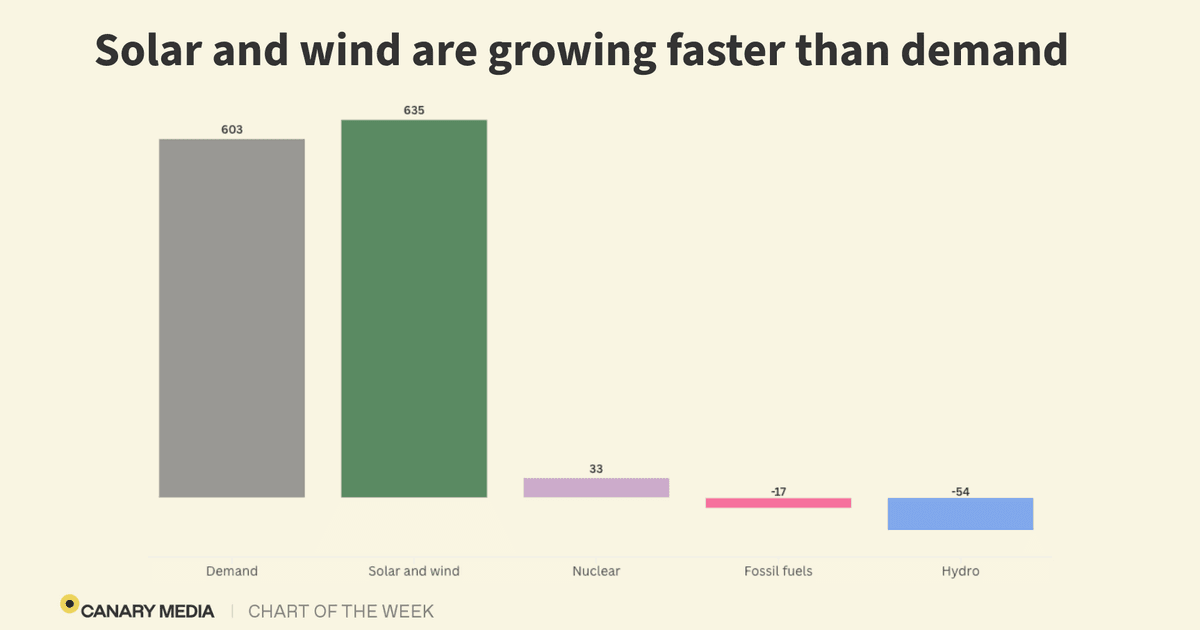
    Between January and September, the two clean-energy sources grew fast enough to more than offset all new demand worldwide, according to data from energy research firm Ember.

    Power demand rose by 603 terawatt-hours compared to that same time period last year. Solar met nearly all that new demand on its own, increasing by 498 TWh. Wind generation, meanwhile, climbed by 137 TWh.

    What happens when clean energy not only meets but exceeds new power demand? We start to burn less fossil fuels. At least a little less: Through Q3, fossil-fuel generation dropped by 17 TWh, compared to the first three quarters of 2024. This trend is expected to continue through the end of the year. Ember forecasts that fossil-fuel generation will have experienced no notable growth in 2025 — something that hasn’t happened since the height of the Covid-19 pandemic.

    It’s unclear whether this flatlining marks the beginning of the end for fossil-fueled electricity or whether it’s just a pause before another surge in dirty power. The answer will more or less be determined by what grows faster: electricity demand or renewable energy.

    Common consensus is that the world’s appetite for electricity will expand rapidly in the coming years. The planet is warming and driving increased use of air conditioning. AI developers are building massive power-hungry data centers. Cars, homes, and factories are being electrified. That all adds up: The International Energy Agency expects power demand to rise by a staggering 40% over the next decade.

    Meanwhile, it’s almost not worth considering long-term forecasts about the growth of clean energy, given how inaccurate they’ve been in the past. Analysts have consistently underestimated solar, in particular.

    For the global power sector to truly decarbonize, carbon-free energy needs to not only keep pace with electricity demand but far outrun it. Let’s hope solar continues to overperform. 

    Continue Reading

  • MHI Publishes “MHI REPORT 2025” and “SUSTAINABILITY DATABOOK 2025”

    MHI Publishes “MHI REPORT 2025” and “SUSTAINABILITY DATABOOK 2025”

    SUSTAINABILITY DATABOOK 2025

    Tokyo, November 28, 2025 – Mitsubishi Heavy Industries, Ltd. (MHI) published its integrated report, “MHI REPORT 2025”, which provides a balance of financial and non-financial information of MHI Group and its “SUSTAINABILITY DATABOOK 2025” (the Databook), an annual report summarizing non-financial information of the Group.

    “MHI REPORT 2025” provides explanations centering on our new corporate strategy, Innovative Total Optimization (ITO) established by CEO Eisaku Ito, who took the office in April. In a message from the President and CEO at the beginning, CEO Ito outlines his management approach to achieve Group-Wide Optimization and Reach Expansion to unlock growth potential and establish a virtuous cycle of high profitability and growth investments by creating new value. Next, in a message from the CFO, CFO Hiroshi Nishio shares his perspective on the financial strategy that supports medium- to long-term growth to meet the capital market’s expectations of the Group, from perspectives such as financial discipline, resource allocation, and portfolio management.

    Two feature articles are included. The topic of the first feature is at the forefront of our future growth areas. A message from CSO Masayuki Suematsu explains our growth strategy, centering on the initiatives for growth areas established in the 2024 Medium-Term Business Plan. In a roundtable discussion on the data center business, the feature discusses the future outlook of the market, the Group’s strengths, and its eagerness to expand this business. The topic of the second feature is the technology platform supporting MHI Group. In a message from the CTO, CTO Tomoaki Omura shares his own mission to transform our technology platform and lay the groundwork for businesses that can underpin growth in the future, in addition to contributing to the ongoing business operations of the Group. The feature introduces the Shared Technology Framework, which is designed to serve as a Group-wide hub for technology.

    The latter half of the report contains an article covering a roundtable discussion on the Company’s governance system. Three outside directors exchange opinions reflecting on the ten years since the Company transitioned to an Audit and Supervisory Committee structure in 2015. The functions of the Nomination and Remuneration Committee and principles on CEO succession are also covered.

    The Databook provides the public with information on the progress being achieved by MHI Group in its sustainability management strategy, with content divided into sustainability management, the environment, society, and governance, along with detailed performance data.

    The 2025 edition of the Databook includes expanded coverage of the Company’s initiatives related to the circular economy.(Note1) Also included are information on the certification of “Wadaoki Forest,” a forested area cultivated within Mihara Machinery Works in Hiroshima Prefecture as a “Nationally Certified Sustainably Managed Natural Site” by the Ministry of the Environment, and the “Strategy Map for Well-being and Health Management” developed to promote employee health and well-being.(Note2)

    MHI Group aims to contribute to the resolution of the issues facing the world with our diverse technologies, thereby providing value to customers and society while also enhancing our corporate value. Going forward, we will continue to clearly communicate this mission to a broad range of stakeholders.

    • 1 A circular economy is an economic system that aims to efficiently circulate resources to promote a sustainable society along with economic growth.
    • 2Well-being is a concept signifying a state in which individual rights and self-fulfillment are guaranteed, and physical, mental, and social conditions are good.

    Continue Reading

  • European shares set for monthly gains, helped by Fed rate cut bets – Reuters

    1. European shares set for monthly gains, helped by Fed rate cut bets  Reuters
    2. STOXX 600 ends steady after multiple-session rally  Business Recorder
    3. EMEA Morning Briefing: Fed’s Rate Trajectory in Focus  富途牛牛
    4. Europe opens mostly flat with data in focus  breakingthenews.net
    5. Fed Cut Hopes Lift European Stocks As AI Fears Cool  Finimize

    Continue Reading