Category: 3. Business

  • UPC Court of Appeal sets test for assessing ‘inventive step’

    UPC Court of Appeal sets test for assessing ‘inventive step’

    The first dispute (35-page / 1.3MB PDF) is between Amgen on the one hand and Sanofi and Regeneron on the other, concerning two products – Amgen’s evolocumab, sold under the brand name Repatha, and Sanofi’s and Regeneron’s alirocumab, sold under the brand name Praluent. Both products are therapeutic monoclonal antibodies used to treat and prevent ailments caused by high cholesterol levels, especially when patients do not respond adequately to changes in diet and treatment with statins. 

    The second dispute (53-page / 2.5MB PDF) is between Edwards Lifesciences Corporation (Edwards) and Meril Life Sciences group (Meril) in relation to Edwards patents relating to a prosthetic heart valve it manufactures and rival Meril valve products.

    The decision in the Amgen v Sanofi and Regeneron case is the first UPC Court of Appeal decision ‘on the merits’, which is where the court hears arguments – and rules – on the substantive legal issues at hand, as opposed to just dealing with preliminary or procedural matters.

    Under the holistic approach that the Court of Appeal has endorsed, the first step in assessing whether there has been an inventive step is to determine a ‘realistic starting point’ in the prior art that would have been of interest to the skilled person considering a similar underlying problem as that which the patent claimed to solve. 

    “This must be done by establishing what the invention adds to the state of the art, not by looking at the individual features of the claim, but by comparing the claim as a whole in the context of the specification and the drawings, thus also considering the inventive concept underlying the invention (the technical teaching), which must be based on the technical effect(s) that the person skilled in the art, on the basis of the application, understands is (are) achieved with the claimed invention,” the Court of Appeal said.

    The UPC Court of Appeal also confirmed that determination of a realistic staring point should not be made with the benefit of hindsight. It said there can be more than one realistic staring point – in those cases “the claimed invention must be inventive starting from each of them”.

    “A starting point is realistic if the teaching thereof would have been of interest to a person skilled in the art who, at the effective date, wishes to solve the objective problem,” the court said. “This may for instance be the case if the relevant piece of prior art already discloses several features similar to those relevant to the invention as claimed and/or addresses the same or a similar underlying problem as that of the claimed invention.”

    Once a realistic starting point has been determined, the next step involves assessing whether it would be obvious for the skilled person to arrive at the claimed solution in the patent from that point.

    In this regard, the Court of Appeal said: “The claimed solution is obvious when at the effective date the person skilled in the art, starting from a realistic starting point in the state of the art in the relevant field of technology and wishing to solve the objective problem, would (and not only ‘could’) have arrived at the claimed solution”.

    The court said this assessment is to be made with a view to the person skilled in the art having “no inventive skills and no imagination” and requiring “a pointer or motivation … that, starting from a realistic starting point, directs them to implement a next step in the direction of the claimed invention”.

    It added: “As a general rule, a claimed solution must be considered not inventive/obvious when the person skilled in the art would take the next step, prompted by the pointer or as a matter of routine, and arrive at the claimed invention. For an inventive step to be present, it is not necessary to show improvement of the technical teaching as defined by the patent claims over the prior art. Inventive step may also be found if the patent claims disclose a non-obvious alternative to solutions known in the prior art.”

    According to the Court of Appeal, the expectations of the skilled person in taking the ‘next step’ after a realistic starting point has been determined will also be informative of whether a patent’s claims are obvious and lacking an inventive step.

    The court said: “A claimed solution is obvious if the skilled person would have taken the next step in expectation of finding an envisaged solution of his technical problem. This is generally the case when the results of the next step were clearly predictable, or where there was a reasonable expectation of success. The burden of proof that the results were clearly predictable or the skilled person would have reasonably expected success, i.e. that the solution he envisages by taking the next step would solve the objective problem, lies on the party asserting invalidity of the patent.”

    “A reasonable expectation of success implies the ability of the skilled person to predict rationally, on the basis of scientific appraisal of the known facts before a research project was started, the successful conclusion of that project within acceptable time limits. Whether there is a reasonable expectation of success depends on the circumstances of the case. The more unexplored a technical field of research, the more difficult it was to make predictions about its successful conclusion and the lower the expectation of success. Envisaged practical or technical difficulties as well as the costs involved in testing whether the desired result will be obtained when taking a next step may also withhold the skilled person from taking that step. On the other hand, the stronger a pointer towards the claimed solution, the lower the threshold for a reasonable expectation of success,” it added.

    The court said that the burden of proof will shift to those claiming obviousness if patent rights holders are able to “sufficiently substantiate” uncertainties and/or practical or technical difficulties relating to the problem that the invention is supposed to solve.

    Applying this holistic approach, the UPC Court of Appeal overturned the earlier decision taken by the Munich Central Division of the UPC in the Amgen v Sanofi and Regeneron case, finding that Amgen’s patent is valid.

    In the Edwards v Meril case, the Court of Appeal largely rejected appeals by Meril against decisions taken by the Paris Central Division of the UPC and the Munich local division of the UPC respectively, confirming the validity of Edwards’ patents at issue and maintaining, albeit with some amendments, injunctions imposed on Meril regarding the supply of its rival products.

    Patent law expert Sarah Taylor of Pinsent Masons said: “The Court of Appeal’s approval of this holistic approach indicates that the UPC is willing to create its own law. That said, it is clearly inspired by the EPO’s approach, and it is interesting that both decisions indicated that, despite the differences in approach between national courts and the EPO, they generally all lead to the same conclusion, supporting the UPC’s broader aim of aligning with EPO case law.”   

    “Many Court of Appeal decisions to-date have helped to present the UPC as a largely patentee-friendly forum, and while the outcomes in both of these cases were patentee-friendly, this holistic approach offers more flexibility to those challenging patent validity and may result in challengers being drawn more to the UPC. It will be interesting to see if the clarification on the approach to inventive step encourages even more engagement with the UPC, particularly by challengers in the pharmaceuticals space,” she said.

    “The Edwards v Meril decision also contains practical considerations for businesses on both sides of a patent disputes, with the Court of Appeal confirming a pragmatic approach to injunctive relief when patient interests are at stake,” added Taylor. 

    The Court of Appeal confirmed that an exception to the right to injunctive relief may be justified where the infringing embodiment – in this case Meril’s extra large valves – is the sole available treatment. The Munich local division had already acknowledged that Edwards offered no equivalent to these larger valves, but determined that Meril’s extra large product should only be excluded from the scope of the injunction once a team at Edwards had approved their use. The Court of Appeal found that the availability of these products should not depend on Edwards’ approval and amended the relief to carve these products out of the scope of the injunction.  

    Continue Reading

  • OPEC+ expected to hold oil output policy steady for Q1, sources say – Reuters

    1. OPEC+ expected to hold oil output policy steady for Q1, sources say  Reuters
    2. OPEC+ seen keeping oil output unchanged, focus on capacity debate  Reuters
    3. Opec+ hits pause on oil hikes — a quick guide to the cuts  Malay Mail
    4. Opec+ expected to hold oil output policy steady for q1 2026 at meetings on sunday, sources say  MarketScreener
    5. OPEC+ expected to hold oil output policy steady for Q1, Reuters’ sources say  BNN Bloomberg

    Continue Reading

  • Gilt Yields Rise, But Market Stays Relatively Calm – The Wall Street Journal

    1. Gilt Yields Rise, But Market Stays Relatively Calm  The Wall Street Journal
    2. Reeves has reassured the bond vigilantes but tests to come  Financial Times
    3. Gilt Yields Rise, Sterling Falls as Concerns Over Budget Resurface  The Wall Street Journal
    4. Stairway to headroom  Resolution Foundation
    5. PIMCO economists react to UK Budget: relief rally in gilts but medium-term fiscal concerns remain  IFA Magazine

    Continue Reading

  • From Nvidia to Nike, American firms face a margin squeeze – The Economist

    1. From Nvidia to Nike, American firms face a margin squeeze  The Economist
    2. “Magnificent 7” Companies Reported Lowest Earnings Growth Since Q1 2023  FactSet Insight
    3. Nvidia, Apple, Tesla to Alphabet: Mega-cap stocks lead earnings growth for S&P 500 in September quarter  livemint.com
    4. Mag7 Earnings Snapshot: Nvidia Tops List, But Heres Where Apple, Google, Meta & Others Stand  NDTV Profit
    5. Breakingviews – Humble 493 hang tough with the Magnificent 7  Reuters

    Continue Reading

  • SEC probes Jefferies over First Brands

    SEC probes Jefferies over First Brands

    Unlock the Editor’s Digest for free

    The US Securities and Exchange Commission is investigating investment bank Jefferies over its relationship with collapsed car parts company First Brands Group.

    The regulator is seeking information about whether Jefferies gave investors in its Point Bonita fund enough information about their exposure to the auto business, which filed for bankruptcy in September with $12bn in debt, according to two people with knowledge of the matter.

    It is also looking into internal controls and potential conflicts within and between different parts of the bank. The SEC’s inquiry is at an early stage and it is not clear whether it will result in any allegations of wrongdoing.

    Jefferies chief executive Rich Handler said last month that the bank believes it was “defrauded” by First Brands, whose collapse raised questions about lending standards in the fast-growing but opaque private credit industry. He said the company’s bankruptcy had not seriously harmed the bank’s core business.

    The existence of a civil probe into Jefferies’ relationship with First Brands is a sign of how the company’s collapse is affecting other financial institutions.

    The regulator, a civil enforcement body rather than a criminal prosecutor, often asks questions about high-profile cases and those probes do not necessarily mean any wrongdoing has taken place. It is not clear whether the SEC is also looking into other financial firms’ dealings with First Brands.

    Jefferies declined to comment. The SEC said it does not comment on the existence or non-existence of a possible investigation.

    Jefferies had a long-standing relationship with First Brands, which included advising the company, providing it with opaque invoice financing and placing billions of dollars of loans with other investors.

    In October Jefferies said a specialist invoice-finance fund it manages, Point Bonita Capital, had about $715mn invested in “receivables” — money owed under customer invoices — from retailers that bought First Brands products such as windscreen wipers to sell to consumers.

    Jefferies has said the receivables were due from blue-chip companies including Walmart. Point Bonita documents did not list any exposure to First Brands as of June, but showed that the fund’s second and third largest exposures were to its customers, Walmart and auto parts retailer O’Reilly.

    However, in a statement in October the bank said First Brands had been “directing” funds from customers to Point Bonita, rather than the Jefferies fund receiving payment from Walmart and others directly. Bankruptcy filings have confirmed that invoice lenders that provided $2.3bn of financing linked to receivables were all paid by First Brands rather than its customers.

    The Financial Times also reported in October that Jefferies earned extra fees on financing it provided to First Brands through a “side letter” with the company, which some lenders said was not disclosed to them and may have violated the terms of their loan.

    Jefferies has since confirmed the existence of the arrangement. It stated that First Brands received a legal opinion confirming the fees did not breach its loan terms and that a document listing the letter was disclosed to all of the group’s lenders.

    Separately, federal prosecutors at the US Department of Justice have opened an inquiry into the collapse of First Brands, the FT reported last month.

    First Brands founder Patrick James this month regained access to his bank accounts after winning a court battle against the company, which was trying to extend a freeze on his assets.

    Additional reporting by Rob Smith in London and Stefania Palma in Washington

    Continue Reading

  • European Commission, Member States and Semiconductor Industry take stock of the innovation and advancement of the IPCEI in Microelectronics and Communication Technologies

    Members of the Important Project of Common European Interest (IPCEI) in Microelectronics and Communication Technologies have gathered over two days of technical insights, networking, live demonstration, pitching opportunities, and strategic discussions.

    Members of the Important Project of Common European Interest (IPCEI) in Microelectronics and Communication Technologies have gathered over two days of technical insights, networking, live demonstration, pitching opportunities, and strategic discussions. The community active in the implementation of this IPCEI came from across Europe for a high-level forum designed to shape the future of microelectronics and connectivity.

    On 26-27 November 2025, about halfway for many companies’ activity, the European Commission, national authorities, participating companies, high level guests and speakers, lived up thematic workshops aligned with the four technical IPCEI’s pillars (Sense, Act, Think, and Communicate). They drove in-depth sessions on strategic semiconductor technologies such as AI, quantum, photonics, and discussed business in a changing and challenging geopolitical and economic context.

    This year’s Annual Forum proposed a new General Assembly format which combined closed sessions for direct participants to this IPCEI on Microelectronics and Communication Technologies, together with networking meetings, running in parallel, open to all participants across this IPCEI ecosystem. This allowed to associate indirect partners to contribute and connect according to their role within the initiative. A key benefit in the use of this IPCEI instrument is to bring research results up to industrial maturity and to foster their first industrial deployment.

    Continue Reading

  • Sparkling wine remains resilient thanks to younger LDA appeal

    Sparkling wine remains resilient thanks to younger LDA appeal

    Despite a difficult 2024, pockets of growth remain for sparkling wine in key markets the US, the UK and France, thanks to the category’s appeal to a younger LDA audience and a move beyond special occasions to everyday, informal settings. Sparkling wine volumes registered slight declines in all three markets during 2024, but still managed to outperform the struggling still wine category, according to the recently released IWSR Sparkling Wine Landscape Reports for France, UK and the US.

    Champagne’s higher prices and premium positioning are limiting its growth potential, with declines in all three markets during the 2019-24 period. Prosecco has been the big winner, growing volumes at a CAGR of +7% in the US and +17% in France over the same timescale, but has lost momentum in the UK. Smaller segments, such as flavoured sparkling in the US, Crémant in France and English sparkling in the UK, are gaining ground.

    “Sparkling wine faces challenges, but also has clear opportunities,” says Luke Tegner, head of consulting. “Younger LDA drinkers are highly engaged with the category and enjoy it on casual, everyday occasions beyond traditional celebrations. If this pattern grows, sparkling wine can attract new consumers and increase the frequency at which existing drinkers purchase it.

    “Overall, sparkling wine is becoming more embedded in consumers’ lifestyles, as consumer behaviour in the category continues to evolve, shaped by shifting attitudes towards spending, wellbeing and consumption occasions. Younger cohorts – particularly Millennials and LDA Gen Z – remain the key drivers of change.”

    US: Participation rebounds

    Although total sparkling wine volumes in the US declined by -2% in 2024, the category remains well above pre-pandemic levels, having expanded at a CAGR of +4% between 2019 and 2024. According to IWSR consumer research, after a decline in the number of sparkling wine drinkers between 2022-24, participation bounced back in 2025, reaching 27% of the LDA population, well above 2019 levels (21%).

    Continue Reading

  • PSX reclaims 165K milestone amid IMF optimism

    PSX reclaims 165K milestone amid IMF optimism

    The benchmark reclaimed the market’s key psychological level on a closing basis for the first time in 25 days

    Pakistan’s stock market surged with renewed vigour as the KSE-100 Index jumped 2,185 points to close at 165,373, marking a robust 1.34% gain. The benchmark reclaimed the psychologically important 165,000 level on a closing basis for the first time in 25 days—since October 22—easing rollover week concerns and signalling a strong bullish comeback.

    “The session opened on a strong footing and maintained its positive trajectory throughout the day,” said Ali Najib, Deputy Head of Trading at Arif Habib Ltd. “This rally was largely driven by optimism surrounding the IMF Board meeting scheduled for December 8, following Pakistan’s Staff-Level Agreement (SLA) with the Fund for the second review of the $7 billion EFF programme and the first review of the $1.4 billion RSF facility.”

    Market sentiment was further buoyed by reports that the Reko Diq project is expected to achieve financial close within the next two weeks, securing $3.5 billion in funding for the multibillion-dollar copper and gold mining venture.

    Read: PSX sees strong rebound as investor confidence boosts index by 1,496 points

    This kept E&P stocks in the spotlight, with PPL and OGDC jointly contributing 303 points. FATIMA and LUCK also attracted renewed buying interest due to their mining-linked exposure, together adding 331 points to the day’s bull run.

    Market activity remained moderate, with 495.7 million shares traded and total turnover amounting to Rs30.5 billion. DSL led the volume chart with 48.4 million shares.

    As anticipated, the PSX crossed the 165,000 mark today. Looking ahead, the KSE-100 Index is likely to extend its bullish trend on Friday, supported by end-of-month window dressing. The index may even push above its current 160,000–170,000 consolidation zone.

    Continue Reading

  • Clyde & Co appoints Patrick Peng Head of Corporate, Greater China : Clyde & Co

    Clyde & Co appoints Patrick Peng Head of Corporate, Greater China : Clyde & Co

    Hong Kong, 27 November 2025: Former Hong Kong Insurance Authority General Counsel (Acting) Patrick Peng joins as Head of Corporate for Greater China


    Clyde & Co appoints Patrick Peng Head of Corporate, Greater China

    Global law firm Clyde & Co today announced the appointment of Patrick Peng as a Partner. He joins from the Hong Kong Insurance Authority, where he served as General Counsel (Acting). He brings a unique perspective, having guided the development of the regulatory framework as a senior official and represented financial institutions in private practice.

    This strategic hire will bolster the firm’s corporate and regulatory insurance practice, strengthening its ability to provide clients with strategic counsel on navigating the region’s complex and fast-evolving regulatory landscape.

    During his more than eight years with the Hong Kong Insurance Authority, Patrick was instrumental in the creation of several pioneering regulatory regimes. His work included key contributions to Hong Kong’s captive domicile, insurance-linked securities (ILS), risk-based capital (RBC), group-wide supervision (GWS), and company re-domiciliation frameworks. His deep experience with the regulatory process spans life and non-life (re)insurance, corporate governance, licensing, market conduct, and policy development.

    His background is further rounded out by his prior experience as a corporate lawyer at leading US law firms, where he represented a wide range of financial institutions in mergers and acquisitions, joint ventures, insurance portfolio transfers, IPOs, and other corporate and commercial matters.

    In addition to his legal practice, Patrick serves as a part-time lecturer at The Hang Seng University of Hong Kong, the Vice-President of the Guangdong-Hong Kong-Macao Greater Bay Area Actuarial and Insurance Industry Academy, and a Director of The Hong Kong Insurance Law Association, underscoring his commitment to industry development.


    Simon McConnell, Partner, APAC Board Chair, Hong Kong, said: “Patrick is extremely well regarded in the market. His sophisticated understanding of the regulatory process, combined with his proven track record in corporate law, is a tremendous asset for our clients. His appointment underscores our commitment to providing top-tier, strategic advice that helps clients succeed in the Greater China insurance market.”

    Fei Kwok, Hong Kong Managing Partner, said: “Family offices and digital asset participants will also greatly benefit from Patrick’s extensive experience. His arrival enables us to further expand the firm’s strong presence in our core sectors across Hong Kong, Beijing, and the Greater Bay Area.”

    Patrick Peng said: “Having been closely involved with the regulatory process, I not only understand the principles and policy goals that shape the landscape but practice them. I look forward to working with the firm’s clients to help them navigate this complexity and build compliant, market-leading strategies. The firm’s powerful global platform is ideally positioned to help clients capitalise on the immense opportunities across Greater China.”

    Growing Corporate and Regulatory Offering in Greater China

    With this appointment, Clyde & Co is uniquely equipped to serve as a strategic partner for clients navigating the convergence of finance, artificial intelligence, and regulation in Greater China.

    Clyde & Co’s global insurance practice of 2,400 lawyers in over 70 offices around the world handles matters across all lines of insurance business, helping the insurance market navigate risk. 

    Continue Reading

  • LR signs global partnership with EIC to strengthen energy transition role

    LR signs global partnership with EIC to strengthen energy transition role

    Lloyd’s Register (LR) has signed a global platinum partnership with the Energy Industries Council (EIC), the world-leading trade association for the energy supply chain, strengthening its position across international markets and major industry events.  

    The agreement marks the first time LR has joined the EIC at platinum level, providing the organisation with a prominent presence at leading global industry gatherings including ADIPEC in Abu Dhabi, the Offshore Technology Conference in Houston and the World Future Energy Summit in 2026. 

    Through this new platinum-level partnership, LR will support EIC trade delegations and facilitate networking initiatives, gaining access to senior-level business forums focused on decarbonisation, financing and regulatory reform.  
     
    For EIC’s member companies – totalling more than 950 across the globe – the partnership will bring Lloyd’s Register’s assurance and risk expertise directly into trade missions, market intelligence briefings and supply chain forums.  

    LR will feature alongside EIC at several major international events over the next 12 months, including Hydrogen Technology Expo Europe, the World Nuclear Exhibition and WindEnergy Hamburg. The company will also support EIC’s trade missions to emerging energy markets such as Mozambique, Guyana and Nigeria. 

    Together, LR and EIC will support the global energy supply chain to de-risk complex projects, open new export routes and contribute to making energy transition investments more bankable and deliverable. 

    Sean Van der Post, LR’s Global Energy Director, said: “Working with the EIC gives us a powerful platform to engage with energy leaders and policymakers, helping shape the discussions that will define the sector’s future. We are committed to supporting the supply chain to explore new technologies, investment opportunities and frameworks that accelerate progress towards net zero.” 

    EIC chief executive Stuart Broadley said: “Lloyd’s Register has been a trusted technical authority across the ocean and energy economies for generations. As our Platinum Global Partner, LR will sit at the heart of our global pavilions and trade delegations, bringing world-class assurance and risk expertise into the conversations that matter most to the energy supply chain. Together we will connect more companies to real export opportunities and help make energy-transition projects safer, more investable and faster to deliver.”

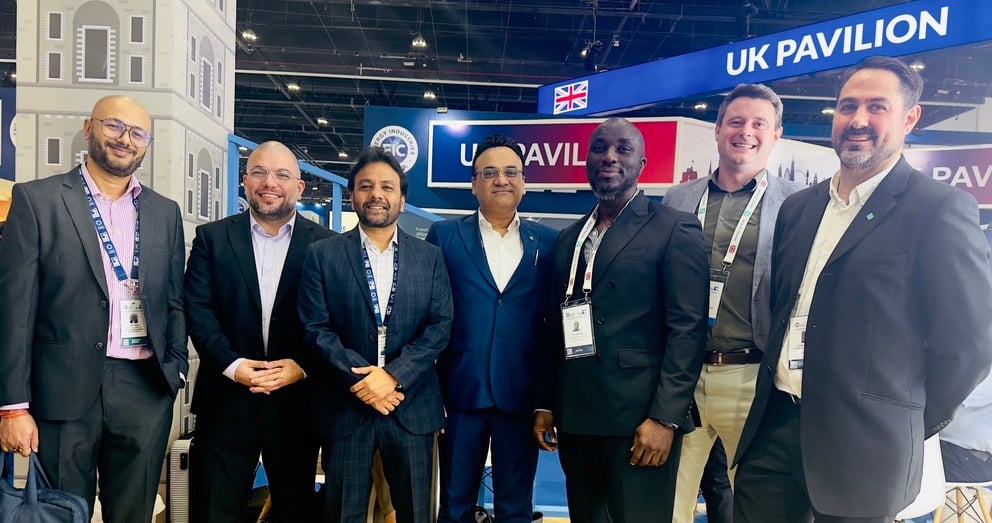
    Kumar Pranav, Global Advisory Lead – Operational Excellence; Ziad Menhem, Business Development Manager; Ambrish Bansal, Senior VP and Global lead Management Consulting; Kamran UlHaq, Senior Vice President – Ports Advisory; Ngozi Gwam, Business Director and Senior Representative for Africa; Ian Crehan, UKI Offshore Business Director; Sean van der Post, LR’s Global Energy Director at ADIPEC 2025.

    Continue Reading