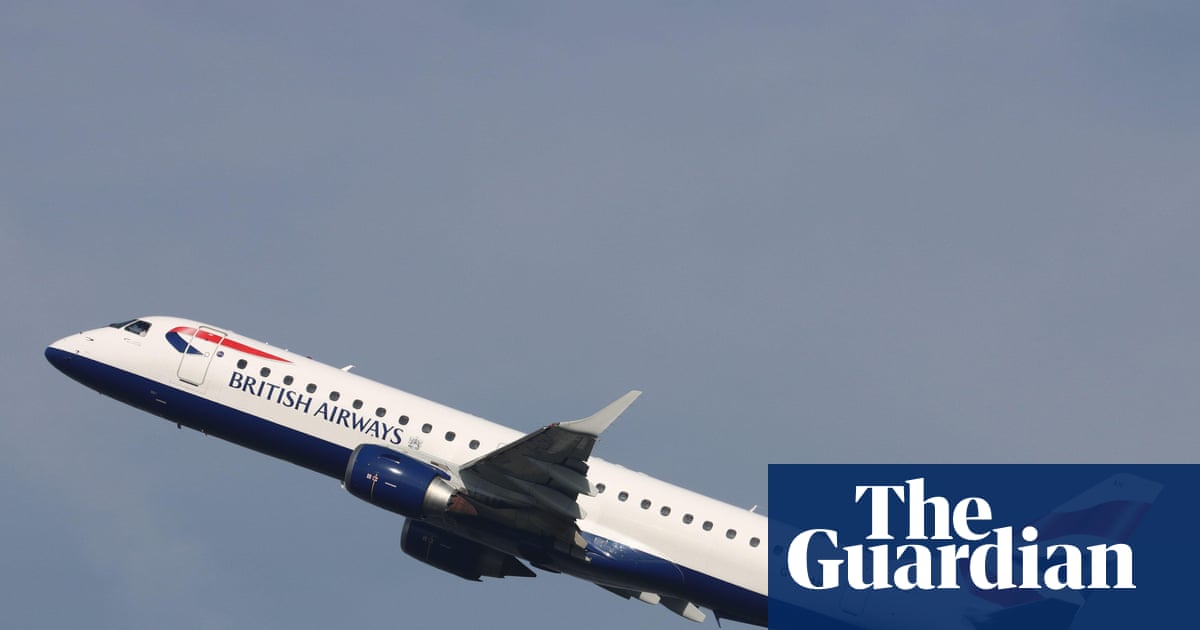
Passengers on British Airways flights will be able to access fast wifi onboard at no cost after the airline’s parent company signed a deal with Elon Musk’s satellite company.
The carrier said the free “reliable and lightning-fast” wifi from Starlink would be available to customers flying in economy, business or first class from next month.
BA’s owner, International Airlines Group (IAG), said it had reached agreement with Starlink to provide internet connectivity on more than 500 aircraft across its carriers, which also include Aer Lingus, Iberia and Vueling.
BA said the rollout of the technology was part of a £7bn “transformation” and would provide lag-free internet access to passengers from boarding to landing, even when they are flying over oceans or remote regions. Passengers will be able to connect multiple devices and they will not need a special login.
Sean Doyle, British Airways’ chief executive, described the launch of the Starlink service as “gamechanging for us and our customers, elevating their experience onboard our flights by offering them seamless connectivity from gate to gate. Especially on short-haul, this will really differentiate us from our competitors.”
Limited wifi access is currently offered to BA passengers on most of its aircraft through its .air service. Members of BA’s loyalty club are able to send messages and text-based emails onboard at no cost, while passengers who want to stream music, video and films during their flight and are not travelling in first class can expect to pay between £4.99 and £21.99 for a wifi package.
Starlink has a network of thousands of satellites and is operated by Musk’s SpaceX company.
Doyle and BA’s management have been working to turn the airline around after years of cost cutting, IT problems, strikes and mass redundancies. BA said use of artificial intelligence technology had helped it to bring its punctuality to the best levels since 2012.
In August, BA reported a jump in operating profits for the first half of the year, helping to push its owner IAG’s profit higher. IAG is due to report its results for the three months from July to September on Friday.
skip past newsletter promotion
after newsletter promotion
BA’s announcement comes days after mobile phone operator Virgin Media O2 said it was partnering with Starlink to improve mobile network coverage in rural parts of the UK, by allowing consumers to automatically connect phones via satellites when no standard mobile signal is available.
(Bloomberg) — Volatility lashed Wall Street, with strong evidence of a cooling labor market pushing high-valuation tech stocks and crypto to big losses while bonds rallied on bets the Federal Reserve will cut rates.
Equities sold off for the second time in three days and 10-year yields tumbled the most in a month following Challenger, Gray & Christmas Inc. data showing the largest October job cuts in more than 20 years. The Nasdaq 100 slumped almost 2%, and a closely watched volatility index briefly hit 20.
Subscribe to the Stock Movers Podcast on Apple, Spotify and other Podcast Platforms.
While bets on Fed cuts have powered the bull market in equities alongside the artificial-intelligence boom, concerns over lofty valuations have surfaced. Technical indicators are flagging reasons for caution while worries about an narrowing cohort of stocks driving gains have become louder.
If anything, the slide in equities appears to be taking some of the “froth” out of the market, said Chris Murphy at Susquehanna International Group LLP.
Traders are also keeping a close eye on a slew of policymakers slated to speak on Thursday.
Fed Bank of Chicago President Austan Goolsbee told CNBC that a lack of inflation data during the shutdown makes him more uneasy about continuing rate cuts. His New York counterpart John Williams said model estimates of the US neutral rate are lower than bond-market estimates, which he cautioned are unreliable.
The S&P 500 fell 1.2%. Tesla Inc. led losses in megacaps. Qualcomm Inc. became the latest chipmaker to deliver an upbeat forecast and still leave investors underwhelmed. Bitcoin lost 2.5%.
The yield on 10-year Treasuries slid eight basis points to 4.08%. Money markets are now implying an about 60% chance of a quarter-point rate reduction next month. A dollar gauge fell 0.2%.
With the scarcity of data caused by the US government shutdown, investors have turned to private figures for the latest readings on the economy.
Companies announced 153,074 job cuts last month, almost triple the number during the same month last year and driven by the technology and warehousing sectors. It’s the most for any October since 2003, when the advent of cellphones was similarly disruptive, said Andy Challenger, the company’s chief revenue officer.
“We are sticking to our view that the Fed will deliver a follow-up 25 basis-point cut in December because restrictive Fed policy can worsen the already fragile employment backdrop,” said Elias Haddad at Brown Brothers Harriman & Co.
Meantime, Revelio Labs data showed the US lost 9,100 nonfarm jobs in October after gaining 33,000 the month prior.
“If anything, the data reinforces the difficulty in making a case that hiring is re-accelerating,” said Vail Hartman at BMO Capital Markets. “When combined with this morning’s Challenger data, we remain skeptical of the argument that the labor market is staging a re-acceleration into year-end.”
Don Rissmiller at Strategas says the US labor market is not collapsing, but it does not look robust to shocks either.
“While some FOMC members have been hesitant to commit to another fed funds rate cut at their December meeting, a wobbling labor market would likely force their hand,” he noted.
The US central bank lowered rates in October as a way to bolster the weakening labor market. But inflation, which at 3% in September remained well above the Fed’s 2% target, has also raised concerns among some officials that it will take longer to come down than they thought.
Fed Chair Jerome Powell last month counseled against trying to predict whether another reduction was likely in 2025.
Despite his cautious rhetoric at the October policy meeting, Ulrike Hoffmann-Burchardi at UBS Global Wealth Management bets the US central bank will cut rates twice more by early 2026.
“Evidence of a cooling labor market will continue to mount, and recent inflation readings have not been sufficient to shift the Fed’s focus away from the weakening demand for workers,” she said. “Further rate cuts should lead to a decline in Treasury yields.”
Hoffmann-Burchardi says quality fixed-income offers an appealing combination of income and the potential to perform well in the event of slowing economic activity and further rate cuts. Income-based investors can also consider equity income or yield-generating structured strategies to improve cash returns, she noted.
Wells Fargo & Co. expects blue-chip companies — particularly large technology firms funding massive artificial intelligence investments — to borrow more from the US bond market next year, taking advantage of favorable financing conditions.
Corporate Highlights:
Microsoft Corp. is pursuing a more powerful form of AI called “superintelligence” it hopes will be capable of making advances in areas like medicine and materials science. DoorDash Inc., the US food-delivery app leader, said it will spend more on investments next year to build new products and bolster internal tools, weighing on its earnings forecast. Peloton Interactive Inc. issued a voluntary recall on about 877,800 units of its high-end Bike+ model in the US and Canada following reports that some seat posts broke, causing riders to fall off. Boeing Co. will avoid a criminal charge over two fatal 737 Max crashes after a federal judge paved the way for a $1.1 billion settlement agreement, handing the embattled manufacturer a victory in a long-running legal battle. Uber Technologies Inc. is in talks on a potential deal with Getir that would help the US company further expand its delivery operations in Turkey, according to people with knowledge of the matter. Lyft Inc. projected an acceleration in bookings this quarter, easing concerns about the ridehailing company’s efforts to expand globally and maintain customer loyalty. Lucid Group Inc. posted a worse-than-expected third-quarter loss as it grapples with sluggish production of its Gravity SUV and a challenging trade environment. Walt Disney Co. signed a new multiyear deal to make DraftKings Inc. the official betting site and odds provider for its ESPN sports networks, replacing a venture it had with casino operator Penn Entertainment Inc. Warner Bros. Discovery Inc., the parent of HBO and CNN, reported third-quarter revenue that missed analysts’ expectations, providing a glimpse into the company’s businesses as it puts itself up for sale. SoftBank Group Corp. explored a potential takeover of US chipmaker Marvell Technology Inc. earlier this year, people familiar with the matter said, in what would have been the semiconductor industry’s largest-ever deal. Texas officials have asked a state court judge to temporarily block Kenvue Inc. from marketing Tylenol as safe for pregnant women, and from issuing a dividend, escalating the company’s legal woes just days after announcing a major merger with Kimberly-Clark Corp. Eli Lilly & Co. and Novo Nordisk A/S secured deals with the Trump administration to slash prices for their blockbuster weight-loss drugs in exchange for tariff relief and wider access for Medicare patients. Novo Nordisk has again increased its offer for Metsera Inc., people familiar with the matter said, as its takeover battle with Pfizer Inc. for the obesity startup escalates. Moderna Inc. posted a narrower third-quarter loss than Wall Street expected, a sign that its cost-cutting measures are helping offset the decline of its Covid business. ConocoPhillips raised its total spending plans for the Willow oil and natural gas project in Alaska to as much as $9 billion, citing inflation and other rising costs. Under Armour Inc. said sales might fall as much as 5% this fiscal year, a bigger decline than Wall Street estimated and raising concern that the sportswear company’s turnaround effort isn’t making enough progress. Krispy Kreme Inc. reported positive cash from operations in the third quarter for the first time in three quarters — and its highest since late 2022 — as the doughnut maker progressed with its turnaround plan following the end of its US McDonald’s partnership in June. EchoStar Corp. reported a $16.5 billion impairment charge and agreed to sell more spectrum licenses to Elon Musk’s SpaceX for $2.6 billion as it works to unwind parts of its 5G wireless network. Celsius Holdings Inc. sank on concern near-term sales might be disrupted by a distribution channel change involving its newly acquired Alani Nu brand. Aquarian Holdings agreed to buy insurer and annuity provider Brighthouse Financial Inc. for $4.1 billion in cash. Snap Inc. surged after the company announced a $400 million partnership with Perplexity AI Inc. to incorporate its AI-powered search engine into Snapchat. Charles Schwab Corp. agreed to buy Forge Global Holdings Inc., a marketplace for buying and selling shares of private companies, for about $660 million. CarMax Inc. sank after terminating its chief executive over lagging sales and a nosedive of the stock that halved the used-car retailer’s market value so far this year. Tapestry Inc. raised its full-year outlook and reported quarterly earnings that beat expectations on the strength of its Coach brand — but the shares slumped, suggesting investors were looking for more. United Parks & Resorts Inc.’s third-quarter revenue missed estimates, as weather disruptions and softer discretionary spending weighed on attendance. Deutsche Boerse AG and Nasdaq Inc. risk hefty European Union fines after the bloc’s antitrust watchdog opened a full-scale investigation into a suspected cartel linked to listing, trading and clearing of derivatives. Canadian jet manufacturer Bombardier Inc. is considering mergers and acquisitions in the defense sector, seeking to capitalize on governments’ plans to spend heavily to rearm their militaries. Commerzbank AG plans to sell significant risk transfers worth €5 billion ($5.8 billion) in the fourth quarter as the German lender seeks to free up capital. HelloFresh SE shares pared most of their losses following a steep drop when short seller Grizzly Research LLC published a report that questioned its management and business model. The German subscription meals firm rejected the criticism. Renault SA presented its new battery-powered Twingo city car as Europe’s automakers try to offer more affordable electric vehicles to fight back against Chinese rivals. Air France-KLM reported earnings that missed expectations, hurt by strikes and higher taxes. Worldline SA Chief Executive Officer Pierre-Antoine Vacheron said a turnaround plan unveiled Thursday aims to permanently address deficiencies at the embattled payments provider following a €500 million capital raise. AstraZeneca Plc’s profit rose more than analysts anticipated last quarter, buoyed by demand for its blockbuster cancer and diabetes drugs. Diageo Plc lowered its full-year outlook for sales and profit as weak demand in China and the US weigh on the British distiller. A.P. Moller-Maersk A/S shares fell with investor disappointment over a smaller-than-expected improvement in the container-shipping giant’s full-year profit guidance. Volvo Car AB is seeking a long-term operating return of 8%, helped by new electric models like the EX60 sport utility vehicle and deeper ties with parent Geely. Nissan Motor Co. promised to build on a better second quarter despite longer-term forecasts signaling persistent challenges for the carmaker’s efforts to turn around its worst financial crisis in decades. What Bloomberg strategists say…
“With the US government shutdown now the longest in history, and official economic indicators delayed as a result, private information on jobs is gaining in importance. And with the Fed focused on weakness in the labor market, the bond markets are uber-sensitive to the data.”
—Alyce Andres, Macro Strategist, Markets Live. For the full analysis, click here.
Some of the main moves in markets:
Stocks
The S&P 500 fell 1.2% as of 12:15 p.m. New York time The Nasdaq 100 fell 1.9% The Dow Jones Industrial Average fell 1% The MSCI World Index fell 0.8% Bloomberg Magnificent 7 Total Return Index fell 2.1% The Russell 2000 Index fell 1.7% Currencies
The Bloomberg Dollar Spot Index fell 0.2% The euro rose 0.4% to $1.1540 The British pound rose 0.5% to $1.3113 The Japanese yen rose 0.8% to 152.86 per dollar Cryptocurrencies
Bitcoin fell 2.6% to $100,952.54 Ether fell 4.6% to $3,282.58 Bonds
The yield on 10-year Treasuries declined eight basis points to 4.08% Germany’s 10-year yield declined two basis points to 2.65% Britain’s 10-year yield declined three basis points to 4.43% The yield on 2-year Treasuries declined eight basis points to 3.55% The yield on 30-year Treasuries declined six basis points to 4.68% Commodities
West Texas Intermediate crude fell 1% to $59 a barrel Spot gold was little changed –With assistance from Denitsa Tsekova.
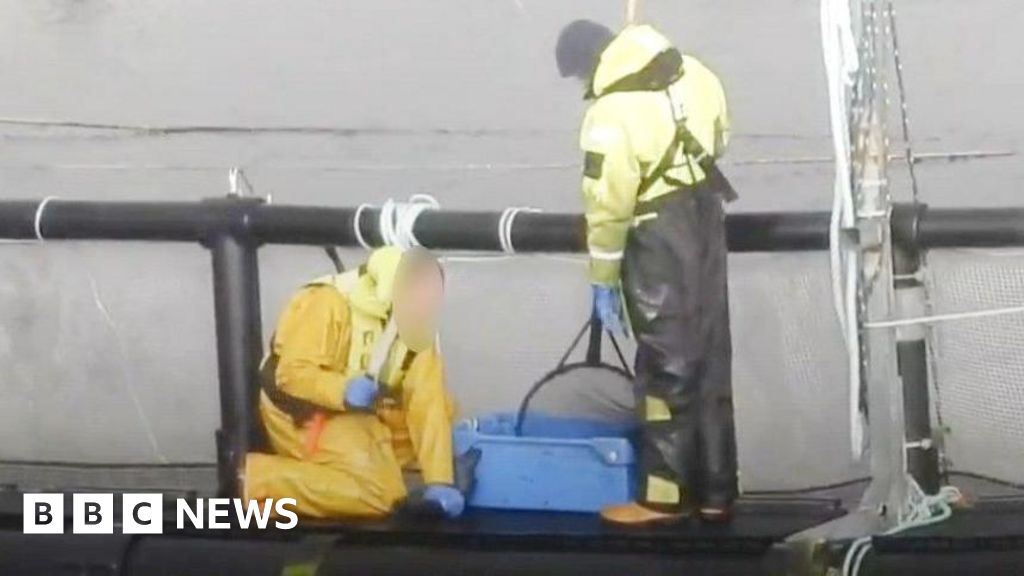
The Green Britain Foundation captured footage of Mowi’s farm on Skye
A salmon farming firm at the centre of cruelty claims has lost the Royal Warrant it has held for 35 years.
Mowi Scotland’s farm at Loch Harport on the Isle of Skye was suspended from an RSPCA welfare scheme in May over videos allegedly showing “systemic cruelty” to fish.
The warrant, which allows a firm to advertise that it supplies the Royal Household, was most recently granted to Mowi in December last year.
The Royal Warrant Holders Association declined to confirm when Mowi’s warrant was removed or the reason for its removal.
A spokesperson for Mowi Scotland said it was “honoured to have held the Royal Warrant” but said it could not comment on decisions from the Royal Household.
The Norwegian-owned firm employs about 1,500 staff in Scotland and has 48 farms that produce more than 68,000 tonnes of salmon each year.
Animal rights group Green Britain Foundation captured footage in March that it claims shows 18 incidents of animal cruelty at Loch Harport.
It said the videos show salmon being beaten and suffocated to death.
Animal welfare standards require that the time a fish spends out of water should “never exceed 15 seconds for a live fish”.
Dying fish should also be given “a non-recoverable percussive blow to the head of the fish to render it immediately insensible”.
But the campaign group said fish were being left out of the water to suffocate for minutes at a time, with some beaten several times before they died.
The RSPCA branded the videos “extremely upsetting” and suspended the farm from its assured labelling scheme.
Mark of recognition
Mowi was awarded its Royal Warrant of Appointment in 1990 when it was trading as Marine Harvest Scotland.
This permits a company to use the Royal Arms on its products.
It is granted as a mark of recognition to companies that have regularly supplied goods or services to the Royal Household.
A warrant is initially granted for up to five years, but may not be renewed if the quality or supply of the product or service is insufficient.
The Royal Warrant Holders Association declined to comment on the removal of Mowi’s Warrant.
The firm does not appear on the association’s current list of Royal Warrant holders.
Other holders of a Royal Warrant unclude BT, John Lewis and Jaguar Land Rover.
The new translation service, now available in beta to select KDP authors, supports translations between English and Spanish and from German to English. Authors can manage and access their translations on the KDP portal, including selecting languages, setting list prices, and publishing. Within a few days, authors can publish fully formatted translations of their books. All translations are automatically evaluated for accuracy before publication, and authors can choose whether to preview or automatically publish completed translations. This launch builds on Amazon KDP’s ongoing commitment to supporting independent authors in reaching global audiences and increasing their earning potential. Kindle Translate provides free translation services for independent authors like Roxanne St. Claire, who said: “For decades, indie authors have been unable to find a cost-effective and trustworthy solution to foreign language translation. With services like Kindle Translate, we are able to easily bring our stories to a wide international audience—a win for authors and readers!” Fellow KDP author Kristen Painter added, “Foreign translations open doors to new readers around the world and give my titles a second life. It’s one of the smartest ways to expand both reach and revenue.”
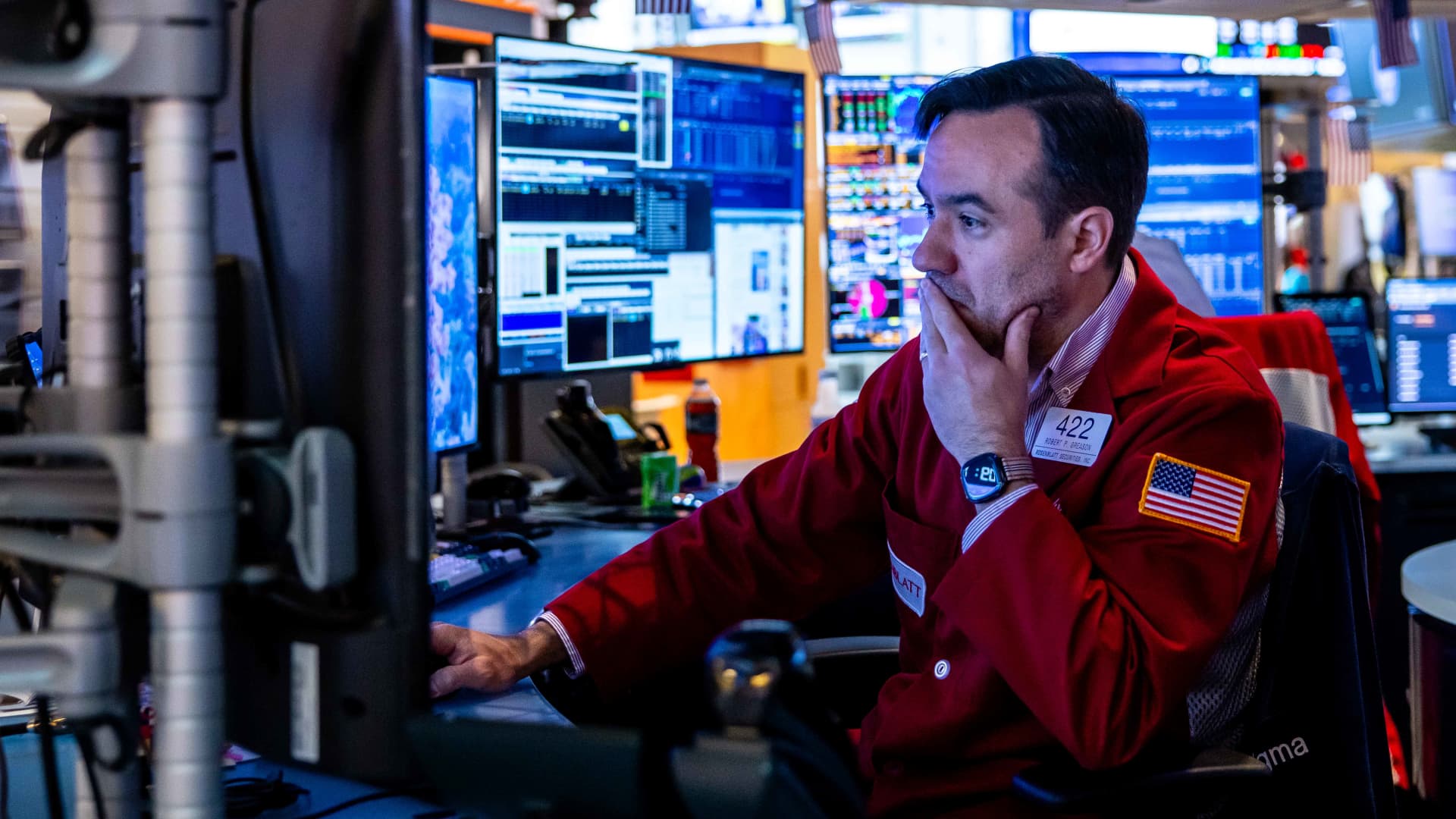
A trader works on the floor of the New York Stock Exchange.
NYSE
U.S. stocks retreated on Thursday as names in the artificial intelligence trade came under pressure yet again amid worries around eye-watering valuations.
The Dow Jones Industrial Average slipped 439 points, or 0.9%. The S&P 500 traded down by 1.1%, while the Nasdaq Composite shed 1.8%.
AI stocks remained in focus for those on Wall Street during the session. Qualcomm shed 4%, even after the chipmaker posted better-than-expected quarterly results. Advanced Micro Devices, a standout name in the prior day, declined 7%, while Palantir Technologies and Oracle dipped 5% and 3%, respectively. Shares of AI darling Nvidia and fellow “Magnificent Seven” name Meta Platforms slid as well.
“So much of this stuff from a valuation standpoint was so lofty and priced for perfection that we’re seeing in the market a bit of a dichotomy between companies that are are beating and raising versus those that maybe are beating on the top line but providing tepid guidance on the bottom line or from an operating profit standpoint,” said Mike Mussio, president at FBB Capital Partners. “That’s the difference between some of these companies on earnings being up double digits versus being down double digits, and there’s not a lot of in-between.”
Equities linked to the AI space rebounded on Wednesday from valuation concerns that swirled earlier this week, serving as a potential boon for the major indexes. AMD closed more than 2% higher in the previous session after the semiconductor company reported better-than-expected third-quarter results. The performance pulled up some other AI stocks alongside it, including Broadcom and Micron Technology. Oracle also recouped some recent losses.
While the recovery of the AI names helped the market bounce back a bit following a soft start to the weekly period, all three major U.S. indexes are still firmly in the red week to date.
Thursday’s pullback was exacerbated by concerns about the state of the labor market, as October saw a significant number of layoff announcements. Job cuts for the month totaled 153,074, marking an increase of 183% from September and 175% from the year-ago period, according to Challenger, Gray & Christmas. That’s the highest level recorded for an October in 22 years. Not only that, 2025 is the worst year for layoffs since 2009.
That data paints a shaky picture of the U.S. economy, particularly in light of the lack of data releases with the ongoing U.S. government shutdown. The stoppage, now in its 37th day, has become the longest in the country’s history.
“We’re starting to get dribs and drabs of the economic data … that’s not government related, and it’s not super rosy,” Mussio said, adding that “all that stuff is just setting up for some for some market weakness.” Though that doesn’t necessarily mean “this is the start of a major skid or anything,” he believes that if the government reopens and the data thereafter shows the consumer is “really not dead” as the holiday season unfolds, that “typical” year-end rally could “continue.”
Investors were also looking at Washington, as the Supreme Court heard arguments over the legality of the Trump administration’s tariffs. They increasingly expect the Supreme Court to rule against the Trump administration’s aggressive trade policy after high court justices on Wednesday expressed some skepticism about the trade taxes’ legality.
The potential ruling would trigger a rollback of the president’s tariffs, likely pushing stocks higher.
1. All information offered on Porsche Newsroom, including but not limited to, texts, images, audio and video documents, are subject to copyright or other legislation for the protection of intellectual property. They are intended exclusively for use by journalists as a source for their own media reporting and are not intended for commercial use, in particular for advertising purposes. It is not permitted to pass on texts, images, audio or video data to unauthorised third parties.
2. All logos and trademarks mentioned on Porsche Newsroom are trademarks of Dr. Ing. h.c. F. Porsche AG (hereinafter: Porsche AG), unless otherwise stated.
3. All contents of Porsche Newsroom are carefully researched and compiled. Nevertheless, the information may contain errors or inaccuracies. Porsche AG does not accept any liability with respect to the results that may be achived through the use of the information, in particular with respect to accuracy, up-to-dateness and completeness.
4. Insofar as Porsche Newsroom provides information concerning vehicles, the data refers to the German market. Statements concerning standard equipment and statutory, legal and tax regulations and repercussion are valid for the Federal Public of Germany only.
5. With respect to the use of Porsche Newsroom, technical faults such as, delays to news transmission, cannot be ruled out. Porsche AG does not accept any liability for any resulting damage.
6. Insofar as Porsche Newsroom provides links to the internet sites of third parties, Porsche AG does not accept any responsibility for the content of the linked sites. On using the links, the user leaves the Porsche AG information products.
7. In agreeing to these rights of use, the user shall be obliged to refrain from any improper use of Porsche Newsroom.
8. In the event of improper use, Porsche AG reserves the right to block access to Porsche Newsroom.
9. Should one or more provisions of these terms and conditions be or become invalid, this shall not affect the validity of the remaining provisions.
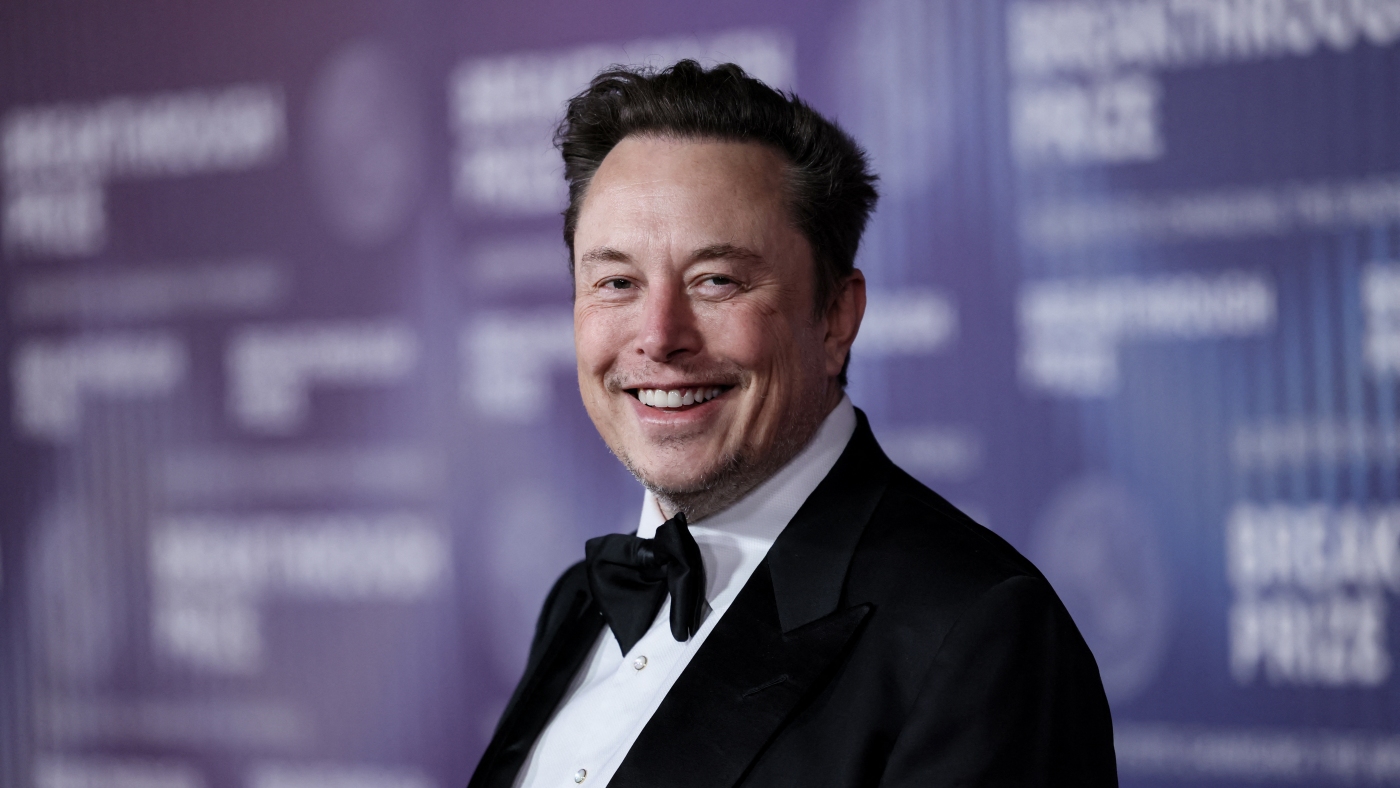
Elon Musk arrives at the Tenth Breakthrough Prize Ceremony at the Academy Museum of Motion Pictures in Los Angeles, California, on April 13, 2024. Tesla shareholders vote Thursday on a pay package that could award Musk a trillion dollars’ worth of Tesla stock if he meets certain targets.
Etienne Laurent/AFP via Getty Images
hide caption
toggle caption
Etienne Laurent/AFP via Getty Images
On Thursday afternoon, Tesla shareholders will vote on a proposed pay package of extraordinary proportions for Elon Musk.
That package is conditional: Musk would earn no salary, but would unlock Tesla stock worth about a trillion dollars if the company meets certain criteria within the next decade.
Among other targets, he would have to raise the company’s market capitalization, the value of all its stock put together, from about $1.5 trillion today to above $8.5 trillion.
For comparison, the most valuable company in the world, Nvidia — the chipmaker boosted by the AI boom — is worth $4.83 trillion. (Its CEO, who is seen as pivotal to the company’s success, is paid $50 million per year and owns 3.5% of the company.)
Musk is already unfathomably wealthy, worth some $460 billion, according to the Bloomberg Billionaires Index. That’s thanks in large part to Tesla’s soaring stock price, currently worth about $465 per share. (That’s more than 400 times more valuable than at the company’s IPO in 2010.)
A previous pay package that offered Musk a then-unprecedented $55.8 billion has been tied up in a lengthy court battle after a judge ruled that the board was too cozy with Musk in designing it. That case is still pending, and Tesla’s board has made sure that Musk will receive tens of billions of dollars’ worth of stock for his last few years of work, no matter how it is resolved.
But what about pay for his future work? Tesla’s board argues that they need to incentivize him to “remain at Tesla and focus his unmatched leadership abilities” on the company, and that extraordinary results merit extraordinary pay. Even some of Musk’s hard-core fans feel that, over the last few years, he has been distracted by politics and other projects, to the detriment of Tesla’s efforts to sell cars. Tesla’s profits have been down from last year throughout 2025.
The new package, like the previous one, is entirely based on performance and divided into twelve tranches. If Tesla’s stock value grows to hit each of 12 targets, and Tesla also meets separate earnings or product-specific sales targets, Musk earns a tranche of stock for each pair of targets he hits. He won’t be able to sell that stock immediately, to further incentivize him to stick around.
Tesla did not respond to a requests for comment, but the board has strongly advocated for this pay package in SEC filings and public comments. Supporters of the pay package emphasize that Musk only gets his big payday if Tesla’s value grows enormously, boosting shareholders. Critics note that he could take home hundreds of billions even if he only unlocks a few relatively modest targets.
Musk only gets the full trillion-dollar prize if he pulls off the “Mars-shot” of hitting all the targets. (Technically, he could take home slightly less, because of some details governing how the restricted stock units would be granted. Of course, it could be more, if the stock growth beats the top target.)
A trillion dollars is hard to wrap your head around, so we did a little number crunching to put this extraordinary pay package in perspective.
$8.8 billion per year
All-stock compensation packages are tricky to value, because their true worth fluctuates with the company’s share price. So what costs the company a small amount to give in 2025 might be worth an enormous amount in 2035, for instance.
Based on recent stock prices, Tesla’s board values this pay package at around $88 billion, which is a small fraction of what Musk would actually receive if he hits his targets and Tesla stock soars. But even using that very conservative figure, it works out to $8.8 billion a year.
Glass Lewis, a proxy advisory firm, analyzes company books and recommends how shareholders should vote on decisions like this. The firm estimates that the entire S&P 500 combined paid all its CEOs about $9 billion last year. So Musk would make about as much as every other major corporate CEO combined — before factoring in stock growth.
28.8%
That’s how much of Tesla’s voting shares Musk would own if he unlocks the full pay package.
Musk and Tesla’s board have publicly said it’s this control — not the money — that is the real prize. “It’s less about compensation and more about the voting influence,” board chair Robyn Denholm told CNBC recently. Critics view it the same way. Tom Dinapoli, the comptroller of New York State, recently called the proposal “pay for unchecked power.”
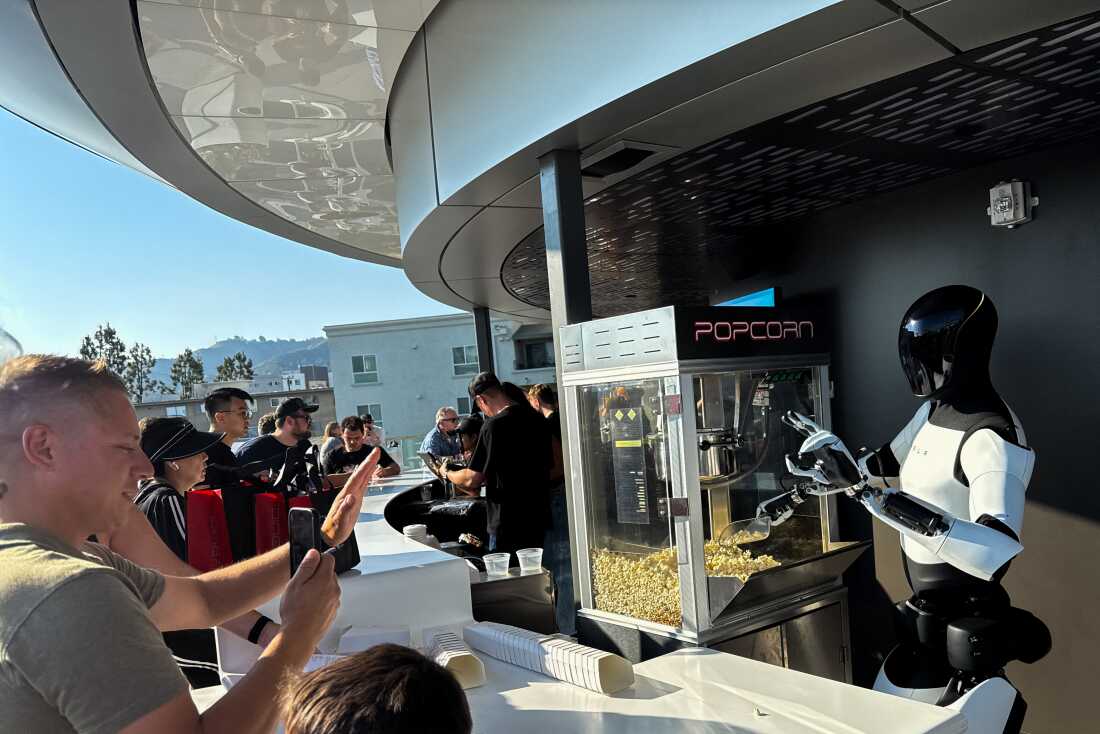
A Tesla Optimus robot scoops popcorn and gestures at attendees during the opening of the Tesla Diner and Drive-In restaurant and Supercharger in Los Angeles, Calif., on July 21, 2025.
Patrick T. Fallon/AFP via Getty Images
hide caption
toggle caption
Patrick T. Fallon/AFP via Getty Images
One of the pay package targets is for Tesla to sell a million robots. Tesla has been developing a humanoid robot called Optimus, designed to work in factories as well as homes. Musk imagines one for every person on Earth, all of them running Tesla software. And on an earnings call last month, he said he wants to make sure that if he builds what he calls a “robot army,” he stays in charge of it.
“It’s not like I’m going to go spend the money. It’s just, if we build this robot army, do I have at least a strong influence over that robot army? Not control, but strong influence,” Musk said. “I don’t feel comfortable building that robot army if I don’t have at least a strong influence.”
33x
This pay package, by Tesla’s own lowball valuation, is more than 33 times larger than the previous biggest-ever package … which was Musk’s 2018 pay package, then given an equally conservative $2.6 billion valuation. (The value of that 2018 package today is actually above $100 billion, thanks to the rise in Tesla’s share price.)
That 2018 package, meanwhile, was 33 times larger than the biggest award before that. Which was Elon Musk’s 2012 pay package, worth approximately $78 million.
$942 billion
Glass Lewis has calculated that Musk would actually take home $942 billion once he hits the targets, after some payments he’d be required to make for tax purposes.
Musk has said he won’t spend the money. But what could he buy if he did? To give a sense of scale, we pulled the numbers for some of the world’s priciest luxury items.
Let’s say Musk bought every single Rolls Royce sold in a year — last year that was 5,712 cars at about $500,000 each. That’s $2.85 billion.
Let’s say he also bought every yacht on offer for a year. Global yacht sales in the first quarter of this year were $1 billion, so call it $4 billion for the year.
How about a year’s worth of jet sales? According to one estimate, the entire global private jet market will hit $39.84 billion this year.
So let’s say that Musk buys every new Rolls-Royce, private jet and yacht sold in the entire world. And then does the same thing every year for a decade.
He’d still have $475 billion left over.
At press time, that’s more money than the richest person on Earth possesses, according to the Bloomberg’s Billionaires Index. That person is, of course, Elon Musk.

 Green Britain Foundation