December 31, 2025 (MLN): D.G. Khan Cement Company Limited (PSX: DGKC) has established
a Letter of Credit for the installation of Pakistan’s largest single clinker
production line.
The brownfield project involves setting up an 11,000 tons
per day clinker production line at Mauza Khofli Sattai, Dera Ghazi Khan
site.
The aforementioned information was disseminated through a
notification to Exchange.
At the time of writing, the company’s share price stood at Rs.
237.25, down 1.39 points, or 0.58%.
Industry is a leading, and growing, source of greenhouse gas (GHG) emissions and will be one of the most challenging sectors to decarbonise, requiring a concerted combination of policy, institutional, and market solutions. By 2050, around 60 percent of heavy industry emission reductions will need to come from technologies that are not currently market ready. Early and accelerated investment in low-carbon and climate-resilient technologies in fast-developing economies will be critical.
The Climate Investment Funds (CIF) established the Industry Decarbonisation Programme (IDP) under the Clean Technology Fund (CTF) to support and accelerate the transition of these high-emitting industrial sectors in developing countries to zero-carbon practice, support the development of clean technology supply chains, and unlock investments in low to net zero-carbon and climate-resilient business models and technologies.Egypt was one of seven countries selected to participate in the CIF IDP and develop an Investment Plan (IP). Participation in the programme, and submission of an IP, secures up to USD 250 million in concessional finance for Egypt to support industrial decarbonisation projects, of which a minimum of 50% must be deployed to the private sector. This funding will be complemented by MDB investment and private sector contributions. The IP is a business plan, to be developed by the Government of the Arab Republic of Egypt (GoE) in cooperation with the CIF’s Multilateral Development Bank (MDB) partners, in this case with the European Bank for Reconstruction and Development (EBRD), World Bank (WB), International Finance Corporation (IFC), and African Development Bank (AfDB). The GoE designated the EBRD as the “Coordinating MDB” to provide overall oversight on the IP preparation process on behalf of the joint MDB group. The IP will lay out government priorities and proposals, identify potential areas for MDB investment and technical assistance, as relevant, and will include mobilisation of complementary co-financing, including from bilateral, multilateral, and private sources.
The objective of the Assignment is to support the development of the Egyptian IDP IP and manage associated tasks and coordination, in collaboration with governmental counterparts, MDB partners, the private sector, and other relevant stakeholders. Specifically, the Assignment will contribute to:
• Coordination of the IP process, including managing inclusive and robust stakeholder engagement processes (e.g., government counterparts, MDBs, CIF Secretariat, private sector, and other relevant organisations).
• Preparation of key inputs to the IP process, including inter alia ToRs for missions; Aide Memoires etc.
• Support the preparation and implementation of scoping/joint missions to Egypt on-site.
• Prepare technical inputs and presentations to inform the scoping/joint missions to Egypt on-site.
• Lead technical drafting of the IP document in consultation with all relevant stakeholders (i.e., MDBs/Government). Draft the IP, produce updates and final version.
• Prepare and contribute to necessary technical assessments to feed into and inform the IP development.
• Develop technical inputs related to IPPG requests.
• Identify and help the GoE and MDBs establish contact with suitable private sector companies enabling consultations for financing decarbonisation projects in such companies.
• Lead the process of collecting and addressing the feedback on the IP drafts (from MDBs, CIF Secretariat, public consultations, TFC members, GoE).
• As needed, lead preparation of the presentation materials required for the TFC meetings Egypt IP session.
• Facilitate consultation meetings and technical discussions with identified key stakeholders (e.g. private sector, development partners, etc.).
• Provide any other relevant technical and/or logistical and coordination support to all IP stakeholders as a “collaborative”, as relevant.
The purpose of this assignment is to support the Government of Egypt, represented by the Ministry of Planning, Economic Development, and International Cooperation (MoPEDIC), in leading and managing a well-coordinated consultation process – both internal and external. This includes facilitating coordination among relevant government entities, MDB partners, and the private sector, as appropriate, to develop the CIF IDP IP for Egypt collaboratively and comprehensively. In addition to MoPEDIC, the assignment will include strong collaboration with the Egyptian Ministry of Industry (MoI) and include their contributions. Outputs of the Assignment (see scope of work and deliverable section) will directly inform the IP’s indicative areas of focus, scope of TA, and indicative pipeline of investments across hard-to-abate industrial sectors.
The assignment should leverage the progress, technical outputs, and networks from existing programmes and relevant coordination mechanisms and workstreams, for example, the Nexus Water-Food-Energy Programme Energy Pillar (NWFE-EP) and the Suez Canal Economic Zone (SCZONE). It should build on existing climate policies and preexisting work conducted on the topics of low carbon transitions and green industrialisation in Egypt, including the low-carbon pathways (LCPs) for the cement and fertiliser sectors, prepared with the support of the EBRD. The assignment should ensure previously identified priority sectors, activities, and technologies for industrial decarbonisation in Egypt are targeted and integrated into the IP.
These priority areas should include, but are not limited to:
• Implementation of key decarbonisation levers of the LCPs in cement, fertilisers, iron/steel, aluminium;
• Deployment of green hydrogen across the entire value chain;
• Deployment of low carbon energy sources specifically relevant to industrial decarbonisation projects and processes;
• Carbon Capture Utilisation and storage (CCUS);
• Energy efficiency and optimisation;
• Demand Side Management (DSM);
• Support P2P framework, scaling renewable capacity, and increasing electrification of industrial processes;
• Fuel switching and supporting the development of alternative and low-carbon fuels and feedstocks (e.g., green hydrogen, biomethane, e-methanol, Sustainable Aviation Fuels (SAF)s);
• Waste heat recovery.
• Fresh water usage efficiency improvements and waste water treatment.
• N2O abatement (for fertiliser production);
• Introduction of alternative raw materials low carbon cement and alternative fuels in the cement production. Support On-site renewable energy production.
• Decarbonisation of mineral extraction and processing, e.g. phosphate;
BEIJING — Chinese Premier Li Qiang has signed a State Council decree issuing a regulation on the implementation of the country’s value-added tax (VAT) law, which will take effect on Jan. 1, 2026.
The regulation is designed to facilitate the effective enforcement of the law by providing detailed rules on its application.
The regulation specifies the scope of taxable goods, services, intangible assets and immovable property, and further defines taxpayer categories.
It also clarifies the application of VAT rates, including zero-rating for certain exports and cross-border sales of services and intangible assets.
In addition, the rules refine methods for calculating VAT payable, clarify standards for tax incentives, and strengthen VAT administration measures.
The VAT law was adopted at a session of the Standing Committee of the National People’s Congress, the national legislature, in December last year.
SBP buys $9.7bn from interbank market in 16 months – Daily Times
We use cookies to ensure that we give you the best experience on our website. If you continue to use this site we will assume that you are happy with it.
“We’re working on some of the detailed plans around it and we’ve been invited to Downing Street to present to the government,” he said.
“We’re finalising all of the arrangements of going down… but it’s fair to say there’s a lot of national government interest in it.
“We’ve also got some great stakeholders that are really keen to make sure we make it a success.”
In August it was revealed that Liverpool-born television producer Jimmy Mulville was part of a group working with Liverpool City Region Mayor Steve Rotheram and industry experts to include an education hub at the site.
Developer Capital & Centric (C&C) also revealed in the summer that it had entered into discussions about securing government funding.
C&C warned the cost of delivering the project “in the current climate exceeds the value of the completed development”.
Its co-founder Tim Heatley said talks had been ongoing with ministers to “explore potential options for gap funding”.
The Liverpool City Region Combined Authority, which has so far committed up to £17m, said it would work with the government, city council and C&C to obtain the required funding.
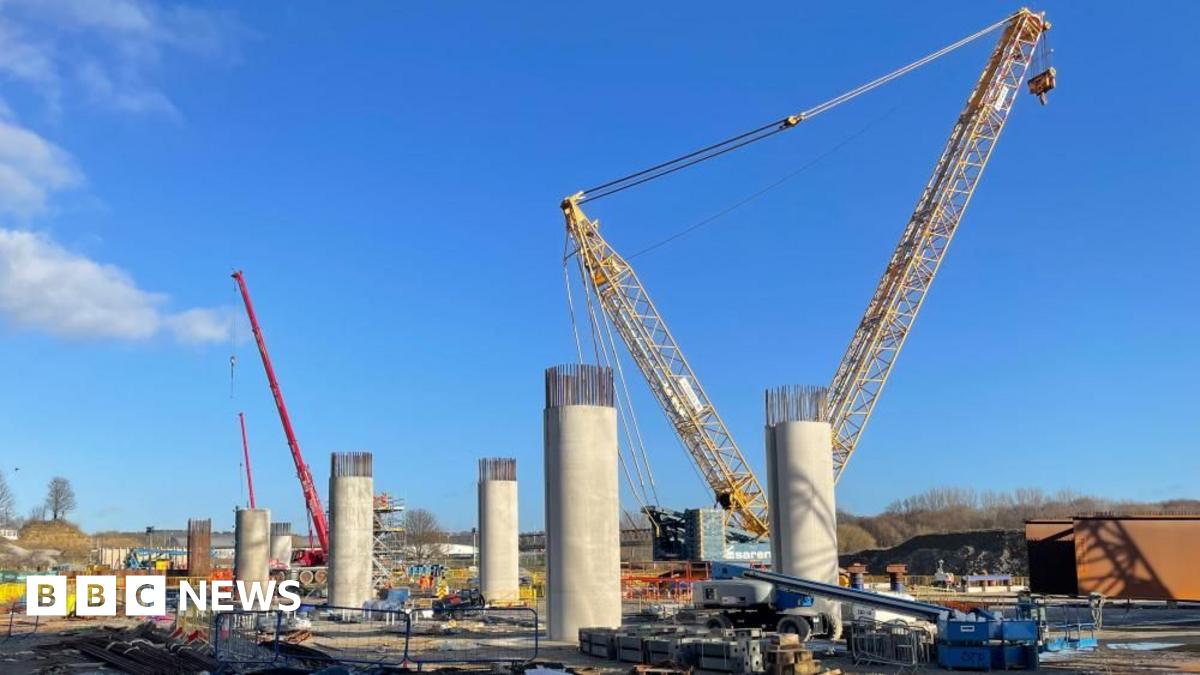
The viaduct will replace two cast-iron bridges that were built by Joseph Butler & Co in Leeds in 1847.
While the Victorian bridges have been deemed no longer suitable for use, they are Grade II listed and will remain in place when the new viaduct opens.
The new nine-span structure is being manufactured from Corten steel, a high-strength material that develops a rusty brown colour and does not need continuous painting.
A 12,000-tonne crane is being used to swing each individual span into position on eight supporting pillars.
Close to the viaduct, Ravensthorpe Station has been closed by Network Rail as part of the upgrade work.
The station is being rebuilt at a nearby location so more trains can stop there and will include a footbridge with lifts, a new forecourt and improved drop-off facilities. It will reopen in March 2028.
Network Rail’s Transpennine Route Upgrade, which is due to be completed in the early 2030s, will see the line between York and Manchester fully electrified.
First-time buyers are expected to drive the UK housing market in 2026, with further interest rate cuts likely to improve stretched affordability.
The for-sale market should accelerate moderately, with prices rising by 2% to 4%, while rent rises are likely to slow from the rapid increases of recent years, according to lenders and estate agents.
With mortgage rates falling, earnings growth running ahead of inflation, and house prices rising slowly, monthly mortgage costs for first-time buyers as a share of income are at their lowest level since 2022, according to Halifax.
House prices across the country rose less than expected in 2025, after a stamp duty tax break expired at the end of March and buyer confidence was knocked first by Donald Trump’s tariffs in April, and later by speculation around property tax changes before Rachel Reeves’s budget in late November.
Property values climbed by 1.8% in the year to November, leaving the average home valued at £272,998, according to Nationwide building society. Lenders and estate agents estimate between 1% and 2% house price growth for 2025, less than the 3%-plus rises they predicted a year ago, and below the rate of inflation, now 3.2%.
“Uncertainty around the budget pretty much killed the market in the second half of 2025, so we were kind of just treading water,” said Marcus Dixon, the head of residential research at JLL. When inflation is taken into account, house prices are falling in real terms, “which for affordability, it’s not necessarily a negative”, he added.
UK house price growth chart
The Bank of England, faced with high inflation, has also been slower to cut interest rates than expected.
With inflation cooling, it delivered a pre-Christmas cut, taking borrowing costs to their lowest in almost three years. Economists expect two further cuts in 2026, and lenders have already acted by offering a number of fixed-rate mortgages below 4%, with the best deal at 3.55% for a two-year fix with a 40% deposit, from Santander.
Forecasts for house price rises next year are concentrated at the lower end of between 2% and 4%, followed by 4% growth in 2027 and rises of up to 5.5% in 2028. Predictions come from the leading mortgage lenders Nationwide and Halifax, the estate agents Savills, JLL, Knight Frank and Hamptons, and the property websites Rightmove and Zoopla.
In London, house prices have been falling, and are expected to flatline in 2026. With prices rising strongly in northern England, the north-south divide in property values has narrowed to its smallest since 2013, according to Nationwide.
Mortgage rules have been relaxed, allowing buyers to take out bigger mortgages with smaller deposits, alongside looser affordability stress tests, and the City watchdog has just announced plans to help first-time buyers and self-employed people get on the property ladder.
“Buyers might be able to purchase with a 15% or 10% deposit, and that makes a huge difference, particularly in London and the south-east,” said Emily Williams, a director of residential research at Savills. “That’s certainly knocking two or three years off the amount of time that you need to save for deposits.”
The Nationwide chief economist, Robert Gardner, said that while in 2023, for a typical first-time buyer with a 20% deposit, the mortgage payment was above 38% of pay, it was now 33%, closer to the long-term average of 30%. He expected this ratio to fall further in 2026.
Hamptons said first-time buyers accounted for a third of all purchases in 2025, a record high, and half of all deals in London. Aneisha Beveridge, its head of research, said: “First-time buyers are becoming a real kind of key driving force in the housing market. But that partly reflects the fact that other people aren’t moving as often because stamp duty costs are so high.”
Williams said that as the Renters’ Rights Act gave tenants more safeguards, some landlords were selling up, and a lot of these properties were going to first-time buyers because they tended to be smaller and cheaper.
The budget brought a high-value council tax surcharge – also known as the “mansion tax” – for £2m-plus homes from April 2028, but this was not as sizeable as feared. With the budget out of the way, JLL said its central London sales business was the busiest in 17 months in November.
However, the market remains slow – it takes more than 200 days for a home to sell from listing to exchange, compared with 150 days normally, Dixon said. The unemployment rate has risen to a four-year high of 5.1% and the economic outlook is lacklustre, which will drag on buyer confidence.
For tenants, average rent increases are expected to slow further, to between 2% and 3.5% in 2026. Official figures showed average UK monthly private rents rose by 5% to £1,360 in the year to October.
However, with a shortage of new rental homes and high tenant demand, “even though rental growth will slow, growth is probably going to come down fairly slowly, and that’s certainly what we’ve seen in the last few quarters”, said Gardner.
The force said the closures followed a wider three-week operation to counteract money laundering and organised crime and 36 businesses were visited.
The shops served closure orders were:
Euro Shop, in Lincoln Road, Millfield – partial closure between 9 December and 8 March, prohibiting it from selling tobacco products and cigarettes during this period
Gaffy Food Store, in Newark Avenue, Dogsthorpe, Peterborough – full closure between 3 December and 14 January
Hana Express in Burghley Road, Peterborough city centre – partial closure between 3 December and 3 March, prohibiting it from selling vapes, cigarettes, and alcohol during this period
International Food Centre, in Lincoln Road, Peterborough city centre – full closure between 18 December and 22 January
International, in Fitzwilliam Street, Peterborough city centre – full closure between 11 December and 15 January
Det Insp Shish Thind said: “I hope this shows the community that we are working to combat money laundering and its associated organised criminality.
“During the periods of these orders, we will monitor them closely to ensure all conditions are being adhered to, and any breaches will be dealt with robustly.”
The force said a further three firms were issued with community protection warnings.
Any further breaches would result in additional action against them, it added.
Gold was steady on Wednesday but remained on track for its strongest annual gain in over four decades, while other precious metals fell sharply as investors booked profits after a strong, record-setting rally.
Spot gold was steady at $4,345.75 per ounce as of 0404 GMT after hitting a record high of $4,549.71 on Friday.
US gold futures for February delivery lost 0.5% to $4,365.0/oz. Bullion has climbed 66% in 2025, marking its largest annual gain since 1979 when prices were driven higher by geopolitical factors, including the Iranian revolution.
Gold’s rally has been driven by interest rate cuts and bets of further easing by the US Federal Reserve, geopolitical conflicts, robust demand from central banks and rising holdings in exchange-traded funds.
However, analysts said that recent declines in precious metals were linked to technical factors alongside thin trading.
“CME announced an increase in margins on metals futures and that was a very painful adjustment for (precious metals on Monday), it seems we have very thin markets here with the holidays,” Ilya Spivak, head of global macro at Tastylive, said.
The US dollar rose to a more than one-week high, making greenback-priced bullion more expensive for other currency holders.
Minutes from the Fed’s December meeting showed policymakers agreed to cut interest rates only after a deeply nuanced debate, though traders expect two more reductions next year.
Low interest rate environments typically support non-yielding assets such as gold.
“Maybe towards the end of the first (quarter of 2026), we could see (gold) test $5,000. Certainly, it seems like the sort of catalysts animating gold, especially over the course of the past year, have become self-sustaining,” Spivak said.
Spot silver fell 4.5% to $73.06 per ounce on Wednesday after hitting an all-time high of $83.62 on Monday.
Silver has gained over 150% year-to-date, far outpacing gold, and is set for its best year ever. The metal broke multiple milestones in 2025, supported by its designation as a critical U.S. mineral, supply constraints, low inventories and rising industrial and investment demand. With the Dow, S&P 500 and Nasdaq all ticking down between a tenth and a quarter of a percent.
Spot platinum shed 6.1% to $2,065.80 per ounce after rising to a lifetime high of $2,478.50 on Monday. It is up over 120% for the year, its strongest gain ever. Palladium fell 7.1% to $1,496.75 per ounce, set to close the year up 65%, its best performance in 15 years.