Category: 3. Business

  • Trained Immunity: RoadMap for drug discovery and development

    Trained Immunity: RoadMap for drug discovery and development

    1 NCT ID NCT06257212 Title Live Vaccines and Innate Immunity Training in COPD Dates 2024/02/28 to 2025/09 Phase Phase 4 Enrolment 60 (Estimated) Condition(s) COPD Intervention(s) BCG vaccine
    MMR vaccine Primary Outcome Innate immune training measured by fold-changes in cytokine production capacity of innate immune cells following pro-inflammatory stimulation. Measured from inclusion in the trial to 4 months’ post-inclusion. Cytokines include: IL-1β, IL-10, TNF-α, IFN-γ 2 NCT ID NCT06266754 Title The Non-Specific Immunological Effects of Providing Oral Polio Vaccine to Seniors in Guinea-Bissau Dates 2024/01/29 to 2024/12/31 Phase Phase 4 Enrolment 80 (Estimated) Condition(s) Vaccine Reaction Intervention(s) Oral Polio vaccine Primary Outcome
    1. Levels of proinflammatory cytokines (including IL1-β, TNF-α, IFN-γ) after stimulation of PBMCs with non-OPV antigens and mitogens 1 month after intervention

    2. Levels of plasma markers of systemic inflammation (e.g. TWEAK and SIRT2) 1 month after intervention

    3. Investigating epigenetic changes in PBMCs by single-cell ATAC-sequencing and whole-genome methylation assays 1 month after intervention

    4. Investigate transcriptional effects on immune cells by single-cell RNA-sequencing 1 month after intervention. Identifying proportions of immune cell subsets

    3 NCT ID NCT05208060 Title Study to Evaluate the Ability of Sublingual MV130 to Induce the Expression of Trained Immunity in Peripheral Blood Cells Dates 2023/09/01 to 2025/12/31 Phase Phases 1 and 2 Enrolment 48 (Estimated) Condition(s) Immune Response Intervention(s) MV130 vaccine Primary Outcome Increase in ex vivo PBMCs cytokine response (TNF-α, IL-6, IL-1β) to secondary restimulation compared to placebo at days 15, 45, and 70 with respect to baseline Selected Secondary Outcomes relevant to Trained Immunity
    1. Epigenetic and metabolic changes in purified monocytes from PBMCs, including specific Trained Immunity-associated miRNAs (miR155, miR146, miR21), lactate production, glucose consumption, and mitochondrial activity at day 45 with respect to baseline

    2. Change in proportions of immune cells (including T cells, B cells, NK cells, and subsets of monocytes) in peripheral blood at days 15, 45, and 70 with respect to baseline

    4 NCT ID NCT02403505 Title Early Phase Clinical Trial About Therapeutic Biological Product Mix for Treating CEA Positive Rectal Cancer Dates 2021/12/28 to 2025/02/28 Phase Phase 1 Enrolment 20 (Estimated) Condition(s) Rectal Cancer Intervention(s) CEA protein antigen and BCG vaccine mix for percutaneous use Primary Outcome Timeframe: up to 90 days

    1. Participants with positive CEA blood test

    2. Participants with positive IGRA blood test with CEA protein antigen after percutaneous use

    3. Participants with IGRA blood test with TB antigens (negative before percutaneous use, positive after percutaneous use)

    5 NCT ID NCT05507671 Title The Role of BCG Vaccine in the Clinical Evolution of COVID-19 and in the Efficacy of Anti-SARS-CoV-2 Vaccines Dates 2021/05/27 to 2023/12/31 Phase Phase 3 Enrolment 556 (Estimated) Condition(s) COVID-19 Intervention(s) BCG vaccine Primary Outcome
    1. Incidence of SARS-CoV-2 infection. Timeframe: 6 months from recruitment day

    2. Incidence of COVID-19 symptoms. Timeframe: 6 months from recruitment day

    3. Intensity of efficacy of first dose of vaccine against COVID-19. Timeframe: 6 months from recruitment day

    4. Duration of efficacy of the second vaccine dose against COVID-19. Timeframe: 1 year from recruitment day

    Selected Secondary Outcomes relevant to Trained Immunity Serum concentrations of cytokines TNF-α, IFN-γ, IL-1β, IL-4, IL-6, and IL-10 in 50 participants of BCG group versus 50 participants of placebo group 2 months after recruitment 6 NCT ID NCT06628544 Title Trained Immunity in Fungal Infection and Its Mechanism Dates 2020/09/01 to 2023/12/01 Phase Early Phase 1 Enrolment 79 (Actual) Condition(s) BCG vaccination Intervention(s) BCG vaccine
    Metformin Primary Outcome IL-6 and TNF-α cytokine production by PBMCs isolated after 5 days of continuous medication and restimulated with C. albicans or Mycobacterium tuberculosis 7 NCT ID NCT03296423 Title Bacillus Calmette-Guérin Vaccination to Prevent Infections of the Elderly Dates 2017/09/21 to 2020/11/30 Phase Phase 4 Enrollment 200 (Actual) Condition(s) Infection
    Hospitalization
    Mortality Intervention(s) BCG vaccine Primary Outcome Time to first infection. Timeframe: 12 months Selected Secondary Outcomes relevant to Trained Immunity
    1. Cytokine stimulation from PBMCs. Timeframe: month 3

    2. Epigenetic changes of circulating monocytes. Timeframe: month 3

    8 NCT ID NCT02114255 Title Effects of BCG on Influenza Induced Immune Response Dates 2014/05 to 2014/09 Phase Phases 2 and 3 Enrolment 40 (Actual) Condition(s) Influenza virus infection
    Trained Immunity Intervention(s) BCG vaccine Primary Outcome
    1. Difference in influenza antibody titers at days 14, 21, 28, and 42

    2. Difference in thrombocyte function at days 0, 14, 21, 28, and 42

    Selected Secondary Outcomes relevant to Trained Immunity
    1. IFN-γ, IL-10, type 1 IFN, IL-17, IL-22 production by ex vivo leukocytes stimulated with inactivated/live influenza virus at days 0, 14, 28, and 42

    2. Production of inflammatory mediators (including TNFα, IL-1β, IFN-γ, IL-10, IL-17, and IL-22) by ex vivo leukocytes stimulated with different stimuli (including M. tuberculosis, S. aureus, C. albicans, and inactivated influenza) at days 0, 21, 28, and 42

    3. qPCR/microarray of inflammatory transcriptional pathways at days 0, 14, 21, 28, and 42.

    4. Granzyme B production by ex vivo leukocytes stimulated with inactivated/live influenza virus at days 0, 14, 21, 28, and 42

    9 NCT ID NCT01734811 Title Efficacy and Safety Evaluation in Recurrent Wheezing Attacks (MV130) Dates 2012/10 to 2017/02 Phase Phase 3 Enrolment 120 (Actual) Condition(s) Bronchospasm
    Bronchiolitis
    Bronchitis Intervention(s) MV130 vaccine Primary Outcome Number of Recurrent Bronchospasm (Wheezing Attacks) (b) Trials investigating modulation of Trained Immunity for therapeutic benefit 10 NCT ID NCT06624436 Title Immunomodulatory Effects of Dexamethasone, Tocilizumab and Anakinra During Experimental Human Endotoxemia Dates 2024/10/24 to 2025/12 Phase Phase 4 Enrolment 52 (Estimated) Condition(s) Sepsis
    Neuroinflammatory Response
    Immunosuppression
    Endotoxemia Intervention(s) Dexamethasone
    Tocilizumab
    Anakinra Primary Outcome
    1. Plasma TNF concentrations upon second LPS challenge

    2. Cerebrospinal fluid TNF concentrations during repeated experimental human endotoxemia

    Selected Secondary Outcomes relevant to Trained Immunity
    1. Plasma cytokine (IL1RA, IL-6, IL-8, IL-10, MIP-1α, MIP-1β, MCP-1, G-CSF, IP-10, CX3CL1, YKL-40) concentrations (plasma and cerebrospinal fluid), other inflammatory protein biomarkers (Olink Target 96 inflammation panel) (plasma and cerebrospinal fluid), and mHLA-DR during first and second LPS challenges

    2. Blood leukocyte single-cell and bulk mRNA profiles/transcriptomic pathways upon LPS challenges

    3. Cytokine production of ex vivo leukocyte cultures

    11 NCT ID NCT03332225 Title A Trial of Validation and Restoration of Immune Dysfunction in Severe Infections and Sepsis Dates 2017/12/15 to 2019/12/31 Phase Phase 2 Enrolment 36 (Actual) Condition(s) Sepsis
    Macrophage Activation Syndrome Intervention(s) Anakinra
    Recombinant human IFN-γ Primary Outcome Mortality. Timeframe: 28 days Selected Secondary Outcomes relevant to Trained Immunity
    1. Cytokine stimulation from PBMCs. Timeframe: 4 and 7 days

    2. Gene expression of PBMCs. Timeframe: 7 days

    3. Epigenetic changes of circulating monocytes. Timeframe: 7 days

    (c) Trials investigating inhibition of Trained Immunity for therapeutic benefit 12 NCT ID NCT05790499 Title LDL-c Level Variability and Trained Immunity Dates 2023/03/20 to 2024/01/31 Phase N/A Enrollment 12 (Estimated) Condition(s) Cholesterol Variability
    Trained Immunity Intervention(s) Atorvastatin Primary Outcome Changes in LDL-C levels between baseline and atorvastatin treatment cycles. Timeframe: 16 weeks Selected Secondary Outcomes relevant to Trained Immunity Timeframe: 16 weeks

    1. PBMCs subgroup percentage and activation status

    2. PBMCs secreting cytokines

    3. PBMCs change in gene expression

    4. Levels of hs-CRP, IL-6, IL-18, and sVCAM-1

    13 NCT ID NCT05210725 Title Trained Immunity by Dual-pathway Inhibition in Coronary Artery Disease Dates 2022/03/01 to 2022/07/01 Phase Phase 4 Enrolment 20 (Actual) Condition(s) Coronary Artery Disease Intervention(s) Rivaroxaban and Acetylsalicylic acid Primary Outcome Whole blood immune responsiveness to LPS stimulation when switching from acetylsalicylic acid monotherapy to acetylsalicylic acid and low-dose rivaroxaban dual pathway inhibition. Timeframe: 12 weeks Selected trial outcomes relevant to Trained Immunity
    1. White blood cell count and distribution. Timeframe: 3 months

    2. Monocyte immune responsiveness to LPS stimulation. Timeframe: 3 months

    3. Enrichment of epigenetic gene marks. Timeframe: 3 months

    Continue Reading

  • CFS Aero Opens New State-of-the-Art APU Test Cell in Warwick

    Published: Tuesday, 23rd December 2025

    CFS Aero, a leading independent aerospace engineering company, officially opened its new Auxiliary Power Unit (APU) Test Cell on Wednesday 10 December.

    With an opening ceremony conducted by Cllr Naveen Tangri, Chairman of Warwick District Council.

    CFS Aero, which relocated to Warwick after its former site at Coventry Airport was earmarked for demolition, has become a valued part of the district’s growing high-technology and engineering community. The company expressed its gratitude to Warwick District Council for the practical support and guidance it provided during the relocation process, which helped secure skilled jobs and technical capability for the region.

    The new APU Test Cell represents a major investment in the company’s future and in Warwick’s reputation for advanced engineering. It features the latest digital monitoring systems, allowing engineers to view live performance data and conduct remote test observations from anywhere in the world. Its design also promotes efficiency and cleanliness, with a modern “plug-and-play” setup that allows preparation work to take place outside the test area in a controlled environment.

    The project has also been made possible thanks to the support of the AMSCI Scheme, administered by Frontier Development Capital, who were established by Finance Birmingham and funded to help innovative British manufacturers grow and compete internationally.

    CFS Aero currently employs 35 people at its Warwick facility and plans to double its workforce over the next four years as demand for its specialist services continues to increase.

    Gareth Sheridan, CFS Aero’s Director responsible for APU operations, commented:

    “We’re proud to be investing in Warwick and to be part of its dynamic manufacturing sector. The new APU Test Cell will help us expand into new markets, create more local jobs, and continue delivering the quality and reliability that CFS Aero is known for.”

    Councillor Naveen Tangri, Chairman of Warwick District Council added:

    “From the Council’s perspective it is extremely rewarding that following our assistance with their relocation from Coventry Airport CFS Aero has put down firm roots in Warwick District and continues to thrive. In addition, their participation in the UKSPF funded Warwickshire Manufacturing Growth Programme is enabling them to bring even more skilled employment opportunities to our area. We want to offer our congratulations for everything they have achieved and look forward to their future success.”

    The opening of the new APU Test Cell marked an important step in CFS Aero’s continuing growth and reinforces Warwick’s standing as a hub for advanced engineering and innovation in the UK.

    Continue Reading

  • ESMA publishes latest Spotlight on Markets newsletter featuring updates on market integration and transparency

    The European Securities and Markets Authority (ESMA), the EU’s financial markets regulator and supervisor, has today published the latest edition of its Spotlight on Markets newsletter.

    This edition opens with ESMA welcoming the European Commission’s ambitious proposal on market integration, underlining the importance of deeper, more integrated and efficient EU capital markets and the role of robust governance and market infrastructure in supporting these objectives.

    Another highlight is the announcement of the selected applicant for the equity consolidated tape provider (CTP), a significant milestone towards a more transparent and integrated equity markets landscape in the EU. The newsletter also features ESMA’s final report on Regulatory Technical Standards (RTS) for non-equity transparency, as well as references to the five-year review of tiering and recognition, the report on cross-border investment activity of firms, and a TRV risk article on the application of the fund names guidelines.

    ESMA will also launch a Common Supervisory Action focusing on MiFID II conflicts of interest requirements, reinforcing supervisory convergence and sound governance practices across Member States.

    In parallel, the European Supervisory Authorities (ESAs) have designated critical ICT third-party providers under the Digital Operational Resilience Act (DORA). This represents an important step in strengthening governance and oversight of critical service providers in the EU financial system.

    The newsletter also highlights ESMA’s findings on UCITS distribution costs, contributing to ongoing work on transparency and investor protection.

    Other key topics:

    For updates, follow us on LinkedIn and X.

    Continue Reading

  • News | RTX’s Raytheon awarded $1.7 billion contract to deliver four Patriot fire units to Spain

    News | RTX’s Raytheon awarded $1.7 billion contract to deliver four Patriot fire units to Spain

    Contract marks Spain’s largest Patriot order ever

    ANDOVER, Mass., Dec. 23, 2025 /PRNewswire/ — Raytheon, an RTX (NYSE: RTX) business, was awarded a $1.7 billion contract to supply Spain with four Patriot® air and missile defense systems.

    The foreign military sales contract includes radars, launchers, command and control stations, and training equipment.

    “Modernizing air and missile defense is vital to Spain’s security and sovereignty. Raytheon’s work with the Spanish government and local industry will help ensure readiness against evolving threats,” said Pete Bata, senior vice president of Global Patriot at Raytheon. “Raytheon is continuing to support Spain’s government while working with their robust defense industry to deliver Patriot.”

    Raytheon has collaborated with local Spanish defense companies including Sener for electro-mechanical control system of the GEM-T missile as part of its Patriot global supply chain network.

    Patriot is the only combat-proven ground-based air and missile defense capability in the world able to defend against long-range cruise missiles, tactical ballistic missiles, and the full spectrum of air-breathing threats.

    Backed by a world-class command-and-control system, Patriot has intercepted hundreds of advanced aerial threats in conflicts around the globe. Patriot is the foundation of air defense for 19 countries, and the system continues to demonstrate its effectiveness against advanced aerial threats and massive complex raid attacks.

    The contract comes as Germany, the Netherlands, and Romania have placed orders for additional Patriot systems in 2025.

    About Raytheon
    Raytheon, an RTX business, is a leading provider of defense solutions to help the U.S. government, our allies and partners defend their national sovereignty and ensure their security. For more than 100 years, Raytheon has developed new technologies and enhanced existing capabilities in integrated air and missile defense, smart weapons, missiles, advanced sensors and radars, interceptors, space-based systems, hypersonics and missile defense across land, air, sea and space.

    About RTX
    RTX is the world’s largest aerospace and defense company. With more than 185,000 global employees, we push the limits of technology and science to redefine how we connect and protect our world. Through industry-leading businesses – Collins Aerospace, Pratt & Whitney, and Raytheon – we are advancing aviation, engineering integrated defense systems for operational success, and developing next-generation technology solutions and manufacturing to help global customers address their most critical challenges. The company, with 2024 sales of more than $80 billion, is headquartered in Arlington, Virginia.

    For questions or to schedule an interview, please contact corporatepr@rtx.com

    SOURCE RTX

    Continue Reading

  • Ørsted brings in Cathay as investor in Greater Changhua 2 Offshore Wind Farm in Taiwan

    Ørsted brings in Cathay as investor in Greater Changhua 2 Offshore Wind Farm in Taiwan

    Ørsted has signed an agreement with Cathay Life Insurance, the leading life insurance company in Taiwan, and its affiliate Cathay Power (together ’Cathay‘), under which Cathay will acquire a 55 % ownership stake of Ørsted’s 632 MW Greater Changhua 2 Offshore Wind Farm.

    Located approximately 50–60 km off the coast of Changhua County, the Greater Changhua 2 site comprises Greater Changhua 2a (295 MW), which is operational, and Greater Changhua 2b (337 MW), which Ørsted is currently constructing, with commissioning expected in Q3 2026. Under the agreement, Ørsted will provide long-term operations and maintenance (O&M) services from its O&M hub at the Port of Taichung.

    The total value of the transaction for the 55% equity stake is approximately DKK 5 billion (approx. TWD 25 billion) and takes into consideration the existing project financing arrangements. The closing of the transaction is planned to occur simultaneously with the project reaching commercial operations, which is expected in Q3 2026. In July 2025, Ørsted reached financial close on a project financing package of approx. DKK 20 billion for the entire project.

    The transaction marks another significant milestone in Ørsted’s partnership and divestment programme and further solidifies the company’s capital structure, which is one of Ørsted’s four strategic priorities. With this agreement, Ørsted has signed divestments with proceeds totalling around DKK 33 billion during 2025, bringing the company close to achieving its target of securing proceeds of more than DKK 35 billion through its partnership and divestment programme in 2025 and 2026.

    Trond Westlie, Chief Financial Officer of Ørsted, says:
    “Having been through a competitive process with multiple parties, we’re pleased to once again partner with Cathay, with whom we already successfully co-own Greater Changhua 1 and 4. The transaction underlines the strong appetite from leading investors for high-quality assets with long-term offtake agreements, and combined with Changhua 2’s project financing package, the transaction marks a further strengthening of our capital structure and is a sizable contribution to our partnership and divestment programme.”

    Andrew Liu, President of Cathay Life Insurance, says:
    “This transaction marks Cathay Life’s continued collaboration with Ørsted through an investment in the Greater Changhua 2 Offshore Wind Farm. This investment reflects our continued support for Taiwan’s renewable energy transition while generating stable, long-term returns aligned with the investment objectives of the insurance sector.

    Per Mejnert Kristensen, Senior Vice President and CEO of Region APAC at Ørsted, says:
    “We’re pleased to deepen our long-standing partnership with Cathay as we advance Taiwan’s offshore wind build-out, with this investment reflecting our shared confidence in Taiwan’s offshore wind fundamentals. As Taiwan scales up renewable energy, Ørsted will continue to partner with industry leaders like Cathay to deliver competitive, resilient, and sustainable offshore wind projects that create lasting value.”

    For further information, please contact:

    Global Media Relations
    Frederik Høj Ruhne
    + 45 99 55 95 52
    Globalmedia@orsted.com 

    Investor Relations
    Valdemar Hoegh Andersen
    +45 99 55 56 71
    ir@orsted.com

    About Ørsted
    Ørsted is a global leader in developing, constructing, and operating offshore wind farms, with a core focus on Europe. Backed by more than 30 years of experience in offshore wind, Ørsted has 10.2 GW of installed offshore capacity and 8.1 GW under construction. Ørsted’s total installed renewable energy capacity spanning Europe, Asia Pacific, and North America exceeds 18 GW across a portfolio that also includes onshore wind, solar power, energy storage, bioenergy plants, and energy trading. Widely recognised as a global sustainability leader, Ørsted is guided by its vision of a world that runs entirely on green energy. Headquartered in Denmark, Ørsted employs approximately 8,000 people. Ørsted’s shares are listed on Nasdaq Copenhagen (Orsted). In 2024, the group’s operating profit excluding new partnerships and cancellation fees was DKK 24.8 billion (EUR 3.3 billion). Visit orsted.com or follow us on LinkedIn and Instagram.

    Attachments

    Continue Reading

  • The Daily — Gross domestic product by industry, October 2025

    The Daily — Gross domestic product by industry, October 2025


    Released: 2025-12-23


    Real GDP by industry

    October 2025

    -0.3% 

    (monthly change)

    Real gross domestic product (GDP) decreased 0.3% in October, offsetting a 0.2% increase in September, driven by contractions in goods-producing and services-producing industries. Overall, 11 of 20 industrial sectors contracted in October.

    Chart 1 

    Chart 1: Real gross domestic product declines in October

    Real gross domestic product declines in October


    Chart 1: Real gross domestic product declines in October

    Goods-producing industries were down 0.7% in October, as most sectors comprising the grouping contracted, led by the manufacturing sector. Services-producing industries declined 0.2% in the month, impacted by a few labour stoppages that dampened the overall activity.

    Manufacturing sector drives October’s decline after leading September’s growth

    The manufacturing sector fell 1.5% in October, largely offsetting September’s expansion, as contractions in durable-goods and non-durable goods manufacturing industries weighed on growth.

    Chart 2 

    Chart 2: Manufacturing sector contracts in October

    Manufacturing sector contracts in October


    Chart 2: Manufacturing sector contracts in October

    Durable-goods manufacturing industries contracted 2.3% in October, more than offsetting September’s 2.2% growth. Machinery manufacturing (-6.9%) contributed the most to the decline in October after driving the increase in the previous month. Wood product manufacturing (-7.3%) recorded its largest decline since April 2020, on widespread contractions across all industry groups. Sawmills and wood preservation (-9.0%) drove the decline in the subsector in October 2025, reflecting production slowdowns following the announcement from the US government of additional tariffs on Canadian lumber effective October 14.

    Non-durable goods manufacturing industries decreased 0.4% in October. The chemical manufacturing subsector (-3.4%) was the largest contributor to the decline, with a 7.2% contraction in pharmaceutical and medicine manufacturing accounting for most of the subsector’s decrease. Meanwhile, petroleum and coal product manufacturing (+2.5%) partly offset some of the decline, on ongoing strengths in petroleum refineries (+2.7%) and petroleum and coal products manufacturing (except petroleum refineries) (+0.2%), as production continued to ramp up following maintenance and turnaround activities earlier in the year.

    Province-wide teachers’ strike in Alberta weighs on the public sector

    The public sector aggregate (comprising educational services, health care and social assistance, and public administration) contracted 0.3% in October.

    Educational services fell 1.8% in October, driven by a contraction in elementary and secondary schools (-3.3%). This decline in elementary and secondary schools reflects a labour action by the members of the Alberta Teacher’s Association that took place from October 6 to October 29. This was the largest decline in the subsector since the public sector workers’ strike in Quebec caused back-to-back monthly decreases in November and December 2023.

    Chart 3 

    Chart 3: The educational services sector falls in October

    The educational services sector falls in October


    Chart 3: The educational services sector falls in October

    Meanwhile, growth in health care and social assistance (+0.2%) and public administration (+0.1%) tempered the decline in the public sector in October 2025.

    Mining, quarrying, and oil and gas extraction sector down in October

    The mining, quarrying, and oil and gas extraction sector contracted 0.6% in October, more than offsetting September’s expansion, as two of the three subsectors declined.

    Following four consecutive monthly expansions, the oil and gas extraction subsector contracted in October (-1.2%). Oil sands extraction (-2.7%) contributed the most to the decline on account of lower crude bitumen extraction in October as several operators were performing maintenance at their facilities. Oil and gas extraction (except oil sands) (+0.2%) tempered the decline, reflecting increased extraction of crude petroleum in Alberta and Newfoundland and Labrador.

    Support activities for mining, and oil and gas extraction (-2.4%) further added to the decline in October, driven by a 3.7% fall in support activities for oil and gas extraction, reflecting lower drilling and rigging services.

    Mining and quarrying (except oil and gas) (+2.6%) tempered the decrease in the sector, with all industry groups growing in October. Non-metallic mineral mining and quarrying (+3.7%) led the growth, as potash mining (+4.5%) rebounded following a planned shutdown of a mine in September.

    Transportation and warehousing sector down amid ongoing postal service workers’ strike

    Transportation and warehousing decreased 1.1% in October, more than offsetting September’s growth, with the postal service leading the decline.

    Chart 4 

    Chart 4: The postal service drops in October

    The postal service drops in October


    Chart 4: The postal service drops in October

    The postal service dropped 32.1% in October, reflecting disruptions in mail and parcel delivery activities as the nation-wide strike by members of the Canadian Union of Postal Workers (CUPW) launched on September 25, and shifted to rotating strikes on October 11. This was the steepest decline in the subsector since December 2024 (-38.1%), when the CUPW members last went on a nation-wide strike.

    Wholesale trade sector down on widespread contractions

    The wholesale trade sector contracted 0.9% in October, more than offsetting September’s expansion. This was the second decrease in the sector in the last three months.

    Miscellaneous merchant wholesalers (-4.3%) and machinery, equipment and supplies merchant wholesalers (-1.6%) contributed the most to the decrease in the wholesale trade sector in October. Meanwhile, motor vehicle and motor vehicle parts and accessories merchant wholesalers (+1.8%) tempered the decline in the sector.

    Retail trade down for the second consecutive month

    The retail trade sector decreased 0.6%, down for the second month in a row, with most subsectors recording contractions in October.

    The food and beverage retailers subsector fell 2.3% in October after recording back-to-back monthly increases in August and September. A labour action in British Columbia in October by members of the BC General Employees Union contributed to lower activity at beer, wine and liquor retailers, affecting the operations of both retailers and distribution centres. This was the lowest level of activity in the subsector since December 2022. Marking its third consecutive monthly decline, gasoline stations and fuel vendors (-1.0%) further added to the decrease in October 2025.

    Meanwhile, growth at furniture, home furnishings, electronics and appliances retailers (+0.9%) and building material and garden equipment and supplies dealers (+0.2%) mitigated the sector’s decline in October, coinciding with the growth in national home resales and the higher activity at the offices of real estate agents and brokers and activities related to real estate (+0.9%).

    Construction decreases for the first time in six months

    The construction sector was down 0.4% in October, with most subsectors posting declines. Engineering and other construction activities (-0.7%) contributed the most to the decrease, recording its first contraction following five consecutive monthly increases. Residential building construction (-0.4%) continued to decline in October, down for the third month in a row, driven in October by decreased construction activity of new single-occupancy homes.

    Meanwhile, non-residential building construction (+0.1%) tempered the decrease in October, reflecting rising institutional building construction activity.

    Finance and insurance sector hits another record high in October

    The finance and insurance sector posted its fifth consecutive monthly increase, rising 0.4% in October, and mitigating the overall GDP decline in October.

    Other finance and insurance (+0.9%) drove the sector’s growth in October, reflecting increased activity in both equity and debt markets.

    Chart 5 

    Chart 5: Main industrial sectors' contribution to the percent change in gross domestic product in October

    Main industrial sectors’ contribution to the percent change in gross domestic product in October


    Chart 5: Main industrial sectors' contribution to the percent change in gross domestic product in October

    Advance estimate for real gross domestic product by industry for November 2025

    Advance information indicates that real GDP by industry increased 0.1% in November. Increases in educational services, construction and transportation and warehousing were partially offset by decreases in mining, quarrying, and oil and gas extraction and manufacturing. Owing to its preliminary nature, this estimate will be updated on January 30, 2026, with the release of the official GDP by industry data for November 2025.


    Sustainable development goals

    On January 1, 2016, the world officially began implementing the 2030 Agenda for Sustainable Development—the United Nations’ transformative plan of action that addresses urgent global challenges over the following 15 years. The plan is based on 17 specific sustainable development goals.

    The release on gross domestic product by industry is an example of how Statistics Canada supports monitoring the progress of global sustainable development goals. This release will be used to help measure the following goal:

      Note to readers

    General information

    Monthly data on gross domestic product (GDP) by industry at basic prices are chained volume estimates with 2017 as the reference year. This means that the data for each industry and each aggregate are obtained from a chained volume index multiplied by the industry’s value added in 2017. The monthly data are benchmarked to annually chained Fisher volume indexes of GDP obtained from the constant-price supply and use tables (SUTs) up to the latest SUTs year (2022).

    For the period starting in January 2023, data are derived by chaining a fixed-weight Laspeyres volume index to the prior period. The fixed weights are 2022 industry current price estimates.

    Statistics Canada also produces expenditure-based GDP estimates at market prices, which are chained quarterly based on a Fisher volume index. Due to conceptual and statistical differences, GDP by industry and GDP by expenditure percent change estimates can diverge slightly.

    All data in this release are seasonally adjusted. For information on seasonal adjustment, see Seasonally adjusted data – Frequently asked questions.

    An advance estimate of industrial production for November 2025 is available upon request.

    For more information on GDP, see the video “What is Gross Domestic Product (GDP)?.”

    For more information on the impact of tariffs on key economic statistics, please consult: “How tariffs are conceptually reflected in key economic statistics.”

    Revisions

    With this release of monthly GDP by industry, revisions have been made back to January 2025.

    Each month, newly available administrative and survey data from various industries in the economy are integrated, resulting in statistical revisions. Updated and revised administrative data (including taxation statistics), new information provided by respondents to industry surveys, and standard changes to seasonal adjustment calculations are incorporated with each release.

    Notably, this monthly release incorporated updated information of Production of principal field crops released on December 4 which resulted in upward revisions for the crop production industry for the first nine months in 2025.

    To satisfy the opposing goals for both timeliness and accuracy, Statistics Canada regularly updates (revises) its estimates of GDP. For more information about GDP revision cycles, please consult the “Revisions to Canada’s GDP” article in the Latest Developments in the Canadian Economic Accounts (Catalogue number13-605-X).

    Real-time table

    Real-time table 36-10-0491-01 will be updated on January 19, 2026.

    Next release

    Data on real GDP by industry for November 2025 will be released on January 30, 2026, including an advance estimate for the December 2025 reference month.


    Products

    The User Guide: Canadian System of Macroeconomic Accounts (Catalogue number13-606-G) is available.

    The Methodological Guide: Canadian System of Macroeconomic Accounts (Catalogue number13-607-X) is also available.

    The Economic accounts statistics portal, accessible from the Subjects module of the Statistics Canada website, features an up-to-date portrait of national and provincial economies and their structure.

    Contact information

    For more information, or to enquire about the concepts, methods or data quality of this release, contact us (toll-free 1-800-263-1136; 514-283-8300; infostats@statcan.gc.ca) or Media Relations (statcan.mediahotline-ligneinfomedias.statcan@statcan.gc.ca).


    Continue Reading

  • Personal Income and Outlays, Data Update, September 2025

    The U.S. Bureau of Economic Analysis today updated the personal income and outlays data for the months of July, August, and September 2025 that were first issued on December 5. These updated monthly statistics reflect newly available source data and accompany today’s initial estimate of gross domestic product for the third quarter of 2025, covering the same period.

    The updated data tables are available as an Excel spreadsheet in the Related Materials tab; in BEA’s interactive data tables (National Income and Products Accounts Section 2); and in BEA’s API. The information published in the Personal Income and Outlays, September 2025, news release of December 5 is superseded; that news release has been archived and its text will not be updated.

    BEA continues working to update its schedule of economic releases, which was affected by the government shutdown. We will publish updated release dates as soon as they are available. Check our website for this information.

    Continue Reading

  • Gross Domestic Product, 3rd Quarter 2025 (Initial Estimate) and Corporate Profits (Preliminary)

    Gross Domestic Product, 3rd Quarter 2025 (Initial Estimate) and Corporate Profits (Preliminary)

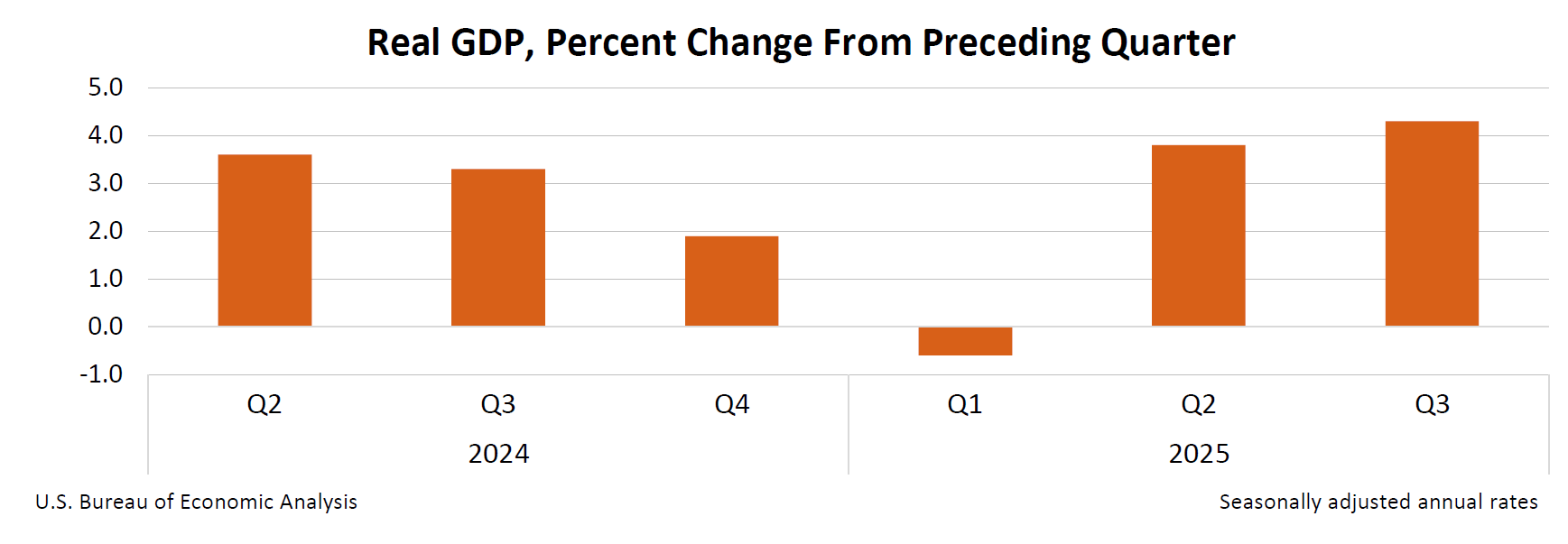
    Real gross domestic product (GDP) increased at an annual rate of 4.3 percent in the third quarter of 2025 (July, August, and September), according to the initial estimate released by the U.S. Bureau of Economic Analysis. In the second quarter, real GDP increased 3.8 percent.

    Due to the recent government shutdown, this initial report for the third quarter of 2025 replaces the release of the advance estimate originally scheduled for October 30 and the second estimate originally scheduled for November 26.

    The increase in real GDP in the third quarter reflected increases in consumer spending, exports, and government spending that were partly offset by a decrease in investment. Imports, which are a subtraction in the calculation of GDP, decreased. For more information, refer to the “Technical Notes” below.

    Contributions to Percent Change in Real GDP, 3rd Quarter 2025

    Compared to the second quarter, the acceleration in real GDP in the third quarter reflected a smaller decrease in investment, an acceleration in consumer spending, and upturns in exports and government spending. Imports decreased less in the third quarter.

    Real final sales to private domestic purchasers, the sum of consumer spending and gross private fixed investment, increased 3.0 percent in the third quarter, compared with an increase of 2.9 percent in the second quarter.

    The price index for gross domestic purchases increased 3.4 percent in the third quarter, compared with an increase of 2.0 percent in the second quarter. The personal consumption expenditures (PCE) price index increased 2.8 percent, compared with an increase of 2.1 percent. Excluding food and energy prices, the PCE price index increased 2.9 percent, compared with an increase of 2.6 percent.

    Quarter-to-Quarter Change in Prices

    Real gross domestic income (GDI) increased 2.4 percent in the third quarter, compared with an increase of 2.6 percent (revised) in the second quarter. The average of real GDP and real GDI increased 3.4 percent in the third quarter, compared with an increase of 3.2 percent (revised) in the second quarter.

    Profits from current production (corporate profits with inventory valuation and capital consumption adjustments) increased $166.1 billion in the third quarter, compared with an increase of $6.8 billion in the second quarter.

    Real GDP and Related Measures
    [Percent change from 2025 Q2 to Q3]
      Initial Estimate
    Real GDP 4.3
    Current-dollar GDP 8.2
    Real final sales to private domestic purchasers 3.0
    Real GDI 2.4
    Average of Real GDP and Real GDI 3.4
    Gross domestic purchases price index 3.4
    PCE price index 2.8
    PCE price index excluding food and energy 2.9

    Today’s release includes updated monthly data for April through September for personal income as well as updated monthly data for July through September for personal outlays and consumer spending. The updated statistics, reflecting newly available source data, are available in BEA’s iTables and API.

    *          *          *

    Next release: January 22, 2026, at 8:30 a.m. EST
    Gross Domestic Product, 3rd Quarter 2025 (Updated Estimate),
    GDP by Industry, and Corporate Profits (Revised)

    *          *          *


    Technical Notes

    Lapse in federal government appropriations

    The federal government shutdown that occurred in October and November resulted in delays in many of the principal source data that are used to produce estimates of GDP. This initial estimate of GDP for the third quarter of 2025 reflects a combination of data and methods that are typically used for the advance and second current quarterly estimates. More information on the source data and BEA assumptions that underlie the third-quarter estimate is shown in the key source data and assumptions table.

    Sources of change for real GDP

    Real GDP increased at an annual rate of 4.3 percent (1.1 percent at a quarterly rate1) in the third quarter, reflecting increases in consumer spending, exports, and government spending that were partly offset by a decrease in investment. Imports, which are a subtraction in the calculation of GDP, decreased.

    • The increase in consumer spending reflected increases in both services and goods. Within services, the leading contributors were health care and other services. Within goods, the leading contributors were recreational goods and vehicles as well as other nondurable goods.
      • Within health care, both outpatient services as well as hospital and nursing home services increased, based primarily on newly available third-quarter Census Bureau Quarterly Services Survey (QSS) data.
      • Within other services, the leading contributors to the increase were international travel, based on data from BEA’s International Transactions Accounts (ITAs), as well as professional and other services (mainly legal services), based on Census Bureau QSS data.
      • The increase in recreational goods and vehicles primarily reflected an increase in information processing equipment, based primarily on Census Bureau Monthly Retail Trade Survey (MRTS) data for all three months of the quarter.
      • The increase in other nondurable goods was mainly in prescription drugs reflecting Census Bureau MRTS data.
    • For both exports and imports, the estimates primarily reflected data from BEA’s ITAs, including updated information that will be publicly available with the U.S. International Transactions, 3rd Quarter 2025 release on January 14, 2026.
      • Within exports, both goods and services increased. The increase in goods was led by capital goods except automotive, as well as nondurable consumer goods. The increase in services was led by other business services, which includes professional and management consulting services.
      • Within imports, a decrease in goods (led by nondurable consumer goods) was partly offset by an increase in services (led by other business services).
    • The increase in government spending reflected increases in both state and local government spending (led by consumption expenditures) as well as federal government spending (led by defense consumption expenditures).
    • The decrease in investment primarily reflected a decrease in private inventory investment (led by wholesale trade and manufacturing), based primarily on Census Bureau inventory book value data and BEA’s inventory valuation adjustment.

    Settlements recorded in the third quarter

    Estimates of corporate profits were reduced by several settlements that were finalized in the third quarter. Settlements are recorded in the National Income and Product Accounts (NIPAs) on an accrual basis in the quarter when the settlement is finalized, regardless of when they are recorded on a company’s financial statement. Notably, in the third quarter:

    • A domestic health insurance provider reached a settlement with multiple sectors totaling $2.8 billion ($11.2 billion at an annual rate), over allegations of antitrust violations.
    • A domestic e-commerce company reached a settlement with the U.S. government in the amount of $2.5 billion ($10.0 billion at an annual rate), over allegations of deceptive enrollment practices.

    The estimate of GDI was not impacted because these settlements were recorded in the NIPAs as business current transfer payments, which offset the reduction to corporate profits.


    Continue Reading

  • PSX remains range-bound as cautious sentiment persists; PIA stake bids in focus

    The Pakistan Stock Exchange (PSX) experienced a largely range-bound session on Tuesday, as investor caution kept the benchmark KSE-100 Index trading within a narrow band. The session opened on a positive note, but after midday, the market saw a gradual decline as profit-taking and cautious trading set in. The KSE-100 Index closed at 171,073.73, down by 130.44 points or 0.08%.

    Investor attention was focused on the ongoing bidding process for a 75% stake in Pakistan International Airlines (PIA), with three consortia submitting sealed bids to take control of the national carrier. On the previous day, the market had already faced pressure as the roll-over week dampened investor sentiment, resulting in a volatile session where the KSE-100 Index dropped by 200.31 points, or 0.12%, to settle at 171,204.18 points.


    Continue Reading

  • IFC signs Rs 33.6bn guarantee to boost Engro Fertilizers and Pakistan’s agri-finance landscape

    The International Finance Corporation (IFC), Standard Chartered Bank Pakistan, and Engro Fertilizers have collaborated on a financing arrangement designed to mobilize long-term local lending for Pakistan’s agriculture sector.

    The deal involves an unfunded partial credit guarantee of up to PKR 33.6 billion from IFC, which reduces credit risk for Standard Chartered as it provides long-tenor rupee financing to Engro. This innovative mechanism aims to lower borrowing costs for Engro, which will use the funds for capital expenditures, including plant maintenance, and ensure stability in urea supply during peak agricultural demand.

    The arrangement is significant as it marks IFC’s first local-currency investment in Pakistan, allowing Engro to secure long-term financing without the need for foreign-currency debt, a key benefit given the current volatility in exchange rates and external financing conditions. The financing structure is also supported by the IFC-Canada Facility for Resilient Food Systems, which absorbs initial risk, making the arrangement more attractive to commercial lenders.

    While the deal does not address broader structural issues in Pakistan’s agriculture, such as inefficient logistics or low productivity, it demonstrates the potential of risk-sharing tools to attract domestic capital for long-term infrastructure investment. Market analysts expect similar financing models to become more common as local-currency financing gains favor over foreign debt in the current macroeconomic climate.


    Continue Reading