Category: 3. Business

  • Whisky industry faces a bleak mid-winter as tariffs bite and exports stall

    Whisky industry faces a bleak mid-winter as tariffs bite and exports stall

    Douglas FraserScotland business and economy editor

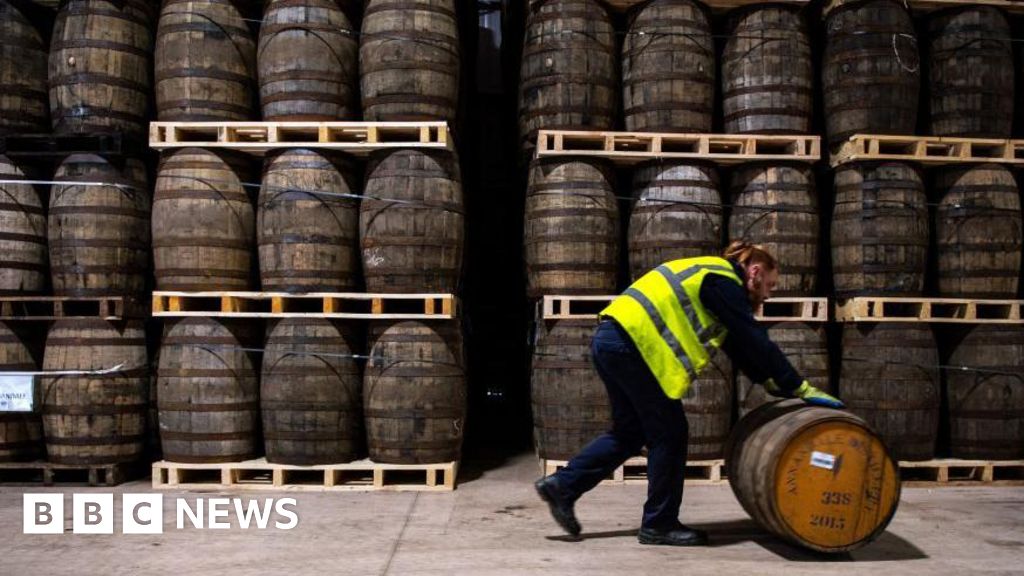
    AFP via Getty Images Stacked whisky casks and a man in a high vis jack rolling a cask in the foregroundAFP via Getty Images

    Scotch whisky is facing a sharp downturn in production as it adapts to tough market conditions around the world.

    Tariffs for export to the USA, introduced under the Trump administration and adding 10% to importers’ costs, have hit sales in the industry’s biggest export market.

    American tariffs on single malts, which were suspended four years ago, are on course to return next spring with a further 25% charge, unless a deal can be done with the Trump administration.

    Single malts, which sell at premium prices, are a particularly important part of exports to the US.

    However, the downturn is not only in the American market.

    There is also weakening demand in other markets due to squeezed growth and consumer spending, increased tax and costs, including packaging regulation, and because of trade disruption.

    Shipments to China last year fell by 31%, moving it from THE fifth biggest market to the tenth biggest. The first half of this year shows a 1% increase in the value of Scotch exports, to £2.5bn, while volumes were down nearly 4%.

    And the negative effects of US tariffs may not become clear for some months, as distillers moved swiftly to build up stocks in the country ahead of the frontier tax being introduced.

    Getty Images Donald Trump with a board showing what he claimed where tariffs on US goods and his proposed reciprocal tariffsGetty Images

    The full impact of Donald Trump’s tariffs is not yet clear as stocks were built up in the US before they took effect.

    One of the brightest prospects for distillers is the sharp tariff reductions in India, the world’s biggest whisky market which last year replaced France as the biggest importer of Scotch by volume.

    Currently at 150% of the value of each bottle, the trade deal between the London and Delhi governments includes a staged reduction to 40% tariffs.

    But with ratification in both countries expected to take time, that is seen as too far off to avoid the slump being felt in the shorter term.

    Companies that supply the industry are also feeling the pressure.

    Distillers’ demand for malted barley has slumped. Expectations for next year are of a cut from the range of 900,000 to 1 million tonnes to the lower range of 600 to 700,000 tonnes.

    Grain farmers are finding it hard to secure contracts for their barley harvests next year. Many are planting other crops such as wheat and rapeseed, or plan to do so.

    According to Jack Stevenson, chair of the crop committee of the National Farmers Union in Scotland, who runs Brangan farm between Portsoy and Banff: “A lot of the merchants are struggling to find contracts. The end users are cutting them back hugely.

    “It’s the same story the length and breadth of Scotland. We’re trying to keep the dialogue open with the Scotch whisky industry, and it’ll come back. It’s a huge market for Scotland.”

    But for now he says: “There’s doom and gloom in the cereals sector. And costs have been getting out of control on the machinery side of things.”

    Getty Images A farm gate in front of a field of growing crop and a blue sign saying Growing for BruichladdichGetty Images

    The downturn affects not just distillers but their suppliers including farmers who grow barley

    He says the break-even point for barley is more than £200 per tonne, and around half of it is sold in contracts for future delivery. But the spot price, without a future contract, fell during September to £160 per tonne.

    According to data compiled by market intelligence agency AHDB, use of barley for distilling and brewing during July to October was down 14% on last year.

    One farmers’ co-operative in Aberdeenshire is facing a halving of its 70,000 tonne barley contract this year with Chivas Brothers, one of the largest whisky distillers, owned by French drinks giant Pernod Ricard.

    A maltings plant, supplying distilleries with processed barley, is being permanently closed at Pencaitland in East Lothian, with the loss of around 20 jobs.

    Julian South, executive director of the Maltsters’ Association of Great Britain (MAGB), says that is partly because the sector has grown its processing capacity elsewhere in recent years, with plans for more expansion.

    “Whisky has its ups and downs, while brewing is more consistent,” he says. “Some people are quite surprised how quickly demand dropped off. Maltsters are having to look at their own production and contracts for barley in the coming season.”

    A key signal to farmers is the industry’s forecast of its demand for all malted barley, including around 40% of it used for brewing beer. The MAGB estimated demand next year is down from 1.8m tonnes to 1.4m.

    Whisky bottles on a production line at a bottling plant

    Some firms are forecasting reduced demand and are adjusting production

    Diageo, the biggest producer of Scotch whisky, has halted work at one of its main maltings, at Roseisle in Moray, until at least next June.

    A Diageo spokesperson said: “We have temporarily paused production at Roseisle Maltings as we look to balance capacity against current demand. We continue to assess production volumes and will communicate future plans as part of the normal planning cycle.”

    The firm has reduced production in some distilleries and has paused distilling at Teaninich, near Alness in Easter Ross.

    Glenmorangie, at Tain in Easter Ross, is among distilleries where production has been halted for several months. Along with Ardbeg, it is a subsidiary of French luxury goods firm LVMH.

    A spokeswoman says this is a “short term adjustment” to production based on forecast demand for Glenmorangie: “

    There was a temporary pause in distillation early in the summer and another pause over the winter, with production scheduled to resume in spring 2026.

    This is part of the strategy to grow the value of the brand, she said.

    That reflects the risk that over-production could force down prices, and not only the profit margins but the premium status built up over years.

    Visitors to a distillery sniffing a barrel of maturing whisky

    Man distilleries combine production with some kind of visitor experience that offers staff alternative roles

    In most cases, the small number of people required to run a distillery are being redeployed, and visitor centres remain open, though there are knock-on effects for hauliers and other suppliers.

    The large US distilling firm that owns the smaller Glenglassaugh and Benriach distilleries in north-east Scotland has been operating only one of them since the start of this year, shutting down Glenglassaugh until autumn. As it started up again, Benriach was closed for two years.

    Brown-Forman, based in Kentucky and owner of Jack Daniels whiskey, also operates the Glendronach distillery near Huntly, and says it has slowed production there, “based on demand planning”.

    That is despite its output of single malt having to wait at least 12 years before it is bottled and available for sale. The whole industry has to forecast where demand will be at least three years from now – the minimum length of time for Scotch whisky to mature in casks.

    Bourbon barrels

    A recent update for investors from Brown-Forman warned about global markets: “We continue to anticipate the operating environment to be challenging, with low visibility due to macroeconomic and geopolitical volatility as we face headwinds from consumer uncertainty and lower non-branded sales of used barrels”.

    The main customer for used bourbon barrels is the Scotch industry, which has been importing around £200m-worth each year.

    The downturn suggests the forecast is for a prolonged downturn in demand, though it may also be due to warehousing, or whisky bonds, being full from high production levels in recent years.

    There is criticism in the industry at slow planning decisions holding back investment in extra capacity.

    Brown-Forman’s global brand director for malts, Adip Agarwal, emphasised that slowing production, and the two-year closure of Benriach, does not alter availability of its Scotch produce.

    “This strategic decision aligns our production with the current market, allowing us to manage our resources effectively and optimise operations,” he said.

    No cheer from the Autumn Budget

    There have been signs of the downturn in pricing of whisky. The super-premium whiskies, which can typically be found in airport shops, have been coming down in price, and there is increased supermarket discounting of premium single malts.

    Some distillers declined to comment on the downturn, referring inquiries to their trade body, the Scotch Whisky Association (SWA).

    A spokeswoman there said: “There is no doubt that the industry is facing significant challenges both at home and on the world stage, including the 10% tariff in our biggest export market and a fall in global consumer demand.”

    The industry has been critical of the UK Treasury’s duty on alcohol, which covers around 7% of Scotch output that is sold in the UK, as well as other spirits including vodka, gin and rum.

    SWA chief executive Mark Kent said another rise in duty announced in the Westminster Budget last month puts “huge additional pressure on a sector suffering job losses, stalled investment and business closures”.

    He added: “Put simply, the government cannot expect the Scotch whisky sector to just keep delivering growth, both at home and on the world stage, if the conditions which support growth are not nurtured”.

    The SWA has been under pressure from farmers to develop more reliable and steady contracts for barley.

    The spokeswoman commented: “The stability of the Scotch Whisky supply chain is of vital importance to our sector, and challenges that impact us will of course impact everyone from the farmers who grow our cereals, through to the hospitality venues who serve our products.

    “Rising costs will impact Scotch Whisky producers’ margins, their long term planning and in some cases the viability of their businesses, and we are seeing the reverberating effects of that across our supply chain.”

    She added: “We remain in regular communication with our colleagues in the farming sector to address our industries’ shared challenges and boost the resilience of the Scotch Whisky supply chain from grain to glass.”


    Continue Reading

  • Opening up Victoria’s Otway basin to offshore gas exploration an ‘environmental betrayal’, Greens say | Energy

    Opening up Victoria’s Otway basin to offshore gas exploration an ‘environmental betrayal’, Greens say | Energy

    The Greens and environmental groups have condemned the federal government’s move to encourage more offshore gas exploration, describing it as an “environmental betrayal” that undermines Labor’s climate agenda.

    The minister for resources, Madeleine King, this week announced five new areas in the Otway basin, stretching from waters off the south-west coast of Victoria to the ocean west of Tasmania, would be opened up for gas exploration as part of the government’s future gas strategy.

    As cabinet deliberates over a major intervention into the east coast gas market, including a gas reservation, King said unlocking new supplies would help contain gas prices and avert potential shortfalls forecast for the end of the decade.

    Sign up: AU Breaking News email

    “Exploration and new discoveries will play an important role in underpinning our energy needs and support Australian industry and households as we meet our net zero commitments,” King said in a statement.

    The announcement comes just days after the Victorian government opened tenders for gas exploration in the Otway and Gippsland basins.

    The Australian Greens and the Wilderness Society have sharply criticised the federal government’s move, warning the search for new gas supplies would worsen the climate crisis and endanger marine wildlife.

    “Labor’s new ocean acreage handout is an environmental betrayal and an early Christmas gift to the fossil fuel companies driving the climate crisis,” the Greens’ resources spokesperson, Steph Hodgins-May, said.

    The party’s oceans spokesperson, Peter Whish-Wilson, questioned how opening new gas fields squared with the transition to clean energy.

    “Labor’s two-faced climate act is wearing thin,” he said.

    The Wilderness Society’s fossil fuel industry campaigner, Fern Cadman, said the waters earmarked in the latest acreage release were “wholly unsuitable” for gas exploration.

    “It’s deeply disturbing that while parts of our country are on fire, fuelled by climate heating and burning of fossil fuels, the Albanese government is mindlessly paving the way for new gas drilling. Australia is meant to be on a path transitioning away from fossil fuels, not opening the door to brand new gas,” Cadman said.

    King said the five new areas – all in commonwealth waters – had buffer zones to protect marine park boundaries.

    Public consultation on the five zones is open until 6 February, with applications for exploration permits closing on 30 June.

    The announcement comes as the Albanese government prepares to release the findings of a six-month review of the east coast gas market, which is widely expected to recommend establishing a new scheme to force producers to reserve supplies for domestic use.

    Cabinet ministers are also reportedly considering bulk-buying gas and selling it to businesses at discounted rates to prevent the closure of struggling manufacturers.

    Ahead of the review’s release, a coalition of environmentalists, inequality advocates and clean energy groups issued a statement opposing new taxpayer subsidises for gas companies, which they said have been “allowed to plunder Australia’s public resources without accountability for too long”.

    The nine organisations backed a 25% tax on gas exports, an Australian Council of Trade Unions’ policy that has been championed by the Greens.

    “Australia’s focus on gas exports has tripled domestic gas and electricity prices driving up inflation and household bills,” said Australian Council of Social Service climate and energy program director Kellie Caught, whose organisation was among the nine groups.

    “The government must implement gas export market controls and avoid options that effectively subsidise gas companies or incentivise new polluting gas production. It’s time for this government to prioritise people over rich gas companies.”

    Continue Reading

  • Implications of New White House Executive Order on Proxy Advisory Firms – Dentons

    1. Implications of New White House Executive Order on Proxy Advisory Firms  Dentons
    2. Trump gives Elon Musk a win over a longtime foe  CNN
    3. President Trump’s Proxy Firm Executive Order Will Protect Manufacturers and Main Street Investors  National Association of Manufacturers – NAM
    4. GC Cheat Sheet: The Hottest Corporate News Of The Week  Law360
    5. White House’s Executive Order on Proxy Advisors: 7 Things to Know Now  JD Supra

    Continue Reading

  • See you in March? Debate in New Zealand over extremely long summer break | New Zealand

    See you in March? Debate in New Zealand over extremely long summer break | New Zealand

    It sounds idyllic: weeks off work at the warmest time of the year, with relaxation mode kicking in before Christmas and little rush to return to the office until late February.

    But in New Zealand, there are concerns that the traditional long summer break could be hurting the country’s productivity.

    Simon Bridges, the head of the Auckland Business Chamber and former National party leader, has been contributing to a national debate over the length of New Zealand’s summer holidays, telling Guardian Australia there is a view that the country “shuts down not just for Christmas and New Year but in many cases all the way through to March”.

    “Even when businesses are physically back at work many are ‘easing into it’, not properly working until rather later than their actual holidays,” he said.

    “People will say in November, ‘I will come back to you Feb/March’ hence the phrase ‘mad March’ when things actually start to feel fully on again.”

    The long New Zealand summer holiday has become a national conversation, with arguments emerging about whether the break is too long, affecting productivity, or simply allowing employees to rest.

    The debate was ignited when business adviser and director Toss Grumley raised his concerns in a LinkedIn post, after getting responses in late November and early December of “let’s circle back [in] February”.

    “Everyone needs a break, but there seems to be this unofficial shutdown period where not a lot is done,” Grumley said.

    There are fears the long break is affecting productivity Photograph: Stuart Black/Alamy

    New Zealanders are entitled to a minimum four weeks paid annual leave each year, but often choose to take most or all of their leave over summer and the Christmas period, leaving little room for rest throughout the year, and causing lower productivity levels in weeks before and after the break.

    Grumley said the “long window” of little productive work in February and March has negative impacts on the “already quite fragile” New Zealand economy.

    He says the start of the year is not the time to take “a bit of oxygen out of the economy”.

    “You want to keep the momentum going to get us back on track,” he said.

    But some argue that a long break is necessary for people exhausted by working all year. This fatigue is felt first-hand by small businesses owners, including creative director Sam Ashby, who said he feels “shattered” by November.

    Before moving to Wellington five years ago, Ashby lived in London, where he said there is “an even cadence of holidays”. He said combining Christmas, New Years’ Eve and summer in New Zealand means holidays become “bunched up” and don’t provide adequate rest throughout the year.

    Ashby says the long holiday can be “very disruptive” for business, where he may not see a client for two or three months, or projects may be paused for long lengths of time.

    The self-employed business owner says he also notices “massive” financial implications on his design business because he is not able to invoice “nearly as much” in December and January, due to the holiday period.

    “It’s going to take me until February/March to really get the money rolling again, so you have to have either that money saved up or you have to really tighten your belt … for small businesses, I think it’s pretty tough in that respect,” he says.

    The implications of a long holiday can also reach beyond New Zealand, with Bridges warning it can complicate international business relationships.

    “Most of Asia, including China and India are always on, communicating quickly and expecting swift responses. If you want to do business with them, you need to be in that mode as well,” he said.

    Are several shorter breaks the solution?

    Massey University professor of innovation and economics, Christoph Schumacher, speaking on NewstalkZB on Tuesday, said holidays may not be structured as well as they could be.

    “The question is just can we structure it better? Can we organise it better, so that not everything shuts down but we scale things. Some people stay here to keep business going as usual, some people take off, and we rotate this,” Schumacher said.

    Spreading holidays throughout the year could be one way to prevent fatigue and improve productivity, according to Bridges. “This could be more productive for business as well as the wider economy as people are more refreshed and rested all year round,” he says.

    However, Kristy Phillips, chief executive of Hospitality New Zealand, says a shorter holiday period could hit the hospitality industry.

    “While a shorter holiday period over our summer may help with economic productivity at a macro-level, many Kiwis like to take their mid-winter break overseas rather than having a domestic holiday, so the benefit to hospitality would likely be minimal,” she said.

    Bridges admits the long holiday would be “really hard to change” in New Zealand culture. “We all feel entitled to our long Kiwi summer, me included.”

    Chris Hipkins, the former prime minister who will be taking three weeks off over summer, agrees. When asked by New Zealand media for his take on the long break, he replied “It’s good”.

    “In some respects it is better for business that everybody takes their holidays all at once, rather than as we see in some other countries where they are staggered and they have to manage all of the ups and downs that go with that.”

    Continue Reading

  • Media Advisory: Housing Announcement in Dartmouth

    Dartmouth, Nova Scotia, December 12, 2025 — Members of the media are invited to an housing announcement with the Honourable Gregor Robertson, Minister of Housing and Infrastructure and Minister responsible for Pacific Economic Development Canada; the Honourable Darren Fisher, Member of Parliament for Dartmouth–Cole Harbour; the Honourable John White, Nova Scotia Minister of Housing; and His Worship Andy Fillmore, Mayor of the Halifax Regional Municipality.

    Date:
    Sunday, December 14, 2025

    Time:
    11:30 a.m. AST

    Location:
    École Shannon Park School

    75 Iroquois Drive,
    Dartmouth, Nova Scotia B3A 4M5

    Members of the media are asked to contact HICC Media Relations at media-medias@infc.gc.ca to confirm their attendance.

    Continue Reading

  • Andrew Caplan, Erin Choo Honored with Award of Merit by the Bar Association of San Francisco

    Andrew Caplan, Erin Choo Honored with Award of Merit by the Bar Association of San Francisco

    The event, held on December 11 at the Hyatt Regency Embarcadero in San Francisco, brought together BASF members, legal professionals and community leaders for an afternoon of reflection, recognition and forward-thinking conversations.

    Caplan and Choo earned the award for providing pro bono counsel to BASF and the Justice and Diversity Center of the Bar Association of San Francisco during complex contract negotiations for their new Association Management System—an essential platform that supports and streamlines operations across both organizations. Their strategic guidance was instrumental in navigating these negotiations, ensuring that the agreement’s terms safeguard the organizations’ interests and support their evolving needs.

    Click here to learn more about the 2025 awards.

    Caplan represents Fortune 500 and emerging growth companies in structuring and negotiating a wide range of commercial agreements, particularly involving software licensing and development, deployment of AI solutions, information technology and business process outsourcing, hardware manufacturing and distribution, intellectual property licensing, financial technology (fintech) partnership and banking-as-a-service agreements, and other strategic commercial relationships.

    Choo focuses on general corporate and securities matters, along with technology-related commercial agreements.

    Continue Reading

  • GPT-5.2 vs Grok 4: Comparing benchmarks, price, and features

    GPT-5.2 vs Grok 4: Comparing benchmarks, price, and features

    Yesterday, just as OpenAI celebrated its 10-year anniversary, the AI company launched GPT-5.2, its latest series of AI models to power ChatGPT. The latest release is allegedly in response to OpenAI’s rumored “code red” state, as the AI market share leader is reportedly bleeding users to Google’s Gemini 3 and other AI chatbots. 

    The main competition appears to be between Gemini 3 and GPT-5.2, as Google’s Gemini 3 has made pretty big waves since it launched in mid-November. Gemini 3 and GPT-5.2 appear to be neck and neck in most metrics, showing that OpenAI still has the chops to compete with the top dogs. However, Grok 4.1 is also a mainstay on leaderboards, and it’s put up some pretty good scores of its own. 

    So, if you’re curious how GPT-5.2 compares to Grok 4.1, we can offer an initial assessment. Keep in mind that GPT-5.2 is still fresh out of the box. This means that the benchmark scores will certainly change over time as more people get their hands on it to run it through its paces. 

    GPT-5.2 vs. Grok 4.1: LMArena rankings

    GPT-5.2 isn’t ranked on most of LMArena’s leaderboards at the time of this writing. Thus, it makes it difficult to compare the two directly from here. That doesn’t mean that we can’t try. According to OpenAI, GPT-5.2 is a few percentage points higher in almost every metric compared to GPT-5.1, which is ranked on LMArena. 

    Assuming GPT-5.2 usurps GPT-5.1 in every category, we can conclude that GPT-5.2 will either be at or very close to the top of the leaderboards. In the one metric where GPT-5.2 exists on LMArena at this time — which is WebDev — OpenAI’s model is currently ranked second overall (above Grok). 

    So, we can conclude that GPT-5.2 will probably rank higher than Grok in almost every category, although Grok may retain its second-place finish on the Text leaderboard, where it places just below Gemini 3.

    Mashable Light Speed

    GPT-5.2 vs. Grok 4.1: Benchmark tests

    Since GPT-5.2 is so new, it hasn’t shown up on a lot of independent benchmark tests yet. For the time being, we have to rely on OpenAI’s self-reported benchmark scores. Keep in mind that these scores are part of a press release and have not been independently verified. 

    • Creative Writing v3 – GPT-5.2 vastly outperforms Grok 4.1 here, with an ELO Score of 1675.5 versus Grok 4.1’s 1268.6.

    • GDPval-AA – GPT-5.2 also wins this one, scoring a 1474 versus Grok’s 1041.

    • GPQA Diamond – GPT-5.2 pulls out another win here, but the gap is much lower, with GPT-5.2 scoring a 90.3% and Grok 4 scoring an 87.7%.

    • AIME 2025 – GPT-5.1 beats Grok with a score of 95.7% to 92.7%. It stands to reason that GPT-5.2 will top the leaderboards here and beat Grok as well. 

    • FrontierMath – Another big win for GPT-5.2 here, with a much higher accuracy than Grok 4.

    The other benchmarks pretty much tell the same story. GPT-5.2 beats Grok 4.1 on benchmarks, and the margins aren’t typically very close. Real-world results may vary, though, as benchmarks only really tell part of the story. 

    GPT-5.2 vs. Grok 4.1: Availability

    Both AI models are generally available to the public via OpenAI’s ChatGPT and Grok’s chat platform, respectively. In terms of features, both have AI chatbot functionality and the ability to generate images directly from the AI chatbot. ChatGPT can make videos with the help of Sora 2, while Grok can generate videos and images from its Grok Imagine platform. Both Sora and Grok Imagine lag far behind rivals like Google’s Veo 3 and LumaAI’s Ray3, however.

    Availability is largely the same, as most people interact with ChatGPT and Grok directly through their interfaces. However, ChatGPT is integrated into more products than Grok, giving it a leg up in terms of overall availability. 

    GPT-5.2 vs. Grok 4.1: Pricing

    For GPT-5.2, you have to get the pro version of ChatGPT, which starts at $20 per month or $200 per month, depending on what you want. Grok’s free version also limits you to Grok 4, and not Grok 4.1, so you also need a subscription for Grok 4.1. A SuperGrok subscription starts at $30 per month and goes up to $300 per month if you want more access. 

    That gives GPT-5.2 the edge, as everyone who passed the first grade knows, $20 is less than $30. 

    As for which one is worth it more, you’ll have to try out both AI platforms for yourself and see which one performs better for the kind of work you want them to do. Benchmarks and price tags don’t mean much if one of them simply doesn’t work as well as the other for your particular use case. 


    Disclosure: Ziff Davis, Mashable’s parent company, in April filed a lawsuit against OpenAI, alleging it infringed Ziff Davis copyrights in training and operating its AI systems.

    Continue Reading

  • RIT integrates print and graphic media into packaging science

    RIT integrates print and graphic media into packaging science

    RIT’s print and graphic media technology curriculum is being integrated into the packaging science program to align with growing and evolving industries.

    Currently enrolled undergraduate and graduate students in the program will complete coursework to graduation. Prospective students are now being directed to the Bachelor of Science degree in packaging science, where they will be able to take coursework that emphasizes manufacturing processes, materials science, color management, and package printing technologies—competencies that are increasingly vital in the fast-growing packaging sector, said Kyle Dunno, packaging and graphic media science department chair in RIT’s College of Engineering Technology (CET).

    “For generations, the print and graphic media program has played a vital role in preparing students to lead in the printing, publishing, and media sectors,” said Dunno. “As print technologies have advanced and the industry has evolved, we’ve reflected deeply on how best to honor that legacy while preparing our students for future opportunities. This strategic integration maintains the core of print education at RIT while expanding its relevance in the rapidly growing packaging and converting industries.”

    In 2022, CET combined its print and packaging science departments to align programs that would better represent the growth in the package printing sector. Since that time, department leadership has worked closely with faculty, industry partners, and alumni to develop a newly aligned curriculum that provides differentiation for both prospective students and program graduates.

    The new curriculum ensures that RIT graduates remain positioned to lead in areas of manufacturing, materials, color management, and package printing technologies.

    Conventional and digital printing processes remain foundational within the curriculum. Coursework will continue to include premedia, production workflows, converting technologies, process control, and variable data printing, and their applications to folding cartons, flexible packaging, labels, corrugated fiberboard, metal decoration, and others.

    “This represents a natural progression for our programs,” said Dunno. “As the industrial world pivots toward integrated packaging solutions, automation, and sustainability, this approach allows us to honor the rich heritage of print education at RIT while embracing innovation in one of today’s most vibrant industrial arenas.”

    This integration reinforces the college’s focus on industry-relevant applied science and engineering education, said S. Manian Ramkumar, dean of CET.

    “By connecting core competencies from both print and packaging, we are ensuring our students gain hands-on, future-oriented experiences that align with evolving workforce needs,” he said.

    Both packaging and print faculty-researchers and professional staff provide support to the printing industry through the department’s existing testing, research, and training services. These services will continue without interruption, ensuring ongoing partnership with companies and professionals who rely on RIT’s expertise. In addition, RIT will continue to serve as the certifying body for Idealliance’s G7 and G7 Plus color calibration programs, supporting industry’s adoption of globally recognized color quality standards and processes.

    “This integration represents a natural and meaningful progression,” Dunno said. “It honors our legacy, strengthens our industry relevance, and ensures that students continue to benefit from cutting-edge technology, hands-on learning, and real-world experience.”

    Continue Reading

  • US TikTok investors in limbo as deal set to be delayed again

    US TikTok investors in limbo as deal set to be delayed again

    A billionaire investor keen on buying TikTok’s US operations has told the BBC he has been left in limbo as the latest deadline for the app’s sale looms.

    The US has repeatedly delayed the date by which the platform’s Chinese owner, Bytedance, must sell or be blocked for American users.

    US President Donald Trump appears poised to extend the deadline for a fifth time on Tuesday.

    “We’re just standing by and waiting to see what happens,” investor Frank McCourt told BBC News.

    “But if the moment arrives, we’re prepared to move forward… we’ve raised the capital to buy it – we’ll see.”

    The popular short-form video app was due to be banned or sold in the US in January in accordance with a law passed by Congress in 2024.

    Lawmakers said at the time ByteDance’s links to the Chinese government threatened national security, and expressed fears Beijing could force the company to hand over data on US users.

    It’s a concern TikTok and its owners have always said is unfounded.

    The law was signed by President Joe Biden while he was still in office and was upheld by the Supreme Court in early 2025.

    Trump and members of his administration have previously claimed a TikTok deal was done, and had the blessing of Chinese President Xi Jinping.

    The president has also said “sophisticated” US investors would acquire the app, including two of his allies: Oracle chairman Larry Ellison and Dell Technologies’ Michael Dell.

    Members of the Trump administration had indicated the deal would be formalised in a meeting between Trump and Xi in October – however it concluded without an agreement being reached.

    Neither TikTok’s Chinese owner ByteDance nor Beijing have since announced approval of a sale, despite Trump’s claims.

    This time there are no such claims a deal is imminent, leading most analysts to conclude another extension is inevitable.

    Without naming Trump’s hand-selected investors, Mr McCourt told the BBC he was concerned “about a concentration of power and influence because platforms like TikTok are very influencing”.

    He is part of a group of investors including Reddit co-founder Alexis Ohanian and Canadian investor Kevin O’Leary.

    “My hope would be that whatever happens, that it is shut down or sold, and lands in the hands of people that comply with the law,” he said.

    He said he wants to operate TikTok without any of its Chinese technology, including its powerful recommendation algorithm, and that his non-profit Project Liberty has developed other technology that could be used instead.

    Continue Reading

  • Teck Obtains Final Court Approval for Merger of Equals with Anglo American

    Teck Obtains Final Court Approval for Merger of Equals with Anglo American

    Vancouver, B.C. – Teck Resources Limited (TSX: TECK.A and TECK.B, NYSE: TECK) (“Teck”) announced today that Teck has obtained a final order from the Supreme Court of British Columbia approving the previously-announced plan of arrangement under section 192 of the Canada Business Corporations Act, involving, among other things, the merger of equals of Anglo American plc (“Anglo American”) and Teck (the “Merger”).

    The Merger remains subject to the satisfaction or waiver of certain other closing conditions customary in a transaction of this nature, including receipt of applicable competition and regulatory approvals in various jurisdictions globally.

    Further details regarding the Merger are set out in Teck’s management information circular dated November 3, 2025 (the “Circular”), which is available under Teck’s profile on SEDAR+ (www.sedarplus.ca) and on EDGAR (www.sec.gov).

    Forward Looking Statements
    This news release contains certain forward-looking information and forward-looking statements as defined in applicable securities laws (collectively referred to as forward-looking statements). These statements relate to future events or future performance. All statements other than statements of historical fact are forward-looking statements. The use of any of the words “anticipate”, “can”, “could”, “plan”, “continue”, “estimate”, “expect”, “may”, “will”, “would”, “project”, “predict”, “likely”, “potential”, “should”, “believe” and similar expressions is intended to identify forward-looking statements. These statements involve known and unknown risks, uncertainties and other factors that may cause actual results or events to differ materially from those anticipated in such forward-looking statements. These statements speak only as of the date of this news release. These forward-looking statements include, but are not limited to, statements concerning the expected timing of completion of the Merger, and other statements that are not historical facts.

    These statements are based on a number of assumptions, including, but not limited to, assumptions regarding general business and economic conditions, future outlook and anticipated events, such as the ability of Anglo American and Teck to complete the Merger, the ability of Teck and Anglo American to obtain all required regulatory approvals, the ability of Teck and Anglo American to satisfy all other conditions to the Merger and the strategic vision of the merger between Teck and Anglo American following the closing of the Merger. The foregoing list of assumptions is not exhaustive. Events or circumstances could cause actual results to vary materially.

    Forward-looking information is based on the information available at the time those statements are made and are of good faith belief of the officers and directors of Teck and Anglo American as of the time with respect to future events and are subject to risks and uncertainties that could cause actual results to differ materially from those expressed in the Forward-looking information. Factors that may cause actual results to vary materially include, but are not limited to, the possibility that the Merger will not be completed on the terms and conditions, or on the timing, currently contemplated, and that it may not be completed at all, due to a failure to obtain or satisfy, in a timely manner or otherwise, required regulatory approvals and other conditions to the closing of the Merger or for other reasons, public perception of the Merger, market reaction to the Merger, the negative impact that the failure to complete the Merger for any reason could have on the business of Anglo American or Teck, the ability of Anglo American and Teck to successfully integrate and capture expected synergies, general economic and market conditions, including interest and foreign exchange rates, global financial markets, changes in government regulations or in tax laws, industry competition, technological developments and other factors described or discussed in Anglo American’s or Teck’s disclosure materials filed with applicable securities regulatory authorities from time to time.

    Teck assumes no obligation to update forward-looking statements except as required under securities laws. Further information concerning risks, assumptions and uncertainties associated with these forward-looking statements, the Merger and Teck’s business can be found in the Circular in respect of the Merger filed under Teck’s profile on SEDAR+ (www.sedarplus.ca) and on EDGAR (www.sec.gov).

    About Teck
    Teck is a leading Canadian resource company focused on responsibly providing metals essential to economic development and the energy transition. Teck has a portfolio of world-class copper and zinc operations across North and South America and an industry-leading copper growth pipeline. We are focused on creating value by advancing responsible growth and ensuring resilience built on a foundation of stakeholder trust. Headquartered in Vancouver, Canada, Teck’s shares are listed on the Toronto Stock Exchange under the symbols TECK.A and TECK.B and the New York Stock Exchange under the symbol TECK. Learn more about Teck at www.teck.com or follow @TeckResources.

    Investor Contact:
    Emma Chapman
    Vice President, Investor Relations
    +44.207.509.6576
    emma.chapman@teck.com

    Media Contact:
    Dale Steeves
    Director, External Communications
    236.987.7405
    dale.steeves@teck.com

    25-34-TR

    Continue Reading