Category: 3. Business

  • Airbus cuts 2025 delivery target due to A320 fuselage panel issue

    Airbus cuts 2025 delivery target due to A320 fuselage panel issue

    PARIS — Aerospace manufacturer Airbus expects to deliver fewer planes than planned this year following an issue with fuselage panels used on some A320 planes.

    The European company said Wednesday it is targeting around 790 commercial aircraft deliveries in 2025 “in light of recent supplier quality issue on fuselage panels impacting its A320 family delivery flow.”

    The previous target was around 820 aircraft, the company said, explaining the projection was revised downward because the problem occurred at the end of the year, which is traditionally a very busy period.

    The issue affecting a “limited number” of metal panels on the single-aisle A320 aircraft was contained and new panels meet all requirements, the company said.

    Airbus sources parts and components from thousands of outside suppliers.

    The quality issue with panels surfaced earlier this week, just days after the firm reported it was rushing to fix a separate software problem impacting about 6,000 of the popular planes.

    Continue Reading

  • Powering the future: The growth of Europe’s battery supply chain

    Powering the future: The growth of Europe’s battery supply chain

    The demand for battery raw materials is expected to increase significantly over the next decade, driven by the growth of electric vehicles (EVs) and energy storage systems. Europe is entering an exciting phase as it expands its production base for battery materials, including lithium, with the aim of strengthening its global position. However, the region faces persistent vulnerabilities such as heavy reliance on imports, supply chain complexities, rising energy and labor costs, slower-than-expected market developments, and the challenge of securing capital-intensive investments — all of which could undermine the sector’s competitiveness.

    In October 2025, Marsh, Rystad Energy, and Commodity Trading Club hosted an event in London to discuss how Europe can develop secure, resilient, and sustainable battery supply chains. The key takeaways from this discussion are summarized below.

    Financing the battery revolution: Overcoming capital challenges

    Securing funding for capital-intensive battery projects remains crucial to scaling the value chain. In Europe, raising capital for land, construction, machinery, technology, and operations can be challenging. Supply chain disruptions and permitting delays further threaten the steady revenue streams that investors seek.

    Equity risk is primarily addressed through non-recourse and project finance structures, where project success can depend on strong offtake agreements and the ability to secure favorable pricing for products. One participant from a multinational energy company highlighted the importance of engaging potential buyers (offtake partners) early to align project schedules and expectations.

    Government support emerged as a key theme. Panelists highlighted the US Inflation Reduction Act (IRA) as a benchmark for accelerating investment through subsidies and tax credits.

    Experience from companies operating in the US and Europe indicates that measures in the US, such as Executive Order 14265, have served to streamline acquisitions and reduce uncertainty, boosting investor confidence. For example, a US$225 million Department of Energy grant accelerated a US lithium project, illustrating the impact of government backing. While the US lithium battery market is growing faster than the EU’s, due in part to such support, the EU market is maturing and leveraging lessons learned abroad to build its capabilities. As one participant noted, it has “been great for us to be able to develop our capabilities in the US and then bring that across into the projects in Europe.”

    Indeed, the EU is fast-tracking battery projects through initiatives such as the FASTEST project, which accelerates battery R&D, and regulations like the Net Zero Industry Act and the Critical Raw Materials Act, which prioritize strategic projects and streamline permitting. The EU Commission has identified 47 key projects to expedite the raw material value chain, aiming to reduce historically lengthy permitting timelines.

    Innovative financing models, such as venture tech approaches, are gaining traction for critical mineral production in Europe and North America. These models tend to prioritize investors’ vision and commitment over traditional cash flow metrics, helping earlier-stage developers to secure funding.

    Mapping the hidden layers of battery supply chains

    The global battery supply chain is complex and geographically concentrated, with China holding 80% of battery cell manufacturing capacity. Chinese restrictions on exports of certain technologies and critical minerals, including lithium iron phosphate (LFP) batteries, have limited European producers’ ability to develop LFP chemistry without reliance on China.

    To enhance growth, Europe should focus on manufacturing optimization, access to capital, cost reduction, and technological innovation. Currently, European lithium-ion (li-ion) battery pack prices average 163€/kWh, about 40% higher than China’s 116€/kWh.

    Despite strong R&D support and new policies, Europe remains dependent on imports for the supply and extraction of raw materials. Emerging geothermal lithium projects show promise, but short-term gaps mean imports will remain necessary for some time.

    Bruno Livi of Marsh emphasized the importance of examining supply chain interdependencies and bottlenecks beyond direct suppliers, “where dependencies can increase up to 150-fold.” He added that many companies lack visibility into these extended networks.

    AI-powered platforms like Marsh McLennan’s Sentrisk, together with specialist insights, can enhance supply chain visibility. For example, Sentrisk analyzed a battery supply chain by mapping its extensive supplier networks and incorporating geopolitical, natural hazard and concentration risks, enabling rapid, data-driven insights to inform risk management and strategic planning. Strategies to strengthen supply chains include supplier development programs, diversification, and nearshoring or friendshoring.

    Sustainability as a strategic imperative

    From a financing perspective, one speaker said environmental, social, and governance (ESG) alignment is “a license to finance. It’s not a nice-to-have. It’s a must-have, a non-negotiable requirement.”

    Financing and risk management in the battery supply chain requires integrating environmental and sustainability concerns into risk assessments, supplier due diligence, and embedding sustainability factors into business strategies. As Aaron Bailey of Marsh said, sustainable business practices can attract investment and align with the insurance industry’s growing focus on responsible practices.

    Navigating political minefields

    The geographical concentration of lithium makes the battery supply chain susceptible to disruptions stemming from political instability, trade disputes, or natural disasters in key producing regions.

    Investors and project owners often have to balance value creation with short- and long-term risks. While perceptions of political risk can deter investment, such risks can be managed through country-specific assessments, market intelligence, regulatory support, and insurance solutions.

    Companies are adopting several risk mitigation strategies, including:

    • Assessing the impact of country risks using resources such as Marsh’s World Risk Review, which provides up-to-date country risk insights.
    • Integrating political risk into risk management decisions at an early stage.
    • Adopting risk mitigation solutions, such as political risk insurance or trade credit insurance.

    These measures help manage country risk, reduce financial exposure, and can assist in unlocking new investment opportunities.

    Balancing innovation, risk, and opportunity

    Europe’s battery supply chain faces a dynamic interplay of global economic forces, industry trends, political motivations, and business strategies. As the sector evolves, companies can increasingly benefit from a nuanced understanding of their risk exposures and solutions in their operating regions.

    As one panelist said, Europe’s battery market is interesting because it has first-of-a-kind projects, many of which are trying to break new ground. One panelist cautioned that the success of Europe’s battery supply chain “depends on keeping the promises that we make.” Insurance coverage has an important role in the growth and strengthening of Europe’s battery supply chain by protecting investments, enabling growth, and promoting compliance with regulatory requirements and consumer expectations.

    For more information on mitigating risks in your battery supply chain operations, please contact your local Marsh representative.

    Want to learn more? Fill out the form and let’s connect.

    Continue Reading

  • OHC & DHC Update Muara–World Jan 2026

    In order to keep providing you with our global services, Maersk is Increasing the Terminal Handling Service – Origin (OHC) & Terminal Handling Service – Destination (DHC) charges for the scope of Muara, BN to/from World with effective from 01-January -2026 until further notice.

    The tariff amount is detailed as follow:

    * Non-SPOT booking – The above rate is retrieved based on PCD. PCD = Price Calculation Date. For non-FMC, PCD refers to the scheduled departure date of the first water leg at the time of booking confirmation for non-spot bookings. For FMC, PCD is last container gate-in date for non-spot bookings.

    * SPOT booking – The above rate is retrieved based on 1st vessel ETD at booking confirmation for Spot bookings.

    For your reference, we have also included the levels and rate structure for some sample corridors from Muara, BN to Rotterdam, NL valid from 01-Jan-26 until further notice. These may be subject to future Change; however, we will make sure to notify you accordingly.

    Muara, BN to Rotterdam, NL

    • The above rates are also subject to other applicable surcharges, including local charges and contingency charges.
    • These rates are unaffected by, and do not affect, any tariff notified, published or filed in accordance with local regulatory requirements.
    • For trades subject to the US Shipping Act or the China Maritime Regulations, quotations or surcharges that vary from the Maersk Line tariff shall not be binding on Maersk Line unless included in a service contract or service contract amendment that has been filed with the Federal Maritime Commission (FMC) or the Shanghai Shipping Exchange, as applicable.

    If you have any questions, please feel free to reach out to our local representatives on Maersk.com

    Continue Reading

  • India's IndiGo reports flight delays, cancellations due to tech issues, congestion – Reuters

    1. India’s IndiGo reports flight delays, cancellations due to tech issues, congestion  Reuters
    2. 33 IndiGo flights cancelled at Hyderabad airport in two days; passengers inconvenienced  Punjab News Express
    3. Mumbai-bound IndiGo flight delayed by over three hours at Coimbatore; passengers complain of poor response  The New Indian Express
    4. Passengers face inconvenience over sudden delay & cancellation of flights  lokmattimes.com
    5. 42 IndiGo flights cancelled at Bengaluru airport on December 3  The Hindu

    Continue Reading

  • Euro area bank interest rate statistics: October 2025

    Euro area bank interest rate statistics: October 2025

    3 December 2025

    Bank interest rates for corporations

    Chart 1

    Bank interest rates on new loans to, and deposits from, euro area corporations

    (percentages per annum)

    Data for cost of borrowing and deposit interest rates for corporations (Chart 1)

    The composite cost-of-borrowing indicator, which combines interest rates on all loans to corporations, remained broadly unchanged in October 2025. The interest rate on new loans of over €1 million with a floating rate and an initial rate fixation period of up to three months increased by 6 basis points to 3.19%. The rate on new loans of the same size with an initial rate fixation period of over three months and up to one year fell by 13 basis points to 3.26%. The interest rate on new loans of over €1 million with an initial rate fixation period of over ten years decreased by 15 basis points to 3.43%. In the case of new loans of up to €250,000 with a floating rate and an initial rate fixation period of up to three months, the average rate charged stayed constant at 3.59%.
    As regards new deposit agreements, the interest rate on deposits from corporations with an agreed maturity of up to one year stayed almost constant at 1.91% in October 2025. The interest rate on overnight deposits from corporations stayed constant at 0.52%.
    The interest rate on new loans to sole proprietors and unincorporated partnerships with a floating rate and an initial rate fixation period of up to one year increased by 6 basis points to 3.97%.

    Table 1

    Bank interest rates for corporations

    i.r.f. = initial rate fixation
    * For this instrument category, the concept of new business is extended to the whole outstanding amounts and therefore the business volumes are not comparable with those of the other categories. Outstanding amounts data are derived from the ECB’s monetary financial institutions balance sheet statistics.

    Data for bank interest rates for corporations (Table 1)

    Bank interest rates for households

    Chart 2

    Bank interest rates on new loans to, and deposits from, euro area households

    Data for cost of borrowing and deposit interest rate for households (Chart 2)

    The composite cost-of-borrowing indicator, which combines interest rates on all loans to households for house purchase, showed no change in October 2025. The interest rate on loans for house purchase with a floating rate and an initial rate fixation period of up to one year remained broadly unchanged at 3.52%. The rate on housing loans with an initial rate fixation period of over one and up to five years stayed almost constant at 3.37%. The interest rate on loans for house purchase with an initial rate fixation period of over five and up to ten years remained broadly unchanged at 3.48%. The rate on housing loans with an initial rate fixation period of over ten years stayed almost constant at 3.16%. In the same period the interest rate on new loans to households for consumption decreased by 7 basis points to 7.33%.
    As regards new deposits from households, the interest rate on deposits with an agreed maturity of up to one year remained broadly unchanged at 1.77%. The rate on deposits redeemable at three months’ notice stayed constant at 1.21%. The interest rate on overnight deposits from households showed no change at 0.25%.

    Table 2

    Bank interest rates for households

    i.r.f. = initial rate fixation
    * For this instrument category, the concept of new business is extended to the whole outstanding amounts and therefore the business volumes are not comparable with those of the other categories; deposits placed by households and corporations are allocated to the household sector. Outstanding amounts data are derived from the ECB’s monetary financial institutions balance sheet statistics.
    ** For this instrument category, the concept of new business is extended to the whole outstanding amounts and therefore the business volumes are not comparable with those of the other categories. Outstanding amounts data are derived from the ECB’s monetary financial institutions balance sheet statistics.

    Data for bank interest rates for households (Table 2)

    Further information

    The data in Tables 1 and 2 can be visualised for individual euro area countries on the bank interest rate statistics dashboard. Additionally, tables containing further breakdowns of bank interest rate statistics, including the composite cost-of-borrowing indicators for all euro area countries, are available from the ECB Data Portal. The full set of bank interest rate statistics for both the euro area and individual countries can be downloaded from ECB Data Portal. More information, including the release calendar, is available under “Bank interest rates” in the statistics section of the ECB’s website.

    For media queries, please contact Benoit Deeg, tel.: +49 69 1344 95686

    Notes:

    • In this press release “corporations” refers to non-financial corporations (sector S.11 in the European System of Accounts 2010, or ESA 2010), “households” refers to households and non-profit institutions serving households (ESA 2010 sectors S.14 and S.15) and “banks” refers to monetary financial institutions except central banks and money market funds (ESA 2010 sector S.122).
    • The composite cost-of-borrowing indicators are described in the article entitled “Assessing the retail bank interest rate pass-through in the euro area at times of financial fragmentation” in the August 2013 issue of the ECB’s Monthly Bulletin (see Box 1). For these indicators, a weighting scheme based on the 24-month moving averages of new business volumes has been applied, in order to filter out excessive monthly volatility. For this reason the developments in the composite cost-of-borrowing indicators in both tables cannot be explained by the month-on-month changes in the displayed subcomponents. Furthermore, the table on bank interest rates for corporations presents a subset of the series used in the calculation of the cost-of-borrowing indicator.
    • Interest rates on new business are weighted by the size of the individual agreements. This is done both by the reporting agents and when the national and euro area averages are computed. Thus changes in average euro area interest rates for new business reflect, in addition to changes in interest rates, changes in the weights of individual countries’ new business for the instrument categories concerned. The “interest rate effect” and the “weight effect” presented in this press release are derived from the Bennet index, which allows month-on-month developments in euro area aggregate rates resulting from changes in individual country rates (the “interest rate effect”) to be disentangled from those caused by changes in the weights of individual countries’ contributions (the “weight effect”). Owing to rounding, the combined “interest rate effect” and the “weight effect” may not add up to the month-on-month developments in euro area aggregate rates.
    • In addition to monthly euro area bank interest rate statistics for October 2025, this press release incorporates revisions to data for previous periods. Hyperlinks in the main body of the press release lead to data that may change with subsequent releases as a result of revisions. Unless otherwise indicated, these euro area statistics cover the EU Member States that had adopted the euro at the time to which the data relate.
    • As of reference period December 2014, the sector classification applied to bank interest rates statistics is based on the European System of Accounts 2010 (ESA 2010). In accordance with the ESA 2010 classification and as opposed to ESA 95, the non-financial corporations sector (S.11) now excludes holding companies not engaged in management and similar captive financial institutions.

    Continue Reading

  • Societal and technological threats rise on G20 business leaders’ risk agendas

    London | 3 December, 2025

    While G201 business leaders remain concerned about the potential impact of economic downturn and inflation in the near-term, the risks associated with insufficient public services and social protections, lack of economic opportunity and misinformation and disinformation are now also seen as significant threats. This is according to the Executive Opinion Survey 2025, conducted by the World Economic Forum and released today by its strategic partners – Marsh McLennan (NYSE: MMC), the world’s leading professional services firm in the areas of risk, strategy and people and Zurich Insurance Group (Zurich), a leading global multi-line insurer and provider of resilience services.

    Andrew George, President, Marsh Specialty, said: “With the rise of AI, the proliferation of misinformation and disinformation is enabling bad actors to operate more broadly. As such, the challenges posed by the rapid adoption of AI and associated cyber threats now top boardroom agendas. Also, while economic and geopolitical factors have deflected some of the focus on change commitments in the short-term, businesses must remain focused on their environmental objectives to mitigate the risks associated with the changing climate in the longer-term.”

    Alison Martin, CEO, EMEA & Bank Distribution, Zurich, said: “This year’s survey makes it clear: critical areas like pensions and public health are no longer just government issues – they’re boardroom priorities. It is concerning to see that in Europe today, there are fewer than three working-age adults for every pensioner, and over a third of EU citizens aren’t saving enough for retirement. These gaps threaten both workforce wellbeing and broader social stability. The time to act is now, by joining forces across sectors, we can help empower people to build financial resilience and secure a brighter future for all.”

    The annual survey reveals the top five near-term risks identified by more than 11,000 business leaders from 116 countries. Fears relating to an economic downturn continue to dominate concerns cited by G20 business leaders – leading the list overall for the third consecutive year – and claiming the top spot in the UK and US.

    For the first time, technological threats associated with misinformation and disinformation entered the top five risks for G20 business leaders, in fifth place. This reflects fears that advances in AI are fuelling information warfare amid rising geopolitical tensions, influencing elections and global markets, and threatening critical infrastructure and cybersecurity.

    Social risks associated with insufficient public services and social protections, and a lack of economic opportunity or unemployment were ranked in second and third place, reflecting growing concerns about social fragmentation. Inflation, which was cited as the third-most pressing risk in 2024, was ranked fourth this year.

    Extreme weather events, which were ranked as the fifth biggest risk by G20 leaders in 2024, did not feature in this year’s top five risks.

    The Executive Opinion Survey is conducted by the World Economic Forum’s Centre for the New Economy and Society. Zurich Insurance Group and Marsh McLennan are strategic partners of the World Economic Forum.

    Continue Reading

  • Airbus to inspect some planes over ‘quality issue’ with panels

    Airbus to inspect some planes over ‘quality issue’ with panels

    Airbus has confirmed an unspecified number of its aircraft will undergo inspections after a “supplier quality issue” with metal panels used on some A320 planes was identified.

    The problem, which the firm said impacts a “limited number” of planes, comes days after thousands of the same model were grounded for an urgent software update.

    On Tuesday, the European manufacturer said it was taking a “conservative approach” by checking all planes that could be affected, even though not all are expected to need repairs.

    As many as 600 A320s – a model widely used by airlines – will need to be checked, though not all are expected to have faulty panels, Airbus’ spokesperson told the BBC.

    “The source of the issue has been identified, contained and all newly produced panels conform to all requirements,” he said.

    The “supplier quality issue” is located at the front of the aircraft, where in some cases, the panels were found to be overly thick or too thin, the spokesperson said.

    “This quality issue does not affect the flight safety of the aircraft in question,” said the Airbus spokesperson.

    A statement continued: “Only inspections will determine where an aircraft may have panels with quality issues and the appropriate action to be taken.”

    The number of jets that needed inspections for quality problem include 168 planes that are already in service, Reuters reported on Wednesday.

    It is not known how long repairs could take.

    The BBC has contacted major airlines that use the A320, including British Airways, American Airlines and Lufthansa Airlines for comment.

    Korean Air told BBC in a statement that it is awaiting more information from Airbus to determine if any of its aircraft are affected.

    Delta said that its teams have completed the required work and that there has been no effect on operations.

    “This applies to a small portion of our Airbus A320 family fleet. Specifically, less than 50 A321neo aircraft,” the airline said in a statement.

    Earlier this week, thousands of Airbus planes were grounded for a software update after it was discovered that intense solar radiation could interfere with onboard flight control computers.

    That issue was discovered after a plane travelling between the US and Mexico suddenly lost altitude as a result of the vulnerability, injuring 15.

    More than 6,000 Airbus aircraft needed emergency computer updates in one of the largest ever aviation industry recalls.

    It resulted in global disruption and flight cancellations over the final weekend of November, a busy time of the year for travel – particularly in the US, where it coincided with Thanksgiving.

    Airbus shares have fallen by more than 6.5% in the past five days.

    Continue Reading

  • iPhone 17 will drive record Apple shipments in 2025: IDC

    iPhone 17 will drive record Apple shipments in 2025: IDC

    Apple’s latest iPhone models are shown on display at its Regent Street, London store on the launch day of the iPhone 17.

    Arjun Kharpal | CNBC

    Apple will hit a record level of iPhone shipments this year driven by its latest models and a resurgence in its key market of China, research firm IDC has forecast.

    The company will ship 247.4 million iPhones in 2025, up just over 6% year-on-year, IDC forecast in a report on Tuesday. That’s more than the 236 million it sold in 2021, when the iPhone 13 was released.

    Apple’s predicted surge is “thanks to the phenomenal success of its latest iPhone 17 series,” Nabila Popal, senior research director at IDC, said in a statement, adding that in China, “massive demand for iPhone 17 has significantly accelerated Apple’s performance.”

    Shipments are a term used by analysts to refer to the number of devices sent by a vendor to its sales channels like e-commerce partners or stores. They do not directly equate to sales but indicate the demand expected by a company for their products.

    When it launched in September, investors saw the iPhone 17 series as a key set of devices for Apple, which was facing increased competition in China and questions about its artificial intelligence strategy, as Android rivals were powering on.

    Apple’s shipments are expected to jump 17% year-on-year in China in the fourth quarter, IDC said, leading the research firm to forecast 3% growth in the market this year versus a previous projection of a 1% decline.

    In China, local players like Huawei have been taking away market share from Apple.

    IDC’s report follows on from Counterpoint Research last week which forecast Apple to ship more smartphones than Samsung in 2025 for the first time in 14 years.

    Bloomberg reported last month that Apple could delay the release of the base model of its next device, the iPhone 18, until 2027, which would break its regular cycle of releasing all of its phones in fall each year. IDC said this could mean Apple’s shipments may drop by 4.2% next year.

    Continue Reading

  • Mastering complexity: Integrated safety process for modern vehicle systems

    Mastering complexity: Integrated safety process for modern vehicle systems

    The relationship between functional safety (FuSa) and the safety of the intended functionality (SOTIF) can be understood as two sides of the same coin: The two together result in one valuable whole. Both sides play a decisive role in modern driver assistance systems, or ADAS (advanced driver assistance systems) for short, as well as in autonomous driving (AD). FuSa addresses the classic question: What happens if a software or hardware component fails?

    The idea of functional safety ensures that the system does not cause an unacceptable risk if internal malfunctions arise, such as a sensor failure or a software error. This is based on a process of structured analysis in which all relevant software and hardware errors are examined and evaluated for their effects. Effects rated as safety-critical are mitigated by technical and procedural measures. The functional safety methods are applied consistently, this being both during the concept phase and in the series implementation phase. SOTIF, the safety of the intended functionality, addresses another, equally important question: What happens if the system operates without failures but fails to master a real operating situation? This concerns the acceptability of risks that arise from the limitations of the function itself, for example when a vehicle camera is blinded by the sun or an algorithm does not detect a cyclist in a complex driving scene. 


    SOTIF is an exploratory discovery process in which iterations are the central tool for gradual improvement of the function design and knowledge generation. In order to achieve the overall safety of the system, FuSa and SOTIF are systemically interconnected and complement each other.

    “FuSa ensures that hardware and software work reliably. SOTIF ensures that the capabilities of these reliable components are sufficiently specified and proven to operate safely in the real world,” explains Marek Hudec, Senior Manager of System Safety at Porsche Engineering. “This is because a system can be safe from the traditional FuSa standpoint, but still not safe enough from a SOTIF standpoint due to performance limitations.”

    Iterative approach for SOTIF

    Despite the similarity, there are differences in the process steps between FuSa and SOTIF, because an iterative approach with exploratory analysis and test methods is generally preferred to achieve SOTIF (see box on page 38). “What that means is that the developers specify, test and revise the system design until an acceptable residual risk is reached,” reports Dennis Müller, Development Engineer at Porsche Engineering. Porsche Engineering offers its customers a comprehensive solution portfolio that includes both safety methods—SOTIF and FuSa—to manage the complex development and verify and validate of driver assistance systems and autonomous driving functions.

    Dennis Müller, Development Engineer at Porsche Engineering, Functional Safety, Porsche Engineering Magazine, 2025, Porsche AG


    Dennis Müller, Development Engineer at Porsche Engineering

    “Among other services, we support our customers in applying the relevant standards such as ISO 26262 (FuSa) and ISO 21448 (SOTIF). This includes their implementation in existing development processes, execution of the hazard and risk analyses, drawing up safety concepts, and supporting the entire safety lifecycle,” explains Müller. “At Porsche Engineering, we ensure safety-conformated development in accordance with FuSa and SOTIF through clearly defined, integrated processes with clearly dedicated responsibilities. This guarantees conformity to standards and provides traceability.“

    Porsche Engineering has many years of expertise throughout the entire development chain: From drawing up requirements to simulating and testing real vehicles, Porsche Engineering uses state-of-the-art simulation and test methods, including ones for developing warning functions, parking systems, and (partially) autonomous driving functions. As an example, one out of many results of this expertise is the modular software component called “Guardian”. It is designed to facilitate the transition from advanced Level 2 systems to highly automated Level 3 driving. It offers a robust, safe, and standard-conforming solution for the implementation of safety components for autonomous driving systems. By analyzing real driving data, potentially critical situations and special cases—referred to as corner cases and edge cases— are identified exploratively and used for data-driven scenario generation. As the responsibility of the system increases, the challenges the system is facing also become bigger. As far as functional safety is concerned, these challenges primarily consist of the fact that degradation and warning concepts can no longer rely solely on the driver, who bears sole responsibility for all vehicle maneuvers during assisted driving (Level 1) and semi-automated driving (Level 2).

    This will change from Level 3 on: In this case, the systems must be able to handle failures autonomously, as the driver will no longer have a constant duty of attention. Only if the systems reach their limits must it be possible to intervene after an appropriate warning period. In principle, therefore, safe operability must continue to be guaranteed when failures occur, at least for a certain period of time – this makes the leap from Level 2 to Level 3 challenging. As a side effect, the number of redundancies in vehicle electronics is increasing rapidly—and so are the associated development workload and costs. With regard to SOTIF, the challenge lies in the depth and breadth of the set of all possible operating scenarios that the function needs to be able to master.

    Marek Hudec, Senior Manager of System Safety at Porsche Engineering, Functional Safety, Porsche Engineering Magazine, 2025, Porsche AG


    Marek Hudec, Senior Manager of System Safety at Porsche Engineering

    “These include the continuously changing vehicle environment, the behavior of road users, and unforeseeable events, which are referred to as unknown unsafe scenarios,” says Hudec. To deal with this complexity, systems are initially designed for a defined operational design domain (ODD). The scenarios to be safely mastered are thus restricted to a systematically derived space, which is divided into discrete individual scenarios by means of a scenario portfolio. The system must ensure that the approach to the boundary of this space is detected at an early stage so that either control can be handed over to the driver or the vehicle can be stopped safely within the boundaries of the ODD. “This approach is extremely important for driver assistance development: The more responsibility a system assumes for the actual driving, the more critical it becomes to consider the safety aspects of FuSa and SOTIF,” explains Müller.

    Improved safety due to redundancy

    One example from practice that illustrates the different but complementary approaches of FuSa and SOTIF is an SAE Level 3 situation for automated driving on the highway in which the driver completely relinquishes responsibility. When it comes to managing hardware or software failures, FuSa is required: Suppose that the radar sensor that measures the distance to the vehicle in front has a hardware defect and is no longer providing data. This example of a fault could lead to the function relying on outdated or invalid sensor data and possibly risking a rear-end collision. That is why the experts at Porsche Engineering use deductive and inductive safety analyses to identify such failures; the analyses must be verified by safety mechanisms. In this specific case, for example, redundancy would be useful to prevent this local individual failure from leading to “global unavailability” of the sensor data, at least until the point in time when the driver again takes responsibility for driving.

    SOTIF comes into play when it is a matter of mastering performance limits for automated driving on the highway. For example, vehicle detection must be designed in such a way that all other vehicles around or approaching the vehicle, including all motorcycles, are detected. However, due to the general, technically inherent performance limits of the sensors used, the vehicle may not correctly detect certain narrow silhouettes and approach trajectories under unfavorable light or weather conditions. Although the hardware and software are working flawlessly, this could cause the function to initiate a lane change that could result in a collision risk with an overtaking motorcycle. In this case, the SOTIF processes stipulate that the design must be analyzed and validated across all operating scenarios and that the weaknesses identified are corrected with the next design iteration (specification update followed by implementation update). For example, additional cameras and lidar sensors could be installed in the rear section or the sensor fusion algorithms could be optimized.

    Mastering performance limits, Functional Safety, Porsche Engineering Magazine, 2025, Porsche AG


    “The biggest challenge is no longer just in the system itself, but in the almost infinite complexity of reality. It is not possible to test every conceivable scenario in advance, but it is necessary to achieve sufficient coverage of the range of operation. The development process is just as complex as one would expect. SOTIF provides the framework for understanding the limits of the system and designing them safely even when all system components are functioning perfectly,” Müller explains.

    Providing qualitative and quantitative evidence that a system is safe requires large amounts of test data, a considerable amount of which is generated through simulations. The biggest challenge is dealing with unknown unsafe scenarios—dangerous situations that were not taken into account during development due to insufficient specifications or that could occur due to changes in operating conditions. To discover and minimize these is the core objective of SOTIF and represents a great challenge when developing the systems. “At Porsche Engineering, we offer our customers not only individual test services, but also close and long-term cooperation to meet the enormous demands placed on ADAS/AD development and to put safe, robust, and reliable functions on the road,” promises Hudec.

    Methods such as AI-based recognition of corner cases or specially trained AI models will increasingly provide developers with support for this in the future. It is already clear today the use of AI in safety-critical systems will require even more complex verification procedures in the future. This topic is addressed by the new international standard draft ISO/PAS 880, which deals with the safety of AI when it is part of the end product. Another innovation is the international draft standard ISO/TS 5083, which focuses specifically on the topic of safety of autonomous driving functions of the vehicle and takes into account not only the vehicle on-board components, but considers also the off- board components and its effect on the overall safety. This is referred to as holistic safety. The safety-oriented V2X communication between vehicles and with the infrastructure not only brings with it new safety-enhancing possibilities, but also new potential sources of faults and new dependencies. These too must be safeguarded with the same consistency—a demanding process that the experts at Porsche Engineering devote themselves to on a daily basis.

    Summary

    The requirements placed on the functional safety of vehicles are significantly due to the widespread use of assistance systems. The performance of the correctly implemented system in corner cases is the main focus of SOTIF. Among other things, Porsche Engineering uses data-driven and AI-based methods to master complexity and thus bring reliable systems on the road.

    Info

    Text first published in Porsche Engineering Magazine, issue 1/2025.

    Text: Ralf Bielefeldt

    Copyright: All images, videos and audio files published in this article are subject to copyright. Reproduction in whole or in part is not permitted without the written consent of Dr. Ing. h.c. F. Porsche AG. Please contact magazin@porsche-engineering.de for further information.

    Continue Reading

  • How corporate fleets can boost demand for Made-in-EU EVs

    How corporate fleets can boost demand for Made-in-EU EVs

    The European Commission is preparing a legislative proposal on Clean Corporate Vehicles. This is a big opportunity to boost demand for Made-in-EU electric cars.

    Our analysis shows that already today, 73% of electric cars registered by companies were produced in the EU. For the private segment this was 63%. Because the majority of new vehicle sales in the EU are company cars, this 73% translates into 403,000 Made-in-EU EVs while for the private market this was only 184,000.

    With the upcoming Clean Corporate Vehicles proposal, the European Commission can further tap into this potential. Asking the corporate market to accelerate and lead Europe’s shift to electric is legitimate:

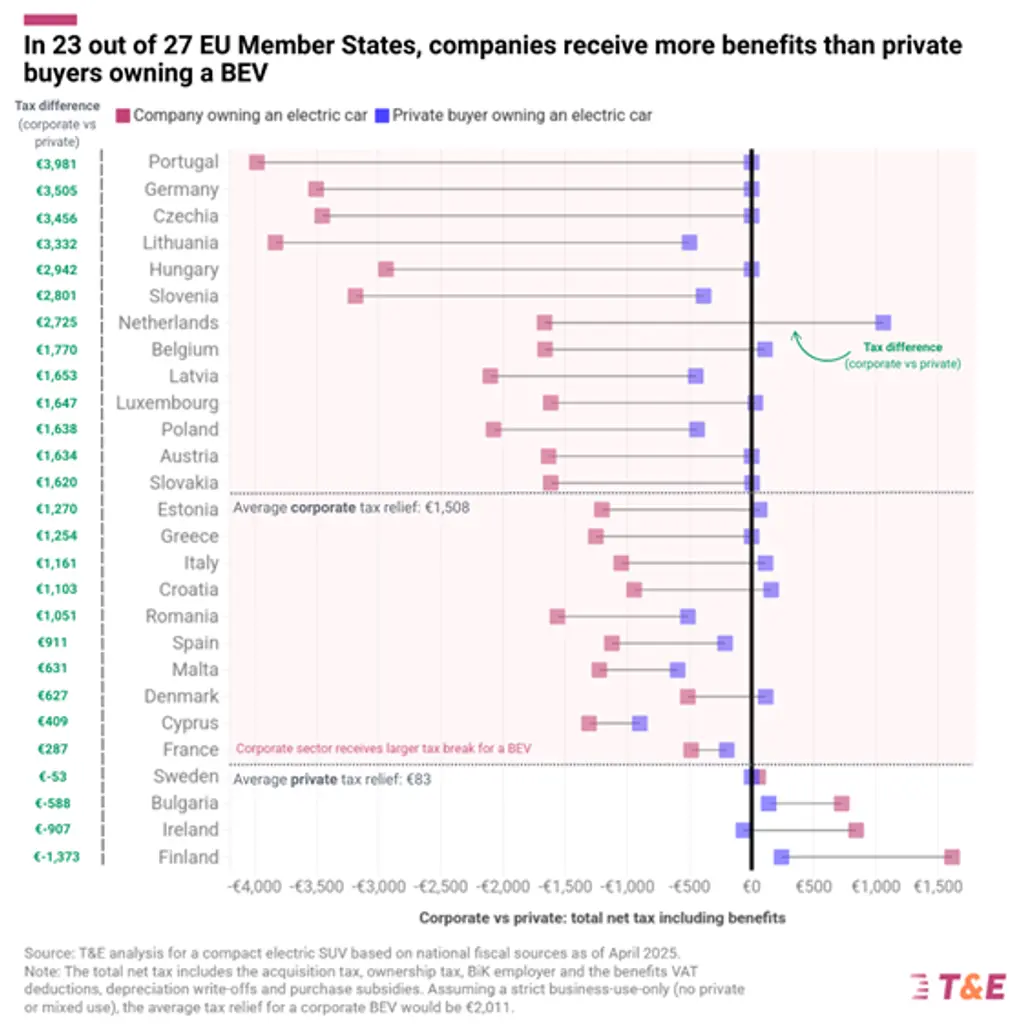
    • In 23 out of 27 Member States, companies receive more benefits than private buyers for owning an EV. In Germany this goes up to €14.000 per car.

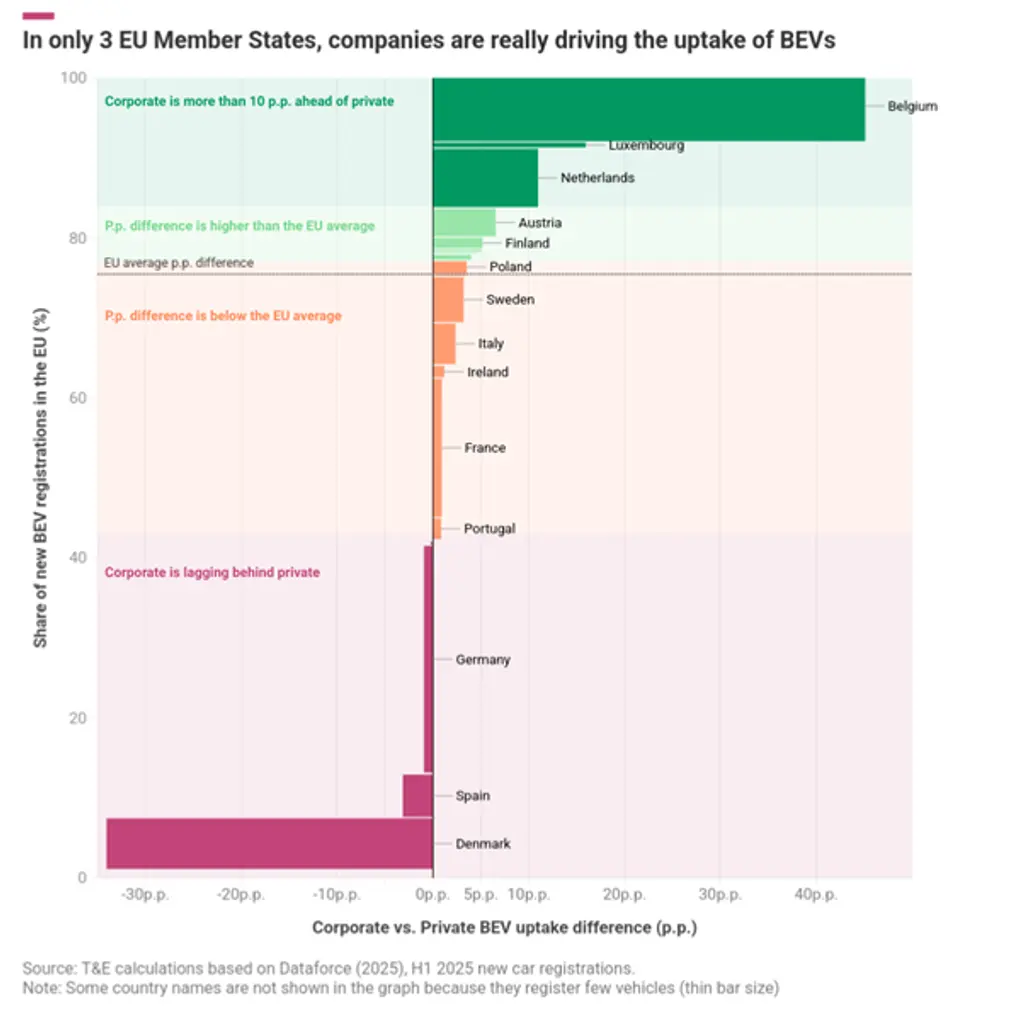
    • Despite such benefits, in only 3 Member States companies are really driving the uptake of electric cars.

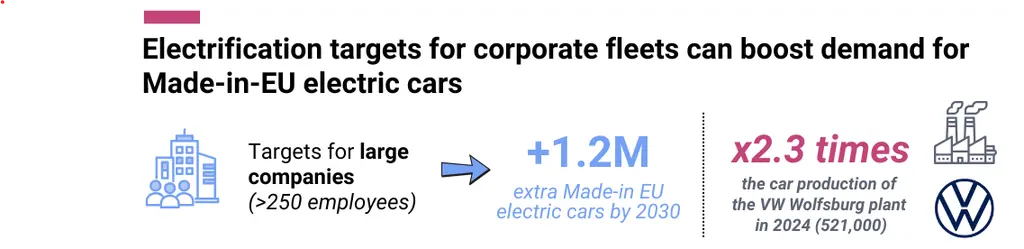
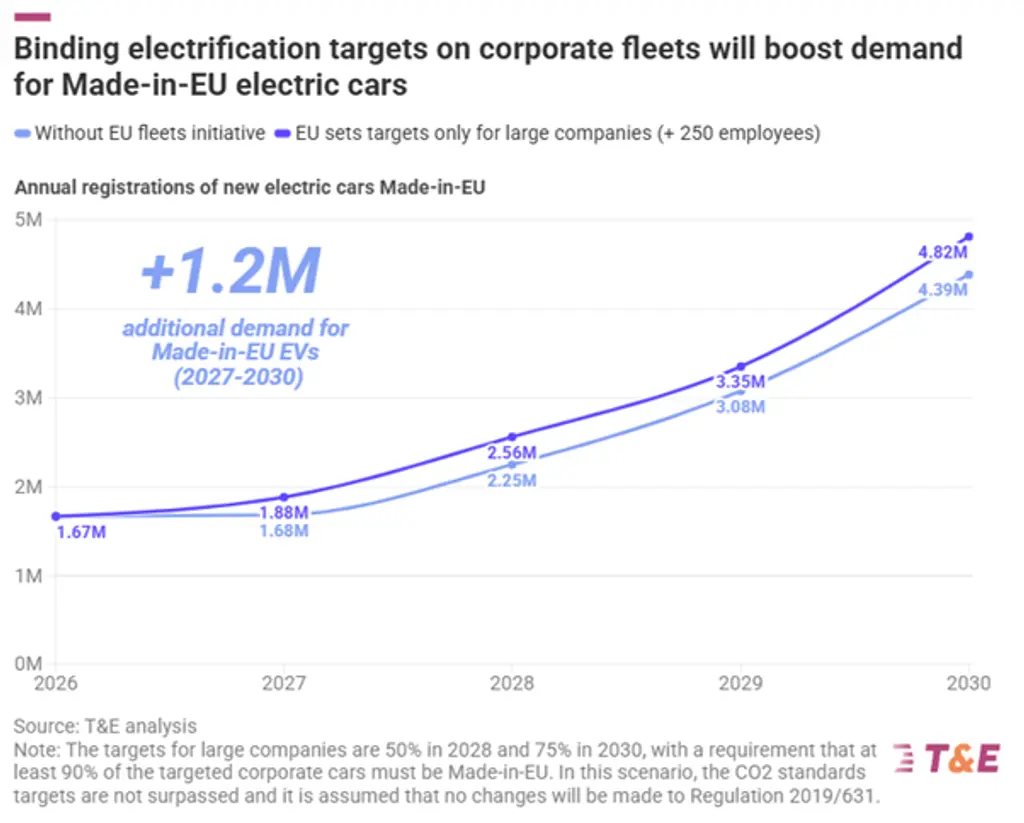
    This means that the corporate market’s potential is far from exhausted: an EU-wide target (on Member States or companies) asking large corporations to electrify 75% of their new cars in 2030, with Made-in-EU requirements, could lead to an additional 1.2 million locally produced EVs by 2030.

    1. Why the EC should ask companies to lead on electrification

    The European Commission is preparing a legislative proposal on Clean Corporate Vehicles. This law is expected to set binding electrification targets on corporate cars – either on Member States or on large companies.

    1.1. Companies benefit from tax breaks when owning an electric car

    There are good reasons for the Commission to ask companies to lead Europe’s switch to electric: when companies buy or lease a car, they benefit from fiscal advantages that are not available to private buyers. Examples are VAT deductions, depreciation write-offs and Benefit-in-Kind.

    In 23 out of 27 Member States, companies receive more benefits than private consumers when owning an electric car. T&E analysis shows that the average EU corporate tax relief for an EV buyer is €1,508 yearly. In Germany, where corporate EV tax benefits are among the highest, this goes up to €3,505 per year, or €14,020 over a typical ownership period of four years. Companies benefit from public money when owning an electric vehicle and should therefore drive the EU’s efforts in decarbonising road transport and boost demand for electric vehicles.

    1.2. Only in three EU countries the corporate car market is clearly leading on electrification

    Despite these fiscal benefits, companies are not clearly outpacing the private market in terms of electrification. This is partly due to the tax benefits that polluting company cars continue to receive. In only three EU countries the corporate market is significantly steering the adoption of BEVs (Belgium, Luxembourg, Netherlands). In large car markets such as Germany, France, Spain or Italy, their performance is underwhelming. Countries that have introduced structural fiscal reforms have a much higher corporate car electrification share. Since 2021, Belgium progressively phased out the fiscal deductibility for fossil fuel vehicles, creating a clear and growing incentive for BEV uptake. This has resulted in corporate BEV registrations of over 54% in the first half of 2025 (compared to 9% in the private market).

    2. Electrifying corporate fleets brings more benefits for EU automotive industry

    2.1. Companies buy more Made-in-EU EVs

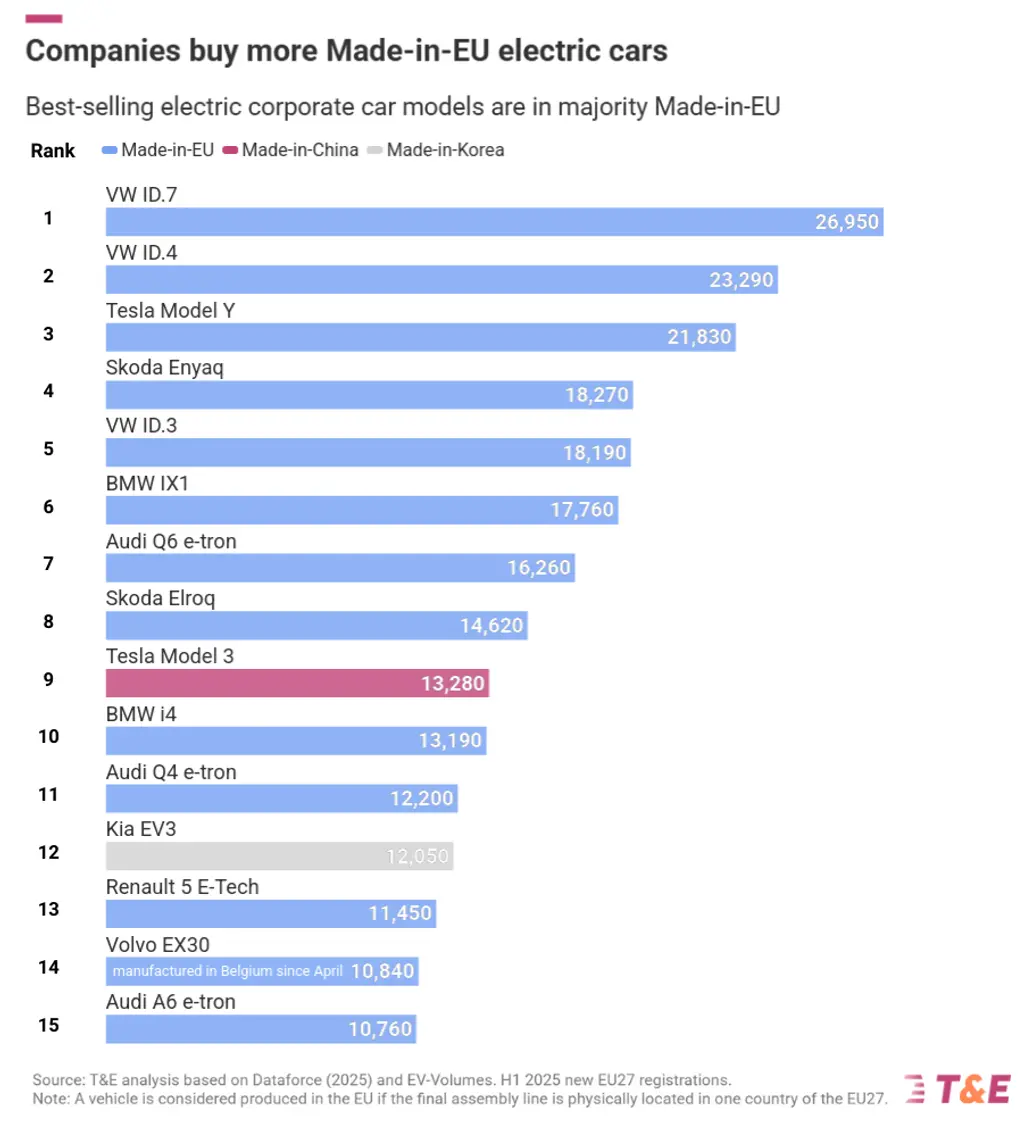
    Looking at the registration data of the first half year of 2025, companies tend to prefer purchasing more EVs that are made-in-EU than private households (73% against 63% for private buyers). Made-in-EU is defined as vehicles for which the final assembly line is located in the EU-27 (i.e. EVs of European brands that are produced in China and imported into the EU are not counted as Made-in-EU). Due to their high market share – 60% of new cars are corporate – and higher preference, there are 2.2 times more Made-in-EU electric cars registered by companies than private: 403,000 compared to 184,000 in just the first half of 2025.

    2.2. What are the most popular EV models in the corporate and private market?

    This trend is also reflected when zooming in on the most popular EV models for both the corporate and private segment: Made-in-EU EVs currently dominate the business segment, with 13 out of the 15 most popular models manufactured in the EU. For private buyers, these numbers are telling a different story: only 10 out of 15 top-selling models are EU made (see annex in full briefing attached on the left side of this page).

    This gap becomes even more apparent when zooming in on the market share of the top 15 models that are not Made-in-EU (see figure below): for the corporate segment, the non Made-in-EU models (Tesla Model 3 and the Kia EV3), account for only 10% of the best-selling corporate EV sales in the first half of 2025. For the private segment, this is 32%.

    3. How EU fleet targets can further boost demand for made-in-EU EVs

    As T&E analysis confirms, companies currently have a higher preference for a Made-in-EU vehicle when purchasing an EV. Nevertheless, there is still a lot of untapped potential, as companies are currently not clearly leading on electrification (see Section 1). In order to assess the additional benefits of the forthcoming EU Clean Corporate Vehicles legislation on Made-in-EU EV production, we have analysed the impact of EU fleet targets on the demand for EVs produced in the EU under two scenarios.

    • Business as usual: without any obligations on corporate vehicles and under today’s market conditions and CO2 standards (Regulation 2019/631), we expect 13.1 million Made-in-EU electric vehicle sales between 2026 and 2030.

    • Binding electrification targets on Member States (only affecting large companies): in this scenario, the European Commission proposes binding ZEV-purchasing targets on large companies (+250 employees) as part of the Clean Corporate Vehicles legislation: 50% of new large company registrations by 2028, and 75% by 2030 have to be zero emission vehicles, with a requirement that at least 90% of the targeted corporate cars must be Made-in-EU. These targets would increase the demand for additional made-in-EU electric cars by 1.2 million, bringing total production to 14.3 million vehicles. For illustration: the total production of the VW Wolfsburg plant in 2024 (all powertrain types) reached 521,000 units.

    Being Europe’s largest manufacturing country, the benefits for electric car production in Germany are particularly big. Results for Germany can be found in the annex.

    This potential increase is crucial for Europe. It proves the CCV initiative is essential for growing the European manufacturing scale and keeping our domestic EV supply chain competitive. It achieves this industrial boost without needing to raise the ambition of current CO2 emission standards.

    4. Policy recommendations

    To fully unlock the potential of the corporate car market to drive both the clean transition and the competitiveness of European car manufacturers, the European Commission should:

    • 1

      Propose a Regulation on Clean Corporate Vehicles: corporate fleets make up 60% of new cars and therefore have a lot of potential for both decarbonisation and European car manufacturing. Today, however, the corporate segment is not really leading on electrification in most Member States, despite existing tax benefits and incentives.

    • 2

      Include ambitious, binding ZEV-targets: the Regulation must set ambitious, binding Zero-Emission Vehicle (ZEV) targets on Member States. When designing national policies, SMEs should be exempted from any requirements to obtain the targets. Instead, Member States should aim their measures at large companies (+250 employees) in order to tap into the industrial potential of corporate vehicles while limiting the impact on European businesses.

    • 3

      Introduce local content requirements: this legislation should also include Made-in-EU requirements to further boost domestic EV production. By doing so, the Commission should clearly define what Made-in-EU EVs and batteries are and set up a transparent methodology rewarding Made-in-EU EVs, batteries, key components and materials.

    Continue Reading