Category: 3. Business

  • Ingka Group spotlights co-workers on International Day of Persons with Disabilities

    Ingka Group spotlights co-workers on International Day of Persons with Disabilities

    To mark UN International Day of Persons with Disabilities, five Ingka Group co-workers across its retail operations, from Portugal to the Netherlands and China shared their experiences, why inclusion matters and why accessibility is essential. Their reflections help Ingka Group listen, learn and continue improving on its journey to be disability inclusive.

    “At Ingka Group, we believe every co-worker is a talent and we want every co-worker to feel they can be their full selves at work. These stories from our colleagues around the world, remind us that disability is part of the human experience, visible or invisible, temporary or permanent, and that inclusion is something we build together every day,” says Buks Akinseye, Global Equality, Diversity & Inclusion Manager, Ingka Group.

    “We are on the way and continue to take steps to strengthen accessibility and disability inclusion. This includes developing and piloting global accessibility standards in our workplaces, offering workplace adjustments so people can work at their best, and working with organisations such as the Valuable 500 and the Business Disability Forum to further strengthen our approach. We are also improving customer experiences and embedding accessibility into our digital and product range across markets. Our journey continues, and we remain committed to creating a better everyday life that includes everyone,” he adds.

    Monique in the Netherlands, rebuilding her life after a brain haemorrhage; Madalena in Portugal, challenging assumptions about blindness in the workplace; Liu in China, thriving with hearing loss thanks to redesigned workflows. Their stories reflect Ingka Group’s belief that every co-worker is a talent and the company’s ambition to create a place where everyone feels a sense of belonging.

    Monique, Sales Co-worker, IKEA Netherlands

    After a brain haemorrhage paralysed my right side, I spent two years in rehabilitation before returning to IKEA. My old role had physical demands I could no longer meet, and I became more sensitive to noise and stimuli. My colleagues, with the best intentions, tried to protect me by taking over my tasks. They were afraid I wouldn’t be able to handle them.

    I appreciated their support, but I also wanted the chance to discover my own limits and strengths again. Once we started having those conversations, everything changed. My team learned when to step in and when to not, and their support is everything. Some days are tough, but my willpower is tougher.

    Liu, Fulfilment Operations Co-worker, IKEA China

    Living with hearing loss, communication used to be a barrier in other workplaces. Losing my hearing gradually from childhood meant adapting constantly, and it shaped how I understood myself and what I thought I could do. Joining IKEA in 2024 was a turning point, because my team welcomed me warmly and made sure I never faced tasks or communication alone. Having a buddy to guide me, a manager who checked in, and colleagues who cared gave me confidence I hadn’t felt in other workplaces.

    At IKEA, my team redesigned walkways, created a digital handover tool and made sure I always felt included. The redesigned walkways and the digital handover tool weren’t just practical solutions; they showed me that accessibility was taken seriously. Over time, I grew more independent, took on new responsibilities, earned my forklift licence, and even began helping customers at the pickup counter. I worried people thought I couldn’t handle the job, but with the right support and tools, I’m as capable as everybody else.

    Sherry, Resolutions Generalist, IKEA China

    After facing discrimination in past jobs due to scoliosis and chronic pain, joining IKEA changed everything, from accessible facilities to a caring team that believed in me. I grew up in the countryside, and after a serious fall as a child, the long-term pain and visible impact on my posture affected how people treated me in previous workplaces. One manager even stopped me from meeting customers because of how I looked, and that broke my spirit.

    But at IKEA, from my very first interview, I felt respect and fairness, no assumptions, just care. On day one, I noticed barrier-free restrooms, adjustable desks, and a team that truly supported me. My buddy checked in, my manager cared, and I began to thrive. Today, my productivity matches my colleagues’, customers praise my work and speaking on stage at our annual kick-off for the new financial year, filled me with pride. To anyone facing struggles: don’t give up. Keep a positive mindset, and you’ll find your path.

    Florence, Product Specialist, IKEA France

    I’m passionate about disability inclusion. In 2012–2013, I was diagnosed with Crohn’s disease, arthritis, and later, autism. It was a difficult period, and I took nearly a year of sick leave to focus on my health. When I was ready to return, IKEA supported my transition into a role that better suited my needs. Today, I work mostly remotely, thanks to flexible arrangements and a caring team.

    Living with invisible conditions can be challenging. People don’t always understand what they can’t see, and assumptions can quickly take hold. That is why I advocate for more awareness around neurodivergence and accessibility. I’ve heard comments suggesting that people with disabilities are less productive or receive unfair advantages and we need to challenge that thinking. Try to let go of the idea that people with disabilities are less productive or need help with everything. Let’s all uphold values of compassion, whether with colleagues or customers.

    Related links:

    • Better lives | Ingka Group – People are at the heart of everything we do. From gender equal pay to inclusive workplaces. We want to take a leading role in creating a fairer and more equal society and to improve the lives of the millions of people that interact with, or are impacted by, our company.


    *World Health Organization – World Health Organization


    About Ingka Group 

    With IKEA retail operations in 31 markets, Ingka Group is the largest IKEA retailer and represents 87% of IKEA retail sales. It is a strategic partner to develop and innovate the IKEA business and help define common IKEA strategies. Ingka Group owns and operates IKEA sales channels under franchise agreements with Inter IKEA Systems B.V. It has three business areas: IKEA Retail, Ingka Investments and Ingka Centres. Read more on Ingka.com.

    Continue Reading

  • An eco obscenity: Norman Foster’s steroidal new skyscraper is an affront to the New York skyline | Architecture

    An eco obscenity: Norman Foster’s steroidal new skyscraper is an affront to the New York skyline | Architecture

    Among the slender needles and elegant spires of the Manhattan skyline, a mountainous lump has reared into view. It galumphs its way up above the others, climbing in bulky steps with the look of several towers strapped together, forming a dark, looming mass. From some angles it forms the silhouette of a hulking bar chart. From others, it glowers like a coffin, ready to swallow the dainty Chrysler building that trembles in its shadow. It is New York’s final boss, a brawny, bronzed behemoth that now lords it over the city with a brutish swagger.

    Fittingly, this is the new global headquarters of JP Morgan, the world’s biggest bank. The firm enjoys a market capitalisation of $855bn (£645bn), more than Bank of America, Wells Fargo and Citigroup’s combined, and it looks as if it might have swallowed all three inside its tinted glass envelope. Last year, for the first time, it made more than $1bn a week in profits. Chairman and chief executive Jamie Dimon likes to boast of its “fortress balance sheet”, and he now has an actual fortress to go with it – built at a cost, he revealed at the opening, of around $4bn. He has certainly made his mark. It would be hard to design a more menacing building if you tried.

    The Brobdingnagian pile is the work of Foster+Partners, led by the 90-year-old Norman Foster, who is no stranger to penning extravagant bank headquarters. His HSBC tower in Hong Kong was the world’s most expensive building when it opened in 1986, standing as a costly essay in structural redundancy, with a stack of steel suspension bridges bolted to its facade. It was described by one former partner as “a sledgehammer to crack a nut”. In comparison, the JP Morgan tower is like using a bronze-plated bulldozer to puree a pea.

    Exploding … steel columns at street level. Photograph: Nigel Young/Nigel Young, courtesy of Foster + Partners.

    The sheer amount of structural steel – 95,000 tonnes in total – is obscene for a building that contains just 60 storeys in its 423-metre height, half the number of floors you might expect in such a colossus. It uses 60% more steel than the Empire State Building, which is taller and has more square footage. One leading engineer calculated that if the steel was flattened into a belt (30mm wide by 5mm thick), it would wrap the world twice – an apt symbol of the bank’s throttling global domination.

    If the building is a bullying affront to the skyline, it is just as domineering at street level. It erupts from the sidewalk with gargantuan bunches of steel columns that fan out at each corner, clutching the base of the tower like Nosferatu fingers. Positioned to dodge train tracks below, the columns splay out to hold the building’s swollen mass ominously above new strips of privately owned “public space”, where shallow steps and planters look designed to deter lingering. To the west, on Madison Avenue, the building greets the street with an incongruous cliff face of carved granite boulders. This, it turns out, is an artwork by Maya Lin, who has achieved the impressive feat of making real stone look like fibreglass scenery from Disney’s Frontierland, complete with morsels of mossy garnish clinging to the cracks.

    On the other side of the block, along Park Avenue, the security guards will let you peer through the windows to admire a US flag hanging from a 12-metre high bronze flagpole at the top of a staircase in the lobby, which, in another surreal twist, flutters in an artificial indoor breeze. It is a rare artwork by Lord Foster himself, who intended the flag’s movement to reflect the wind conditions outside. On the calm, still day of my visit, it was billowing at a stiff clip. In this “city within a city”, JP Morgan gets to dictate the weather it wants.

    Inside, everything is colossal. Great walls of fluted travertine, sourced from a single quarry in Italy, rise up through the 24-metre-high lobby, flanking a grand travertine staircase framed by a pair of huge Gerhard Richter paintings. Banks of elevators shuttle the 10,000 workers up into a vertical office-wellness universe, complete with a 19-restaurant food court (with kitchen-to-desk delivery), a hair salon, meditation rooms, fitness centre, medical clinic and a pub. The column-free office floors are fitted with circadian rhythm lighting, creating a carefully calibrated environment, detached from the outside world in the manner of a Las Vegas casino, in the hope that employees might never leave their desks. Dimon is serious about getting everyone back to the office full-time, despite the pleas of his staff. This is his machine to crush the hybrid-working movement once and for all.

    Surreal twist … the lobby flag that blows in an artificial breeze. Photograph: Nigel Young/Nigel Young, courtesy of Foster + Partners.

    The ceiling heights may be lofty (adding many more cubic metres of air to heat and cool), but when an image of the new trading floors was posted on social media, condemnation was swift. Comparisons were made to factory-farmed chickens, Chinese sweatshops, and the very 1950s cellular office space that open-plan layouts are intended to avoid. A conspicuous steel truss zigzagging through the space somewhat undermines the “column-free” claims, and raises questions over the building’s structural logic. One engineer who has studied the plans notes that adding a few more columns and reducing the spans by a couple of metres could have reduced the building’s carbon footprint by 20-30%. But then Foster and Dimon wouldn’t have got the heroic, protein-fuelled steelwork they so desired, slicing its way through the building in monumental Vs.

    Beyond the structural braggadocio, they were also keen to dial up the theatrics by night. Every evening, for miles around, New Yorkers can now gaze in wonder and horror as the tower’s summit transforms into a glittering crown, bubbling with twinkling lights that rise up the facade like a supersized flute of champagne. It is the work of Leo Villareal, who recently illuminated the Thames bridges. Sometimes, the throbbing diamond shape adds an inescapable Eye of Sauron vibe. At other moments, it appears to shift into a pulsating yonic void.

    Vajazzled steeple aside, what makes the tower’s pumped-up extravagance so galling is that it saw a perfectly good office building needlessly bulldozed. The 52-storey Union Carbide headquarters, built in 1960 as the celebrated work of Natalie de Bois at SOM, stood as a sleek, Miesian monolith. It had even undergone a full refurbishment and environmental upgrade in 2012 – trumpeted by JP Morgan at the time as “the largest green renovation of a headquarters building in the world”. Just seven years later, at the hands of the same ruthless bank, it became the tallest building ever to be intentionally demolished. To be replaced by something almost twice the height, but with just eight extra floors.

    A touch of Vegas casino … a carefully calibrated enviroment detaches employees from the outside world. Photograph: Nigel Young/Nigel Young, courtesy of Foster + Partners.

    The reason this happened, beyond ego and greed, can be traced to a 2017 zoning change. There had been a growing fear among landlords in East Midtown that the area was losing its lustre as the world’s pre-eminent business address. Office tenants were flocking west, to the glistening new shafts of Hudson Yards, in what is known, in real estate lingo, as the “flight to quality”. The city’s solution, in a shortsighted act of self-sabotage, was to allow Midtown to shape itself after the soulless corporate wasteland of Hudson Yards. Incentives were introduced to encourage demolition, including allowing the sale of unused “air rights” from landmarked buildings within the 78-block area. This means that historical structures that didn’t fill the maximum bulk allowed on their plots could sell their unused potential to others. JP Morgan acquired 65,000 square metres of air rights from Grand Central station, and 5,000 square metres from St Bartholomew’s church nearby, allowing it to inflate its size far beyond the usual limits.

    What few might have predicted is the cumulative effect that unleashing this scale of development might have. The JP Morgan tower is not a one-off, but merely the first of a whole new breed of steroidal supertalls. An even bigger 487-metre high, 62-storey tower was recently granted permission at 350 Park Avenue nearby, also designed by Foster+Partners as another bunch of towers strapped together, with the look of a discount bulk-buy. SOM won permission for a similarly sized monster at 175 Park Avenue, set to pierce the ground with more fans of columns converging to a point. This part of Midtown will soon resemble a huddle of bloated bankers squeezed into stilettos, casting ever longer shadows down the canyons of Manhattan and obliterating views of the city’s cherished peaks, while crushing a generation of handsome, usable buildings beneath them.

    From a distance, across the pond, you might care little about the fate of New York. It is a place long shaped by the forces of unbridled capital, where form follows finance and landowners get to build “as of right”, citizens be damned. But Foster’s bronze goliath is a prelude of what might soon come to London, on an even bigger scale. Last week, JP Morgan announced that it will begin work on a 280,000 square metre European headquarters in Canary Wharf – by far the biggest office building in the capital, containing more space than the Shard, Gherkin and Walkie-Talkie combined. The design, also by Foster+Partners, has only been teased with a glimpse of a ground-level corner, showing some curved bronze fins wrapping a bulging glass drum. Brace yourselves for what’s out of shot.

    Continue Reading

  • Regional Cyber Center Malaysia 03122025

    Regional Cyber Center Malaysia 03122025

    The opening of the Regional Cyber Center not only strengthens Leonardo’s positioning as a leader in global security, but also consolidates Malaysia’s role as a strategic hub for the Southeast Asia

    The Global CyberSec Center based in Kuala Lumpur joins Leonardo’s global network, which already includes the federated centers in Chieti, Bristol, Brussels and Riyadh


    The opening of the new Regional Cyber Center strengthens Leonardo’s positioning as a leader in technologies for global security. The inauguration, which took place today in the presence of the Malaysian Minister of Communications, Yang Berhormat Datuk Fahami Fadzil, underlines the company’s commitment to ensuring global security, responding proactively to today’s increasingly complex and rapidly evolving cyber threats. 

    The strategic choice of Malaysia reflects the country’s leading role in cybersecurity. Malaysia stands out in the region for its advanced legislation on the subject and its protection of critical national infrastructure. Leveraging the integration of Leonardo’s proprietary technologies in the field of cyber security, physical security and mission-critical communications and its experience in strategic sectors in Italy and abroad, the new Center will make a substantial contribution to global protection against new hybrid threats, strengthening the digital autonomy and supporting the sustainable development of Malaysia and the entire region.

    The new center in Kuala Lumpur is part of the Global CyberSec Center (GCC), Leonardo’s trusted and mission-critical cybersecurity service provider headquartered in Chieti (Italy), and joins the already operational federated Regional Cyber Centers in Brussels (European Union), Bristol (United Kingdom) and Riyadh (Saudi Arabia). The GCC’s global network is designed to ensure cyber mission assurance for strategic customers – including defence organisations and critical national infrastructures – by pooling processes, information on threats, and cutting-edge technologies. This federated model ensures both the ability to operate on a global scale in preventing, countering and responding to new threats, and the control of strategic data, fully respecting individual national sovereignty.

    “This initiative is a long-term investment reflecting Leonardo’s major commitment to building a strong industrial and technological partnership with Malaysia while contributing to the development of high specialised local human capital. In a world where cyber self-reliance has become the new currency of stability, we enable National Strategic Organizations to assure security and continuity of their operations leveraging our Global CyberSec Platform. Through this investment in Malaysia, our objective is to support the transformation of critical infrastructures, such as National Cloud and National Security Operation Centers, into autonomous strategic assets”. States Andrea Campora, Leonardo’s Managing Director Cyber & Security Solutions Division.

    The inauguration of the new regional Cyber Center in Malaysia represents a key milestone in Leonardo’s long-term strategy of expanding its international presence in the country and throughout the region. The initiative, combined with recent acquisitions in Zero Trust architecture, further strengthens Leonardo’s leading role in ensuring global security, and consolidates Malaysia as a crucial and strategic hub for the Southeast Asia and, in perspective, for the Far East.

    Leonardo has had an established presence in Malaysia for over forty years, making a significant contribution to its defence and aerospace sectors. Over the decades, the company has supported the country with a comprehensive portfolio of advanced solutions, including helicopters for military and commercial operations, military aircraft, integrated defence systems – such as radar and both naval and electronic warfare capabilities – and security solutions for critical infrastructure and mission-critical communications.

    Photo 

    Continue Reading

  • CVC announces the acquisition of Smiths Detection for £2bn

    CVC announces the acquisition of Smiths Detection for £2bn

    CVC, one of the world’s leading private markets investment firms, today announced that it has entered into an agreement to acquire Smiths Detection, a global leader in threat-detection and security-screening technologies for airports and critical infrastructure, from Smiths Group plc. Leveraging CVC’s extensive experience in executing corporate carve-outs and history of scaling newly independent companies, Smiths Detection is well placed to build on its strong market positions and unlock substantial long-term value.

    Headquartered in the UK, Smiths Detection employs 3,400 people, including over 1,100 field service engineers and over 500 R&D professionals and operates from facilities across Europe, the US and Asia. The business has a global #1 position in aviation security – i.e. screening technology for carry-on bags, hold luggage, and air cargo at airports – where it serves 47 of the world’s top 50 airports, with both industry-leading hardware and sector-leading digital capabilities, including automated detection algorithms. Smiths Detection also serves other critical infrastructure end markets such as urban security (screening systems for government and commercial buildings, public venues and spaces ) and ports and borders (cargo and vehicle inspection) and the business has a leading niche chemical threat identification capability for defense end markets.

    Dominic Murphy, a Managing Partner and Co-Head of the UK private equity team at CVC and Conor Keogh, Managing Director at CVC, said: “Smiths Detection’s industry-leading threat detection and security screening technologies play a crucial role in helping protect people and critical infrastructure worldwide. We look forward to supporting the business during the next phase of its growth and development through continued investment in technology innovation, high-quality engineering and best-in-class aftermarket service.”

    James Mahoney, Partner and Head of CVC’s private equity activities in the Aviation, Defence & Space sectors added: “We are excited to partner with Jérôme de Chassey and his team. Smiths Detection’s strong market positions, anchored by its global leadership in aviation, create a compelling platform for long-term value creation.”

    The transaction is subject to customary regulatory approvals and is expected to close in the second half of 2026. Barclays acted as financial advisor and Latham & Watkins acted as legal counsel to CVC. 

    The investment will be made through CVC Capital Partners IX.

    Continue Reading

  • Asian shares are mixed as steady bond yields, rebound for bitcoin push US stocks higher

    Asian shares are mixed as steady bond yields, rebound for bitcoin push US stocks higher

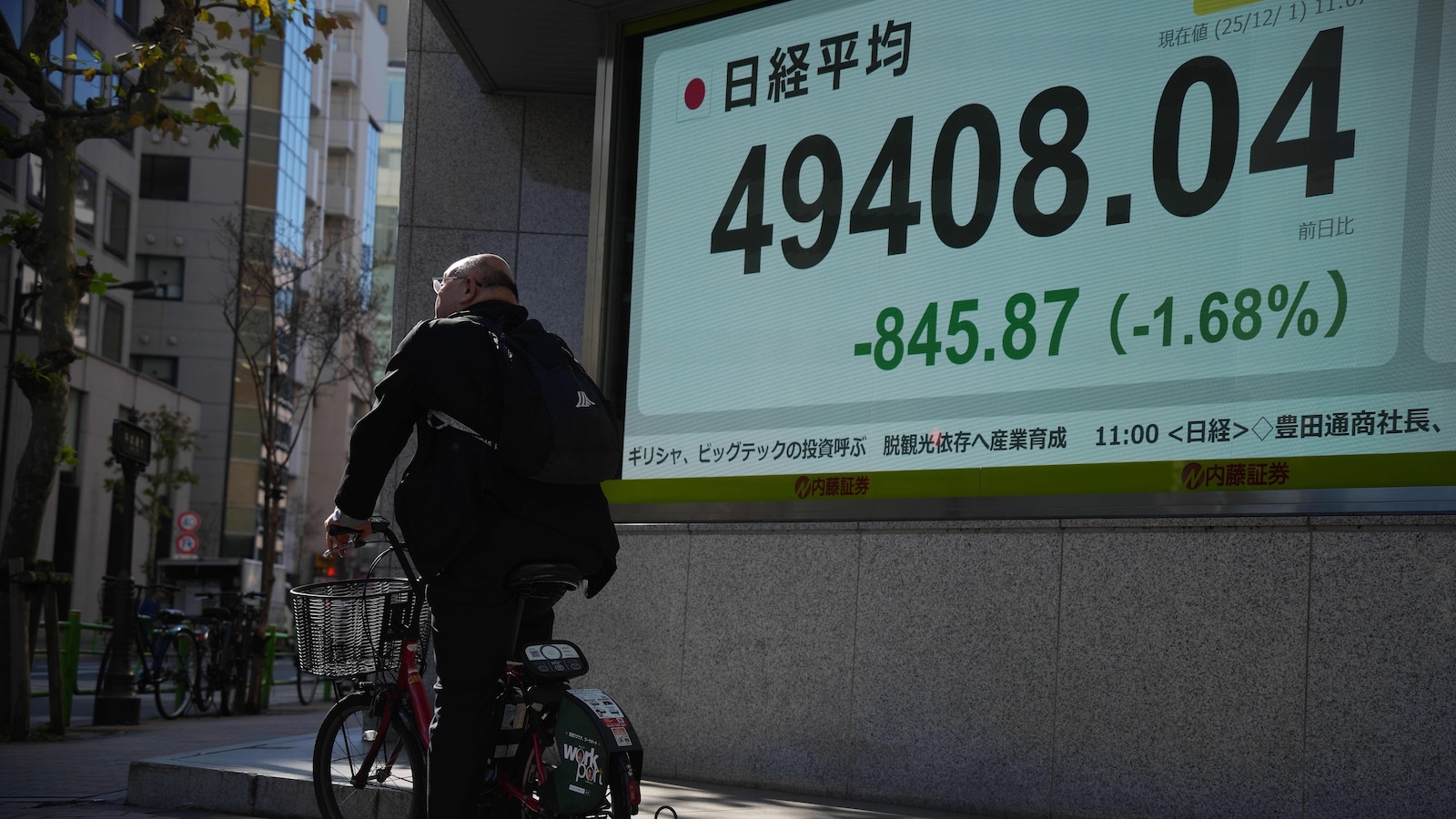
    BANGKOK — Asian shares were mixed Wednesday after stocks on Wall Street held steadier as both bond yields and bitcoin stabilized.

    U.S. futures rose and oil prices edged higher.

    Tokyo’s Nikkei 225 jumped 1.6% to 50,063.65 on big gains for technology shares like Tokyo Electron, which jumped 5.6%. Adventest, a maker of computer chip testing equipment, surged 6.9%.

    Technology and telecoms giant SoftBank Group Corp. surged more than 8% following reports that its founder, Masayoshi Son, regretted having to sell shares in computer chip maker Nvidia to help pay for other investments. The company’s share price sank after it announced last month that it had sold the shares for $5.8 billion.

    South Korea’s Kospi also got a lift from tech shares, gaining 1.2% to 4,042.40. Shares in Samsung Electronics, the country’s biggest company, rose 1.8%.

    But Chinese markets declined following the release of data showing weaker factory activity.

    Hong Kong’s Hang Seng fell 1.1% to 25,797.24, while the Shanghai Composite index shed 0.3% to 3,885.36.

    Australia’s S&P/ASX 200 edged 0.2% higher, to 8,595.20.

    On Tuesday, the S&P 500 rose 0.2% to 6,829.37. The Dow Jones Industrial Average added 0.4% to 47,474.46, and the Nasdaq composite gained 0.6% to 23,413.67.

    Boeing soared 10.1% and was one of the strongest forces lifting the S&P 500. Chief Financial Officer Jay Malave said the plane maker expects growth next year in an underlying measure of how much cash it produces.

    Database company MongoDB also helped lead the market, jumping 22.2% after it delivered stronger results for the latest quarter than analysts expected.

    They helped offset a 6.8% drop for Signet Jewelers, which gave a forecast for revenue in the holiday shopping season that fell short of analysts’ expectations. The jeweler said it’s expecting “a measured consumer environment.”

    Another potential warning about U.S. shoppers’ strength came from the chief financial officer of Procter & Gamble, the giant behind Tide detergent and Ivory soap, whose shares slipped 1.1%.

    The U.S. economy has been holding up overall, but that’s masking sharp divisions beneath the surface. Lower-income households are struggling with higher prices while richer households are benefiting from a stock market that’s within 1% of its all-time high set in late October.

    In the bond market, Treasury yields calmed following their jumps the day before. The 10-year yield edged down to 4.08% from 4.09% late Monday, while the two-year yield eased to 3.51% from 3.54%.

    Higher yields can drag prices lower for all kinds of investments, and those seen as the most expensive can take the biggest hit.

    Monday’s climb in Treasury yields came after the governor of the Bank of Japan hinted that it may raise interest rates there soon. But hopes are still high that the Federal Reserve will cut its main interest rate when it meets in Washington next week.

    The Japanese central bank is likely to raise its benchmark rate at its Dec. 19 meeting, Tan Boon Heng of Mizuho Bank in Singapore, because failing to do so could lead investors to sell off Japanese yen.

    “Yet, delivering a ‘done deal’ hike may perversely deny any appreciable JPY (Japanese yen) gains, whilst boosting long-end yields,” he said in a report.

    The Fed has already cut its overnight interest rate twice this year in hopes of shoring up a slowing job market. But lower rates can fan inflation, which has stubbornly remained above its 2% target.

    Complicating things is the U.S. government’s earlier shutdown, which delayed reports on the job market and other areas of the economy.

    In other dealings early Wednesday, bitcoin, which tumbled below $85,000 on Monday as bond yields worldwide marched higher, rose to $94,000.

    U.S. benchmark crude oil edged 3 cents higher to $58.67 per barrel. Brent crude, the international standard, gained 4 cents to $62.49 per barrel.

    The U.S. dollar slipped to 155.68 Japanese yen from 155.87 yen. The euro rose to $1.1645 from $1.1626.

    ___

    AP Business Writers Matt Ott and Stan Choe contributed.

    Continue Reading

  • Chop and change: pork is ‘new beef’ for money-saving Britons, report finds | UK cost of living crisis

    Chop and change: pork is ‘new beef’ for money-saving Britons, report finds | UK cost of living crisis

    Pork is the “new beef”, with Britons increasingly making the money-saving meat swap for dishes such as spaghetti bolognese or T-bone steak, according to a new report.

    With the latest official figures showing beef price inflation running at 27%, customers are looking to buy pork cuts that you would typically associate with beef. That list runs to free-range fillets and short ribs as well as T-bone and rib-eye steaks, Waitrose says in its annual food and drink report.

    Recipe searches for “lasagne with pork mince” have doubled on its website, while searches for “pulled pork nachos” are up 45%. Its sales of pork mince are up 16% on last year, as home cooks adapt favourite recipes.

    Pork is making a “massive comeback but in a premium way”, according to Matthew Penfold, a senior buyer for Waitrose. Shoppers can buy pork for a fraction of the cost, with a fillet costing about £20 a kg, while beef is £80 a kg or more.

    The annual exercise by the upmarket retailer highlights the food trends that will shape what is being sold on supermarket shelves. Ones to watch include new portmanteau flavours “spour” (spicy and sour) and “fricy” (fruity and spicy). It also flags the rise of the “fibremaxxing” movement, which involves going to town with linseeds and dried fruit.

    But while much of this excitement is driven by TikTok, the increased demand for pork is down to cold, hard economics as shoppers make tight household budgets stretch further.

    This cost consciousness is also behind the renaissance of the baked potato – if it ever went away. Sales of large potatoes are up by more than third in Waitrose stores but bog-standard toppings such as beans and cheese will no longer do. The alternatives dreamed up by food influencers include kimchi, and chicken shawarma with tahini.

    The impact of high food prices on shopping habits is writ large in separate figures prepared by the Agriculture and Horticulture Development Board (AHDB).

    With the average price for a kilogram of beef mince in the shops up by 37% year on year in the 12 weeks to 2 November, the quantity sold tumbled nearly 11%. Consumers were opting to buy smaller 250g packs (saving £1.77 on average compared with a 500g pack) and frozen mince instead, it said.

    The financial squeeze meant consumers were seeking out cheaper proteins such as chicken, pork sausages and fish, AHDB said. Its data showed pork mince sales volumes surging 36.6% year on year, and chicken mince by 65.6%. “Some consumers are looking for cheaper substitutes for cooking their family favourites such as spaghetti bolognese or chilli con carne,” it said.

    Katharina Erfort, the principal at the supply chain experts Inverto, said higher feed and labour costs were among the factors driving beef prices higher. “That has led to a reduction in the raising of beef cattle in the UK, impacting the overall supply. Pork has traditionally been cheaper to produce because pigs need far less feed than cattle – around four times less for every kilo of meat,” she said, adding that they also required less space and reached full size in about six months.

    Continue Reading

  • HUGO BOSS PROVIDES STRATEGIC UPDATE TO PAVE THE WAY FOR PROFITABLE GROWTH

    HUGO BOSS PROVIDES STRATEGIC UPDATE TO PAVE THE WAY FOR PROFITABLE GROWTH

    • Next strategic phase to realign, simplify, and strengthen the business 
    • Clear execution focus: brand, distribution, and operational excellence through 2028
    • Strong free cash flow of around EUR 300 million annually targeted until 20281
    • 2026 as year of brand and channel realignment for long-term efficiency improvements
    • Currency-adjusted Group sales expected to decline mid- to high-single digits in 2026
    • EBIT expected between EUR 300 million and EUR 350 million in 2026 as top-line development will outweigh targeted gross margin improvements and cost efficiency
    • Return to profitable growth expected from 2027 onward
    • Long-term potential: Outgrow the market and drive EBIT margin to a level of around 12%

    “Since 2021, we have repositioned our Company with CLAIM 5, creating a strong foundation for the future. We have refreshed our two brands and invested extensively in our organizational platform,” says Daniel Grieder, Chief Executive Officer of HUGO BOSS. “Following the successes of recent years, we are now deliberately taking a step back to prepare for tomorrow’s growth. Our focus in the coming years will be on the ongoing optimization in the areas of brand, distribution, and operations with the clear ambition to transform them from great to excellent. Next to strong cash generation, this will drive sustainable profitable growth and long-term value for our shareholders. Our vision is clear: to be the premium, tech-driven, customer-centric global fashion platform.” 

    Today, HUGO BOSS launches CLAIM 5 TOUCHDOWN, setting the course through 2028 and paving the way for sustainable, profitable growth. Amid a challenging market environment, this strategy builds on the successes of CLAIM 5 since 2021. Both brands, BOSS and HUGO, delivered strong growth (CAGR 2020-2024: +22%) and global market share gains, while structural investments have created a robust business platform for the future. 

    Moving forward, HUGO BOSS’ strategic direction remains unchanged, but the focus sharpens. 2026 will serve as a year of realignment, strengthening the business by streamlining processes, refining assortments, and optimizing the distribution network. At the same time, HUGO BOSS will significantly accelerate free cash flow generation, forming the foundation for continued shareholder returns. To deliver against this, execution will center on three key fields of excellence: brand, distribution, and operations. These priorities will boost efficiency and set the stage for renewed top- and bottom-line growth from 2027 onward.

    Brand Excellence
    HUGO BOSS is committed to driving Brand Excellence by further elevating BOSS and HUGO, strengthening brand relevance, and deepening customer loyalty. While BOSS Menswear will continue to leverage its strong 24/7 lifestyle positioning, the Company is improving the long-term performance of BOSS Womenswear and HUGO. BOSS Womenswear will focus on a refined product assortment built around essential products, to strengthen resonance with female consumers. HUGO will sharpen its identity with a refined positioning and a more accessible product range centered even more on contemporary tailoring. A new organizational setup with two dedicated powerhouses for menswear and womenswear will unlock synergies across the two brands. Marketing spendings are targeted at around 7% of Group sales, with priority on high-return initiatives, including key partnerships like Beckham x BOSS and product-led campaigns that drive conversion.

    Distribution Excellence 
    A clear focus on Distribution Excellence will elevate the brand experience across all touch-points, with a more targeted, higher-quality distribution footprint. HUGO BOSS will continue to optimize its own store portfolio for an even better customer experience while enhancing sales productivity and retail efficiency. In brick-and-mortar wholesale, the Company will foster strategic partnerships, adopt a more selective assortment approach, and expand its franchise business. HUGO BOSS will strengthen its digital business by further advancing seamless brand and customer experiences across platforms. From a regional perspective, the Company will further build on its position in the U.S. and China, with a particular focus on optimizing its distribution and tailoring brand activities to local needs. HUGO BOSS will leverage its strong presence in Europe for further market share gains and it will also capture new business opportunities in emerging markets.

    Operational Excellence 
    HUGO BOSS will elevate Operational Excellence across the value chain by leveraging its past investments to fuel long-term growth, profitability, and cash generation. Key priorities include driving further sourcing efficiency through ongoing vendor optimization, a sea-freight-first approach, and shorter lead times. In parallel, the Company will enhance its planning capabilities and enable faster, smarter decisions through technology and artificial intelligence. HUGO BOSS will also maximize the benefits of its expanded automated logistics network and strengthen back-end efficiency through streamlined processes and automation.

    Financial ambition centered on profitability and cash generation 
    CLAIM 5 TOUCHDOWN builds on past successes and centers on efficiency for future sustainable growth. Over the medium to long term, the Company aims to outgrow the market and achieve an EBIT margin of around 12%. Against this ambition, the next years will mark a phase of deliberate refocus and realignment, as HUGO BOSS further strengthens its operational and financial base. Free cash flow is targeted at around EUR 300 million annually, nearly tripling as compared to recent years2. This will be supported by lower capital expenditure (3% to 4% of Group sales) and strict trade net working capital management (18% to 20% of Group sales). Inventory levels are expected to be reduced steadily, approaching 20% of sales by 2028. 

    “2026 will be a year of consolidation and realignment and an important step toward positioning HUGO BOSS for long-term profitable growth,” says Yves Müller, Chief Financial Officer and Chief Operating Officer of HUGO BOSS. “While we expect a temporary decline in sales, we will continue to drive our efficiency agenda along the value chain to safeguard margins and strongly accelerate cash flow generation. With this stronger financial foundation, we are well positioned to return to top- and bottom-line growth from 2027 onward and progress toward our long-term EBIT margin ambition of around 12%, reinforcing our commitment to delivering value to all shareholders.” 

    Refocus in 2026 to pave the way for renewed profitable growth in 2027
    Against the backdrop of deliberate brand and channel realignment, currency-adjusted sales are expected to decline mid- to high-single digits in 2026, before returning to growth in 2027, and accelerating in 2028. Gross margin improvements are expected in 2026 and beyond, supported by sourcing efficiencies, selective price adjustments, and even stronger full-price sell-through. Against the backdrop of ongoing cost discipline, EBIT is expected between EUR 300 million and EUR 350 million in 2026, with profitability improving from 2027 onward. 

    Capital allocation framework with firm commitment to shareholder returns
    As part of CLAIM 5 TOUCHDOWN, the Company’s capital allocation framework is designed to balance investment, value creation, and resilience. The framework emphasizes continued investments into the business to support long-term profitable growth, while also including a firm commitment to delivering continued shareholder returns via dividends and/or share buybacks. At the same time, HUGO BOSS will continue to further strengthen its balance sheet over the coming years, aiming to reduce financial leverage while remaining within its target corridor and maintaining strong investment-grade ratings from S&P (“BBB”) and Moody’s (“Baa2”). The Company will also preserve the strategic flexibility needed to pursue future M&A opportunities.

    From Great to Excellent 
    CLAIM 5 TOUCHDOWN serves to sharpen focus, discipline, and execution across the business. With clear priorities, a performance-driven culture, and fully committed teams, HUGO BOSS is ready to navigate today’s challenges, by turning strategic focus into tangible results for tomorrow. Backed by its strong cash flow profile and a clear trajectory toward sustainable, profitable growth, HUGO BOSS is firmly committed to driving long-term shareholder value.

    HUGO BOSS will present its detailed outlook for fiscal year 2026 including details on shareholder returns on March 10, 2026, as part of its full-year 2025 results release. 

    1Average annual free cash flow target stated excluding the impact of IFRS 16. Including IFRS 16, this corresponds to around EUR 500 million.
    2Average annual free cash flow target stated excluding the impact of IFRS 16. Including IFRS 16, this corresponds to around EUR 500 million.

    For further information, please contact:  
    Media Relations 
    Carolin Westermann 
    Senior Vice President Global Corporate Communications 
    Phone: +49 7123 94-86321 
    E-mail: carolin_westermann(at)hugoboss.com 

    Investor Relations 
    Christian Stöhr 
    Senior Vice President Investor Relations 
    Phone: +49 7123 94-87563 
    E-mail: christian_stoehr(at)hugoboss.com

    GROUP.HUGOBOSS.COM
    YOUTUBE: @HUGOBOSSCorporate
    LINKEDIN: HUGO BOSS

    Continue Reading

  • Pensions Weekly Update – 3 December 2025

    Pensions Weekly Update – 3 December 2025

    Here is our weekly summary of key legal and regulatory developments relevant to occupational pension schemes that you might have missed, with links for further information.

    • HM Revenue and Customs (HMRC) has published pension schemes newsletter 175. This includes an overview of the pensions tax measures in the Autumn Budget, which we summarised in our 26 November weekly update. More information is provided about the measure to allow direct payment of surplus assets to members and beneficiaries. Such payments will be treated as authorised payments and will be taxed as pension income at the individual’s marginal rate of tax. Schemes will have to be in surplus on the same funding basis as applies to payments to employers. This is currently the full buyout basis, although the government has indicated its intention to relax this. The member will have to be above their normal minimum pension age. The newsletter also contains more information about the inheritance tax changes that will come into effect in April 2027. If personal representatives reasonably expect that inheritance tax will be due, legislation will give them the power to direct pension scheme administrators to withhold 50% of the taxable benefits for up to 15 months from the date of a member’s death. They can then direct pension scheme administrators to pay inheritance tax due to HMRC from the withheld benefits before releasing the balance to the beneficiaries. There will be some limited exceptions. Personal representatives will also be discharged from liability for any pensions that are discovered after they have received clearance from HMRC.
    • The House of Commons has published an updated briefing paper on pensions tax, following on from the budget. This includes a summary of the way that salary sacrifice currently operates, as well as the impact of the budget announcement. There have been reports in the media that the government has said that it will reassure markets that the £2,000 salary sacrifice cap will proceed, by legislating in the next few weeks, although the cap will not be effective until April 2029.
    • The government has tabled amendments to the Pension Schemes Bill, in advance of the report stage being held today (3 December). These include:
    • An amendment so that the costs of the Pension Protection Fund (PPF) Ombudsman will be met out of The Pensions Regulator’s (TPR) general levy. This will be treated as having come into force from 1 April 2007, in line with what has happened in practice.
    • Amendments to provide for the indexation of PPF and Financial Assistance Scheme (FAS) compensation in relation to pre-1997 accruals. Increases would be by reference to the consumer prices index capped at 2.5% and are estimated to cost £1.2 billion. They will commence on 1 January 2027, for those members whose scheme rules provided for such indexation. The PPF assesses that around 165,000 PPF and 91,000 current FAS members have some pre-97 benefits where their former schemes provided mandatory indexation and so would benefit from this amendment.
    • Amendments so that administration expenses of the PPF and Fraud Compensation Fund will be payable out of those funds, instead of through a separate administration levy. This will be effective from 1 April 2026.
    • Amendments to asset pooling provisions in the Local Government Pension Scheme.
    • Refinements to the way in which small pot consolidation will operate.
    • An amendment to the asset scaling requirements that will ensure that, when determining whether a relevant master trust (or group personal pension plan (GPP)) has sufficient assets (£25 billion) to be approved under the new sections of the Pensions Act 2008, the assets of connected relevant master trusts/ GPPs will be included, along with an amendment that regulations would specify the types of relationships that would constitute being “connected”.
    • Amendments in relation to the Virgin Media remedy, which include minor clarifications, along with a few more significant changes. The first amendment of substance is in relation to what action would constitute “positive action” that would exclude a scheme from being able to take advantage of the Virgin Media remedy. Clause 100(7)(b) is amended to clarify that “taking any other step in relation to the administration of the scheme” actually means notifying any members of the scheme in writing to the effect that the trustees or managers are taking (or have taken) “any other step in relation to the administration of the scheme”. The second amendment of substance is in relation to the types of legal proceedings that would exclude a scheme from benefitting from the Virgin Media remedy. The government amendment clarifies that legal proceedings relate to court proceedings, and not proceedings of a tribunal or The Pensions Ombudsman and that there must be a dispute as to the rules of the scheme, where the parties are or include both the trustees or managers of the scheme and beneficiaries or their representative. The third amendment of substance is to clarify that so far as the Virgin Media remedy applies in relation to a scheme that has transferred to the PPF, it also applies to a section of a scheme if the whole scheme did not transfer to the PPF. A final amendment changes the commencement provision for the Virgin Media remedy so that it would come into force on the day on which the bill receives royal assent, rather than two months later, which is perhaps an indication that the timetable for royal assent has slipped by a couple of months.
    • It is five years since the pledge to combat pension scams campaign was launched. Paul Sweeney, The Pension Scams Action Group Intelligence Business Lead, encourages more organisations to sign up to the pledge and for existing signatories to self-certify that they are turning their commitment into action. He reminds trustees and administrators that they play a crucial role in protecting pension savers.
    • The Pensions Administration Standards Association (PASA) has published the first in a new three-part practical guidance series on delivering digital transformation. It outlines how pension schemes can establish the right frameworks, technologies and cultural mindset to ensure successful and sustainable digital change.
    • For those directors of corporate trustees who have not yet verified their identity with Companies House, there is new guidance on how to verify your identity at the post office. Note, however, that the first stage still requires an individual to start the verification process on GOV.UK One Login. You can still complete the whole process online if you prefer. You can now check your own personal deadline for verifying your identity by searching against your own name at Companies House.
    • Have you seen our Winter Hot Topics in pensions? It is packed with festive fun as well as topical items for your trustee and corporate agenda.

    If you would like specific advice on any of these issues or anything else, please contact a member of our Pensions team.

    Continue Reading

  • Scottish space sector lands £4.6m investment

    Scottish space sector lands £4.6m investment

    Scotland’s space sector will receive a £4.6m funding boost to accelerate breakthrough technologies, the UK Space Agency has announced.

    The funding includes a £3.7m sum from the Agency’s National Space Innovation Programme (NSIP), which will go towards four Scottish universities to advance innovations in the likes of satellites and ways of monitoring pollution from space.

    The news comes on the opening day of the biggest space industry event ever held in the country, Space-Comm Expo Scotland.

    More than 2,300 delegates, 100 speakers and 80 exhibitors are attending the conference at Glasgow’s SEC campus.

    Dr Natasha Nicholson, chief executive of Space Scotland, said the new investment was a vote of confidence in the country’s space sector.

    “These projects demonstrate the strength of our research base and the talent driving advancements in secure communications, environmental monitoring, and resilient navigation — technologies that will shape the future of global space infrastructure,” she said.

    The four universities receiving funding include the University of Edinburgh, for work developing an instrument to measure pollution from space.

    Also benefitting are the University of Strathclyde, to develop a satellite navigation system that doesn’t rely on GPS, and Heriot-Watt University to help build a quantum communication transmitter for small satellites.

    Strathclyde will receive further funding as part of a consortium led by the University of Bristol. It is developing a UV-based device to enable secure data transmission between satellites, strengthening cybersecurity in orbit.

    Scotland Office Minister Kirsty McNeill, who is giving a keynote speech at the expo, said the Scottish space sector was now “a vitally important industry”.

    She said: “With our globally renowned expertise in designing and building satellites and rockets, world-leading universities and research centres analysing and applying space data, a commitment to sustainability and unrivalled geographical launch advantages, Scotland is rightly positioned at the forefront of the ever accelerating space revolution.”

    The Scottish government’s Business Minister Richard Lochhead said the funding will help accelerate the industry.

    “Scotland’s space sector and wider supply chain is already delivering on its significant economic potential but also helping solve some of the world’s most important challenges from climate change to telecommunications,” he said.

    “This funding from the National Space Innovation Programme will help accelerate this work, leveraging our world-class universities to ensure the country’s industry remains at the forefront of space technology development and advancement.”

    Further funding includes £350,000 for Space Scotland to strengthen capabilities in Earth Observation and In-Orbit Servicing and Manufacturing (ISAM) by fostering new partnerships between academia, industry, and government.

    Another £410,000 of funding will go towards the OXYGEN project, aimed at making lunar exploration more sustainable. Partners in the project include the University of Glasgow.

    The two day Space-Comm Expo will include talks and panels on topics including spaceports, rocket launches, satellite manufacturing, computing, AI and robotics.

    Speakers include James ‘JD’ Polk, the chief health and medical officer at Nasa, astronaut and pilot David Mackay and Dr Sian Proctor, the first woman commercial spaceship pilot.

    Space Agency statistics show that Scotland accounts for 13% of total UK space sector employment, with about 7,120 people employed, making it the third-largest employer after London (33%) and the South East (17%).

    Continue Reading

  • Financing Transitional Activities in the Iron and Steel Sector – Climate Policy Initiative

    1. Financing Transitional Activities in the Iron and Steel Sector  Climate Policy Initiative
    2. The costs of India’s hunger for cheap steel  Financial Times
    3. India’s ‘steely’ resistance in face of climate goals, and a fashion-forward country  ThePrint
    4. Public Funding Key To Scaling Green Steel As India Expands Capacity: IEEFA Report  KNN India
    5. India needs targeted public finance to scale green steel  fundsglobalasia.com

    Continue Reading