Members of the South Bandung Farming Cooperative (KPBS) have recorded a 38 per cent increase in productive loans and a 43 per cent rise in sales volumes over the past two years, following the introduction of a new business app.
“Easier access to financing means higher loan volumes, which in turn means more cattle and higher income for our farmers,” said Head of KBPS Aun Gunawan. “This is how financial inclusion leads to improved livelihoods.”
UN Indonesia/Miklos Gaspar
Dairy farmers in Indonesia are using a new business-focused app which is helping them to boost sales.
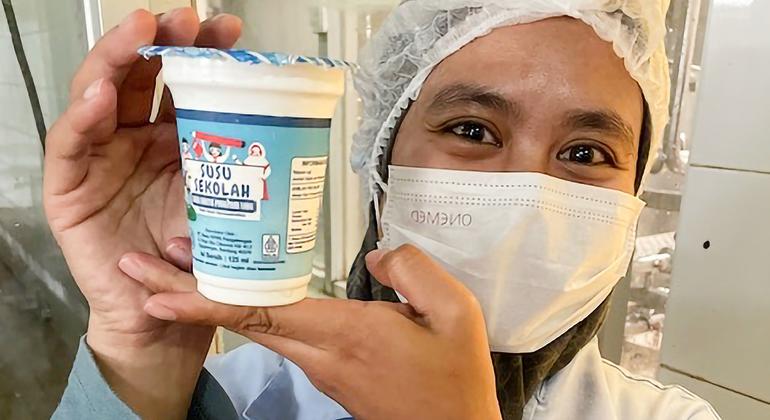
Founded in 1969, KPBS has 5,000 members and produces 70,000 tons of milk a day. The cooperative operates its own dairy plant, using around 15 per cent of its milk production to manufacture yoghurt and mozzarella cheese, while the remainder is sold to dairy companies in the region.
In addition, the cooperative runs a hospital, veterinary service, and a bank—all designed to support members and enhance their well‑being and competitiveness.
Holistic and healthy
“We take a holistic approach, and for us it is all about health—not only the health of farmers and their cattle, but also financial health,” Mr Gunawan explained to the heads of United Nations agencies in Indonesia, who visited KPBS as part of their annual Leadership Dialogue on shaping the UN’s trajectory in the country.
The International Labour Organization (ILO) is now supporting the cooperative in implementing this vision, leveraging digitization to strengthen financial inclusion. The project is implemented in cooperation with the Indonesian Financial Services Authority (OJK) and the Coordinating Ministry of Economic Affairs.
UN Indonesia/Miklos Gaspar
A worker checks the pH of semi-fermented milk as part of the cheese-productioin process.
“KPBS was already a strong, well‑managed business before our involvement,” said Simrin Singh, ILO Country Director for Indonesia and Timor‑Leste. “The tools we have provided have catalyzed further improvements and enhanced livelihoods.”
Through the Enterprise Resource Planning (ERP) system business app – introduced by the ILO under a project funded by the Government of Switzerland – farmers can now track their income and expenses, including the cost of fodder provided by the cooperative.
They also have 24/7 access to the cooperative’s veterinarians, who can reach farms within 30 minutes.
The app records individual animals’ veterinary data, including vaccination schedules, enabling milk collection points to segregate milk from recently vaccinated cows. If mixed with regular milk, such milk could reduce the day’s overall quality—and therefore the selling price.
Higher volume, better price
“These practical improvements have contributed not only to higher volumes but also to better prices per litre sold,” Mr Gunawan said.
The most significant impact, however, has been improved access to finance. The cooperative has operated its own bank since 1993 to provide farmers with credit.
With the ERP system, loan applications have become simpler and more accessible, Ms Singh explained. The bank can now view farmers’ financial data – income, liquidity, and outstanding debt – directly through the system, resulting in a higher rate of approved applications.
Applications have also increased. With the integrated ERP tool, farmers no longer need to travel and queue to complete forms; they can apply directly through the app, where their financial history is already recorded and available to the lending team.
UN Indonesia/Miklos Gaspar
Dairy cows feed at a farm in Pangalengan, in West Jave, Indonesia.
“This may sound like a matter of convenience, but it is far more than that,” said dairy farmer Encih Mintarsih. “Farmers cannot easily leave their cattle for half a day, let alone multiple times, to submit an application that may not even be approved.
“Now we can apply online and spend our time productively. That makes us far more likely to pursue financing,” she added.
Towards food self‑sufficiency
Programmes like this have broader national relevance: strengthening domestic food production and self‑reliance is a top priority for the Government of Indonesia.
The country currently imports around 80 per cent of its dairy products. Enhancing the productivity and competitiveness of local milk producers contributes directly to national self‑sufficiency goals.
It also provides a model for inclusive rural economic growth.
“In an upper‑middle‑income country like Indonesia, the digital transformation of the economy and improved access to finance are essential for progressing toward high‑income status,” said Gita Sabharwal, UN Resident Coordinator in Indonesia. “For this reason, in close consultation with the Government, digitalization and access to finance are key priorities of the new cooperation framework between the UN and Indonesia.”
The United Nations Sustainable Development Cooperation Framework (UNSDCF), signed in August 2025 and aligned with the SDGs and Indonesia’s national development agenda, outlines how the UN will contribute to three transformative outcomes in the country, including Economic and Digital Transformation.
“This outstanding programme by the ILO demonstrates how the UN can complement the Government’s efforts to accelerate inclusive development using modern technology,” Ms Sabharwal said.
The project contributes directly to OJK’s Rural Bank Transformation Blueprint, strengthens the inclusive financial ecosystem model, and supports the efforts of the National Committee on Financial Literacy and Inclusion to improve financial literacy and inclusion. It also aligns with national priorities to digitize small and medium-sized enterprises (SMEs) and boost productivity through digital tools.
“In Indonesia, 90 per cent of jobs are created by SMEs – so improving their competitiveness is critical to ensuring decent work,” Ms Singh said.
The intent is for this approach to be rolled out more widely across the country.
What advice does Mr Gunawan have for other cooperatives and policymakers? “Show farmers clear and tangible benefits, and they will quickly adopt digital technologies,” he said.
“Buzzwords like ‘digitization’ and ‘financial inclusion’ must be translated into their daily reality – just as we have done here with the support of the ILO and the UN.”