While some investors are already well versed in financial metrics (hat tip), this article is for those who would like to learn about Return On Equity (ROE) and why it is important. By way of learning-by-doing, we’ll look at ROE to gain a better understanding of YSX Tech. Co., Ltd (NASDAQ:YSXT).
Return on equity or ROE is a key measure used to assess how efficiently a company’s management is utilizing the company’s capital. Simply put, it is used to assess the profitability of a company in relation to its equity capital.
AI is about to change healthcare. These 20 stocks are working on everything from early diagnostics to drug discovery. The best part – they are all under $10bn in marketcap – there is still time to get in early.
ROE can be calculated by using the formula:
Return on Equity = Net Profit (from continuing operations) ÷ Shareholders’ Equity
So, based on the above formula, the ROE for YSX Tech is:
15% = US$4.0m ÷ US$28m (Based on the trailing twelve months to March 2025).
The ‘return’ is the amount earned after tax over the last twelve months. Another way to think of that is that for every $1 worth of equity, the company was able to earn $0.15 in profit.
View our latest analysis for YSX Tech
Arguably the easiest way to assess company’s ROE is to compare it with the average in its industry. However, this method is only useful as a rough check, because companies do differ quite a bit within the same industry classification. You can see in the graphic below that YSX Tech has an ROE that is fairly close to the average for the Consumer Services industry (17%).
NasdaqCM:YSXT Return on Equity November 16th 2025
So while the ROE is not exceptional, at least its acceptable. While at least the ROE is not lower than the industry, its still worth checking what role the company’s debt plays as high debt levels relative to equity may also make the ROE appear high. If a company takes on too much debt, it is at higher risk of defaulting on interest payments. You can see the 3 risks we have identified for YSX Tech by visiting our risks dashboard for free on our platform here.
Companies usually need to invest money to grow their profits. That cash can come from retained earnings, issuing new shares (equity), or debt. In the first and second cases, the ROE will reflect this use of cash for investment in the business. In the latter case, the use of debt will improve the returns, but will not change the equity. In this manner the use of debt will boost ROE, even though the core economics of the business stay the same.
Although YSX Tech does use debt, its debt to equity ratio of 0.22 is still low. The combination of modest debt and a very respectable ROE suggests this is a business worth watching. Judicious use of debt to improve returns can certainly be a good thing, although it does elevate risk slightly and reduce future optionality.
Return on equity is useful for comparing the quality of different businesses. Companies that can achieve high returns on equity without too much debt are generally of good quality. If two companies have around the same level of debt to equity, and one has a higher ROE, I’d generally prefer the one with higher ROE.
Having said that, while ROE is a useful indicator of business quality, you’ll have to look at a whole range of factors to determine the right price to buy a stock. It is important to consider other factors, such as future profit growth — and how much investment is required going forward. You can see how the company has grow in the past by looking at this FREE detailed graph of past earnings, revenue and cash flow.
Of course YSX Tech may not be the best stock to buy. So you may wish to see this free collection of other companies that have high ROE and low debt.
Have feedback on this article? Concerned about the content?Get in touch with us directly. Alternatively, email editorial-team (at) simplywallst.com.
This article by Simply Wall St is general in nature. We provide commentary based on historical data and analyst forecasts only using an unbiased methodology and our articles are not intended to be financial advice. It does not constitute a recommendation to buy or sell any stock, and does not take account of your objectives, or your financial situation. We aim to bring you long-term focused analysis driven by fundamental data. Note that our analysis may not factor in the latest price-sensitive company announcements or qualitative material. Simply Wall St has no position in any stocks mentioned.
As you might know, Vinci Compass Investments Ltd. (NASDAQ:VINP) last week released its latest quarterly, and things did not turn out so great for shareholders. Results showed a clear earnings miss, with R$241m revenue coming in 4.4% lower than what the analystsexpected. Statutory earnings per share (EPS) of R$0.74 missed the mark badly, arriving some 47% below what was expected. The analysts typically update their forecasts at each earnings report, and we can judge from their estimates whether their view of the company has changed or if there are any new concerns to be aware of. With this in mind, we’ve gathered the latest statutory forecasts to see what the analysts are expecting for next year.
We’ve found 21 US stocks that are forecast to pay a dividend yield of over 6% next year. See the full list for free.
NasdaqGS:VINP Earnings and Revenue Growth November 16th 2025
Following the latest results, Vinci Compass Investments’ five analysts are now forecasting revenues of R$1.14b in 2026. This would be a notable 19% improvement in revenue compared to the last 12 months. Statutory earnings per share are predicted to soar 105% to R$5.67. Yet prior to the latest earnings, the analysts had been anticipated revenues of R$1.14b and earnings per share (EPS) of R$4.84 in 2026. Although the revenue estimates have not really changed, we can see there’s been a decent improvement in earnings per share expectations, suggesting that the analysts have become more bullish after the latest result.
Check out our latest analysis for Vinci Compass Investments
The consensus price target was unchanged at US$13.39, implying that the improved earnings outlook is not expected to have a long term impact on value creation for shareholders. It could also be instructive to look at the range of analyst estimates, to evaluate how different the outlier opinions are from the mean. Currently, the most bullish analyst values Vinci Compass Investments at US$14.43 per share, while the most bearish prices it at US$11.96. With such a narrow range of valuations, the analysts apparently share similar views on what they think the business is worth.
Of course, another way to look at these forecasts is to place them into context against the industry itself. The period to the end of 2026 brings more of the same, according to the analysts, with revenue forecast to display 15% growth on an annualised basis. That is in line with its 16% annual growth over the past five years. By contrast, our data suggests that other companies (with analyst coverage) in a similar industry are forecast to see their revenues grow 6.9% per year. So it’s pretty clear that Vinci Compass Investments is forecast to grow substantially faster than its industry.
The biggest takeaway for us is the consensus earnings per share upgrade, which suggests a clear improvement in sentiment around Vinci Compass Investments’ earnings potential next year. Happily, there were no major changes to revenue forecasts, with the business still expected to grow faster than the wider industry. The consensus price target held steady at US$13.39, with the latest estimates not enough to have an impact on their price targets.
With that said, the long-term trajectory of the company’s earnings is a lot more important than next year. We have forecasts for Vinci Compass Investments going out to 2027, and you can see them free on our platform here.
And what about risks? Every company has them, and we’ve spotted 4 warning signs for Vinci Compass Investments (of which 1 is a bit concerning!) you should know about.
Have feedback on this article? Concerned about the content?Get in touch with us directly. Alternatively, email editorial-team (at) simplywallst.com.
This article by Simply Wall St is general in nature. We provide commentary based on historical data and analyst forecasts only using an unbiased methodology and our articles are not intended to be financial advice. It does not constitute a recommendation to buy or sell any stock, and does not take account of your objectives, or your financial situation. We aim to bring you long-term focused analysis driven by fundamental data. Note that our analysis may not factor in the latest price-sensitive company announcements or qualitative material. Simply Wall St has no position in any stocks mentioned.
Options traders appear to be turning bearish on the Brazilian real, which has delivered carry trade returns of around 30% this year.
(Bloomberg) — Some of the year’s most popular emerging-market trades such as betting on the Brazilian real and stocks linked to artificial intelligence are becoming a source of concern as money managers warn of risks from overcrowding.
Most Read from Bloomberg
Wells Fargo Securities sees valuations for Latin American currencies — among 2025’s top carry trade performers — as detached from fundamentals. Fidelity International is concerned about less liquid markets in Africa that it sees at risk should global volatility spike. Lazard Asset Management meanwhile is keeping its guard up after early November’s firesale in Asian tech stocks — the worst since April.
“Investors are too complacent on emerging markets,” said Brendan McKenna, an emerging-market economist and FX strategist at Wells Fargo in New York. “FX valuations, for most if not all, are stretched and not capturing a lot of the risks hovering over markets. They can continue to perform well in the near-term, but I do feel a correction will be unavoidable.”
Such caution isn’t without reason. Many parts of the developing-markets universe look overheated after a heady cocktail of Federal Reserve rate cuts, a softer dollar and an AI boom drove stellar gains. The very flows that propelled the rally are now posing the risk of sudden drawdowns that have the potential to ripple through global sentiment and tighten liquidity across asset classes.
A quarterly HSBC Holdings Plc survey of 100 investors representing a total $423 billion of developing-nation assets showed in September that 61% of them had a net overweight position in local-currency EM bonds, up from minus 15% in June. A Bloomberg gauge of the debt is on track for its best returns in six years.
The MSCI Emerging Markets Index of stocks has risen each month this year through October — the longest run in over two decades. Up almost 30%, the gauge is headed for its best annual gain since 2017, when it rallied 34%. That was followed by a 17% slump in 2018 when a more hawkish than expected Fed, a US-China trade war and a surging dollar took the wind out of overcrowded EM stocks as well as popular carry — in which traders borrow in lower-yielding currencies to buy those that offer higher yields — and local-bond trades.
“As we approach year-end, there is a risk that some investors look to take profits on what has been a successful trade in 2025 and that this leads to a rise in volatility in FX markets,” Anthony Kettle, senior portfolio manager at RBC BlueBay Asset Management in London, said in reference to local-currency bonds.
Stock traders in Asia this month had a first-hand experience of the risks that come with extreme valuations and crowding, when the region’s high-flying AI shares took a sudden nosedive. While tech stocks sold off globally, analysts have cautioned that the risk in some Asian markets are even more pronounced given the sector’s relatively higher weighting in their indexes.
One notable example is South Korea’s Kospi — the world’s top-performing major equity benchmark in 2025, with an almost 70% jump. As volatility spiked, the gauge plunged more than 6% in one session before paring half of the losses by the close. “Positioning in Korea’s AI-memory trade is extremely tight,” said Charu Chanana, chief investment strategist at Saxo Markets in Singapore.
Rohit Chopra, an emerging-market equity portfolio manager at Lazard Asset Management in New York, has turned cautious after the tech rout.
“From a factor perspective, lower-quality companies have been outperforming higher-quality peers,” he said. “Historically, this divergence has not been sustained, suggesting the potential for a reversal if positioning remains concentrated.”
Chopra co-manages the Lazard Emerging Markets Equity Portfolio, which has returned 23% over the past three years, beating 95% of peers, according to data compiled by Bloomberg.
Carry Trades
Options traders appear to be turning bearish on the Brazilian real, which has delivered carry trade returns of around 30% this year. Three-month risk reversals rose to a four-year high earlier this month.
The real is the best example of an asset that has had a good run this year and where positioning has now become crowded, said Alvaro Vivanco, head of strategy at TJM FX. There are renewed fiscal concerns for Brazil, which is another reason to be more cautious, he said.
Other Latin American currencies such as Chile’s, Mexico’s and Colombia’s are also “looking a little rich,” said Wells Fargo’s McKenna.
The trade-weighted value of the Colombian peso is at the highest in seven years, according to data from the Bank of International Settlements, and is one standard deviation above the 10-year average. The same gauge for the Mexican peso is 1.4 standard deviations above the average.
Frontier Bonds
Bonds in some frontier markets also emerged as beneficiaries when a broader investor shift away from US assets gathered pace this year. Asset managers such as Fidelity International are now sounding caution on them.
“More concerning to me are trades where a sudden rush for an exit can overwhelm the natural buyer base,” said Philip Fielding, a portfolio manager for Fidelity. Markets such as Egypt, the Ivory Coast or Ghana “can also be illiquid in times of higher volatility,” he added.
Fielding is the lead manager for the $538 million Fidelity Emerging Market Debt Fund that has returned about 12% in the past three years, beating 84% of peers, data compiled by Bloomberg show.
What to Watch
Bank Indonesia’s rate decision will be announced on Wednesday, while China’s loan prime rate will be released Thursday
Malaysia, Poland and South Africa will release the latest inflation statistics, as investors look for signs of dis-inflationary pressures
Hungary, South Africa and Egypt also have policy rate decisions
Thailand, Colombia and Mexico will publish third-quarter gross domestic product figures
–With assistance from Mpho Hlakudi, Malavika Kaur Makol and Zijia Song.
When then Tropical Storm Melissa was churning south of Haiti, Philippe Papin, a National Hurricane Center (NHC) meteorologist, had confidence it was about to grow into a monster hurricane.
As the lead forecaster on duty, he predicted that in just 24 hours the storm would become a category 4 hurricane and begin a turn towards the coast of Jamaica. No NHC forecaster had ever issued such a bold forecast for rapid strengthening.
But Papin had an ace up his sleeve: artificial intelligence in the form of Google’s new DeepMind hurricane model – released for the first time in June. And, as predicted, Melissa did become a storm of astonishing strength that tore through Jamaica.
Forecasters at the NHC are increasingly leaning hard on Google DeepMind. On the morning of 25 October, Papin explained in his public discussion and on social media that Google’s model was a primary reason he was so confident: “Roughly 40/50 Google DeepMind ensemble members show Melissa becoming a Category 5. While I am not ready to forecast that intensity yet given the track uncertainty, that remains a possibility.
“It appears likely that a period of rapid intensification will occur as the storm moves slowly over very warm ocean waters which is the highest oceanic heat content in the entire Atlantic basin.”
Google DeepMind is the first AI model dedicated to hurricanes, and now the first to beat traditional weather forecasters at their own game. Through all 13 Atlantic storms so far this year, Google’s model is the best – even beating human forecasters on track predictions.
Melissa eventually made landfall in Jamaica at category 5 strength, one of the strongest landfalls ever documented in nearly two centuries of record-keeping across the Atlantic basin. Papin’s bold forecast likely gave people in Jamaica extra time to prepare for the disaster, possibly saving lives and property.
Google DeepMind has been making weather forecasts for a few years now, and the parent forecast system from which the new hurricane model is derived also performed spectacularly well in diagnosing large-scale weather patterns last year.
Google’s model works by spotting patterns that traditional time-intensive physics-based weather models may miss.
“They do it much more quickly than their physics-based cousins, and the computing power is less expensive and time consuming,” Michael Lowry, a former NHC forecaster, said.
“What this hurricane season has proven in short order is that the newcomer AI weather models are competitive with and, in some cases, more accurate than the slower physics-based weather models we’ve traditionally leaned on,” Lowry said.
To be sure, Google DeepMind is an example of machine learning – a technique that has been used in data-heavy sciences like meteorology for years – and is not generative AI like ChatGPT.
Machine learning takes mounds of data and pulls out patterns from them in a such a way that its model only takes a few minutes to come up with an answer, and can do so on a desktop computer – in strong contrast to the flagship models that governments have used for decades that can take hours to run and require some of the biggest supercomputers in the world.
Still, the fact that Google’s model could outperform previous gold-standard legacy models so quickly is nothing short of amazing to meteorologists who have spent their careers trying to forecast the world’s strongest storms.
skip past newsletter promotion
after newsletter promotion
“I’m impressed,” said James Franklin, a retired NHC forecaster. “The sample is now large enough that it’s pretty clear this is not a case of beginner’s luck.”
Franklin said that although Google DeepMind is beating all other models on forecasting the future path of hurricanes worldwide this year, like many AI models it occasionally gets high-end intensity forecasts wrong. It struggled with Hurricane Erin earlier this year, as it was also undergoing rapid intensification to category 5 north of the Caribbean. It also struggled with Typhoon Kalmaegi – which made landfall in the Philippines on Monday.
In the coming offseason, Franklin said he plans to talk with Google about how it can make the DeepMind output even more helpful for forecasters by providing additional under-the-hood data they can use to assess exactly why it is coming up with the its answers.
“The one thing that nags at me is that while these forecasts seem to be really, really good, the output of the model is kind of a black box,” said Franklin.
There has never been a private, for-profit company that has produced a top-level weather model which allows researchers a peek into its methods – unlike nearly all other models which are provided free to the public in their entirety by the governments that designed and maintain them. While Google has made top-level output of DeepMind publicly available in real time on a dedicated website, its methods have still largely been hidden.
Google is not alone in starting to use AI to solve difficult weather forecasting problems. The US and European governments also have their own AI weather models in the works – which have also shown improved skill over previous non-AI versions.
The next steps in AI weather forecasts seem to be startup companies taking swings at previously tough-to-solve problems such as sub-seasonal outlooks and better advance warnings of tornado outbreaks and flash flooding – and they are receiving US government funding to do so. One company, WindBorne Systems, is even launching its own weather balloons to fill the gaps in the US weather-observing network, which has recently been downsized by the Trump administration.
WildBrain Ltd. (TSE:WILD) last week reported its latest quarterly results, which makes it a good time for investors to dive in and see if the business is performing in line with expectations. Revenues were in line with expectations, at CA$126m, while statutory losses ballooned to CA$0.15 per share. Earnings are an important time for investors, as they can track a company’s performance, look at what the analysts are forecasting for next year, and see if there’s been a change in sentiment towards the company. Readers will be glad to know we’ve aggregated the latest statutory forecasts to see whether the analysts have changed their mind on WildBrain after the latest results.
We’ve found 21 US stocks that are forecast to pay a dividend yield of over 6% next year. See the full list for free.
TSX:WILD Earnings and Revenue Growth November 16th 2025
Taking into account the latest results, the consensus forecast from WildBrain’s four analysts is for revenues of CA$570.7m in 2026. This reflects a reasonable 6.1% improvement in revenue compared to the last 12 months. WildBrain is also expected to turn profitable, with statutory earnings of CA$0.023 per share. Before this latest report, the consensus had been expecting revenues of CA$564.9m and CA$0.01 per share in losses. While there’s been no material change to the revenue estimates, there’s been a pretty clear upgrade to earnings estimates, with the analysts expecting a per-share profit compared to previous expectations of a loss. So it seems like the latest results have led to a significant increase in sentiment for WildBrain.
View our latest analysis for WildBrain
There’s been no major changes to the consensus price target of CA$2.34, suggesting that the improved earnings per share outlook is not enough to have a long-term positive impact on the stock’s valuation. It could also be instructive to look at the range of analyst estimates, to evaluate how different the outlier opinions are from the mean. The most optimistic WildBrain analyst has a price target of CA$3.00 per share, while the most pessimistic values it at CA$1.60. Analysts definitely have varying views on the business, but the spread of estimates is not wide enough in our view to suggest that extreme outcomes could await WildBrain shareholders.
Taking a look at the bigger picture now, one of the ways we can understand these forecasts is to see how they compare to both past performance and industry growth estimates. It’s clear from the latest estimates that WildBrain’s rate of growth is expected to accelerate meaningfully, with the forecast 8.2% annualised revenue growth to the end of 2026 noticeably faster than its historical growth of 2.6% p.a. over the past five years. Other similar companies in the industry (with analyst coverage) are also forecast to grow their revenue at 9.9% per year. Factoring in the forecast acceleration in revenue, it’s pretty clear that WildBrain is expected to grow at about the same rate as the wider industry.
The most important thing to take away is that the analysts now expect WildBrain to become profitable next year, compared to previous expectations that it would report a loss. Happily, there were no real changes to revenue forecasts, with the business still expected to grow in line with the overall industry. There was no real change to the consensus price target, suggesting that the intrinsic value of the business has not undergone any major changes with the latest estimates.
Keeping that in mind, we still think that the longer term trajectory of the business is much more important for investors to consider. We have estimates – from multiple WildBrain analysts – going out to 2028, and you can see them free on our platform here.
We don’t want to rain on the parade too much, but we did also find 1 warning sign for WildBrain that you need to be mindful of.
Have feedback on this article? Concerned about the content?Get in touch with us directly. Alternatively, email editorial-team (at) simplywallst.com.
This article by Simply Wall St is general in nature. We provide commentary based on historical data and analyst forecasts only using an unbiased methodology and our articles are not intended to be financial advice. It does not constitute a recommendation to buy or sell any stock, and does not take account of your objectives, or your financial situation. We aim to bring you long-term focused analysis driven by fundamental data. Note that our analysis may not factor in the latest price-sensitive company announcements or qualitative material. Simply Wall St has no position in any stocks mentioned.
Global Ship Lease, Inc. (NYSE:GSL) is about to trade ex-dividend in the next 4 days. The ex-dividend date occurs one day before the record date, which is the day on which shareholders need to be on the company’s books in order to receive a dividend. The ex-dividend date is important as the process of settlement involves a full business day. So if you miss that date, you would not show up on the company’s books on the record date. Meaning, you will need to purchase Global Ship Lease’s shares before the 21st of November to receive the dividend, which will be paid on the 4th of December.
The company’s next dividend payment will be US$0.625 per share, on the back of last year when the company paid a total of US$2.50 to shareholders. Based on the last year’s worth of payments, Global Ship Lease stock has a trailing yield of around 7.2% on the current share price of US$34.51. We love seeing companies pay a dividend, but it’s also important to be sure that laying the golden eggs isn’t going to kill our golden goose! So we need to investigate whether Global Ship Lease can afford its dividend, and if the dividend could grow.
Trump has pledged to “unleash” American oil and gas and these 15 US stocks have developments that are poised to benefit.
Dividends are typically paid from company earnings. If a company pays more in dividends than it earned in profit, then the dividend could be unsustainable. Global Ship Lease has a low and conservative payout ratio of just 19% of its income after tax. Yet cash flows are even more important than profits for assessing a dividend, so we need to see if the company generated enough cash to pay its distribution. Over the last year it paid out 56% of its free cash flow as dividends, within the usual range for most companies.
It’s encouraging to see that the dividend is covered by both profit and cash flow. This generally suggests the dividend is sustainable, as long as earnings don’t drop precipitously.
Check out our latest analysis for Global Ship Lease
Click here to see the company’s payout ratio, plus analyst estimates of its future dividends.
NYSE:GSL Historic Dividend November 16th 2025
Businesses with strong growth prospects usually make the best dividend payers, because it’s easier to grow dividends when earnings per share are improving. If business enters a downturn and the dividend is cut, the company could see its value fall precipitously. That’s why it’s comforting to see Global Ship Lease’s earnings have been skyrocketing, up 50% per annum for the past five years.
Another key way to measure a company’s dividend prospects is by measuring its historical rate of dividend growth. Global Ship Lease’s dividend payments per share have declined at 2.4% per year on average over the past 10 years, which is uninspiring. It’s unusual to see earnings per share increasing at the same time as dividends per share have been in decline. We’d hope it’s because the company is reinvesting heavily in its business, but it could also suggest business is lumpy.
From a dividend perspective, should investors buy or avoid Global Ship Lease? Earnings per share have grown at a nice rate in recent times and over the last year, Global Ship Lease paid out less than half its earnings and a bit over half its free cash flow. Global Ship Lease looks solid on this analysis overall, and we’d definitely consider investigating it more closely.
On that note, you’ll want to research what risks Global Ship Lease is facing. We’ve identified 2 warning signs with Global Ship Lease (at least 1 which is concerning), and understanding these should be part of your investment process.
Generally, we wouldn’t recommend just buying the first dividend stock you see. Here’s a curated list of interesting stocks that are strong dividend payers.
Have feedback on this article? Concerned about the content?Get in touch with us directly. Alternatively, email editorial-team (at) simplywallst.com.
This article by Simply Wall St is general in nature. We provide commentary based on historical data and analyst forecasts only using an unbiased methodology and our articles are not intended to be financial advice. It does not constitute a recommendation to buy or sell any stock, and does not take account of your objectives, or your financial situation. We aim to bring you long-term focused analysis driven by fundamental data. Note that our analysis may not factor in the latest price-sensitive company announcements or qualitative material. Simply Wall St has no position in any stocks mentioned.
Lowering the prices of prescription drugs has been high on United States President Donald Trump’s agenda since he took office in January. He has taken a number of steps, including striking deals with pharmaceutical companies, to lower the costs of prescription drugs.
Trump has also directed the Food and Drug Administration (FDA) to streamline its regulation process to boost cheaper copycat drugs, such as generic and biosimilar drugs.
Recommended Stories
list of 3 itemsend of list
Biosimilars are highly similar versions of biologics, a group of drugs produced through biological processes. One of the most widely used biologic drugs is insulin, which is used to treat diabetes.
Biologics, which make up just 5 percent of prescriptions, account for more than half of the total expenditures on medicines in the US, according to the health data analysis company IQVIA.
The Trump administration said it hopes to make these medications more affordable, partly by increasing access to biosimilars.
So what are biologics and biosimilars, and will the administration’s proposals help drive down their costs?
What are biologics?
Biologics is short for biological medications or products. It’s a broad category of products that include vaccines, blood and blood components, gene therapy and tissues. They are a class of complex drugs produced through biological processes or from living organisms, such as proteins and genes. They treat cancer, autoimmune diseases and other rare disorders.
Biologics are typically administered by injection or through an intravenous infusion, said Alex Keeton, executive director of the Biosimilars Council at the Association for Accessible Medicines, an industry group that advocates on behalf of biosimilar manufacturers.
The FDA approval process for these products is rigorous and typically takes 10 to 15 years, said Brian Chen, a University of South Carolina health law and economics expert. Speedier timelines are possible in extraordinary circumstances: Federal agencies worked with vaccine manufacturers and scientists to expedite COVID-19 vaccines, for example.
What are biosimilars?
As the name suggests, these medications are similar to the original biologics approved by the FDA. Biosimilars are developed and sold after the original biologic has lost its patent exclusivity, Keeton said. Biosimilars for Humira, a drug used by people with rheumatoid arthritis, include Cyltezo, Amjevita and Idacio.
“They still work the same way clinically, but they’re not exactly the same,” Keeton said.
That’s because, unlike with generic versions of brand name drugs, it’s impossible to make exact copies of biologics. Biologics have complicated production processes and their components are derived from live organisms.
“Biologics are like strands of flexible, cooked spaghetti folded in very specific ways, making exact replication nearly impossible,” Chen said.
The FDA evaluates proposed biosimilar products against the original biologic to determine whether the product is extremely similar and has no meaningful clinical differences. It is expected to have the same benefits and risks as the original biologic. To be approved, biosimilar manufacturers must show patients using their products don’t have new or worsening side effects compared with patients using the original biologic.
FDA approval for biosimilars often takes five to six years, Keeton said.
Biosimilars increase market competition, incentivising brand name drug manufacturers to lower their prices.
How much do biologics and biosimilars usually cost?
They’re pricey, and exact costs vary.
One 2018 study found that biologics and biosimilars can cost a US patient $10,000 to $30,000 each year on average.
Humira is more. It was listed at $6,922 for a month’s supply in early November. The Humira biosimilar Cyltezo advertises for 5 percent off Humira’s cost. The makers of Cyltezo also offer a non-brand name option for people who pay cash at pharmacies while using the GoodRx app at a price of $550.
The actual amount insured patients pay also depends on their plan and their insurer’s negotiated rates.
Biosimilar prices typically run 15 percent to 35 percent lower than their brand name biologic counterparts, one 2024 study found. The FDA found biologics produce a more dramatic cost savings of 50 percent on average.
Why are these medications so expensive?
Biologics and biosimilars are difficult to develop and produce, which adds to their expense.
Making a standard over-the-counter medication such as aspirin requires five ingredients. Making insulin, a biologic, requires genetic modifications to living organisms.
These complex manufacturing procedures and proprietary information make it difficult for competitors to create alternatives.
To put this in perspective, there were 226 marketed biologics in the US as of July, and the FDA had approved 76 biosimilars such as insulin. When it comes to non-biologic medications, the FDA has approved more than 32,000 generic drugs. That’s more than the number of approved brand name drugs.
Can biosimilars be used in place of the original, FDA-approved biologics?
Yes. All biosimilars must meet FDA requirements and must be highly similar and have no clinically meaningful differences from their existing FDA-approved biologic counterpart.
So how does the Trump administration hope to change the FDA approval process for biosimilars?
Under its draft guidance, the administration proposed reducing some of the tests required as part of the FDA process used to prove a biosimilar drug is as safe and effective as its biologic counterpart.
Currently, a manufacturer requesting a biosimilar licence has to provide clinical study data proving its product’s similarity. The FDA’s new proposal would no longer require drug developers to conduct these comparative clinical trials.
Manufacturers would still be required to test proposed biosimilars. Other data – including comparative analysis, immune response data and human study data showing how the drug moves through the body – could sufficiently demonstrate the drug’s similarity to an existing biologic, the FDA said.
Why does the FDA want to change the biosimilar approval process?
Ultimately, the agency said it aims to incentivise drug manufacturers to quickly develop biosimilars by eliminating redundant, costly and time-consuming clinical studies, Keeton said.
Saving that time might increase the number of biosimilar alternatives.
It would almost certainly lower the front-end development costs for drugmakers, Chen said.
Will that change lower the costs of these medications for patients who need them?
Regulatory changes alone may not significantly drive down prices for many Americans.
Several non-brand name options need to be available to produce significant price drops, according to a US Department of Health and Human Services report.
But prices could remain the same even with more options.
A 2024 study in the JAMA Health Forum, a health policy journal, found that annual out-of-pocket costs either increased or remained stable for most biologics even after biosimilars were available. Patients who used biosimilars didn’t pay less than those who used the original biologics.
That’s at least partly because biologic manufacturers often offer substantial rebates to pharmacy benefit managers, companies that work with insurers, employers and others to manage prescription drug plan benefits. In exchange, insurers give the name brand biologics preferred or exclusive placement on their lists of insurance-covered drugs, Chen said. Rebate walls ultimately prevent the sale of cheaper biosimilars, he said.
Are there any other obstacles to getting more biosimilars on the market?
Yes, another key hurdle remains: Name brand biologic manufacturers often hold many patents and file lawsuits blocking approved biosimilars from being commercially marketed.
A 2018 study conducted by Chen found that of 12 FDA-approved biosimilar products, five were commercially available as of October 2018. Six others were unavailable because of patent disputes.
PolitiFact researcher Caryn Baird contributed to this report.
Further information regarding the EBRD’s approach to measuring transition impact is available here.
Business opportunities
For business opportunities or procurement, contact the client company.
For business opportunities with the EBRD (not related to procurement) contact:
Tel: +44 20 7338 7168
Email: projectenquiries@ebrd.com
For state-sector projects, visit EBRD Procurement:
Tel: +44 20 7338 6794
Email: procurement@ebrd.com
General enquiries
Specific enquiries can be made using the EBRD Enquiries form.
Environmental and Social Policy (ESP)
The ESP and its associated Environmental and Social Requirements (ESRs) set out the ways in which the EBRD implements its commitment to promoting “environmentally sound and sustainable development”. The ESP and the ESRs include specific provisions for clients to comply with the applicable requirements of national laws on public information and consultation, and to establish a grievance mechanism to receive and facilitate resolution of stakeholders’ concerns and grievances, in particular, about the environmental and social (E&S) performance of the client and the project. Proportionate to the nature and scale of a project’s environmental and social risks and impacts, the EBRD also requires its clients to disclose information, as appropriate, about the risks and impacts of projects or to undertake meaningful consultation with stakeholders and consider and respond to their feedback.
More information on the EBRD’s practices in this regard is set out in the ESP.
Integrity and compliance
The EBRD’s Office of the Chief Compliance Officer (OCCO) promotes good governance and ensures that the highest standards of integrity are applied to all of the Bank’s activities in accordance with international best practice. Integrity due diligence is conducted on all Bank clients to ensure that projects do not present unacceptable integrity or reputational risks to the Bank. The EBRD believes that identifying and resolving issues in the project assessment and approval stages is the most effective means of ensuring the integrity of Bank transactions. OCCO plays a key role in these protective efforts andhelps to monitor integrity risks in projects post-investment.
OCCO is further responsible for investigating allegations of fraud, corruption and misconduct in EBRD-financed projects. Anyone, either within or outside the Bank, who suspects fraud or corruption should submit a written report to the Chief Compliance Officer by email to compliance@ebrd.com. OCCO will follow-up all matters reported. It will review all matters reported. Reports can be made in any language of the Bank or of the Bank’s countries of operation. The information provided must be made in good faith.
Access to Information Policy (AIP)
The AIP, which entered into force on 1 January 2025, sets out how the EBRD discloses information and consults with its stakeholders to promote better awareness and understanding of its strategies, policies and operations. Please visit the Access to Information Policy page to find out what information is available from the EBRD website.
Specific requests for information can be made using the EBRD enquiries form.
If efforts to address environmental, social or public disclosure concerns with the Client or the Bank are unsuccessful (for example, through the client’s project-level grievance mechanism or through direct engagement with Bank management), individuals and organisations may seek to address their concerns through the EBRD’s Independent Project Accountability Mechanism (IPAM).
IPAM independently reviews project issues that are believed to have caused (or to be likely to cause) harm. The purpose of the mechanism is: to support dialogue between project stakeholders to resolve environmental, social and public disclosure issues; to determine whether the Bank has complied with its Environmental and Social Policy or the project-specific provisions of its Access to Information Policy; and where applicable, to address any existing non-compliance with these policies, while preventing future non-compliance by the Bank.
Please visit the Independent Project Accountability Mechanism webpage to find out more about IPAM and its mandate and how to submit a Request for review. Alternatively, contact IPAM by email at ipam@ebrd.com for guidance and more information on IPAM and how to submit a request.
The earnings season is nearly done, but some some of the largest companies are still due to report. Nvidia , along with retail giants Walmart and Home Depot , is scheduled to post its latest quarterly results. With Nvidia, investors will look for clues on the state of the artificial intelligence trade — and whether it can stabilize after a volatile few weeks. For the retailers, Wall Street will pore through those numbers to gauge the state of the U.S. consumer. This earnings season has been a strong one. Roughly 460 of the companies in the S & P 500 have posted results. Of those, more than 82% have exceeded expectations. Below is a look at what to expect from some of next week’s key reports. All times are ET. Tuesday Home Depot is set to report earnings before the open. A call between management and analysts follows at 9 a.m. Last quarter: HD rose 3% after maintaining its full-year outlook . This quarter: The home improvement giant’s earnings are expected to have increased slightly year over year, according to FactSet. What history shows: Home Depot earnings beat expectations 85% of the time, according to Bespoke Investment Group data. Wednesday Target is set to report earnings in the premarket, with a conference call scheduled for 8 a.m. Last quarter: TGT tumbled as the retailer announced a new CEO would take over and said sales declined again . This quarter: The retailer’s earnings per share are expected to have fallen 7%, FactSet data shows. What to watch: JPMorgan, which has a neutral rating on the stock, lowered its third-quarter same-store sales estimates last week, pointing to softness in September and October “on deeper valleys between shopping events, pressures on the lower-income consumer, (some) second boycott pressure (launched in early Sept), and stress on the consumer being exaggerated by the government shutdown/elections in large states into October.” What history shows: Target shares fell after the last four earnings releases, including a 21% plunge on the back of the company’s Q3 2024 report. Nvidia is scheduled to report earnings after the bell. Management will then hold a conference call with analysts at 5 p.m. Last quarter: NVDA beat on the top and bottom lines, saying it expects its big AI spending to continue . This quarter: Analysts polled by FactSet expect earnings soared more than 50% from the year-earlier period. What to watch: Several analysts raised their 12-month price targets heading into the report. Oppenheimer , which hiked its forecast to $265 from $225 last week, noted: “We see several structural tailwinds driving sustained out-sized top-line growth in high performance gaming, datacenter/AI and autonomous driving vehicles.” What history shows: Nvidia earnings have beaten earnings expectations for 11 straight quarters, according to Bespoke. Thursday Walmart is set to report earnings before the stock market opens, followed by a conference call at 8 a.m. Last quarter: WMT hiked its sales and earnings outlook despite rising tariff costs . This quarter: Analysts expect earnings per share to rise slightly from the year-earlier period, FactSet data shows. What to watch: Investors will look for clues on the future of the nation’s largest retailer, after it announced CEO Doug McMillon would step down from his post effective Feb. 1. What history shows: Last quarter marked the first since 2022 that Walmart earnings missed expectations, Bespoke said. Despite that rare miss, Walmart’s earnings beat rate stands at 72%.
Scott Bessent, the US treasury secretary, returned from South Carolina last week brandishing a small piece of metal, proclaiming that it was the first rare-earth magnet made in the US in a quarter of a century.
It was, he indicated to Fox Business, proof that the US is ending “China’s chokehold on our supply chain”. Thanks to the South Carolina company eVAC’s new rare-earth mineral processing center, Bessent added: “We’re finally becoming independent again.”
Breaking China’s processing and manufacturing dominance in these materials, essential for some semiconductors, batteries and armaments, is a top priority for the Trump administration that has made a bet, via tariffs and other economic tools, that it can return the industry to US shores.
Those tariffs led China to restrict rare-earth exports to the US and pushed Donald Trump to sign deals with Australia, Malaysia, Cambodia and Japan.
The US and China have now brokered a trade truce on rare earths but China, with approximately 70% of global mining and over 90% of global processing capacity, has a head start that Trump will struggle to erode.
There’s no easy fix for the US to reset its dependence on Chinese production of minerals critical to national security, semiconductor production, and the transfer of energy production from fossil fuels to wind and solar. The US imported 80% of the rare earths it used in 2024, according to the US Geological Survey.
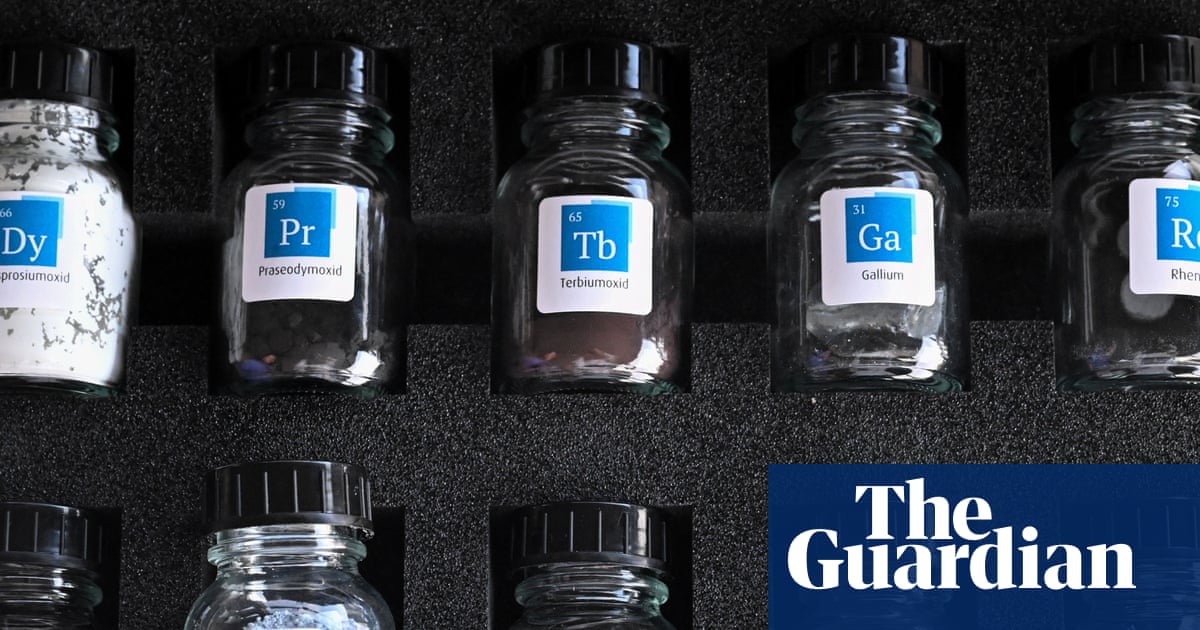
For some rare-earth minerals such as dysprosium, used in chip production, and samarium, essential to military applications, Chinese refinement dominance rises to 99%. Dysprosium and terbium are used in magnets essential for electric engines in electric vehicles and generators in wind turbines, along with uses in cellphones, high-intensity lighting and nuclear reactors.
“These materials are used in electric motors for EV cars but also in guidance systems that have obvious applications for the defense department,” says Adam Webb, head of energy raw materials at Benchmark Mineral Intelligence. “Anything that has a decent magnet in it uses rare earths.”
Trump’s efforts to reduce the US’s dependence on Chinese production on rare-earth minerals could take years. “‘Rare earths’ is somewhat of a misnomer because they’re not that uncommon in terms of abundance in the earth’s crust,” Webb says, but many deposits, including in Ukraine, where Trump made a deal earlier this year, are only in the early stages of extraction.
“It’s not that there’s a shortage per se, it’s that China can limit how much is exported,” Webb said, adding that getting export licenses from China can be a lengthy, difficult process.
Greenland, another focus of Trump’s attention, and Brazil, are two other countries where there are significant rare-earth deposits. In the continental US, there are deposits in California, Wyoming and Missouri, with the largest operational mine operating at Mountain Pass, California, about 60 miles from Las Vegas.
In July, the Pentagon became the largest shareholder in MP Materials, the operator of the California mine, with plans to open a new “mine-to-magnet” plant, called 10X, to make magnets crucial in F-35 fighter jets, drones and submarines, according to the department.
In North America, measured and indicated resources of rare earths were estimated to include 3.6m tons in the US and more than 14m tons in Canada, according to the geological survey data – far less than the 44m tons estimated in China.
Mirroring direct investment and stakes in the steel industry and US chipmaker Intel, the interior department said it was prepared to make direct investments in critical mineral companies.
skip past newsletter promotion
after newsletter promotion
“You’re competing against state capital because China is picking these strategically as areas that they want to invest in,” Doug Burgum, the US secretary of the interior, said during a speech at the Hamm Institute for American Energy in April.
Burgum floated that the US could utilize a sovereign wealth fund to speed production. “Why wouldn’t the wealthiest country in the world have the biggest sovereign wealth fund?” he asked.
US efforts to support domestic production have floundered in the past when China lowered prices, rendering unsupported rare-earth development uneconomic against China’s lower cost of production and long-term strategic outlook.
Five years ago, Simon Moores, managing director of Benchmark Mineral Intelligence, testified before the US Senate committee on energy and natural resources that “those who invest in battery capacity and supply chains today are likely to dominate this industry for generations to come. It is not too late for the US but action is needed now.”
Five years on, a scramble to assemble trading alliances around rare earths is accelerating.
“In about a year from now, we’ll have so much critical mineral and rare earths that you won’t know what to do with them,” Trump told reporters. That came eight months after Trump demanded $500bn of Ukraine’s minerals to compensate the US for the military aid. In September, the government of Pakistan signed a $500m deal with the American company US Strategic Metals, giving it access to minerals such as antimony and copper.
But can the US make up its shortfall and loosen China’s hold on rare-earth supply chains? “The US has taken really significant steps already,” Webb says. The US, he adds, cannot be “self-reliant in the short term because it takes time to bring a mine online and build refining capacity.”