
Category: 3. Business

  • REGENXBIO’s MPS II Gene Therapy RGX-121 Hit With CRL | NeurologyLive

    REGENXBIO’s MPS II Gene Therapy RGX-121 Hit With CRL | NeurologyLive

    REGENXBIO’s biologics license application (BLA) for clemidsogene lanparvovec (RGX-121), an investigational adeno-associated virus (AAV) vector-based gene therapy intended to treat mucopolysaccharidosis type 2 (MPS II, also known as Hunter syndrome), has received a complete response letter (CRL) from the FDA.1

    According to REGENXBIO, the FDA’sCRL, which it received on February 7, 2026, covered several reasons that the gene therapy product was not approved—despite the agency’s agreement with the study protocol in principle—including concerns about the ability of the clinical trial eligibility criteria to distinguish between neuronopathic disease and attenuated disease adequately, whether the external natural history control population used is sufficiently comparable to the trial population, and if there is reasonable likelihood that the surrogate end point used—heparan sulfate (HS) D2S6 levels in the cerebrospinal fluid (CSF)—can predict clinical benefit in an appropriate manner. Notably, the CRL contained several suggested pathways to a potential approval for the product, such as a new clinical trial, carrying out dosing of additional patients with longer follow-up, and implementation of an untreated control group on-study. Although, REGENXBIO stated that it has concerns about the difficulty of these pathways considering the ultrarare nature of MPS II.

    “This decision is devastating for the families of boys living with this progressive, life-threatening disease,” Curran M. Simpson, the president and chief executive officer of REGENXBIO, said in a statement.1 “We are concerned about FDA’s feedback regarding the overall development path and evaluation of the data in the context of the urgent need for this irreversible ultra-rare disease. We remain confident in the quality and volume of evidence demonstrating the long-term potential of RGX-121 to positively change the trajectory of Hunter syndrome. This program has been in development for over 10 years. We are incredibly grateful to all the patients, their families, investigators, and site staff who have supported this program and our continued efforts to bring a much-needed new treatment option to the Hunter syndrome community. We will continue those efforts.”

    REGENXBIO stated its intent to pursue a Type A meeting with the FDA to discuss a planned resubmission of the BLA, which it noted could include longer-term clinical data and “additional evidence from global MPS II experts to further clarify the neuronopathic patient population.”1 The company noted that it believed it had already addressed the FDA’s concerns through data updates and responses to information requests during the BLA review period and that analyses and reviews had been held between the FDA and “leading global MPS and biomarker experts” during this period.1

    “MPS II is a very complex disease, but its impact is well established, resulting in irreversible brain damage for the majority of patients; without appropriate treatments stopping this neurocognitive decline, the neuronopathic MPS II child will die prematurely, usually in their mid-teens,” Joseph Muenzer, MD, PhD, the director of Muenzer MPS Research and Treatment Center and a Bryson Distinguished Professor in the Division of Genetics and Metabolism in the Department of Pediatrics Genetics at University of North Carolina at Chapel Hill, added to the statement.1 “I remain encouraged by the clinical data behind RGX-121. New innovations like gene therapy could make a significant impact for these patients, and time is precious for these families.”

    Notably, the pivotal phase 1/2/3 CAMPSIITE clinical trial (NCT03566043) evaluating RGX-121 was placed on clinical hold by the FDA in January 2026.2 The hold was related to an intraventricular central nervous system tumor that occurred in 1 patient who was treated with RGX-111, a separate REGENXBIO AAV vector-based gene therapy product under evaluation for severe mucopolysaccharidosis Type I (MPS I, also known as Hurler syndrome) in a phase 1/2 clinical trial. The patient has not experienced symptoms, but the neoplasm was identified on a routine brain MRI 4 years after the patient was treated with the gene therapy product, and preliminary analysis indicated an AAV vector genome integration event associated with overexpression of PLAG1, a protooncogene. REGENXBIO noted that the tumor was resected, that the patient has shown positive developmental advancements, and that whether the serious AE was related to RGX-111 has not yet been determined. Although the event occurred in an RGX-111 trial, according to the company the FDA placed a hold on the RGX-121 program in addition to the RGX-111 program because of “similarities in products, study populations, and shared risk between the clinical studies.”2

    “We are surprised by FDA’s decision to place our RGX-121 program on hold while the investigation of this single, inconclusive incident in RGX-111 continues,” Simpson said in a January 2026 statement.2 “These are separate therapies, and the positive safety profile of RGX-121 in more than 30 patients treated, including those dosed nearly 7 years ago, remains unchanged. Patient safety is our top priority, and we, our investigators, and the patient community remain confident in the benefit-risk ratio of RGX-121 and are highly encouraged by the meaningful efficacy profile demonstrated in the pivotal trial. RGX-121 presents an opportunity to address the urgent, significant unmet medical need in this ultrarare disease community, and continued delay means continued neurodevelopmental decline in boys with MPS II.”

    REFERENCES
    1. REGENXBIO announces regulatory update on RGX-121 BLA for MPS II. News release. REGENXBIO Inc. February 9, 2026. Accessed February 9, 2026. https://ir.regenxbio.com/news-releases/news-release-details/regenxbio-presents-positive-twelve-month-pivotal-data-phase
    2. REGENXBIO announces regulatory update on ultra rare MPS programs. News release. REGENXBIO Inc. January 28, 2026. Accessed January 28, 2026. https://ir.regenxbio.com/news-releases/news-release-details/regenxbio-announces-regulatory-update-ultra-rare-mps-programs/

    Continue Reading

  • Hybrid Energy Strategies for Data Centres Key Limits – FTI Consulting

    1. Hybrid Energy Strategies for Data Centres Key Limits  FTI Consulting
    2. Only the Big Power Players Will Win the AI Game  Electropages
    3. Aterio Reports 169.65 GW of U.S. Data Center Capacity Announced in 2025 as AI Buildouts Accelerate  azcentral.com and The Arizona Republic
    4. AI-Fueled Data Center Construction Surges as 2026 Projects Top $88B  Construction Owners Club
    5. Inside JLL’s 2026 Outlook: Power constraints and the new data center playbook  Institutional Real Estate, Inc.

    Continue Reading

  • IEA report describes nuclear growth and need for grid flexibility — ANS / Nuclear Newswire

    IEA report describes nuclear growth and need for grid flexibility — ANS / Nuclear Newswire

    Behind the growing consumption: The IEA report noted that electricity consumption growth is being driven by “some of the most dynamic segments of global economies, such as artificial intelligence (AI), data centers, and evolving technological innovations.” It also cites the increasing electricity uptake by electric vehicles, air conditioning, and general industrial usage.

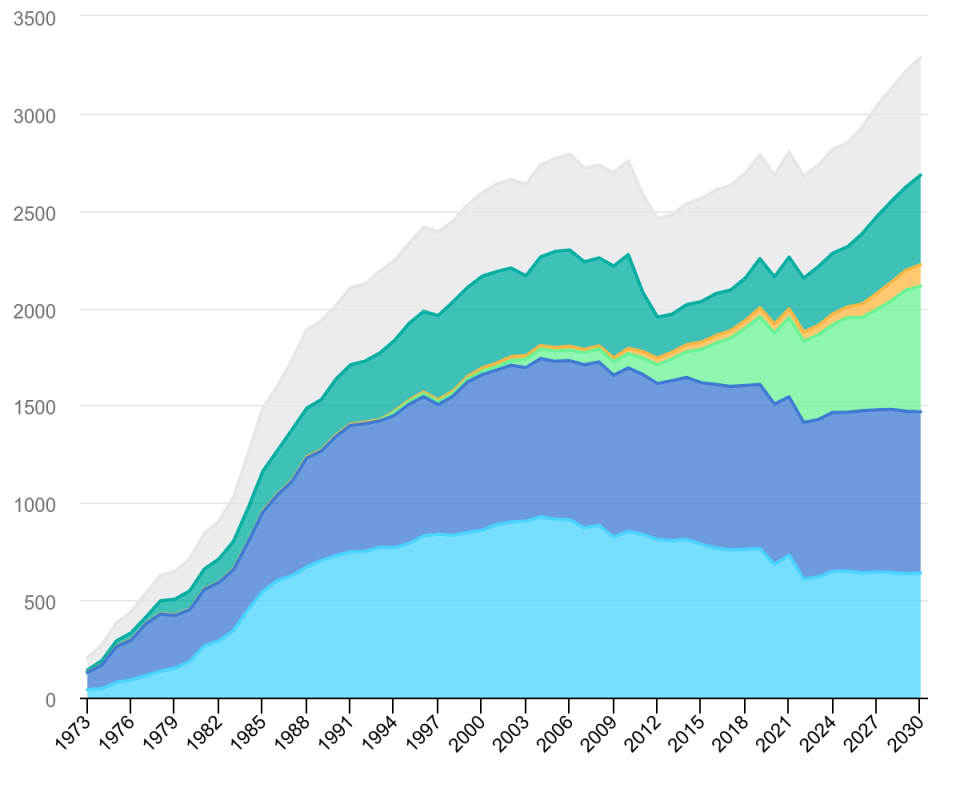
    Emerging and developing economies remain “the main engines of electricity demand growth,” but consumption by advanced economies is also now increasing “after 15 years of stagnation.” One-fifth of the power demand increase through 2030 is expected to come from advanced economies.

    Rapid expansion of grids: Because of this growing demand, along with “an increasingly weather-dependent mix of power generation sources,” Electricity 2026 stated that “power systems will need greater flexibility to securely and cost-effectively integrate an increasingly diverse mix of electricity generation sources while accommodating evolving demand patterns and technologies.” It called for a rapid and efficient expansion of electricity grids, the deployment of grid-enhancing technologies, and regulatory reforms that allow for more flexible connections and usage.

    With such steps, as much as 1,600 GW of the more than 2,500 GW of currently stalled, queued projects could be integrated into the grid system in the near term, according to the report.

    Outlook for nuclear: As described in the IEA report’s executive summary, the outlook for nuclear energy is positive around the world:

    Nuclear generation set a new record in 2025 and is set to continue rising steadily through 2030. Nuclear power output in 2025 was supported by reactor restarts in Japan, higher generation in France, and new capacity additions in China, India, and other countries. While most of the growth in nuclear generation through 2030 is expected to occur in emerging economies, with China alone accounting for around 40 percent of the global increase, nuclear energy is also regaining strategic importance in many advanced economies, underpinned by supportive policy frameworks to extend the lifetime of reactors and add new capacity.

    Affordability: Another topic covered in Electricity 2026 is energy affordability, which is a worsening problem as household electricity prices have been rising faster than incomes in many countries since 2019. The high electricity costs are also adding financial pressures to industries and businesses.

    According to the report, the non-energy components of costs—“such as network charges, taxes, and other levies—continue to account for a large, and often growing, share of household bills. In addition, electricity is also taxed more heavily than natural gas in many countries, weakening incentives for households to electrify heating, cooking, or hot water use. As a result, policymakers are increasingly focusing on policy frameworks, market designs, and regulation to improve affordability and encourage electrification.”

    A main challenge will be “ensuring prices remain affordable while still reflecting costs and incentivizing demand‑side flexibility.”

    Electricity security: Electricity security remains a crucial issue for modern economies, the report said, citing blackouts in Chile, the Iberian Peninsula, and Mexico in 2025, as well as “the EstLink-2 cable outage between Finland and Estonia, the Heathrow substation fire and the Berlin arson attack.” All of those incidents “exposed critical vulnerabilities” that suggest “strengthening the physical protection of critical infrastructure and deploying advanced monitoring and early‑detection systems will be essential to guard against threats.”

    Ultimately, ensuring a reliable supply of electricity “depends on strong grids, resilient supply chains and diverse flexibility resources,” the report stressed.

    Continue Reading

  • Fitch Upgrades Lumen, Level 3 and Qwest IDRs to 'B' – Fitch Ratings

    1. Fitch Upgrades Lumen, Level 3 and Qwest IDRs to ‘B’  Fitch Ratings
    2. Major company acquires fiber internet networks in Boise  Boise Dev
    3. Lumen Technologies’ senior unsecured debt rating raised to ’B’ at S&P  Investing.com
    4. AT&T to add 100+ jobs in Orlando after $5.75B fiber acquisition  The Business Journals
    5. AT&T closes billion-dollar acquisition to win back customers  MSN

    Continue Reading

  • Mexico jet fuel changes to raise costs unevenly

    Mexico jet fuel changes to raise costs unevenly

    Mexican state-owned Airports and Auxiliary Services (ASA) will overhaul its jet fuel discount structure from mid-February, a move market participants say will raise fuel logistics costs unevenly across the aviation market.

    ASA notified fuel buyers in mid-January that it will revise the volume thresholds required to access discounts on its jet fuel administrative service charge (CSAC), which applies to storage and into-plane services, beginning 15 February, with a more aggressive second phase taking effect on 1 July, according to documents seen by Argus.

    While the changes do not involve a headline increase in jet fuel prices, they will materially alter effective operating costs by limiting access to discounts for all but the highest-volume buyers.

    The changes disproportionately affect airlines and jet fuel buyers outside Mexico’s three largest carriers. Under the revised structure, participants outside of the top-volume tiers would see their CSAC discounts cut sharply, while a narrow group of top-tier buyers would retain access to materially higher discounts, market participants said.

    Mexico’s jet fuel market remains dominated by the government through state-owned Pemex and ASA, which together control fuel supply, storage and into-plane services at most airports nationwide. The CSAC, introduced in July 2024, applies to all companies using ASA’s fuel storage and into-plane infrastructure, making it a mandatory cost for all jet fuel suppliers and buyers operating at Mexican airports.

    This structure amplifies the impact of the revised CSAC scheme, as companies have no practical alternatives for jet fuel logistics. The changes could reinforce concentration further down the value chain by favoring a limited group of high-volume buyers, effectively creating a new commercial bottleneck beneath the state-controlled infrastructure layer, according to market sources.

    The issue has been raised with the International Air Transport Association (IATA), which confirmed it is engaging with ASA over the revised CSAC structure.

    “IATA is in contact with ASA on this subject and is advocating on behalf of the industry to ensure that the impact on costs is kept as competitive as possible,” the association said in a statement to Argus.

    ASA did not respond to a request for comment.

    Discount curve shifts sharply from Feb

    Under the current CSAC discount structure, differences across market participants are relatively narrow, but the gap will widen sharply under the first phase of changes in mid-February.

    Most jet fuel buyers — including large foreign airlines and private-sector jet fuel suppliers — currently receive discounts ranging from 85-98pc, while the largest buyers qualify for discounts of 99pc, resulting in broadly comparable costs across much of the market.

    But from 15 February, discount tiers will tighten, with participants outside the highest volume threshold seeing their discounts fall to around 40pc, while top-tier buyers will retain discounts of 90pc, according to market sources and documents seen by Argus.

    The gap widens further under the second phase, effective 1 July.

    From July, participants that do not meet the highest volume threshold will receive discounts as low as 20pc, while top-tier buyers will continue to qualify for discounts of 80pc. This would translate into effective CSAC costs up to four times higher for all participants outside the largest buyers.

    The companies falling into the lower discount tiers include large foreign airlines, private-sector jet fuel suppliers, regional airlines and private aviation.

    Market sources said the revised structure marks a clear difference from the previous model, in which discount gaps existed but remained manageable. Under the new framework, the discount disparity is big enough to create a structural cost disadvantage for some participants.

    Regional aviation under pressure

    The revised CSAC structure could threaten the viability of regional aviation, as higher fuel logistics costs would further strain an already fragile segment of Mexico’s aviation market, according to market sources.

    Regional airlines operate short-haul routes with limited ability to pass higher costs through to fares, making them particularly sensitive to increases in fuel logistics charges. The revised discount thresholds would sharply erode route economics, a source familiar with regional airline operations said.

    The impact could even extend to state-owned airline Mexicana de Aviacion, which does not meet the volume thresholds required to access the highest CSAC discounts.

    Continue Reading

  • Kirkland Advises GBL on Acquisition of Stake in Rayner | News

    Kirkland & Ellis is advising Groupe Bruxelles Lambert (GBL) on signing definitive agreements to acquire a 45% co-control stake in Rayner, a leading manufacturer of intraocular lenses and related products. GBL will invest ~€0.5 billion of equity alongside incumbent shareholders CVC and the Rayner management team.

    Read GBL’s press release

    The Kirkland team includes corporate lawyers Vincent Bergin, Adrian Maguire and Carmella Crinnion; debt finance lawyer Evgeny Zborovsky; and tax lawyer Peter Abbott. 

    Continue Reading

  • Revolutionizing the Industrial Base: South Korea’s AI Integration in Manufacturing – Stimson Center

    1. Revolutionizing the Industrial Base: South Korea’s AI Integration in Manufacturing  Stimson Center
    2. “What Does the Robot Industry Need Most?” This Book Argues Korea Has Both  매일경제
    3. Changwon University, Ministry Partner on Manufacturing AX  조선일보
    4. Ministry Of Science And ICT Reviews Physical AI Outcomes In Gyeongnam  아시아경제
    5. Korea SMEs startups agency partners with industry for AI training  Tech in Asia

    Continue Reading

  • AI chatbots give inaccurate medical advice says Oxford Uni study – BBC

    AI chatbots give inaccurate medical advice says Oxford Uni study – BBC

    1. AI chatbots give inaccurate medical advice says Oxford Uni study  BBC
    2. AI no better than other methods for patients seeking medical advice, study shows  marketscreener.com
    3. Chatbots Make Terrible Doctors, New Study Finds  404 Media
    4. Reliability of LLMs as medical assistants for the general public: a randomized preregistered study  Nature
    5. When patients ask AI first, with Amber Maraccini, Ph.D., M.A., of Medallia  Medical Economics

    Continue Reading

  • Tissue-Free ctDNA and Outcomes in Patients With Colorectal Cancer Receiving FOLFOX-Based Adjuvant Therapy

    Tissue-Free ctDNA and Outcomes in Patients With Colorectal Cancer Receiving FOLFOX-Based Adjuvant Therapy

    By Matthew Stenger
    Posted: 2/9/2026 9:53:00 AM

    Last Updated: 2/9/2026 10:36:07 AM

    In a study reported in the Journal of Clinical Oncology, Sinicrope et al found that a tissue-free circulating tumor DNA (ctDNA) assay had strong prognostic value in patients receiving FOLFOX (fluorouracil, leucovorin, and oxaliplatin)-based adjuvant therapy for stage III colorectal cancer.

    Study Details

    The study used data from 2,260 evaluable patients with stage III disease receiving FOLFOX-based adjuvant therapy in the phase III Alliance N0147 trial. Plasma samples collected after surgery and before adjuvant FOLFOX alone or with cetuximab were assessed by tissue-free ctDNA assay. In ctDNA-positive patients, tumor fraction (TF) was quantified and genotyping was performed with a 739-gene panel.

    Key Findings

    Among the 2,260 patients, 461 (20.4%) were ctDNA-positive; significantly higher positivity rates were found among advanced T-/N-stage, high-grade, obstruction/perforation, and BRAF V600E–mutant tumors.

    At a median follow-up of 6.1 years, ctDNA positivity was independently associated (all P < .0001) with poorer time to recurrence (hazard ratio [HR] = 5.96, 95% confidence interval [CI] = 5.11–6.96), disease-free survival (HR = 5.03, 95% CI = 4.36–5.81), and overall survival (HR = 4.45, 95% CI = 3.76–5.27). For the ctDNA-positive group vs the ctDNA-negative group, 5-year disease-free survival was 27.7% vs 77.1 and 5-year overall survival was 50.4% vs 86.8%. The adverse prognostic impact of ctDNA positivity was greater in lower T/N stage, low-risk, and deficient mismatch repair subgroups (interaction P = .0012–.041).

    Among ctDNA-positive patients, TF was approximately twice that in those with recurrence or death (P = .0002), and TN-stratified patients for time to recurrence, disease-free survival, and overall survival (all adjusted P < .002). On genotyping, mutations in FLT1 (odds ratio [OR] = 8.99) and PREX2 (OR = 7.73) were the most strongly associated with recurrence (P < .03).

    The investigators concluded: “Evaluation of ctDNA in resected stage III [colorectal cancer] using a tissue-free assay provided robust and independent prognostic value. Higher ctDNA burden, [deficient mismatch repair], and specific mutations defined poor prognostic groups among ctDNA-positive patients.”

    Frank A. Sinicrope, MD, of the Department of Oncology, Mayo Clinic, Rochester, Minnesota, is the corresponding author for the Journal of Clinical Oncology article.

    DISCLOSURE: The study was supported by the Mayo Foundation for Research and Education and Guardant Health, Inc. For full disclosures of the study authors, visit ascopubs.org.

    Continue Reading

  • Reworld™ Welcomes Mauro Gregorio to its Board of Directors

    Reworld™ Welcomes Mauro Gregorio to its Board of Directors

    FLORHAM PARK, N.J., Feb. 9, 2026 /PRNewswire/ — Reworld™, a leader in sustainable waste solutions, proudly announces the appointment of Mauro Gregorio to its Board of Directors. A longtime executive at Dow Inc. with extensive global leadership and board experience, Gregorio brings a proven track record of supporting growth, strengthening operations and creating long-term value within complex, asset-intensive industries.

    “With his extensive leadership background and keen understanding of customer needs across industrial value chains, Mauro will make a meaningful impact on our Board,” said Azeez Mohammed, President and CEO of Reworld™. “We are confident in Mauro’s ability to help us drive profitable growth while advancing the company’s long-term vision of sustainability and innovation.”

    Gregorio most recently served as President of Dow’s Performance Materials & Coatings division, with annual sales of approximately $10 billion, delivering material science solutions for infrastructure, transportation, renewable energy, electronics and consumer markets. Earlier in his career, Gregorio held several senior leadership roles spanning more than two decades, including President of Dow Consumer Solutions and Chief Executive Officer of Dow Silicone Corporation where he led the integration of Dow Corning following its acquisition by Dow Chemical.

    “Mauro has an impressive history of delivering performance improvements across a diverse set of businesses,” stated Howard Lance, Chairman of the Reworld™ Board of Directors. “He will provide important perspective to our Board and help Reworld™ continue to innovate and lead in the industry.”

    “I’m proud to join the Board of Directors at Reworld™,” said Gregorio. “I look forward to leveraging my experience to support the organization’s mission of driving smarter, more sustainable solutions that positively impact people and the environment.”

    In addition to his executive leadership background, Gregorio has served on the boards of several public and private companies, including Eagle Materials, Graham Corporation and Radius Recycling, one of North America’s largest manufacturers and exporters of recycled metal products.

    About Reworld™ Reworld™ is a leader in sustainable waste solutions, providing innovative and environmentally responsible services to a global community. Reworld™ is committed to advancing zero waste initiatives and supporting sustainability goals through state-of-the-art technologies that reimagine, reduce, reuse, recycle, recover and renew. For more information, visit www.reworldwaste.com.

    Media Contacts
    Linda Ribakusky
    [email protected]
    Coyne PR
    [email protected]  

    SOURCE Reworld Holding Corporation

    Continue Reading