Category: 3. Business

  • Asian Shares Rise After Two-Day Loss, Dollar Dips: Markets Wrap

    Asian Shares Rise After Two-Day Loss, Dollar Dips: Markets Wrap

    (Bloomberg) — Asian equities rebounded from their steepest two-day decline since April, as dip buyers returned after a brief pullback in technology shares, driven by concerns about lofty valuations.

    MSCI’s regional gauge rose 1.3%, with Hong Kong and Japan among the biggest gainers. All 11 industry groups in the index advanced, with more than two stocks gaining for every one that fell. Softbank Group Corp. shares rose 0.5% as it explored a potential takeover of US chipmaker Marvell Technology Inc.

    Asian gains came after Wall Street indexes bounced back from Tuesday’s selloff as traders bought the dip on some of the biggest winners of the AI boom. Futures on the S&P 500 and Nasdaq 100 indexes were relatively flat. Qualcomm Inc. shares fell 2.6% in late trading, becoming the latest chipmaker to deliver an upbeat forecast and still leave investors underwhelmed.

    “For investors with cash on the sidelines, the recent market pullback seems like a good time to buy, especially for investors with a longer time horizon,” said Robert Edwards at Edwards Asset Management. “Earnings are crushing it and growing faster than revenues, and that often leads to multiple expansion.”

    After a brief pullback that stirred concerns about stretched valuations, buyers returned as strong earnings momentum and upbeat private economic data lifted stocks. The shift in sentiment came after the global equity rally hit a speed bump earlier this week, when Wall Street executives cautioned that lofty valuations could trigger a correction.

    Concerns about a narrowing cohort of stocks driving equity gains have become louder, while a pivot in the Federal Reserve’s commentary dented optimism about interest-rate cuts.

    Meanwhile, President Donald Trump’s use of broad powers to impose his signature tariffs faced questions at the Supreme Court, which appeared skeptical of the sweeping global levies. Trump announced the century-high levies in April as part of his economic policy to reshape global trade.

    In a nearly three-hour hearing Wednesday, the court hinted it was ready to put significant limits on Trump’s far-reaching agenda for the first time since he took office in January.

    “It will certainly have a place in the back of the mind for investors,” said Nick Twidale, chief market analyst at AT Global Markets in Sydney. “Until it transfers to any action, I don’t think we will see much of a reaction from markets.”

    While the importance of this case and the likelihood of a close split on the court argue for lengthy deliberation, the expedited consideration of the case and likely desire to avoid even larger eventual refunds imply that the court is likely to rule in December or January, Goldman Sachs Group Inc. economists including Alec Phillips wrote in a note.

    In other corners of the market, gold held its gains, while oil edged up after three days of losses. The dollar fell slightly against all Group-of-10 peers, and Treasuries rose. The Bloomberg Dollar Spot Index edged 0.1% lower after snapping a five-day rally on Wednesday.

    The dollar fell most against the yen, which rose after wage data showed faster growth in Japan’s labor cash earnings, supporting the case for the Bank of Japan to normalize its policy.

    Meanwhile, the number of Chinese companies in MSCI Inc.’s global stock gauges has climbed for the first time in nearly two years, setting up the market for more inflows from passive investors.

    More Chinese stocks were added to MSCI’s Global Standard Indexes than deleted in the quarterly shuffle for the first time since February 2024, according to data compiled by Bloomberg. The index provider added 26 Chinese companies and removed 20.

    Corporate Highlights:

    Arm Holdings Plc, which provides the most widely used technology in computing processors, gave a bullish revenue forecast, helped by increasing interest in designing chips to run AI data centers. United Overseas Bank Ltd. shares slumped after the lender set aside its biggest provision of S$615 million ($470 million) citing commercial real estate risks in the US and Greater China. James Hardie Industries Plc shares tumbled after rivals sounded fresh warnings on the US home-improvement market, worsening what’s been a disastrous year for the company’s management and investors. The US will cut flight capacity by 10% at 40 high-volume markets across the country to alleviate pressure on air traffic controllers and the aviation system during what is now the longest government shutdown in history. International routes will be spared. Nissan Motor Co. has agreed to sell its global headquarters in Yokohama for ¥97 billion ($630 million) to a group sponsored by Hong Kong-listed autoparts maker Minth Group. Pony AI Inc. and WeRide Inc. fell on their trading debuts in Hong Kong after the pair of Chinese robotaxi firms battled for investors during their public offerings, which raised more than $1.1 billion. Some of the main moves in markets:

    Stocks

    S&P 500 futures were little changed as of 12:59 p.m. Tokyo time Japan’s Topix rose 1.5% Australia’s S&P/ASX 200 rose 0.3% Hong Kong’s Hang Seng rose 1.6% The Shanghai Composite rose 0.9% Euro Stoxx 50 futures were little changed Currencies

    The Bloomberg Dollar Spot Index was little changed The euro rose 0.1% to $1.1507 The Japanese yen rose 0.2% to 153.88 per dollar The offshore yuan was little changed at 7.1272 per dollar Cryptocurrencies

    Bitcoin was little changed at $103,638.01 Ether fell 0.2% to $3,434.82 Bonds

    The yield on 10-year Treasuries declined two basis points to 4.14% Japan’s 10-year yield advanced one basis point to 1.670% Australia’s 10-year yield advanced five basis points to 4.37% Commodities

    West Texas Intermediate crude rose 0.3% to $59.80 a barrel Spot gold rose 0.2% to $3,987.71 an ounce This story was produced with the assistance of Bloomberg Automation.

    –With assistance from Joanna Ossinger and Winnie Hsu.

    ©2025 Bloomberg L.P.

    Continue Reading

  • Darwin C. The descent of man, and selection in relation to sex. London: John Murray; 1871.

  • Dale J, et al. The effects of life history and sexual selection on male and female plumage colouration. Nature. 2015;527(7578):367–70.

    Article 
    CAS 
    PubMed 

    Google Scholar 

  • Prum RO. The Lande-Kirkpatrick mechanism is the null model of evolution by intersexual selection: implications for meaning, honesty, and design in intersexual signals. Evolution. 2010;64(11):3085–100.

    Article 
    PubMed 

    Google Scholar 

  • Cooney CR, et al. Sexual selection predicts the rate and direction of colour divergence in a large avian radiation. Nat Commun. 2019;10(1):1773.

    Article 
    PubMed 
    PubMed Central 

    Google Scholar 

  • Cardoso GC, Mota PG. Speciational evolution of coloration in the genus carduelis. Evolution. 2008;62(4):753–62.

    Article 
    PubMed 

    Google Scholar 

  • Martin TE, Badyaev AV. Sexual dichromatism in birds: importance of nest predation and nest location for females versus males. Evolution. 1996;50(6):2454–60.

    Article 
    PubMed 

    Google Scholar 

  • Hill GE, McGraw KJ. Bird coloration. Cambridge, Mass.: Harvard University Press; 2006.

    Book 

    Google Scholar 

  • Stoddard MC, Prum RO. Evolution of avian plumage color in a tetrahedral color space: a phylogenetic analysis of new world buntings. Am Nat. 2008;171(6):755–76.

    Article 
    PubMed 

    Google Scholar 

  • Cooney CR, et al. Latitudinal gradients in avian colourfulness. Nat Ecol Evol. 2022;6(5):622–9.

    Article 
    PubMed 

    Google Scholar 

  • Carballo L, et al. Body size and climate as predictors of plumage colouration and sexual dichromatism in parrots. J Evol Biol. 2020;33(11):1543–57.

    Article 
    PubMed 

    Google Scholar 

  • Hamilton WJ, Heppner F. Radiant solar energy and the function of black homeotherm pigmentation: an hypothesis. Science. 1967;155(3759):196–7.

    Article 
    PubMed 

    Google Scholar 

  • Leitão AV, Monteiro AH, Mota PG. Ultraviolet reflectance influences female preference for colourful males in the European Serin. Behav Ecol Sociobiol. 2014;68(1):63–72.

    Article 

    Google Scholar 

  • Leitao AV, et al. Female and male plumage colour signals aggression in a dichromatic tropical Songbird. Anim Behav. 2019;150:285–301.

    Article 

    Google Scholar 

  • Terrill RS, Shultz AJ. Feather function and the evolution of birds. Biol Rev. 2023;98(2):540–66.

    Article 
    PubMed 

    Google Scholar 

  • Kemp DJ, et al. An integrative framework for the appraisal of coloration in nature. Am Nat. 2015;185(6):705–24.

    Article 
    PubMed 

    Google Scholar 

  • Shultz AJ, Burns KJ. The role of sexual and natural selection in shaping patterns of sexual dichromatism in the largest family of songbirds (Aves: Thraupidae). Evolution. 2017;71(4):1061–74.

    Article 
    PubMed 

    Google Scholar 

  • Spottiswoode C, Møller AP. Extrapair paternity, migration, and breeding synchrony in birds. Behav Ecol. 2004;15:41–57.

    Article 

    Google Scholar 

  • Fitzpatrick S. Colourful migratory birds: evidence for a mechanism other than parasite resistance for the maintenance of ‘good genes’ sexual selection. Proc Biol Sci. 1994;257:155–60.

  • Spottiswoode CN, Tottrup AP, Coppack T. Sexual selection predicts advancement of avian spring migration in response to climate change. Proc Royal Soc B-Biological Sci. 2006;273(1605):3023–9.

    Article 

    Google Scholar 

  • Simpson RK, Johnson MA, Murphy TG. Migration and the evolution of sexual dichromatism: evolutionary loss of female coloration with migration among wood-warblers. Proc Biol Sci. 2015;282(1809).

  • Galván I, et al. On showy dwarfs and sober giants: body size as a constraint for the evolution of bird plumage colouration. Acta Ornithologica. 2013;48(1):65–80.

    Article 

    Google Scholar 

  • Ricklefs RE. Insights from comparative analyses of aging in birds and mammals. Aging Cell. 2010;9(2):273–84.

    Article 
    CAS 
    PubMed 

    Google Scholar 

  • Delhey K, et al. The evolution of carotenoid-based plumage colours in passerine birds. J Anim Ecol. 2023;92(1):66–77.

    Article 
    PubMed 

    Google Scholar 

  • Endler JA. The color of light in forests and its implications. Ecol Monogr. 1993;63(1):1–27.

    Article 

    Google Scholar 

  • McNaught MK, Owens IPF. Interspecific variation in plumage colour among birds: species recognition or light environment? J Evol Biol. 2002;15(4):505–14.

    Article 

    Google Scholar 

  • Marchetti K. Dark habitats and bright birds illustrate the role of the environment in species divergence. Nature. 1993;362(6416):149–52.

    Article 

    Google Scholar 

  • Soler JJ, Moreno J. Evolution of sexual dichromatism in relation to nesting habits in European passerines: a test of wallace’s hypothesis. J Evol Biol. 2012;25(8):1614–22.

    Article 
    CAS 
    PubMed 

    Google Scholar 

  • Badyaev AV. Altitudinal variation in sexual dimorphism: a new pattern and alternative hypotheses. Behav Ecol. 1997;8(6):675–90.

    Article 

    Google Scholar 

  • Delhey K, et al. Reconciling ecogeographical rules: rainfall and temperature predict global colour variation in the largest bird radiation. Ecol Lett. 2019;22(4):726–36.

    Article 
    PubMed 

    Google Scholar 

  • Bleiweiss R. Covariation of sexual dichromatism and plumage colours in lekking and non-lekking birds: A comparative analysis. Evol Ecol. 1997;11(2):217–35.

    Article 

    Google Scholar 

  • Prum RO. Phylogenetic tests of alternative intersexual selection mechanisms: trait macroevolution in a polygynous clade (Aves: Pipridae). Am Nat. 1997;149(4):668–92.

    Article 

    Google Scholar 

  • Delhey K, et al. Evolutionary predictors of the specific colors of birds. Proc Natl Acad Sci U S A. 2023;120(34):e2217692120.

    Article 
    CAS 
    PubMed 
    PubMed Central 

    Google Scholar 

  • Tazzyman SJ, Iwasa Y, Pomiankowski A. Signaling efficacy drives the evolution of larger sexual ornaments by sexual selection. Evolution. 2014;68(1):216–29.

    Article 
    PubMed 

    Google Scholar 

  • Dunn PO, Armenta JK, Whittingham LA. Natural and sexual selection act on different axes of variation in avian plumage color. Sci Adv. 2015;1(2):e1400155.

    Article 
    PubMed 
    PubMed Central 

    Google Scholar 

  • Irwin RE. The evolution of plumage dichromatism in the New-World Blackbirds – Social selection on female brightness. Am Nat. 1994;144(6):890–907.

    Article 

    Google Scholar 

  • Weaver RJ, et al. Carotenoid metabolism strengthens the link between feather coloration and individual quality. Nat Commun. 2018;9(1):73.

    Article 
    PubMed 
    PubMed Central 

    Google Scholar 

  • Hill GE et al. Plumage redness signals mitochondrial function in the house finch. Proc Biol Sci. 2019;286(1911).

  • Weaver RJ, Koch RE, Hill GE. What maintains signal honesty in animal colour displays used in mate choice? Philos Trans R Soc Lond B Biol Sci. 2017;372(1724).

  • Simons MJ, Cohen AA, Verhulst S. What does carotenoid-dependent coloration tell? Plasma carotenoid level signals immunocompetence and oxidative stress state in birds-A meta-analysis. PLoS ONE. 2012;7(8):e43088.

    Article 
    CAS 
    PubMed 
    PubMed Central 

    Google Scholar 

  • Perez-Rodriguez L, Mougeot F, Alonso-Alvarez C. Carotenoid-based coloration predicts resistance to oxidative damage during immune challenge. J Exp Biol. 2010;213(Pt 10):1685–90.

    Article 
    CAS 
    PubMed 

    Google Scholar 

  • Moller AP, et al. Carotenoid-dependent signals: indicators of foraging efficiency, immunocompetence or detoxification ability? Avian Poult Biology Reviews. 2000;11(3):137–59.

    Google Scholar 

  • Lozano GA. Carotenoids, Parasites, and sexual selection. Oikos. 1994;70(2):309–11.

    Article 

    Google Scholar 

  • Hill GE. Condition-dependent traits as signals of the functionality of vital cellular processes. Ecol Lett. 2011;14(7):625–34.

    Article 
    PubMed 

    Google Scholar 

  • Koch RE, et al. Mechanisms of carotenoid metabolism: understanding the links between red coloration, cellular respiration, and individual quality. Integr Comp Biol. 2025.

  • Lopes RJ, et al. Genetic basis for red coloration in birds. Curr Biol. 2016;26(11):1427–34.

    Article 
    CAS 
    PubMed 
    PubMed Central 

    Google Scholar 

  • Winkler DW, Billerman SM, Lovette IJ. Cardinals and allies (Cardinalidae), version 1.0. In: Billerman SM, Rodewald PG, Schulenberg TS, editors. Birds of the World. Ithaca, NY, USA: Cornell Lab of Ornithology; 2020.

  • Barker FK, et al. New insights into new world biogeography: an integrated view from the phylogeny of blackbirds, cardinals, sparrows, tanagers, warblers, and allies. Auk. 2015;132(2):333–48.

    Article 

    Google Scholar 

  • Scott BF, Shultz AJ, Burns KJ. The impact of habitat and migration on plumage colour in Cardinalidae. Biol J Linn Soc. 2023;141(2):264–77.

    Article 

    Google Scholar 

  • Leitão AV, et al. Evidence for multiple functions in a sexually selected ornament. Anim Behav. 2015;110:155–61.

    Article 

    Google Scholar 

  • Maia R, et al. Pavo: an R package for the analysis, visualization and organization of spectral data. Methods Ecol Evol. 2013;4(10):906–13.

    Article 

    Google Scholar 

  • Core Team R. R: A Language and environment for statistical computing. R Foundation for Statistical Computing: Vienna, Austria; 2022.

  • Ödeen A, Håstad O, Alström P. Evolution of ultraviolet vision in the largest avian radiation – the passerines. BMC Evol Biol. 2011;11.

  • Vorobyev M, et al. Tetrachromacy, oil droplets and bird plumage colours. J Comp Physiol A. 1998;183(5):621–33.

    Article 
    CAS 
    PubMed 

    Google Scholar 

  • Hart NS, Vorobyev M. Modelling oil droplet absorption spectra and spectral sensitivities of bird cone photoreceptors. J Comp Physiol Neuroethol Sens Neural Behav Physiol. 2005;191(4):381–92.

    Article 

    Google Scholar 

  • Stoddard MC, Prum RO. How colorful are birds? Evolution of the avian plumage color gamut. Behav Ecol. 2011;22(5):1042–52.

    Article 

    Google Scholar 

  • Delhey K. The colour of an avifauna: A quantitative analysis of the colour of Australian birds. Sci Rep. 2015;5:18514.

    Article 
    CAS 
    PubMed 
    PubMed Central 

    Google Scholar 

  • Dunning JB Jr. CRC handbook of avian body masses. 2nd ed. CRC; 2008.

  • Mikula P, et al. A global analysis of song frequency in passerines provides no support for the acoustic adaptation hypothesis but suggests a role for sexual selection. Ecol Lett. 2021;24(3):477–86.

    Article 
    PubMed 

    Google Scholar 

  • Running SW, et al. A continuous satellite-derived measure of global terrestrial primary production. Bioscience. 2004;54:547–60.

    Article 

    Google Scholar 

  • Orne D, et al. The Caper package: comparative analysis of phyloge-netics and evolution in R. 2013.

  • Jetz W, et al. The global diversity of birds in space and time. Nature. 2012;491(7424):444–8.

    Article 
    CAS 
    PubMed 

    Google Scholar 

  • Lüdecke D, et al. performance: assessment of regression models performance. 2021: https://easystats.github.io/performance/

  • Bürkner PC. Brms: an R package for bayesian multilevel models using Stan. J Stat Softw. 2017;80(1):1–28.

    Article 

    Google Scholar 

  • Paradis E, Schliep K. Ape 5.0: an environment for modern phylogenetics and evolutionary analyses in R. Bioinformatics. 2019;35(3):526–8.

    Article 
    CAS 
    PubMed 

    Google Scholar 

  • Tella JL, et al. Ecological, morphological and phylogenetic correlates of interspecific variation in plasma carotenoid concentration in birds. J Evol Biol. 2004;17(1):156–64.

    Article 
    CAS 
    PubMed 

    Google Scholar 

  • Andersson MB. Sexual selection. Princeton, N.J Baltimore, Md: Princeton University Press; 1994.

    Book 

    Google Scholar 

  • Maynard-Smith J, Harper D. Animal signals. Volume 166. Oxford: Oxford University Press; 2003.

    Book 

    Google Scholar 

  • Cardoso GC, Mota PG. Chapter seven – Evolution of song and colour across the Canary relatives. The canary: natural history, science and cultural significance. London, UK: Academic; 2024. pp. 163–97. L.R. Cardoso GC, Mota PG, Editor.

    Chapter 

    Google Scholar 

  • Badyaev AV, Hill GE. Avian sexual dichromatism in relation to phylogeny and ecology. Annu Rev Ecol Evol Syst. 2003;34:27–49.

    Article 

    Google Scholar 

  • Lande R. Genetic correlations between the sexes in the evolution of sexual dimorphism and mating preferences. In: Bradbury JW, Andersson M, editors. Sexual selection: testing the alternatives. New York: John Wiley & Sons; 1987. p. 83–94.

  • Gazda MA, et al. A genetic mechanism for sexual dichromatism in birds. Science. 2020;368(6496):1270–.

    Article 
    CAS 
    PubMed 

    Google Scholar 

  • Norden KK, Price TD. Historical contingency and developmental constraints in avian coloration. Trends Ecol Evol. 2018;33(8):574–6.

    Article 
    PubMed 

    Google Scholar 

  • Clutton-Brock T. Sexual selection in males and females. Science. 2007;318(5858):1882–5.

    Article 
    CAS 
    PubMed 

    Google Scholar 

  • Tobias JA, Montgomerie R, Lyon BE. The evolution of female ornaments and weaponry: social selection, sexual selection and ecological competition. Philosophical Trans Royal Soc B-Biological Sci. 2012;367(1600):2274–93.

    Article 

    Google Scholar 

  • Doutrelant C, Fargevieille A, Grégoire A. Chapter Four – Evolution of female coloration: what have we learned from birds in general and blue Tits in particular. Adv Study Behavior52. 2020;52:123–202.

    Article 

    Google Scholar 

  • Trigo S, et al. Female ornamentation in European Serins is related to age but not to male mate choice and social competition. Behav Ecol Sociobiol. 2024;78(116).

  • Doutrelant C, et al. Female plumage coloration is sensitive to the cost of reproduction. An experiment in blue Tits. J Anim Ecol. 2011;81(1):87–96.

    Article 
    PubMed 

    Google Scholar 

  • Farine D, Sheldon B. Selection for territory acquisition is modulated by social network structure in a wild Songbird. J Evol Biol. 2015;28(3):547–56.

    Article 
    CAS 
    PubMed 
    PubMed Central 

    Google Scholar 

  • Nolazco S, et al. Ornaments are equally informative in male and female birds. Nat Commun. 2022;13(1):5917.

    Article 
    CAS 
    PubMed 
    PubMed Central 

    Google Scholar 

  • Clutton-Brock T, Huchard E. Social competition and selection in males and females. Philos Trans R Soc Lond B Biol Sci. 2013;368(1631).

  • Gonzalez-Voyer A, et al. Evolution of acoustic and visual signals in Asian barbets. J Evol Biol. 2013;26(3):647–59.

    Article 
    CAS 
    PubMed 

    Google Scholar 

  • Eliason CM, et al. Complex plumages spur rapid color diversification in kingfishers (Aves: Alcedinidae). Elife. 2023;12.

  • Seddon N, et al. Sexual selection accelerates signal evolution during speciation in birds. Proc Biol Sci. 2013;280(1766):20131065.

    PubMed 
    PubMed Central 

    Google Scholar 

  • Perez-Rodriguez L. Carotenoids in evolutionary ecology: re-evaluating the antioxidant role. BioEssays. 2009;31(10):1116–26.

    Article 
    CAS 
    PubMed 

    Google Scholar 

  • Svensson PA, Wong BBM. Carotenoid-based signals in behavioural ecology: a review. Behaviour. 2011;148(2):131–89.

    Article 

    Google Scholar 

  • Trigo S, Mota PG. What is the value of a yellow patch? Assessing the signalling role of yellow colouration in the European Serin. Behav Ecol Sociobiol. 2015;69(3):481–90.

    Article 

    Google Scholar 

  • Espinosa CE, et al. Crown saturation and intrasexual dominance: evidence of a negatively correlated handicap in male saffron finches. Avian Res. 2025;16(2).

  • Koch RE, Josefson CC, Hill GE. Mitochondrial function, ornamentation, and immunocompetence. Biol Rev. 2017;92(3):1459–74.

    Article 
    PubMed 

    Google Scholar 

Continue Reading

  • Sequoia Plans for More AI, Less Partisanship Under Grady and Lin – Bloomberg.com

    1. Sequoia Plans for More AI, Less Partisanship Under Grady and Lin  Bloomberg.com
    2. Sequoia Capital Leader Exits in VC Shake-Up  The Wall Street Journal
    3. Sequoia’s Change in Leadership: Will Advancements in AI Help Restore Broken Trust?  Bitget
    4. Sequoia Capital elevates Alfred Lin and Pat Grady to lead venture capital firm  Pensions & Investments
    5. Meet Sequoia Capital’s new stewards  Fortune

    Continue Reading

  • Ten organizations have jointly launched a project titled “Development of Integrated Simulation Platform for Sustainable and Competitive Maritime Industry”

    Ten organizations have jointly launched a project titled “Development of Integrated Simulation Platform for Sustainable and Competitive Maritime Industry”

    1.Project Title:

    Development of Integrated Simulation Platform for Sustainable and Competitive Maritime Industry

    2.Project Leader:

    Hideyuki ANDO, Director of MTI

    3.Co-Leaders:

    MHIMSB Shingen TAKEDA
    Senior Vice President, CTO,
    Head of Marine Engineering Center
    TSUNEISHI Kazutaka SEKI
    General Manager, Ship Planning Dept. & Model Based Design Promotion Dept., Design Div.
    JAMSTEC Yasumasa MIYAZAWA
    Principal Researcher, Seasonal Prediction Center for Shipping Digital Transformation
    JMU Yutaka NISHIMURA
    General Manager, Corporate Planning Department
    MITSUI E&S Kazutaka SHIMADA
    Deputy General Manager, Engine Design Dept.
    NMRI Kunihide OHASHI
    Deputy Director, Fluids Engineering and Ship Performance Evaluation Department
    TSUNEISHI AKISHIMA Koyu KIMURA
    Director, Head of Research & Development Division
    UOsaka Atsuo MAKI
    Professor, Division of Global Architecture
    Graduate School of Engineering
    KU Takeshi ENOMOTO
    Professor, Disaster Prevention Research institute

    4.Project Outline:

    The focus of ship demand will shift toward high-performance next-generation ships that adopt alternative fuels to reduce greenhouse gas emissions, energy-saving technologies such as wind propulsion, and advanced integrated control systems including autonomous navigation. Japan’s maritime industry faces the challenge of developing and supplying next-generation ships with increasingly sophisticated and complex functions in shorter lead time, while also expanding its shipbuilding capacity to meet growing global demand amid a declining labor force.
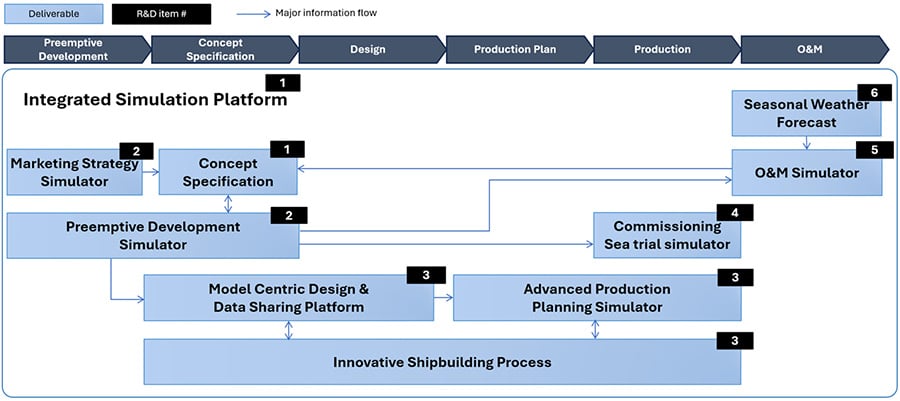
    To address this, this research and development project will establish an “Integrated Simulation Platform” that enables simultaneous consideration of ship lifecycle and supply chain, at the initial development and design stages, to optimize ship design and construction plans. This project will promote the implementation of virtual engineering concept and techniques into the maritime industry.
    Additionally, regarding weather and sea condition predictions that impact the safe and stable ship operations, a seasonal prediction technology, covering 1 to 3 months in advance, including extreme phenomena such as typhoons, will be developed and integrated into the platform.

    5.Research and Development Items

    Research on Implementation of Integrated Simulation Platform in Society
    Leader: Hideyuki ANDO, MTI
    Participating Organizations: MTI / MHIMSB / TSUNEISHI / JAMSTEC

    Research on Preemptive Development Simulator
    Leader: Kazutaka SEKI, TSUNEISHI
    Participating Organizations: TSUNEISHI / MTI / TSUNEISHI AKISHIMA / NMRI / MITSUI E&S / MHIMSB / JMU

    Research on Ship Design and Ship Building
    Leader: Hiroshi TANAKA, MHIMSB
    Participating Organizations: MHIMSB / JMU / NMRI

    Research on Commissioning and Sea Trial
    Leader: Kiyoko SUGIYAMA, TSUNEISHI
    Participating Organizations: TSUNEISHI / MTI / MITSUI E&S / UOsaka / TSUNEISHI AKISHIMA

    Research on Operation and Maintenance Simulator
    Leader: Ryo KAKUTA, MTI
    Participating Organizations: MTI / TSUNEISHI / TSUNEISHI AKISHIMA / UOsaka / MITSUI E&S

    Research on Seasonal Meteorological and Oceanographic Forecast Simulator
    Leader: Yasumasa MIYAZAWA, JAMSTEC
    Participating Organizations: JAMSTEC / KU / MTI /

    6.Project Period:

    5 years from October 1st, 2025 to September 20th, 2030

    Based on the components of the Integrated Simulation Platform, research and development will be promoted across six R&D items. In 2028, an interim evaluation including a stage-gate assessments will be conducted, and by 2030, the deliverables from each R&D topic will be integrated into the Integrated Simulation Platform (see diagram below), aiming for its demonstration in the design and construction of actual ships.

    Components of the Integrated Simulation Platform

    7.Project Budget:

    Maximum JPY 12 billion

    • Total budget for the R&D Project

    8.Contact Information:

    MTI Co., Ltd.
    JCAST Project Management Office under K Program
    E-mail: [email protected]

    9.Related Links:

    1. JST Press Releases (in Japanese)
      https://www.jst.go.jp/pr/info/info1772/index.html
    2. “Development of Integrated Simulation Platform for Sustainable and Competitive Maritime Industry” has been selected as a R&D project under K Program
      https://www.monohakobi.com/en/company/news/news_20250708/
    3. Additional Call for Proposals for R&D topic 6 of “Development of Integrated Simulation Platform for Sustainable and Competitive Maritime Industry” (in Japanese)
      https://www.monohakobi.com/ja/company/news/news_20250902/

    Continue Reading

  • Stocks falter below 160,000 on weak trade data – Dawn

    1. Stocks falter below 160,000 on weak trade data  Dawn
    2. KSE-100 loses momentum, sheds over 1,500 points  Business Recorder
    3. PSX slumps over 1,700 points as investor sentiment weakens  The Express Tribune
    4. PSX drops over 1% as profit-taking weighs on market  Profit by Pakistan Today
    5. PSX stays bearish, loses 1,703 more points  Associated Press of Pakistan

    Continue Reading

  • China’s Trade Truce and Five-Year Plan Help Coal Price Recover – Bloomberg.com

    1. China’s Trade Truce and Five-Year Plan Help Coal Price Recover  Bloomberg.com
    2. Expectations of a ‘cold winter’ support strong coal prices during the heating season, driving a short-term rally in Hong Kong-listed coal stocks.  富途牛牛
    3. Asian Coal Imports Set for Decline on Higher Prices  Crude Oil Prices Today | OilPrice.com
    4. Cathay Pacific Haitong: Bottom of the coal sector cycle confirmed, multiple factors driving supply-demand reversal  富途牛牛
    5. Open Source Securities: Coal prices are experiencing inertia-driven increases, and the supply-demand fundamentals of the coal market are expected to continue improving.  富途牛牛

    Continue Reading

  • China’s WeRide drives towards ‘ubiquitous’ robotaxi service after Hong Kong listing

    China’s WeRide drives towards ‘ubiquitous’ robotaxi service after Hong Kong listing

    Chinese self-driving technology firm WeRide, fresh off raising HK$2.39 billion (US$307 million) in a Hong Kong share sale, plans to rev up commercialisation of autonomous taxis and expand into markets like the Middle East, Southeast Asia and Japan.

    Tony Han, founder and CEO of the Guangzhou-based company, said WeRide would deploy 10,000 robotaxis worldwide over the next few years, adding that its fleet could eventually grow to hundreds of thousands in line with the ultimate goal of “supplying more ubiquitously available global taxi service”.

    “WeRide, as the first mover and industrial leader in the self-driving industry, will expand to the global market,” he said, adding that the proceeds from the Hong Kong offering would support research and development as well as geographic expansion.

    Han said WeRide also planned to roll out different lines of businesses, such as using premium-level autonomous cars to provide taxi service to wealthy customers.

    “But we definitely will focus on supplying very efficient or economically efficient services to the working class or normal people,” he added.

    WeRide, which already trades on the Nasdaq market, made its Hong Kong trading debut on Thursday, where its shares fell 14 per cent to HK$23.22 at the start of trading. The firm priced its Hong Kong shares at HK$27.10 apiece, a premium of 11.5 per cent to its Tuesday close of US$9.40 on the Nasdaq. One American depositary share is equal to three ordinary shares.

    Continue Reading

  • Stock Market Today: Dow, S&P Live Updates for November 6

    Stock Market Today: Dow, S&P Live Updates for November 6

    Asian stocks tracked Wall Street’s gains after dip buyers returned following a brief pullback in technology shares, and signs of a resilient US labor market lifted sentiment.

    MSCI’s regional stock gauge rose 0.9%, with Hong Kong and Japan among the gainers. Contracts for the Nasdaq 100 index fell as much as 0.3% after Qualcomm Inc., the largest maker of smartphone processors, became the latest chipmaker to deliver an upbeat forecast and still leave investors underwhelmed. Its shares retreated 2% in late trading. Futures for the S&P 500 fell 0.2%.

    Continue Reading

  • Chinese researchers reveal nicotinamide’s heart-protective effect in tumor treatment

    Chinese researchers reveal nicotinamide’s heart-protective effect in tumor treatment

    LANZHOU — Chinese researchers have revealed the heart-protective effect of nicotinamide — a derivative of B vitamins — in exploring the mechanisms of related cardiotoxicity in tumor treatment, according to Lanzhou University.

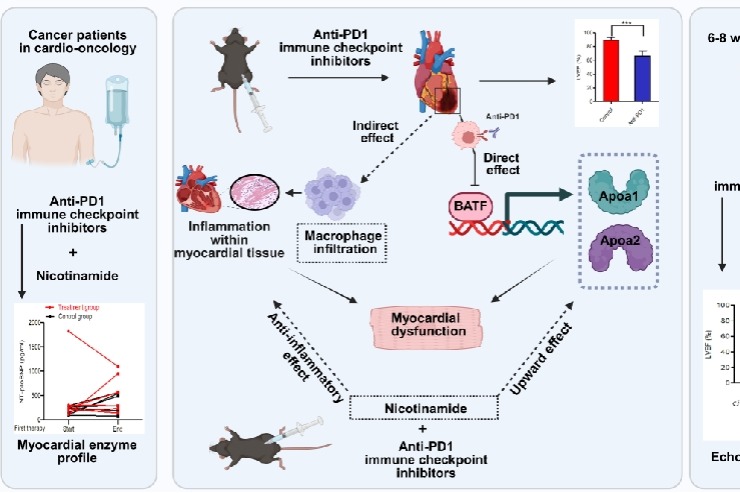
    Their study uncovered the mechanisms by which immune checkpoint inhibitors induce early cardiotoxicity, and developed a new, safe and effective approach to preventing and treating cardiotoxicity in patients receiving tumor immunotherapy, the university said.

    Conducted by researchers at the Lanzhou University First Hospital, the study has been published in the Science China: Life Sciences journal.

    Having the potential to result in death, cardiac immune-related adverse events associated with anti-programmed cell death protein 1 (PD-1), which is a type of immune checkpoint inhibitor, are becoming a concern. This study aimed to explore effective means of early warning and prevention, according to Bai Ming, a professor at the Lanzhou University First Hospital and the study”s leader.

    The team first investigated the role of PD-1 in the early stages of cardiotoxicity and its underlying mechanisms by combining clinical data with experiments.

    Then, the researchers conducted randomized controlled trials to verify the preventive effect of nicotinamide against early cardiotoxicity related to PD-1.

    Their findings showed that nicotinamide demonstrates potential in preventing cardiotoxicity in patients receiving anti-PD-1 cancer treatment, according to Bai.

    The clinical transformation of this research also confirmed that nicotinamide — a drug commonly used in clinical practice — is suitable for rapid transformation and application.

    Nicotinamide therapy focuses on “early” cardiotoxicity, making it possible to prevent and treat cardiotoxicity. Therefore, this therapy highlights the concept of synergistic treatment that ensures anti-tumor efficacy while protecting heart functions, per the study.

    “The findings of the study contribute to a better understanding of cardiac anti-PD-1 immune-related adverse events. They show that nicotinamide could be a promising preventive strategy in the early stages of cardiotoxicity, which is associated with the use of such checkpoint inhibitors in cancer treatment,” Bai said.

    “Therefore, this study sheds new light on the well-considered safety issues in tumor treatment,” he added.

    Continue Reading

  • Saudi Arabia cuts December oil prices for Asia as OPEC+ boosts output

    Saudi Arabia cuts December oil prices for Asia as OPEC+ boosts output

    Nov 6 (Reuters) – Saudi Arabia, the world’s top oil exporter, has sharply reduced the prices of its crude for Asian buyers in December, responding to a well-supplied market as OPEC+ producers ramp up production.

    State oil giant Saudi Aramco set its December official selling price at $1 per barrel above the Oman/Dubai average, marking the first price reduction since October after it kept rates unchanged in November.

    Sign up here.

    The December prices for other grades – Arab Medium and Arab Heavy – fell by $1.40 each to five cents and 10 cents a barrel, while that for Arab Extra Light dropped by $1.20 to $1.30 a barrel, the document said.

    The pricing decision came shortly after the Organization of the Petroleum Exporting Countries and its allies, or OPEC+, agreed on Sunday to a modest oil output increase for December, followed by a pause in production hikes during the first quarter of next year. The producers’ alliance opted to moderate its push to reclaim market share amid growing concerns over a potential global supply glut.

    OPEC+ has raised output targets by around 2.9 million barrels per day, or about 2.7% of global supply, since April, but slowed the pace from October amid predictions of a looming oversupply.

    The price cuts are within market expectations, according to a Reuters survey.

    Saudi Aramco determines its crude oil prices by incorporating feedback from customers and assessing monthly changes in the value of its oil, which are influenced by product prices and market yields.

    As a matter of policy, Saudi Aramco officials do not comment on the kingdom’s monthly OSPs.

    Below are Saudi prices for December in dollars per barrel.

    Reporting by Sarah Qureshi and Ishaan Arora in Bengaluru; Editing by Chris Reese and Sherry Jacob-Phillips

    Our Standards: The Thomson Reuters Trust Principles., opens new tab

    Continue Reading