Earlier this week, ARK Invest purchased over US$30.9 million worth of Block Inc. shares across three exchange-traded funds, including ARKK, ARKW, and ARKF, highlighting continued interest among institutional investors.
This investment comes as Block accelerates its rollout of integrated bitcoin solutions for merchants, further cementing its role at the intersection of digital payments and cryptocurrency adoption.
We’ll explore how ARK Invest’s expanded position in Block underscores confidence in the company’s advancing crypto and payments ecosystem.
The latest GPUs need a type of rare earth metal called Terbium and there are only 37 companies in the world exploring or producing it. Find the list for free.
To own Block shares, you need to believe in the long-term relevance of its two-sided payments and banking ecosystem, built around Cash App and Square, especially as digital finance and bitcoin adoption expand. ARK Invest’s sizable US$30.9 million purchase showcases institutional optimism but does not materially change the core risk: Block’s earnings remain highly sensitive to bitcoin-related revenue fluctuations and ongoing competitive threats in peer-to-peer payments, which may be amplified or mitigated in the near term by broader crypto trends.
The most relevant recent announcement is the rollout of Square’s new integrated bitcoin payments solution for merchants, making it easier for businesses to seamlessly accept, hold, and convert bitcoin through Square’s point-of-sale system. This initiative directly aligns with Block’s push to deepen cryptocurrency integration, one of its central growth catalysts, by strengthening its merchant platform and reinforcing its role as a bridge between digital asset adoption and real-world payments.
But while interest in bitcoin solutions is growing, investors should pay careful attention to the risk that…
Read the full narrative on Block (it’s free!)
Block’s outlook anticipates $32.8 billion in revenue and $2.4 billion in earnings by 2028. This is based on a projected 11.3% annual revenue growth rate, but earnings are forecast to decrease by $0.6 billion from the current $3.0 billion.
Uncover how Block’s forecasts yield a $88.40 fair value, a 16% upside to its current price.
XYZ Community Fair Values as at Nov 2025
Seventeen members of the Simply Wall St Community estimate Block’s fair value between US$60.37 and US$104, showing a wide range of outlooks. With Block’s ongoing integration of bitcoin payments for merchants, this diversity hints at how opinions can differ around the business’s exposure to crypto volatility, open these alternative perspectives to understand what could drive future results.
Explore 17 other fair value estimates on Block – why the stock might be worth as much as 37% more than the current price!
Disagree with existing narratives? Create your own in under 3 minutes – extraordinary investment returns rarely come from following the herd.
Early movers are already taking notice. See the stocks they’re targeting before they’ve flown the coop:
This article by Simply Wall St is general in nature. We provide commentary based on historical data and analyst forecasts only using an unbiased methodology and our articles are not intended to be financial advice. It does not constitute a recommendation to buy or sell any stock, and does not take account of your objectives, or your financial situation. We aim to bring you long-term focused analysis driven by fundamental data. Note that our analysis may not factor in the latest price-sensitive company announcements or qualitative material. Simply Wall St has no position in any stocks mentioned.
Companies discussed in this article include XYZ.
Have feedback on this article? Concerned about the content? Get in touch with us directly. Alternatively, email editorial-team@simplywallst.com
Roula Khalaf, Editor of the FT, selects her favourite stories in this weekly newsletter.
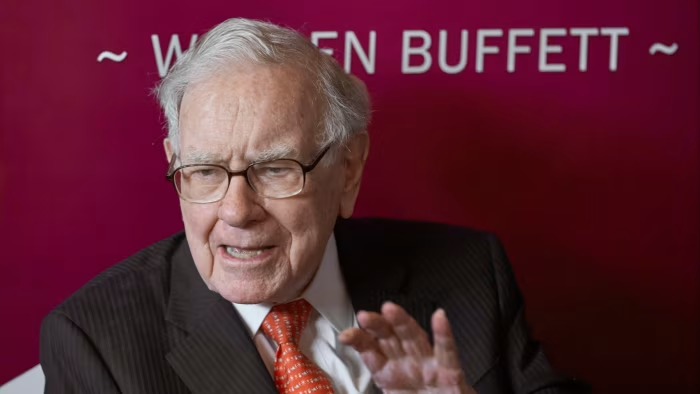
Warren Buffett offloaded stocks for the third consecutive year, as the chief executive of Berkshire Hathaway enters his final months at the sprawling conglomerate he built over more than six decades.
Berkshire Hathaway disclosed on Saturday that it had sold another $6.1bn of common stock in the three months to September 30. Buffett has seen more opportunities in selling than buying equities for the past three years, with stock prices rising precipitously across several sectors.
The conglomerate’s cash reserves also continued to climb and reached a record for the quarter, with $382bn flowing in from a business that spans insurance, manufacturing, utilities and one of North America’s biggest railways. Berkshire once again did not buy back any shares during the quarter.
The group’s share price has lagged the benchmark S&P 500 index since Buffett announced plans to step down as chief executive at the end of this year. He will be succeeded by Greg Abel, who is head of Berkshire’s non-insurance businesses, in January.
Thanksgiving was once a holiday Britons knew only from American films, but a growing appetite for US cuisine, from Southern-style comfort food to pumpkin pie, is driving a rise in UK celebrations.
Retailers and restaurants are reporting increased sales and bookings in the run-up to the American holiday, boosted by British enthusiasm for US flavours and a rising number of American expats now living in the UK.
At Pipers farm in Devon, sales of turkeys and related Thanksgiving products rose 38% in the fortnight leading up to Thanksgiving last year compared with the two weeks before. The farm said it had expanded its range of sides and turkey sizes this year to meet what it expects will be even higher demand.
Data from the online retailer Ocado shows searches for Thanksgiving have jumped 440% year on year, while pumpkin spice is up more than 550%. Ocado’s sales data also indicates American food has grown in popularity among shoppers: sales of Herr’s buffalo blue cheese curls are up 410% year on year, and Newman’s Own ranch dressing by more than 202%.
Research commissioned by the firm found 42% of gen Z and millennials say they have attended a Thanksgiving meal in the UK, and 16% plan to attend or host the holiday for the first time this November. More than half (53%) believe US holidays such as Thanksgiving and American-style Halloweens are becoming bigger fixtures in the British calendar.
Dan Elton, the chief customer officer at Ocado Retail, said: “We’re seeing this love of American food culture translating into what people are buying … from ranch dressing and marshmallows, to mac and cheese.”
According to the market research company Mintel, interest in American-style food has risen sharply in the past two years, particularly among younger consumers. More than half of British adults (58%) have ordered or are interested in ordering southern US dishes such as Louisiana gumbo. That figure has grown from 52% in early 2024 to 67% by mid-2025, peaking at 81% among gen Z – those born approximately between 1997 and 2012. In the same period, one in five Britons visited an American-style restaurant, rising to nearly one in three younger consumers.
“UK interest in Thanksgiving reflects a growing appetite for American food,” said Trish Caddy, the associate director of food service research at Mintel. “It’s less cultural adoption, more culinary celebration. This taps into a wider experience-driven eating trend where people seek themed menus, social connection and limited-edition offerings.”
London restaurant CUT at 45 Park Lane has extended its Thanksgiving service in response to a surge in bookings. “We’re now doing around 180 covers throughout the day and have opened Bar 45 for the whole week, serving Thanksgiving-inspired snacks like pecan pie, turkey croquettes and bacon-wrapped dates,” said the culinary director, Elliott Grover.
He added that bookings had roughly doubled year on year but this has also been due to them opening up further covers to meet demand. It’s popular with lots of American guests, but also many others who simply want to experience it for the first time, Grover said.
In May, the Guardian reported a rise in Americans moving to the UK for political reasons as Donald Trump assumed the presidency. US applications for UK citizenship hit a record high last year at more than 6,100, a 26% increase from 2023. There was a 40% year-on-year rise during the final three months of 2024, coinciding with the time of Trump’s re-election.
At Whole Foods Market UK, the demand around Thanksgiving now rivals the buildup to Christmas. “The moment our online ordering for the holiday goes live, we see a rush of customers eager to secure their meal,” said Izzie Peskett, the head of marketing. “It’s become a real occasion here, whether people are hosting American friends or simply recreating that classic, comforting spread at home.”
While American expats remain part of the audience, Peskett says curiosity among British shoppers has grown rapidly. “Thanksgiving is now less about where you’re from and more about embracing the warmth and generosity of the occasion,” she said.
“Our customers come for the quality and authenticity of classic dishes, from pumpkin and pecan pies, cornbread stuffing, green beans, sweet potatoes and, of course, our organic turkeys.”
DUBAI, Nov. 1 (Xinhua) — China International Capital Corporation (CICC), a leading investment bank, has held its wealth management forum in Dubai, the United Arab Emirates (UAE), attracting around 200 participants from government, business, and financial sectors to discuss investment opportunities in China and global asset allocation.
Themed “Invest in China, Invest in Future,” the forum on Friday featured nearly 20 representatives from China’s leading new-economy enterprises and global asset management firms who engaged in in-depth discussions on China-UAE cooperation.
During the event, the CICC unveiled the international edition of its “China Top 50,” an integrated buy-side advisory solution, for the first time in the Middle East, and signed a memorandum of cooperation with the Arab Federation for Digital Economy.
Owen Wu, member of the CICC executive committee, deputy president, and managing director of CICC Wealth Management, said that as Middle East countries are shifting from “looking East” to “going East,” their sovereign wealth funds are increasingly deepening investment in China.
“As a key participant and builder in the development of China’s capital markets, the CICC will continue to leverage its professional capabilities to expand China’s investment network and promote new landscapes of China-UAE investment cooperation,” he added.
Kevin Liu, chief offshore China and overseas strategist at CICC Research, noted that Chinese assets have performed strongly this year, with the Hong Kong market outperforming major global markets.
“The RMB has remained resilient amid a complex external environment, and exports have also exceeded market expectations,” Liu said, adding that, as the global economy grows more complex, structural opportunities in China’s capital markets are becoming increasingly evident. While Hong Kong, as a “super connector,” will continue to play a vital role in linking Chinese and international markets.
Statistics from the People’s Bank of China showed that, in the first nine months of this year, the amount of cross-border RMB receipts and payments between China and the UAE reached 864 billion yuan (about 122 billion U.S. dollars). Meanwhile, the UAE’s sovereign wealth fund has also been engaged in stock, bond, and private equity investments in China. ■
Warren Buffett and Greg Abel walkthrough the Berkshire Hathaway Annual Shareholders Meeting in Omaha, Nebraska on May 3, 2025.
David A. Grogen | CNBC
Warren Buffett’s Berkshire Hathaway reported a sharp rebound in operating profit on Saturday, while its cash pile swelled to a new high with no buybacks.
Berkshire’s operating profit generated from the conglomerate’s wholly owned businesses including insurance and railroads jumped 34% year over year to $13.485 billion in the third quarter. The gains were driven by a more than 200% surge in insurance underwriting income, which rose to $2.37 billion.
Buffett once again refrained from repurchasing shares despite a significant pullback in the stock. The company said there were no share buybacks during the first nine months of 2025. Class A and B shares of the conglomerate are up 5% each in 2025, while the S&P 500 is up 16.3%.
Without any buybacks, Berkshire’s cash hoard swelled to a record $381.6 billion, surpassing the previous high of $347.7 billion set in the first quarter of this year.
Berkshire also didn’t find other stocks attractive, net selling equities in the third quarter for a taxable gain of $10.4 billion.
Berkshire Hathaway class A shares year to date
The 95-year-old Buffett in May announced he’s stepping down as CEO at the year-end after six legendary decades. Greg Abel, Berkshire’s vice chairman of non-insurance operations, is set to take over as chief executive, while Buffett will remain chairman of the board. Abel will also start writing annual letters in 2026.
The Omaha-based conglomerate’s shares have tumbled double digits from all-time highs following the announcement. The sell-off partially reflects the so-called Buffett premium, or the extra price investors are willing to pay because of the billionaire’s unmatched record and exceptional capital allocation skills.
Last month, Berkshire announced a deal to buy Occidental Petroleum’s petrochemical unit, OxyChem, for $9.7 billion in cash. The deal marks Berkshire’s largest since 2022, when it paid $11.6 billion for insurer Alleghany.
Lock it in or let it ride? It’s a question that investors might ponder at this point in an unexpectedly rewarding year, as the calendar pivots appropriately from the season of feigned fright to one of gratitude for life’s bounty. For most people, this is less about getting fully out of or staying wholly in equities, but it’s a moment to set expectations and perhaps portfolios in recognition of the distance traveled to date. The S & P 500 is up 16.3% this year to 6,840, which is almost exactly 2,000 points higher than its intraday low at the depths of the tariff panic on April 7. With dividends, it’s delivered more than 17%. Even the staid 60/40 stock-bond portfolio, as represented by the Vanguard Balanced Index Fund, has logged a total return of 13.1% this year, trouncing its long-term average just above 8%. On a three-year trailing basis — dating back to the end of the 2022 bear market and just ahead of the launch of ChatGPT — the S & P 500 has delivered an annualized total return of 22.8%. This is better than 90% of all three-year periods back to 1945, according to Strategas Group. .SPX YTD mountain S & P 500, YTD What tended to happen afterward when three-year gains hit the top decile? Over the ensuing six months, forward returns were slightly better than average, though the average return starts to lag over one- and two-year lookahead periods. The present rally has also been uncommonly steady and uninterrupted by jarring pullbacks. The S & P 500 has gone some 130 trading days since the last 5% setback ended in April. That places it among the half-dozen longest such streaks without a 5% drop of the past four decades, according to investment analyst and blogger Urban Carmel. Which suggests the clock is ticking at least faintly on this orderly advance — though the longest such run lasted more than twice as long as this one has. And the first 5% pullback, whenever it comes, has typically not marked the ultimate top of a bull market; usually it’s bought for at least a final upward move. The current hot streak is, of course, now at the entry point of the best seasonal window of the year, on average. Keith Lerner, CIO at Truist Wealth, notes that out of 21 times when the S & P 500 has been up more than 15% through October, it was positive the remainder of the year all but once, with an average further gain of 4.7%. What happens if AI trade cools? Part of the story here is the way the market’s concentrated and persistent leadership in mega-cap tech and other quality-growth names has flattered the S & P 500 beyond most other broad benchmarks or active portfolios. The passive S & P 500 index fund is again outperforming more than 70% of all large-cap mutual funds this year. And owners of such an index benefit from the way these funds inherently let the winners run. If given the 500 stocks in the index to manage actively, would most people let Nvidia grow to an 8.5% position without selling a share, or allow the seven heftiest holdings to expand to 35% of the account? A year ago, rotating into the equal-weighted was a trendy call. But while that more balanced approach has done fine and is still in an uptrend, its 8.7% total return this year is just over half that of the market-cap-weighted version. Of course, market character can change and a downswing in the AI trade would more acutely damage the index than to a less-concentrated portfolio, as happened in 2022 when the Nasdaq 100 tumbled almost 30% from peak to trough. Jason Hunter, chef technical strategist at JP Morgan, lays out the setup: “The contrasting performance of the bullishly trending cap-weighted S & P 500 and stagnant, equally weighted S & P 500 Index since mid-summer also helps illustrate the high dispersion within the index and associated crowding in the thin leadership.” He adds, “momentum indicators on the daily and weekly timeframes are not confirming the new highs. All of the above are indications of rally exhaustion, but they are also conditions that have been in place on many occasions throughout the evolution of the rally in recent quarters, which have had little to no impact most of the time.” As has been the case with some frequency, last week’s action was less impressive below the surface. The equal-weight S & P 500 was down 1.75% and lagged the main index by 2.5 percentage points. And each of the key threads of the bullish narrative frayed just a bit: The Federal Reserve cut rates a quarter-point but sought to cast doubt on another reduction in December, with homebuilder, regional-bank and retail stocks suffering in reaction. The trade summit with China yielded a tepid truce rather than breakthrough deal. And while Magnificent 7 earnings were unassailably strong and capex intentions lifted, the market responded stingily to Meta Platforms (down 12%) and Microsoft (off 1%). It’s fair to withhold style points for such uneven rhythms, but Tony Pasquariello, Goldman Sachs head of hedge-fund coverage, gives voice to a sort of market-breadth agnosticism: “Has the recent rally been particularly narrow? Yes. Is S & P a very top-heavy index? Yes. Is this a meaningful departure from the regime that has totally dominated the past three years? No. Does this history book tell us that highly concentrated markets have to end badly? No.” All points are well taken, and along with most broad assessments of the landscape they argue for giving the market the benefit of the doubt over the immediate horizon. While not losing sight, of course, of the way the march higher has compressed some risk-absorbing cushions along the way. What the ‘hyperscaler’ earnings showed Meta, for instance, can effortlessly afford the additional $30 billion in debt it issued last week to help fund its AI ambitions. But more broadly, this data-center buildout is coming to rely increasingly on leverage than spare cash. The Fed, meantime, is halting the runoff of its balance sheet in part because overnight money markets have started to show signs of intermittent tightness. And investor sentiment has turned more aggressive, if not alarmingly so. Here we see the ratio of bulls to bears in the Investors Intelligence survey of market advisory services popping above the “excessive optimism” threshold after months of residual caution following the April selloff. Note that it can stay elevated like this for a while with little payback in the market, as it did last year, but fair to say this is no longer a truly “hated rally.” The prevailing takeaway from the “hyperscaler” quarterly results was that they still feel they don’t have enough computing capacity to meet demand. Nvidia shares gained almost 9% last week, enlarging its market value by $400 billion, and accounting for most of the S & P 500’s net gain. The correction in Meta shares showed that the Street trusts the company less or perceives its strategy as more desperate and less certain than its peers. For now, though, the market is willing largely to accept the way the massive cloud and social-media players are funneling what would otherwise be their free cash flow to Nvidia and other AI infrastructure vendors. Here’s the free-cash-flow yield of the four big spenders, crashing to or below 2%. How quickly the standard investment case for these companies turned from “asset-light cash machines” to “builders of the physical future of computing.” As with so many attributes of the current environment, this shows a remarkable level of investor fortitude and “informed greed,” underwriting the market’s resilience amid macro flux and bubble anxiety – a collective willingness to let it ride, for at least a bit longer.
China will exempt some Nexperia chips from an export ban that was imposed amid an escalating row with the Dutch government, officials said on Saturday.
“We will comprehensively consider the actual situation of enterprises and grant exemptions to exports that meet the criteria,” the Chinese Commerce Ministry said in a statement.
Nexperia produces components in Europe, sends them to China for finishing and then re-exports them back to customers in Europe.
The Netherlands-based company is owned by China’s Wingtech Technology. But the Dutch government invoked a Cold War-era law to effectively take control of the semiconductor maker in September, citing security concerns.
This prompted China to announce export controls on the chips in October.
China, EU and US talk export controls
The Wall Street Journal, citing unnamed sources, said the exemption for Nexperia chips came after a meeting between US President Donald Trump and Chinese President Xi Jinping in South Korea.
The Dutch government refused to comment on the reports and said it remained in contact with Chinese authorities “to work toward a constructive solution that restores balance to the chip supply chain and that is good for Nexperia and our economies.”
Nexperia manufactures components in several European countries before sending them to its facilities in China to be finishedImage: Fabian Bimmer/REUTERS
Meanwhile, Chinese and European Union officials also held talks on export controls more broadly.
“China confirmed that the suspension of the October export controls applies to the EU. Both sides reaffirmed commitment to continue engagement on improving the implementation of export control policies,” EU Trade Commissioner Maros Sefcovic said in a post on X.
Why are Nexperia semiconductors important?
Nexperia components are mainly found in cars, with the company supplying 49% of the electronic components used in the European automotive industry, according to German business newspaper Handelsblatt.
Although the components are technically replaceable, establishing alternative supply chains poses a major challenge for European automakers and other Nexperia customers.
Chip shortage puts German carmakers in a tight spot
“Without these chips, European automotive suppliers cannot build the parts and components needed to supply vehicle manufacturers and this therefore threatens production stoppages,” European auto lobby ACEA warned last month.
In its statement on Saturday, China’s Commerce Ministry placed blame on “the Dutch government’s improper intervention in the internal affairs of enterprises” for causing “the current chaos in the global supply chain.”
Business: Advanced Drainage Systems is a manufacturer of stormwater and onsite wastewater solutions. The company and its subsidiary, Infiltrator Water Technologies, provide stormwater drainage and onsite wastewater products used in a wide variety of markets and applications, including commercial, residential, infrastructure and agriculture, while delivering customer service. Its pipe segment manufactures and markets thermoplastic corrugated pipe throughout the United States. Its infiltrator segment is a provider of plastic leachfield chambers and systems, septic tanks and accessories, primarily for use in residential applications. Its international segment manufactures and markets products in regions outside the United States, with a strategy focused on its owned facilities in Canada and those markets serviced through its joint ventures in Mexico and South America. Its Allied Products segment manufactures a range of products which are complementary to their pipe products.
Stock Market Value: : $11.98 billion ($144.10 per share)
Activist: Impactive Capital
Ownership: 2.14%
Average Cost: n/a
Activist Commentary: Impactive Capital is an activist hedge fund founded in 2018 by Lauren Taylor Wolfe and Christian Alejandro Asmar. Impactive Capital is an active ESG investor that launched with a $250 million investment from CalSTRS and now has approximately $3 billion. In just seven years, they have made quite a name for themselves as AESG investors. Wolfe and Asmar realized that there was an opportunity to use tools, notably on the social and environmental side, to drive returns. Impactive focuses on positive systemic change to help build more competitive, sustainable businesses for the long run. Impactive will use traditional operational, financial and strategic tools that activists use, but will also implement ESG change that they believe is material to the business and drives profitability of the company and shareholder value. Impactive looks for high quality businesses that are usually complex and mispriced, where they can underwrite a minimum of a high teens or low 20% internal rate of return over a three- to five-year holding period, and have active engagement with management to set up multiple ways to win.
What’s happening
On Oct. 21, Impactive said they had taken a position in Advanced Drainage Systems.
Behind the scenes
Advanced Drainage Systems is the market share leader in plastic stormwater and onsite septic wastewater management solutions. The company is a pioneer in the development and manufacturing of plastic drainage products, primarily utilizing high-density polyethylene (HDPE) and polypropylene. Recycled materials made up 46% of WMS’ purchased inputs in fiscal year 2025, making it one of the largest recyclers in North America. The company has three primary business lines: (i) Pipe – storm and drainage pipe, 56% of FY25 revenue; (ii) Allied Products – complementary products to its pipe offerings like storm chambers, structures and fittings, 26%; and (iii) Infiltrator – chambers, tanks and advanced wastewater treatment solutions, 18%. Between its three segments, the company has a $15 billion addressable market and is the clear industry leader with 75% to 95% market share across its segments.
There is a lot to like about WMS, as it is an extremely high-quality and well-run company with a long history of compounding growth and secular tailwinds. As a result, WMS has an impressive track record, having grown earnings per share almost 10x since its initial public offering, and has a 28% EPS compound annual growth rate with returns on invested capital consistently above 20%. Management is also very focused on shareholder value and are great capital allocators, increasing dividends and launching buybacks in most years where it does not see a compelling M&A opportunity.
Despite this, the company’s share price performance has been lackluster over the past 1- and 3-year periods, underperforming the Russell 2000, and its stock has re-rated down to a P/E multiple in the low-to-mid 20s. The reason for this is twofold: investor fears regarding the cyclicality of construction spending and margin compression. However, Impactive Capital believes that both concerns appear to be overblown or misplaced and that management has built this business to protect its top line from market cyclicality and make margin expansion structural, not cyclical.
As to the cyclicality of construction spending, construction spending is down 3% year to date as higher interest rates and affordability concerns have dampened residential and non-residential construction spending, setting this up to be the worst year for construction in the past two decades aside from the global financial crisis. But company revenue has not been declining and is not expected to decline for several reasons.
First, plastic pipes have been stealing market share from concrete and steel. Only about 20% of the market in 2010, plastic now exceeds 40% due to it being 20% cheaper than alternatives and offering superior performance.
Second, with the 2019 acquisition of Infiltrator and the upcoming acquisition of National Diversified Sales, WMS has increased its exposure to the residential repair and remodel end-market, adding resiliency to its revenue streams. This should also make WMS a natural beneficiary of the reversion in existing home sales, which are currently at a 15-year low.
Third, billion-dollar storm events have quintupled since the 1980s, necessitating increased investment in resiliency and more complex stormwater infrastructure. The company also has a wide moat, enabled by its high brand loyalty from contractors, its vertical integration and excellent distribution network.
As for margin concerns, there are fears that weakness in construction will lead to margin compression. However, this is something else that management has taken a lot of steps and adopted many initiatives to avoid. Over the past six years, the company has been diversifying its business toward its higher-margin Allied Product and Infiltrator offerings, both of which have adjusted operating margins in the mid-50s, whereas pipe is around 30%.
Additionally, one of its largest input costs are oil and resin, and WMS has a unique way to mitigate these costs. The company toggles between recycled and virgin resins depending on the price of oil. So, when oil spikes, they use recycled resin, and when it drops, they switch to virgin resin and capture better margins. WMS is the only one of its competitors who can do this at scale. Moreover, when construction is weak, oil and resin prices tend to decline. So, loss to the top line can be made up on the bottom line as the decline in resin prices is more than enough to offset end-market weaknesses (i.e., construction spending is down about 3% YTD, resin prices are down 15% to 20%). As a result, pipe and Allied Products adjusted EBITDA margins have expanded by about 8 percentage points since 2020, but some fear that this will eventually normalize.
However, Impactive believes that this shift is structural, not cyclical and WMS will not only avoid margin compression but could see gross margin expand by 100 bps over the next 12-24 months; something that is not factored into forward consensus estimates.
As a result of this confluence of factors, Impactive models that WMS will return to mid-teens EPS growth and projects a base case three-year total return and IRR of 69% and 19%, respectively, and an upside case of 146% and 34%, respectively.
Ken Squire is the founder and president of 13D Monitor, an institutional research service on shareholder activism, and the founder and portfolio manager of the 13D Activist Fund, a mutual fund that invests in a portfolio of activist investments.